Appendix A Chapter 9 versus Chapter 1 1 at a Glance Chapter 9 - - PDF document

appendix a chapter 9 versus chapter 1 1 at a glance
SMART_READER_LITE
LIVE PREVIEW

Appendix A Chapter 9 versus Chapter 1 1 at a Glance Chapter 9 - - PDF document

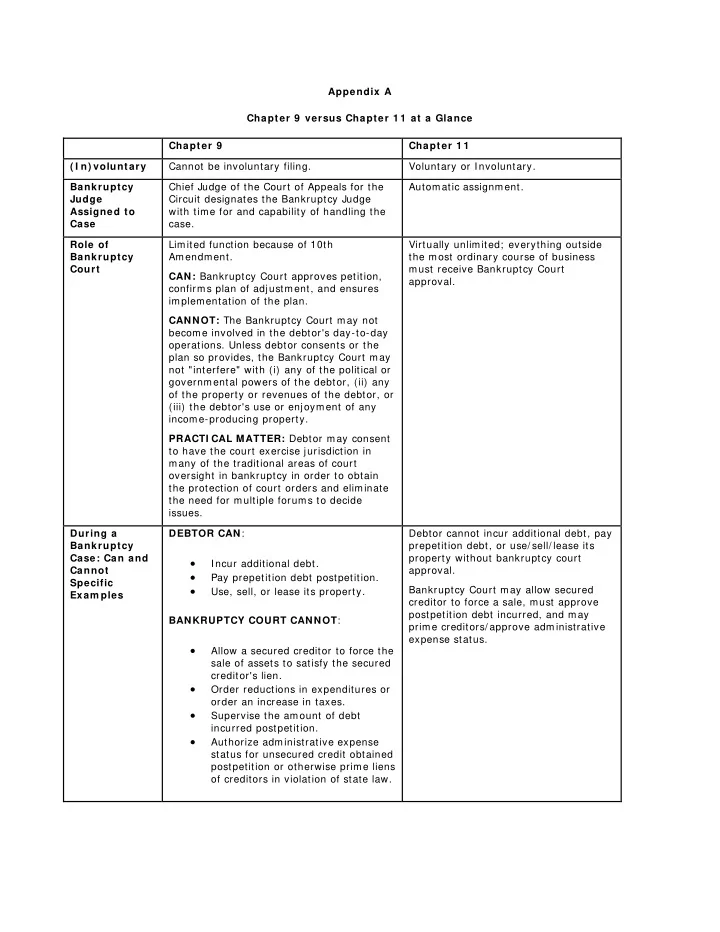
Appendix A Chapter 9 versus Chapter 1 1 at a Glance Chapter 9 Chapter 1 1 ( I n) voluntary Cannot be involuntary filing. Voluntary or Involuntary. Bankruptcy Chief Judge of the Court of Appeals for the Automatic assignment. Judge Circuit


slide-1
SLIDE 1

Appendix A Chapter 9 versus Chapter 1 1 at a Glance Chapter 9 Chapter 1 1 ( I n) voluntary Cannot be involuntary filing. Voluntary or Involuntary. Bankruptcy Judge Assigned to Case Chief Judge of the Court of Appeals for the Circuit designates the Bankruptcy Judge with time for and capability of handling the case. Automatic assignment. Role of Bankruptcy Court Limited function because of 10th Amendment. CAN: Bankruptcy Court approves petition, confirms plan of adjustment, and ensures implementation of the plan. CANNOT: The Bankruptcy Court may not become involved in the debtor's day-to-day

  • perations. Unless debtor consents or the

plan so provides, the Bankruptcy Court may not "interfere" with (i) any of the political or governmental powers of the debtor, (ii) any

  • f the property or revenues of the debtor, or

(iii) the debtor's use or enjoyment of any income-producing property. PRACTI CAL MATTER: Debtor may consent to have the court exercise jurisdiction in many of the traditional areas of court

  • versight in bankruptcy in order to obtain

the protection of court orders and eliminate the need for multiple forums to decide issues. Virtually unlimited; everything outside the most ordinary course of business must receive Bankruptcy Court approval. During a Bankruptcy Case: Can and Cannot Specific Exam ples DEBTOR CAN:

  • Incur additional debt.
  • Pay prepetition debt postpetition.
  • Use, sell, or lease its property.

BANKRUPTCY COURT CANNOT:

  • Allow a secured creditor to force the

sale of assets to satisfy the secured creditor's lien.

  • Order reductions in expenditures or
  • rder an increase in taxes.
  • Supervise the amount of debt

incurred postpetition.

  • Authorize administrative expense

status for unsecured credit obtained postpetition or otherwise prime liens

  • f creditors in violation of state law.

Debtor cannot incur additional debt, pay prepetition debt, or use/ sell/ lease its property without bankruptcy court approval. Bankruptcy Court may allow secured creditor to force a sale, must approve postpetition debt incurred, and may prime creditors/ approve administrative expense status.

slide-2
SLIDE 2

Chapter 9 Chapter 1 1 Role of U.S. Trustee No general supervisory authority in chapter 9 other than appointment of creditors' committee. Municipal debtor is not subject to the reporting requirements and other general duties of a chapter 11 debtor. No first meeting of creditors. General supervisory authority in chapter 11 including appointment of creditors' committees, enforcing reporting requirements, and

  • rganizing/ supervising first meeting of

creditors. Legislative Authority to File Chapter 9 filing must be specifically authorized under state law. No such requirement. Eligibility to File for Chapter 9 Must file a Statement of Qualifications under section 109(c) of the Bankruptcy Code; eligibility can be challenged; filing may be dismissed.

  • Must be a municipality.
  • State law must authorize the filing.
  • Must be insolvent as of the date of

filing the petition.

  • Must "desire to effect a plan" to

adjust debts.

  • Must show one of the following four

requirements: (a) obtained the agreement of creditors holding at least a majority in amount of the claims of each class than the municipality intends to impair under a plan; (b) negotiated in good faith with creditors but failed to reach an agreement; (c) unable to negotiate with creditors because impracticable; or (d) reasonably believes that a creditor may attempt to obtain an avoidable preference. No such eligibility requirement; no such insolvency requirement. Good Faith Requirem ent Dismissal of petition required if no finding of good faith. Factors include:

  • Debtor's subjective beliefs.
  • Whether the debtor's financial

problems can be addressed by chapter 9.

  • Extent of debtor's prepetition

negotiations, if practical.

  • Extent to which the debtor

considered alternatives to chapter 9.

  • Scope and nature of debtor's

financial problems.

  • Standing alone, debtor's refusal to

impose/ raise assessments or to borrow funds is not sufficient to warrant a finding of bad faith.

slide-3
SLIDE 3

Chapter 9 Chapter 1 1 Filings Accom panying Petition Must file a list of creditors (normally filed with the petition, but there is no specific requirement as to timing or contents of list). Must file a list of creditors, Schedules of Assets and Liabilities, and Statement of Financial Affairs. Notice of Case Notice must be given to such persons as the court may direct, plus notice must be published at least once a week for three successive weeks in at least one newspaper

  • f general circulation. Creditors can file
  • bjections to the petition.

No claims/ noticing agent. Notice must be given to certain parties, but there is no publication requirement; claims/ noticing agent is standard in most chapter 11 cases. I ntervention; Right of Others to be Heard Secretary of the Treasury of the United States, a representative of the state in which the debtor is located, and the Securities and Exchange Commission may intervene in a chapter 9 case. Treatm ent of Bonds Special revenue bondholders have an advantage over general obligation bondholders in chapter 9 cases because bonds secured by special revenue will have continued access to the revenue stream securing debt service payments.

  • Prepetition security interest in

special revenue bonds is maintained postpetition.

  • Special revenue bonds are subject

to the necessary operating expenses

  • f the underlying project.
  • Chapter 9 debtor can pay special

revenue bonds postpetition to satisfy postpetition amounts of principal and interest coming due under bonds secured by the special revenues.

  • Secured creditor can apply special

revenues to amounts due or coming due under bonds; automatic stay does not generally apply.

  • Bondholders with claims payable

solely from special revenues do not have recourse claims against the debtor. General revenue bonds are treated as any

  • ther unsecured claim.

Prepetition debt cannot be serviced postpetition.

slide-4
SLIDE 4

Chapter 9 Chapter 1 1 Retention of Professionals No Bankruptcy Court approval is required to retain or pay professionals. Need to file, as part of the confirmation, amounts paid by debtor for services/ expenses, which must be found to be reasonable. Payment of professionals that represent a creditors' committee is uncertain; technically not required, but done as a practical matter. Approval is required to retain and pay professionals; official creditors' committee advisory fees are required to be paid by debtor. Preferences Same as in chapter 11, except that a transfer of property by a municipality to or for the benefit of bondholders on account of such bond may not be avoided as a preference (section 926(b)). Payments to or for the benefit of creditors on account of an antecedent debt made within 90 days (one year if insider) of petition date and while debtor is insolvent can be avoided by debtor as preferential payments and must be paid back to the estate (subject to defenses).