IFB is famous for. . Own electric flying platforms, Composites, Wind - - PowerPoint PPT Presentation

ifb is famous for own electric flying platforms
SMART_READER_LITE
LIVE PREVIEW

IFB is famous for. . Own electric flying platforms, Composites, Wind - - PowerPoint PPT Presentation

Institute of Aircraft Design IFB is famous for. . Own electric flying platforms, Composites, Wind Energy Institute of Aircraft Design Research Areas Aircraft Design Prof. Strohmayer Manufacturing Lightweight Design Technologies Prof.


slide-1
SLIDE 1

Institute of Aircraft Design

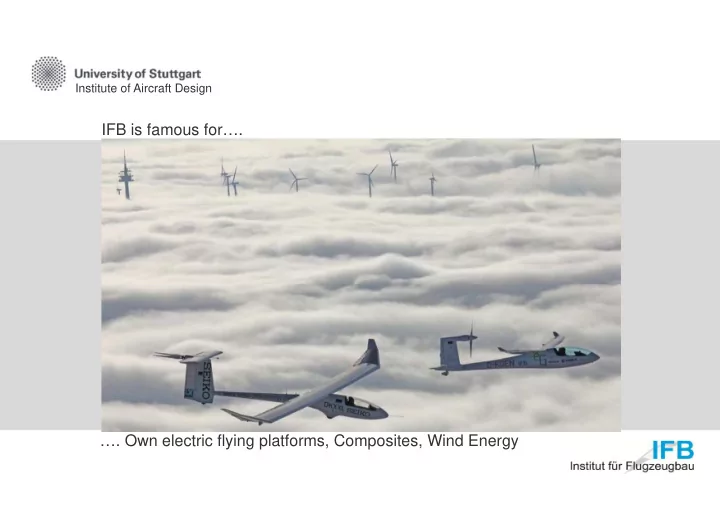
IFB is famous for…. …. Own electric flying platforms, Composites, Wind Energy

slide-2
SLIDE 2

Research Areas Institute of Aircraft Design

Manufacturing Technologies

  • Prof. Middendorf

Lightweight Design

  • Prof. Middendorf

Aircraft Design

  • Prof. Strohmayer

staff: 3 professors - 60 academics - 11 engineers

  • 5

administrators

  • ~80

students - 4 trainees sales: 25% basic funding - 75% third- party-funds accommodation: 2 buildings - 1000m2

  • ffice - 250m2 seminar rooms -

300m2 laboratories - 1300m2 workspace - 300m2 storage

Wind Energy

  • Prof. Cheng

University of Stuttgart - Dr.-Ing. Stefan Carosella 26.11.2017 2

slide-3
SLIDE 3

University of Stuttgart - Dr.-Ing. Stefan Carosella 3

Composites Institute of Aircraft Design

Automated Preforming and Fibre Placement Resin Infusion and Injection Testing and Material Characterization COMPOSITES MANUFACTURING Preform Draping and Handling with Integrated QA-System Process Simulation Structure Simulation Optimization Multiscale Material Modelling COMPOSITES SIMULATION

30 scientific engineers are dealing with composites

26.11.2017

slide-4
SLIDE 4

University of Stuttgart - Dr.-Ing. Stefan Carosella 4

More than Lectures Institute of Aircraft Design

Public Funded Projects Industry Cooperation

26.11.2017

slide-5
SLIDE 5

University of Stuttgart - Dr.-Ing. Stefan Carosella 5

Experience in Preform Technologies Since 2005 Institute of Aircraft Design

26.11.2017

slide-6
SLIDE 6

26.11.2017 University of Stuttgart 6

Development of a Carbon Manipulator using Braiding Technology Braided Manipulator (ZASCHE handling)

  • Low-weight carbon manipulator (70% less weight compared to steel)
  • Radial braiding technology for efficient manufacturing
  • High bending and torsional stiffness for easy manipulation
slide-7
SLIDE 7

Example: R.A.C.E. Plate Holder

  • 4. Braiding technology

26.11.2017 7 University of Stuttgart - Dr.-Ing. Stefan Carosella

slide-8
SLIDE 8

26.11.2017 8

Tailored Fibre Placement

IFB

  • Load path optimized lay-up
  • Low cut-off (Near-Net-Shape)
  • High volume production possible
  • Multimaterial process
  • High Design freedom

University of Stuttgart - Dr.-Ing. Stefan Carosella

slide-9
SLIDE 9

26.11.2017 9

Tailored Fibre Placement - Introduction

University of Stuttgart - Dr.-Ing. Stefan Carosella

slide-10
SLIDE 10

26.11.2017 10

ZIM: Innovative design and process chain for multifunctional parts made of continuous glass or carbon reinforced thermoplastics

  • Machining of thermoplastic hybrid yarns by using the TFP

technology

  • Development of a pressing/grouting process for the TFP preforms
  • Integration of functions of the consolidated preforms by
  • Materials: Carbon fiber/PA6 und glass fiber/PA66
  • Analysis of characteristic material values
  • Part design using the example of a torque support

In Cooperation with:

slide-11
SLIDE 11

26.11.2017 11

Production Steps of a TFP Process

TFP Preform Die-cutting Consolidation Machining Overmolding Final Part

slide-12
SLIDE 12

26.11.2017 12

Designchain of a TFP Process

FEM analysis AOPS Design of TFP pattern Preform topography analysis EDOPath Topography extraction EDOPath MoldFlow CFD Analysis

  • vermolding paramter

CAD tool design for grouting/overmolding Demonstrator part Torque support

slide-13
SLIDE 13

26.11.2017 University of Stuttgart - Dr.-Ing. Stefan Carosella 13

Institute of Aircraft Design

VARI - Vacuum Assisted Resin Infusion VAP - Vacuum Assisted Process

Standard set-up in single sided mould with line injection Set-up in oven or in a closed mould with cascade injection To get a higher consolidation the process can be done within an autoclave.

Resin Infusion Process: Vacuum Assited Infusion

slide-14
SLIDE 14

26.11.2017 University of Stuttgart - Dr.-Ing. Stefan Carosella 14

Institute of Aircraft Design

RTM with press control and injection machine RTM with transparent mould Monitoring und control of temperature and pressure in the mould, at the inlet point,… Teaching application: Visualizing the effects of vacuum, injection pressure, temperature, flow front speed, heating and cooling rates on the mould filling behaviour and laminate quality Field of application: Basic research and development, prototyping, process optimization and small series production

Resin Infusion Process: Resin Transfer Moulding (RTM)

slide-15
SLIDE 15

26.11.2017 University of Stuttgart - Dr.-Ing. Stefan Carosella 15

Institute of Aircraft Design

Wet pressing with press control Monitoring und control of temperature and pressure in the mould, Process figures: 30 sec.- 1 min. curing, part to part < 2min., 58%-60% FV, < 1% void content Field of application: Basic research and development, prototyping, process optimization and small series production

Out of Autoclave Processes, Wet Pressing

Wet pressing with local reinforcement and one shot sandwich structures 3D application

slide-16
SLIDE 16

University of Stuttgart - Dr.-Ing. Stefan Carosella 16

New APP Concept wit OoA Curing material @IFB Institute of Aircraft Design

www.lowflip.eu

26.11.2017

  • Novel out of autoclave manufacturing

process

  • 3D placement technology for plies and

tapes

  • Wrinkle free placement of double curved

surfaces

  • Energy efficient and fast heating tools
slide-17
SLIDE 17

University of Stuttgart - Dr.-Ing. Stefan Carosella 17

New APP Concept wit OoA Curing @IFB Institute of Aircraft Design

26.11.2017

slide-18
SLIDE 18

26.11.2017 University of Stuttgart - Dr.-Ing. Stefan Carosella 18

3D Stitching: Equipment and Competences

  • Robot-supported stitching, allowing the

stitching of complex 3D-Geometries

  • Experience with multiple single-sided stitching

techniques.

  • Further understanding of through-the-

thickness reinforcement through stitching.  Improvement of interlaminar strength  Damage tolerance  Crack growth arrestment

slide-19
SLIDE 19

26.11.2017 University of Stuttgart - Dr.-Ing. Stefan Carosella 19

Research Focus: Selective Stitching

Identification of the most efficient stitching configurations for CFRP stiffened panels in terms

  • f damage tolerance
  • Establishing a correlation between coupon-level

and substructure-level results.

  • Development of fail-safe structures that control

damage growth through stitching.

  • Isolation of the contribution of stitching to the

inter-laminar strength of a laminate.

  • Determination of the most suitable stitching

techniques and positions that provide better stiffener-skin joints.

  • Reduction of time and material costs, while still
  • btaining damage tolerant structures.
  • Determination of the most appropriate method

for on-line damage growth monitoring.

slide-20
SLIDE 20

Overview

Material Characterization

  • Textile Characterization
  • Mechanical Testing
  • Structural Testing
  • Non-Destructive Testing

Numerical Simulation

  • Different Simulation

Methods (FEM, CFD, analytical)

  • Process Simulation
  • Structural Simulation

Manufacturing Process + Validation

  • Textile Processing (Braiding,

Draping, Tailored Fiber Process, Stitching)

  • Resin Infusion (VARI, VAP,

RTM)

  • Prepreg

Simulation at IFB

26.11.2017 20 University of Stuttgart - Dr.-Ing. Stefan Carosella

slide-21
SLIDE 21

Virtual Process Chain Simulation at IFB

PROCESS SIMULATION STRUCTURAL SIMULATION OPTIMIZATION MULTISCALE MODELLING

Simulation at the IFB

15 Phd, 2 Teams Manufacturing and Process Simulation Braiding simulation, Draping Simulation, Infusion Simulation, CAM Structural Simulation Impact, Crash, Fatigue, Design Optimization, Joints Simulation, Sandwich Structures, Effects of Defects Software ESI, Abaqus, LS Dyna, Hyperworks, Matlab, etc. Hardware HPC Cluster, Intel XEON, Quad-, Octa-, 12-Core 4,7TFlops

26.11.2017 21

slide-22
SLIDE 22

PROCESS SIMULATION STRUCTURAL SIMULATION OPTIMIZATION MULTI-SCALE MODELLING

Overview Multi-Scale-Modeling

Approach

  • Unit-Cell Models:
  • Stiffness and strength calculation
  • Volume fraction influence
  • Preform simulation to determine real fiber
  • rientation
  • Implementation of the real composite

architecture into the structural simulation

  • Obtain macroscopic material model for large

structural simulation

26.11.2017 22 University of Stuttgart - Dr.-Ing. Stefan Carosella

slide-23
SLIDE 23

Process Simulation

Background:

  • Modelling manufacturing process of FRP

Structures

  • Consider physical effects
  • Different levels of detail depending on application

Application:

  • Predict real fiber architecture for structural

simulation considering influences of manufacturing process

  • Neutral data format for data transfer
  • CAM-Interface
  • Virtual process optimization

Overview

Application-oriented Modelling Virtual Process Optimization Data Transfer

PROCESS SIMULATION STRUCTURAL SIMULATION OPTIMIZATION MULTI-SCALE MODELLING 26.11.2017 23 University of Stuttgart - Dr.-Ing. Stefan Carosella

slide-24
SLIDE 24

Gaps Fiber Angle Change Detaching

Approach:

  • Mesoscopic, explicit FEM-Simulation with beams or

shell elements for modelling of fibers

  • Possibility of dynamic and friction effects

representation

  • In-house pre-processor

Advantage:

  • Modelling of real physical phenomenon
  • Fiber angle deviation, gaps, detaching of layers,

compaction effects

  • Process related part design
  • Process planning and optimization possible

Process Simulation Braiding Simulation

PROCESS SIMULATION STRUCTURAL SIMULATION OPTIMIZATION MULTI-SCALE MODELLING 26.11.2017 24 University of Stuttgart - Dr.-Ing. Stefan Carosella

slide-25
SLIDE 25

Approach:

  • Application driven modelling
  • Kinematic and macroscopic FEM-simulation with

reduced simulation time

  • Mesoscopic, explicit FEM-simulation with high level of

detail

  • Possibility of dynamic and friction effects

representation

Advantage:

  • Modelling of real physical phenomenon
  • Fiber angle deviation, gaps, detaching of layers,

compaction effects

  • Process related part design
  • Process planning and optimization possible

Process Simulation Draping Simulation

Fiber orientation + overlapping Gaps + wrinkles Modelling Process simulation

PROCESS SIMULATION STRUCTURAL SIMULATION OPTIMIZATION MULTI-SCALE MODELLING 26.11.2017 25

slide-26
SLIDE 26

Process Simulation Infusion Simulation

Approach:

  • Exp. measurement of permeability (K1, K2, K3)
  • Numerical calculation of permeability through CFD
  • Explicit FEM macro infusion simulation + meso-

macro CFD infusion simulation

  • ESI, TexGen, WiseTEx, RTM-Worx, OpenFoam,

InHouse-Codes

Advantage:

  • Near net shape numerical, local permeability

calculation

  • Design of molding
  • Detailed process understanding

runner simulation Validation of permeabillity Mesoscopic preform architectur PROCESS SIMULATION STRUCTURAL SIMULATION OPTIMIZATION MULTI-SCALE MODELLING 26.11.2017 26 University of Stuttgart - Dr.-Ing. Stefan Carosella

slide-27
SLIDE 27

Approach:

  • Compare simulation results to real parts through
  • ptical measurement of fiber architecture or ATOS
  • Automatic recognition of textile effects (gapping,

fiber angle, wrinkles)

  • Automatic application of measured results to

structural simulation

  • Process design based on real preform effects
  • Prediction of real material / structural behavior

based on process simulation

  • Virtual material characterization

Process Simulation Validation of Simulation

PROCESS SIMULATION STRUCTURAL SIMULATION OPTIMIZATION MULTI-SCALE MODELLING 26.11.2017 27 University of Stuttgart - Dr.-Ing. Stefan Carosella

slide-28
SLIDE 28

Goal:

  • Optimization of time and costs through completely
  • ffline programming of robot-based procedures and

manufacturing processes

  • Closing the gap between the process simulation and

the real manufacturing process

Approach:

  • Development of a novel knowledge-based CAM-

Software (FlexiCAM) for various manufacturing processes

  • Further development of FlexiCAM in regard to

“Industrie 4.0”

Process Realization In-house CAD/CAM Software “FlexiCAM”

PROCESS SIMULATION STRUCTURAL SIMULATION OPTIMIZATION MULTI-SCALE MODELLING Process simulation Offline path planning and programming of industrial robots Real manufacturing process

Connection between Simulation and Reality

26.11.2017 28 University of Stuttgart - Dr.-Ing. Stefan Carosella

slide-29
SLIDE 29

Structural Simulation Material- / Failure and Damage Modelling

Delamination Non-linear Loading / Unloading Element degradation

Part Simulation

0.03mm/ s 3000mm/s

Material Model Development

Approach: „Non-linear 3D-Puck“ for NCF

  • Orthotropic Material behavior
  • Non-linear material behavior in shear and transfer

tension

  • Puck failure criterion for 2D and 3D stress states
  • Energy based post-failure damage model
  • Cohesive zone elements for delamination
  • High strain rate effects on strength

PROCESS SIMULATION STRUCTURAL SIMULATION OPTIMIZATION MULTI-SCALE MODELLING 26.11.2017 29 University of Stuttgart - Dr.-Ing. Stefan Carosella

slide-30
SLIDE 30

Structural Simulation Impact and Crash

Approach:

  • Puck failure criterion for 2D and 3D stress states
  • Delamination initiation through intra-laminar

transverse crack modelling

  • Inter-laminar crack growth (delamination) through

cohesive zone modelling

  • Discrete finite element model for arbitrary crack

formation

  • Stacked-Shell Modell
  • Puck failure criterion for 2D and 3D stress states
  • Non-linear material model

PROCESS SIMULATION STRUCTURAL SIMULATION OPTIMIZATION MULTI-SCALE MODELLING 26.11.2017 30 University of Stuttgart - Dr.-Ing. Stefan Carosella

slide-31
SLIDE 31

Structural Simulation Structural Joints (static / dynamic / crash)

Tufted GFRP / Aluminum Bonding Mesoscopic connecting elements

Goal:

  • Prediction of failure
  • Simulation of entire damage process
  • Maximizing energy consumption

Application:

  • CFRK-CFRK Adhesive Joints: high-performance

structures (aerospace, automotive)

  • Tufted CFRP-Alu Joints: Crash
  • Bonded & Bolted: Damage Tolerance/ Crash

Approach:

  • Stacked-Shell / Stacked-Solid Model
  • Non-linear material model
  • 3D-Puck failure criterion
  • Cohesive-Zone-Element: Delamination
  • Mesoscopic modelling of joints / connections

PROCESS SIMULATION STRUCTURAL SIMULATION OPTIMIZATION MULTI-SCALE MODELLING 26.11.2017 31 University of Stuttgart - Dr.-Ing. Stefan Carosella

slide-32
SLIDE 32

Structural Simulation Fatigue-Simulation / Residual Strength

Goal:

  • Damage Tolerance Design
  • Prediction of crack growth under high cycle

fatigue loading

  • Prediction of residual strength
  • Investigation of „crack-arresting features“

Approach:

  • Mesoscopic explicit simulation
  • Modified cohesive zone elements for fatigue
  • „Cycle-Jump“ method
  • XFEM
  • Artificial Neural Networks

PROCESS SIMULATION STRUCTURAL SIMULATION OPTIMIZATION MULTI-SCALE MODELLING 26.11.2017 32 University of Stuttgart - Dr.-Ing. Stefan Carosella

slide-33
SLIDE 33

Structural Simulation Fold Core - Sandwich Composites

Evaluation of Core Properties Prediction of Stiffness / Strength Impact Simulation

Goal:

  • Prediction of stiffness and strength under static

loading

  • Modelling of failure in core and sandwich

composites

  • Preliminary design of sandwich components
  • Impact modelling and energy consumption

Approach:

  • Non-linear, explicit simulation
  • Mesoscopic modelling of fold cores
  • Shell (metal) and layered-shell (composite)

elements

  • User-subroutines for material modelling

PROCESS SIMULATION STRUCTURAL SIMULATION OPTIMIZATION MULTI-SCALE MODELLING 26.11.2017 33 University of Stuttgart - Dr.-Ing. Stefan Carosella

slide-34
SLIDE 34

Optimization Design for Performance, Weight and Cost

Objective function minimisation

a) Laminated layups, fiber direction and thicknesses b) Stitch positions c) TFP design

Approach:

  • Identification of design variables:

fiber orientation, tufting location, reinforcement fibers

  • Definition of optimization functions  multiple

criteria: Weight, Cost, Stiffness

  • Gradient based or genetic optimization
  • Fiber orientation to maximize stiffness-to-weight and

stiffness-to-strength ratio

  • Tufting location for optimal impact behavior
  • Optimized Single-Fiber Layup (tailored fiber

placement)

PROCESS SIMULATION STRUCTURAL SIMULATION OPTIMIZATION MULTI-SCALE MODELLING 26.11.2017 34 University of Stuttgart - Dr.-Ing. Stefan Carosella

slide-35
SLIDE 35

Optimization Stress-Based Single Fiber Path Generation for CFRP-Structures

Topologieoptimierung (bspw.) Bewertung Generierung von Lastpfaden

Approach:

  • Application of standard software tools

(HyperWorks, Abaqus, Nastran, LS-Dyna etc.)

  • In House tool / interface development for specific

applications of specialized CFRP design

  • Consideration of multiple load cases

Generation of Fiber Paths

  • Topology optimization
  • Principle stress analysis
  • Automation of evaluation
  • Automation of fiber path generation
  • Optimized stiffness- and strength-to-weight

Analysis Optimized Design

  • Meso-modelling of discrete fibers
  • Considering manufacturing boundaries

PROCESS SIMULATION STRUCTURAL SIMULATION OPTIMIZATION MULTI-SCALE MODELLING 26.11.2017 35 University of Stuttgart - Dr.-Ing. Stefan Carosella

slide-36
SLIDE 36

26.11.2017 36

Quasistatic Testing

  • Standard and non-standard tests for composites material
  • Temperatures from -55°C to +250°C
  • Testing loads: 500N, 2, 5, 20, 25 and 250 KN

Dynamic Testing

  • 5 axial actuators (10 – 100 KN)
  • 1 rotary cylinder (2 KNm)
  • Test bay for structural and subcomponent testing

Laminate manufacturing for testing

  • Goods issues testing for NCF material

Chemical laboratory

  • FVC determination, Microscopy (optical, SEM)
  • TGA, DMA, DSC
  • Density determination

Institute of Aircraft Design Overview Material Testing

University of Stuttgart - Dr.-Ing. Stefan Carosella

slide-37
SLIDE 37

University of Stuttgart - Dr.-Ing. Stefan Carosella 37

Overall Permeability Characterization Institute of Aircraft Design

Linear/Radial Permeability Determination (2D) Through Thickness Permeability Determination (3D) Yarn Permeability Determination (Micro Infiltration)

26.11.2017

slide-38
SLIDE 38
  • Tension-Torsion testing
  • 100kN axial and 2kNm torsional
  • 10kN and 25kN axial Test-machines
  • In-Situ optical damage measurement

38

Coupon level Fatigue Testing at IFB

Loading Force / Moment Displaceme nt Axial 10 10kN 250mm Axial 25 25kN 250mm INSTRON 100kN 2kNm 125mm

26.11.2017 University of Stuttgart - Dr.-Ing. Stefan Carosella

slide-39
SLIDE 39
  • Test rig development after specification
  • Strain measurement
  • Optical – Videoextensometer, DIC
  • Mechanical
  • 64 Channels for various DAQ measurements
  • Random and spectrum loading
  • Up to 250kN

39

Structural Detail level Fatigue Testing @ IFB

26.11.2017 University of Stuttgart - Dr.-Ing. Stefan Carosella

slide-40
SLIDE 40
  • Structural Test-bed
  • 6x3m and 2x3 m
  • Servohydraulic test cylinders
  • Axial and Torsional
  • Multiaxial structural testing possible

40

Structural level Fatigue Testing @ IFB

Loading Force / Moment Displacement Axial 16 16kN 250mm Axial 100 100kN 250mm Axial 250 250kN 125mm Torsional 4kNm

26.11.2017 University of Stuttgart - Dr.-Ing. Stefan Carosella

slide-41
SLIDE 41

26.11.2017 University of Stuttgart - Dr.-Ing. Stefan Carosella 41

IFB Equipment Summary

Preforming Resin Injection Material characterisation

Braiding 3D Stitching TFP Draping VAP / VARI Compression molding RTM

slide-42
SLIDE 42

University of Stuttgart - Dr.-Ing. Stefan Carosella 42

ARENA2036 DigitPro (Digitaler Prototyp) Projects

26.11.2017

  • Closed process chain
  • From CAD design to final product
  • Micro-, meso- and macroscopic

modelling

  • Different simulation tools
  • HDF5 data Format

 Braided structures  Open-Reed-Weaving-structures

  • 50 % Development time
  • 10 % Weight

Numerical closed process chain for support of product design processes of FRP structures

slide-43
SLIDE 43

University of Stuttgart - Dr.-Ing. Stefan Carosella 43

ARENA2036 Leifu (Leichtbau mit Funktionsintegration) Projects

Mechanical

Improvement of stiffness, stability, NVH

In LeiFu different approaches of functional integration are developed, implemented and evaluated on the basis of a FRP demonstrator module.

Thermal

Active heating and cooling function

Electric

Inductive charging and battery system

Sensors

Structural integrated crash sensor

Approaches to be integrated scopes

Functions

Concept for a demonstrator with functional integration TFP process for inductive charging modules Integration of carbon heating textile Printed liquid detections sensors on textile preform FRP battery housing with integrated sensors 26.11.2017

slide-44
SLIDE 44

University of Stuttgart - Dr.-Ing. Stefan Carosella 44

Additive Manufacturing @ IFB

Selective Laser Sintering (SLS) Stereolithography (SLA) Fused Deposition Modeling (FDM) Processes Research & Applications Load optimized design Fiber-reinforced 3D printing UV curing & post- process optimization 3D-printed moulds & soluble cores Functional prototypes Material characterization

26.11.2017

slide-45
SLIDE 45

e-mail phone +49 (0) 711 685- fax +49 (0) 711 685- Universität Stuttgart

Thank you!

  • Dr. Stefan Carosella

60245 62449 Institut für Flugzeugbau carosella@ifb.uni-stuttgart.de Pfaffenwaldring 31, 70569 Stuttgart Institute of Aircraft Design