
SLIDE 1
DRAFT No.1
Uralkali: A Leader in the Global Potash Market
- Analyst Presentation
20 August 2007 Moscow
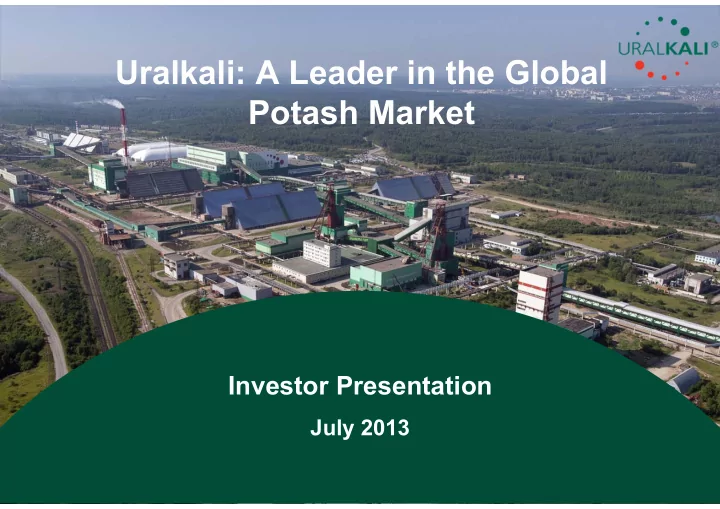
Uralkali: A Leader in the Global Potash Market Analyst - - PowerPoint PPT Presentation
Uralkali: A Leader in the Global Potash Market Analyst Presentation 20 August 2007 Investor Presentation Moscow July 2013 DRAFT No.1 Disclaimer This presentation has been prepared by JSC Uralkali (the Company). By attending the
20 August 2007 Moscow
This presentation has been prepared by JSC Uralkali (the «Company»). By attending the meeting where the presentation is made, or by reading the presentation slides, you agree to the following limitations and notifications. With respect to any information communicated by the Company, its agents or its representatives (including its directors, officers, employees, members, attorneys, advisors and any affiliates) to you or your agents or representatives (including any directors, officers, employees, members, attorneys, advisors and affiliates), directly or indirectly, whether in written, oral, visual, electronic or any other form, during or constituting the whole or part of this presentation or any presentation meeting or any conversation or discussion relating to or held in connection with this presentation,
directly or indirectly, whether in written, oral, visual, electronic or any other form, for any purpose. The Information communicated does not constitute or form part of, and should not be construed as, an offer, solicitation or invitation to subscribe for, underwrite or otherwise acquire, any securities of the Company or any member of its group nor should it or any part of it form the basis of, or be relied on in connection with, any contract to purchase or subscribe for any securities
purchase of any securities of the Company or any member of its group must inform himself or herself independently before taking any investment decision. The Information communicated has been provided to you solely for your information and background and is subject to amendment. Further, the Information communicated has been compiled on the basis of information from a number of sources and reflects prevailing conditions as of its date, which are subject to change. The medium through which the Information is communicated constitutes neither an advertisement nor a prospectus. The Information communicated has not been independently verified. The Information communicated is subject to verification and amendment without notice and the Company is not under any obligation to update or keep current the Information. Accordingly, no representation or warranty, express or implied, is made or given by or on behalf of the Company or any of its directors, officers, employees, members, attorneys, advisors, affiliates or any other person as to the correctness, accuracy, currency, completeness, adequacy, usefulness, reliability, fairness or otherwise of the Information communicated, and any reliance you place on such Information will be at your sole risk. Neither the Company nor any of its directors, officers, employees, members, attorneys, advisors, affiliates or any other person accepts any liability whatsoever for any loss howsoever arising from any use of the Information communicated. To the fullest extent permitted by applicable law, the Company shall not be liable for any compensatory, punitive, special, consequential or other damages, any loss of income or revenue, any loss of business, any loss of anticipated savings, any loss of goodwill, or any other losses, liabilities, expenses or costs of whatever nature arising from or attributable to your access to, or inability to access, or reliance on Information even if the Company has been advised of the possibility of such damages, losses, liabilities, expenses or costs. Some of the Information may constitute projections or other forward-looking statements regarding future events or the future financial performance of the Company. These statements involve numerous assumptions regarding the present and future strategies of the Company and the environment in which it operates and will operate in the future and involve a number of known and unknown risks and other factors that could cause the Company’s or its industry’s actual results, levels of activity, performance or achievements to be materially different from any future results, levels of activity, performance or achievements expressed or implied by such forward-looking statements. Accordingly, the Company provides no assurance whatsoever that its or its industry’s actual results, levels of activity, performance or achievements will be consistent with the future results, levels of activity, performance or achievements expressed or implied by such forward looking statements. Neither the Company nor any of its directors, officers, employees, members, attorneys, advisors, affiliates or any other person intends or has any duty or obligation to supplement, amend, update or revise any of the forward-looking statements contained herein to reflect any change in the Company’s expectations with regard thereto or any change in events, conditions or circumstances on which any such statements are based. Multiple factors could cause the actual results to differ materially from those contained in any projections or forward-looking statements, including, among others, potential fluctuations in quarterly or other results, dependence on new product development, rapid technological and market change, acquisition strategy, manufacturing risks, volatility of stock price, financial risk management, future growth subject to risks of political instability, economic growth and natural disasters, wars and acts of terrorism.
1
2
2010 2011 2012 Total Sales, KCl mn t 5.1 8.6 9.4 Exports Volume, KCl mn t 4.4 7.0 7.3 Net Revenue2, US$ mn 1,338 2,968 3,343
800 2,097 2,375
59.8% 70.7% 71.0% Total Debt5, US$ mn 369 3,282 3,926 Total Debt / Adj. EBITDA 0.5x 1.6x 1.7х Net Debt6, US$ mn
2,264 2,257 Net Debt / Adj. EBITDA n/a 1.1x 0.95x
Key Metrics1
Source: Uralkali's audited consolidated financial statements as of FY2010, FY2011, and FY2012, USGS, SRK Consulting, Uralkali data, Companies financial reports and presentations, Fertecon Notes: 1. Silvinit Group financial results are consolidated since May 17, 2011. Please see footnote 6 in FY 2012 IFRS for more details; 2. Calculated as Revenues less railway tariff, freight and transhipment costs; 3. Calculated as net profit adjusted for income tax expense, finance expense, finance income, depreciation and amortization expense, mine flooding costs and some
equivalents and non-current and current restricted cash
fundamentals and expected long-term evolution
S&P, Moody’s and Fitch (BBB-/Baa3/BBB-)
efficiency and low capital intensity
sustain strong balance sheet and low leverage
Company Snapshot
Moscow Perm Region
Production Assets
3
4
Q1 2013 Key Figures ¹
(US$ mln) Q1 2013 Q1 2012 FY 2012 Gross Revenue 738 901 3,950 Net Revenue 614 780 3,343 Average potash price, FCA, US$
315 268 254
313 376 370 (Mln tonnes) Production volume 2.1 1.9 9.1 Sales volume 1.9 2.1 9.4
0.4 0.5 2.1
1.5 1.6 7.3
Q1 results reflected strategy of matching supply with demand; more positive demand fundamentals in Q2 across all major markets
Note:
Q2 2013 Q2 2012 H1 2013 H1 2012 Potash Production 2.4 mln t 2.9 mln t 4.5 mln t 4.8 mln t
Q2 2013 Production Update
Pure-potash focus and industry leadership
■
Focus on potash – nutrient which represents strongest investment story across fertilizer sector
■
Aspire to strengthen leading global position supporting sustainable developments to global food supply Capacity expansion to meet growing demand
■
Value accretive investment program to selectively expand production capacity
■
Strategy of matching supply to demand Robust capital structure
■
Retain robust capital structure (net debt: LTM EBITDA - 1.0x-2.0x)
■
Maximize shareholder return through balanced approach to investing in organic growth and return of excess liquidity Maximize efficiency through competitive cost position
■
Maintain and enhance position as one of the lowest cost potash producers globally
■
Continuous improvements in operational efficiency and realization of synergies from combination with Silvinit Focus on people and communities
■
Position Company as employer of choice amongst CIS mining companies
■
Labor safety / employee development / community development Promoting environmental safety
■
Delivering value whilst operating in a socially responsible manner
■
Minimization of environmental impact of our operations Leading corporate governance standards
■
Principles of openness, transparency and risk mitigation for all stakeholders
■
Continuous improvement in our leading corporate governance standards
Clear strategic roadmap to drive longer term value creation and capital discipline
5
1 2 3 4 5 6 7
13,0 12,4 10,3 10,3 9,3 7,1 6,0 2,5 2,0 2,0 0,9 0,9 9,1 7,9 7.7 7,1 6,1 5,2 4,9 1,8 1,4 1,2 0,8 0,5
Source: Companies financial reports and presentations, Fertecon
Potash Production (2012), KCl mn t Potash Capacity (2012), KCl mn t Global Market Leader by Both Production and Capacity
Chinese producers Chinese producers
Arab Potash Company Arab Potash Company Wachstum erleben Wachstum erleben
6
10.6 0.9 0.5 0.5 1.6 0.4 1.5 0.5 2.5
19.0
10 12 14 16 18 20 mln tonnes KCl 11.5
7
2012-2014F 2015F-2017F 2018F-2021F Total Expansion Capex, US$bn 1.2 2.3 1.9 5.5
Sustaining long-term leadership on the most cost effective basis in the industry
Asset Scale Attractive Mine Fundamentals
450m)
Cost Advantage
investments – c. US$230/t4
Note: 1. Including 0.5 mln tonnes of additional capacity and 2.3 million tonnes of new capacity that will substitute the depleting capacity of Berezniki-2 mine 2. Capacity is given as of the year end 3. Weighted Average Cost 4. Required Rate of Return 15%
Strategic Capacity Expansion to Meet Growing Demand
2 2
For more details on Uralkali’s expansion programme please visit
www.uralkali.com/expansion_programme/
Project Name Project Capacity, mln t KCI Capex (US$ per tonne) Commissioning/ Full Capacity Date Debottlenecking 1.9 192 2011/2017 Solikamsk-3 expansion:
0.3 393 2015/2015
1.7 536 2016/2019 Berezniki-4 expansion 1.5 430 2012/2012 Ust-Yayvinsky field 2.81 583 2020/2025 Polovodovsky field 2.5 943 2021/TBC
Achieved capacity 13 mln t
2011
420 750 2 050 Uralkali Brownfield Uralkali Greenfield Industry standard for Greenfield
Source: Fertecon, December 2012
Low Cash Costs
Notes: 1. Defined as group’s net cash flow from operating activities less capital expenditure; 2. Calculated as group’s Adj. EBITDA divided by net revenues
Free Cash Flow1, US$ mn
1 327 1 154 925 837 585 320 216 52 1 255 1 456 775 687 934 336 396 Neg 2012 2011
Source: Company reports, Fertecon
Wachstum erleben Arab Potash Company Arab Potash Company Wachstum erleben
71% 53% 47% 41% 29% 28% 26% 16% 71% 58% 51% 48% 31% 31% 29% 17% 2012 2011
Low Cost CAPEX, US$/t (KCl)
Source: Company reports, Fertecon Source: Uralkali (based on expansion programme approved by BoD in 2011), Potash Corp
100 200 300 CIS Dead Sea N.America Europe Ex-mine FOB port
8
North America 25% Europe&ME 30% Latin Ametica 3% CIS² 42%
3
Source: IFA, Companies’ reports, Uralkali Note: 1. Excluding Canadian potash export to the United States 2. Including Uzbekistan with market share 0.6%
2012 2011 Sources of Export Trade in 2012¹
tough competition between suppliers in spot markets which led to redistribution of their market shares
while offering higher leverage to potash prices
9
North America 27% Europe&ME 28% Latin Ametica 2% CIS 43%
10
2 488 2 375 2011 2012
Adjusted EBITDA3 mln US$
351 370 2011 2012 3 568 3 343 2011 2012
11
Solid results despite challenging market environment Key Figures Key Highlights1
2012 Uralkali Sales Structure Net Revenue2, mln USD EBITDA3, mln USD
Notes: 1. 2011 figures are given on a pro-forma basis 2. Net revenue represents adjusted revenue (sales net of freight, railway tariff and transshipment costs) 3. EBITDA is calculated as Operating Profit plus depreciation and amortization and does not include mine flooding costs and other one-off expenses, without adjustment on income from reverse of reserve in amount of US$54.7 mln 4. EBITDA margin is calculated as EBITDA divided by Net revenue
Average export potash price, FCA
5%
IFRS Pro-forma Change (US$ mln) FY 2012 FY 20111 % Sales volume, mln tonnes 9.4 10.6
2.1 1.9 11%
Sales for local consumption
0.6 0.6
7.3 8.8
Revenue 3 950 4 203
Net Revenue2 3 343 3 568
EBITDA3 2 375 2 488
EBITDA margin4, % 71% 70% Net Profit 1 597 1 527 5% CAPEX 426 444
208 247
(US$/tonne)
13% India 9% China 26% SEA 13% USA 5% Europe 11% Other 1% Russia (farmers) 7% Russia (non- farmers) 15%
1 752 426 400 800 1 200 1 600 2 000
2012
Operating Cash Flow Capex
12
Balanced approach to investing in organic growth and returning excess capital to shareholders whilst maintaining a robust capital structure Capex , Operating Cash Flow , Balance Sheet
Expansion 56%
Dividends and Buy-back update
(US$ mln)
51% 20% 17% 12%
Interim – c. US$ 0.77 per GDR FY 2012 – c. US$ 0.62 4 per GDR (approved on the AGM on 4 Jun’13) Dividend payout: ~50%
+
Maintenance Other expansion projects & Infrastructure Ust-Yayva Berezniki-4
US$35.62/GDR
(US$ bn) 1 Jun’13 Debt (bank loans)2 3.9 Cash 1.6 Net debt/(cash) 2.3 Net Debt/EBITDA3 1.0x
Notes:
parameters:
13
Source: CBOT, Bursa Malaysia
2 4 6 8 10 12 14 16 18
Jan-08 May-08 Sep-08 Jan-09 May-09 Sep-09 Jan-10 May-10 Sep-10 Jan-11 May-11 Sep-11 Jan-12 May-12 Sep-12 Jan-13 May-13 $/bu
Corn Soybeans Wheat
Source: Bloomberg
expectations for higher stock-to-use ratios are putting some downward pressure on agriculture futures
prices in the summer. Any supply disruptions due to unfavorable weather conditions will apply upward pressure on agricultural futures
profitable
Soybeans stocks-to use ratio
Source: USDA
Wheat stocks-to-use ratio 0% 10% 20% 30% 01/02 03/04 05/06 07/08 09/10 11/12 13/14F
Corn stocks-to-use ratio
0% 10% 20% 30% 01/02 03/04 05/06 07/08 09/10 11/12 13/14F
Soybeans stocks-to-use ratio
0% 10% 20% 30% 40% 01/02 03/04 05/06 07/08 09/10 11/12 13/14F
Wheat stocks-to-use ratio
Source: USDA
14 Front Month Agriculture Prices
Global stocks-to-use ratios for key crops
4
to inventory drawdown in these respective markets
by the end of 2013 compared to the previous year
Источник: оценка БКК
Mtpa
Notes:
Source: BPC/UKT estimates
2,0 1,9 1,2 0,7 4,9 0,6 1,3 1,9 1,4 0,8 3,5 0,8
0,0 1,0 2,0 3,0 4,0 5,0 6,0
SEA Brazil India China² EMEA
Mn metric tonnes
end of 2012 31 May 2013
15
Source: IFA, Uralkali estimates
46 52 54 49 55 54 32 53 58 53 47 52 52 49 56 52 29 55 57 51 53-54
2003 2004 2005 2006 2007 2008 2009 2010 2011 2012 2013F
capacity production sales
Supply/Demand Dynamics 2001-2013F
45 47 49 51 53 55 Potash demand 2012 India China North America Latin America SEA EMEA Potash demand 2013F
Million metric tonnes
51
0.8-1.0 0.6-0.9 0.9-1.0 0.2-0.3 0.2-0.4 0.1-0.2
53-54
Million tonnes KCI
Rebound in potash demand 2013F
Source: IFA, Uralkali estimates
Q1 2013
2013-2014
16
100 200 300 400 500 600 700
Jan-10 Mar-10 Apr-10 Jun-10 Aug-10 Sep-10 Nov-10 Jan-11 Mar-11 Apr-11 Jun-11 Aug-11 Oct-11 Nov-11 Jan-12 Mar-12 May-12 Jun-12 Aug-12 Oct-12 Dec-12 Jan-13 Mar-13 May-13 US$/t
DAP FSU FOB Urea Yuzhny FOB MOP FSU FOB
major markets
stabilization after having bottomed out in Q4 2012
17
Phosphate Nitrogen Potash
18
19
20
Focused on delivery of growth to drive shareholder value
farmers income
Potash Market Update
Trading Update
21
22
23
Production Logistics Sales
Control Over Entire Value Chain - From Reserve Base to End Customer
24
Berezniki-2
mine
standard potash
Berezniki-4
mine
Ust-Yayvinsky Field
tonnes¹
tonnes KCI in launch year 2020
Existing Assets - 5 MINES, 6 POTASH PLANTS, 2 GREENFIELD PROJECTS (Ust-Yayva and Polovodovo)
4 3 3
Solikamsk-2
potash
Solikamsk-1
mine
Polovodovsky Field
KCI in launch year 2021
Solikamsk-3
and mine
2 1 2 4 5
Berezniki-3
potash
Production capacity as of January 2013:
Employees in Uralkali main production unit:
Note 1: JORC as of 1 January 2013
25
COMPANY-OWNED RAILCARS BALTIC BULK TERMINAL (BBT) WAREHOUSES
transhipment terminal with capacity
transportation route from mines to port
can be fully accommodated by BBT‘s existing capacity in the mid- term
and marine port terminal sites
tonnes:
up to 400,000 tonnes
railcar fleets in Russia
26
27
Cash COGS Global Cash Costs
Labour cost 38% Fuel and energy 23% Repairs and maintenance 11% Other costs 3% Materials and components used 25%
Notes: 1. 2011 figures are given on a pro-forma basis 2. EBITDA margin is calculated as EBITDA divided by Net Sales
Unit Cash COGS
56 55 62 10 20 30 40 50 60 70 2010 2011 2012 60% 70% 71%
(US$/tonne)
EBITDA Margin 2
50 100 150 200 250 300 Europe
Dead Sea CIS Ex-mine FOB port
Source: Fertecon, December 2012
28
G&A Costs1 Cash S&D Costs Effective Railway Tariff & Freight
(US$ mln) (US$/tonne) Notes: 1. 2011 figures are given on a pro-forma basis
Global cost leadership through optimization and delivery of synergies
235 231 50 100 150 200 250 2011 2012 45 72 33 20 40 60 80 Effective frieght China effective railway tariff SPb effective railway tariff
Freight 32% Railway tariff 44% Transhipment 4% Transport repairs 7% Labour 2% Other 11%
29
OPERATIONAL TRANSPORTATION SALES SG&A (incl. HR) FINANCIAL RECURRING SYNERGIES
potash production in Berezniki-1
moved to BBT
runs/empty runs
agreements with traditional Silvinit traders (IPC/Agrifert)
streamlining
functions, streamlining divisional functions
administrative functions and services
portfolio
expensive Silvinit debt
Updated synergy effect estimates suggest annual synergies of c. US$300m p.a. by 2013
US$331 m
100% US$104 m 100% US$69 m 100% US$64 m 79% US$69 m 66% US$25 m Estimated synergies Run Rate (US$ mln) Achieved in 2012, % Run Rate (2013 onwards)
30
Stock Exchange, Moscow Exchange
(equivalent of 587,203,178 GDRs)
as of February 4, 2013
the purchase of
Enterpro Services Limited, wholly owned indirect subsidiary of Uralkali
Notes: Data as of 1st April 2013 1. Includes shares transferred under repo agreement(s) with voting rights being retained by the seller. 2. Includes 2 per cent. of the shares of Uralkali which underlie bonds exchangeable into ordinary shares of Uralkali issued by Fenguard Ltd which are held by VTB Capital plc. The bonds were issued in 2012 and mature in 2014. 3. Wadge Holdings Ltd is ultimately jointly controlled by Mr. Kerimov, Mr. Mutsoev, Mr. Skurov and Mr. Galtchev. Wadge Holdings Ltd is the issuer of bonds held by Chengdong Investment Corporation that are exchangeable into 12.5 per cent. of Uralkali’s ordinary shares. The bonds were issued in 2012 and mature in 2014.
Shareholder Structure
31
Source: Company data
17,2%
7,0%
6,4%
4,8% Wadge Holdings Ltd; 12,5%
5 Non-related core Russian investors Free-float 47.0%
1 1 1, 2 1 3
Uralkali Organisational Structure
General Shareholder Meeting CEO (General Director) Management Board
Uralkali is Committed to Continuous Improvement in its Leading Corporate Governance Practices
Appointments and Remuneration Committee Investments and Development Committee Audit Committee Corporate Social Responsibility Committee
32
was elected at the AGM on 04 June 2013
committee includes at least tree independent directors
Alexander Voloshin Chairman - Independent Director Sir Robert John Margetts Chairman of the CSR Committee Senior Independent Director Anna Kolonchina Chairman of the Appointments and Remuneration Committee Paul James Ostling Chairman of the Audit Committee Independent Director Vladislav Baumgertner CEO Alexander Malakh Chairman of the Investments and Development Committee Vladislav Mamulkin Anton Averin Gordon Holden Sage Independent Director
Board of Directors
Internal Audit Department
Vladislav Baumgertner CEO Viktor Belyakov CFO
team comprises of highly experienced
and functional professionals
in mining/chemicals as well as potash industry
Management team optimally positioned to drive future growth
33
Elena Samsonova Director of Human Resources Marina Shvetsova Director of Legal and Corporate Affairs Yevgeny Kotlyar COO Stanistav Seleznev Director of Health, Safety and Environment Protection Anna Batarina Head of Investor Relations and Capital Markets Alexander Babinsky Head of Public Relations Vladimir Bezzubov Director of Procurement Oleg Petrov Director of Sales and Marketing Andrey Motovilov Head of Government Relations
34
Primary nutrients
Secondary nutrients Micro-nutrients
Ca Mg S B Zn Fe Cu Mg Mo Cl
H2O CO2 O2
colour and yield
Nitrogen (N)
development and photosynthesis process
Phosphate (P)
resistance to drought, disease, weeds, parasites and cold weather
Potash (K) Each nutrient plays its own role, but only together they ensure a balanced nourishment and cannot replace each other 35
Growing demand Challenging supply Growing demand and high supply visibility make potash a unique industry¹
Income growth in developing countries Biofuels and scientific recommend- ations potential Increasing population Mineral scarcity High capex requirements Declining arable land per person Relatively few top players Changing diets Higher demand for food Limited number of players able to bring additional capacity High barriers to entry New source of demand for crops
36
Source: Fertecon, IFA, PotashCorp Notes: 1. Including fertilizer consumption 2. 1t KCl contains 62% K2O (nutrient) 3. Excluding infrastructure
Potash represents the strongest investment story across the fertilizer industry
Very limited 37.5 million tonnes K2O Profitability Estimated cost of greenfield Capacity3 (NH3)
Potash (K) Phosphate (P) Nitrogen (N)
Market size1 (2013E Consumption) (60.4 million tonnes KCl)2 40.0 million tonnes 109.1 million tonnes (N) Geographic availability Limited Readily available Industry members High Low/Medium Low/Medium US$4.1bn for 2 mln tonnes (KCl) US$1.6bn for 1 mln tonnes US$1.7bn for 1 mln tonnes Small number of leading players Several leading players Large number of players ( P2O5 ) ( P2O5 ) Estimated greenfield development time min 7 years ~3-4 years min 3 years
37
38
0.4% Israel 1.4% United States 2.2% China 1.5% Germany 7.9% Belarus 46.3% Canada
Proven reserves of potash are largely concentrated in Canada and Russia Limited access to resources, few high quality large scale ore deposits
Source: USGS, January 2013
Jordan 0.4% Chile 1.6% Spain 0.2% 3.1% Brazil % - Share in world’s proven reserves 34.5% Russia Canada 46.1% UK 0.2%
Emerging & developing economies World Output Advanced Economies 2 4 6 8 2010 2011 2012F 2013F
200 400 600 800 1 000 1 200 1961 1965 1969 1973 1977 1981 1985 1989 1993 1997 2001 2005 2009 2020F mln tonnes
Meat Dairy
Growing population Needs Higher Crop Yields Arable land per capita is shrinking Global Economic recovery set to continue Food consumption is increasing
Source: Source: U.S. Census Bureau, International Data Base, Source: FAO Source: IMF, World Economic Outlook projections Source: FAO, World Bank (GDP % change to previous year )
2 3 4 5 6 7 8 9 10 1950 1960 1970 1980 1990 2000 2010 2020 2030 2040 2050 Population in bln 0.16 0.18 0.20 0.22 0.24 0.26 0.28 1990 2000 2010 2020 2030 2040 2050 Arable hectares per capita
39
0% 5% 10% 15% 20% 25% 30% 35%
Total Wheat Coarse Grains Rice 1 800 1 900 2 000 2 100 2 200 2 300 2 400
1996 1997 1998 1999 2000 2001 2002 2003 2004 2005 2006 2007 2008 2009 2010 2011
Production Utilization
40
World Cereal Production and Utilization World Cereal Stock-to-Use Ratio
Developing countries have a big portion of total crop acreage …though have lower yields compared to developed agricultures
Source: FAO Source: USDA, Source: IFA, FAO, USDA
Mt
Source: USDA
10 20 30 40 50 United States China Brazil India Indonesia United States China Brazil India SEA United States China Brazil India SEA Corn Rice Soybean mln HA 2 4 6 8 10 United States China Brazil India Indonesia United States China Brazil India SEA United States China Brazil India SEA Corn Rice Soybean MT/HA
World Meat Consumption
Source: FAO Source: OECD
Share of Potash in Total Farmer’s Costs (%) Grain Consumption vs. Meat Production
Source: BPC
41
Global Biofuel Production
2 4 6 8 Poultry Pork Beef Kg of grain needed to produce 1Kg of meat
Source: FAS
50 100 150 200 250
2006 2008 2010 2012 2014 2016 2018 2020 Biodiesel Ethanol
Production, blns of litres 200,000 210,000 220,000 230,000 240,000 250,000 2007 2008 2009 2010 2011 2012 (f) 2.97% 0.87% 2.46% 0.16% 1.55% Metric Tons ‘000 6% 8% 11% 4% 0% 20% 40% 60% 80% 100% Rice, China Corn, USA Soybean, Brazil Wheat, Europe
42
2.Crushing
Standard Product Compacting
approximate depth of 400 metres
underground, then the extracted one is moved by conveyor belts to the shafts and lifted to the surface
rod mills and screens break ore into smaller particles of the size required for further enrichment
flotation machine, bubbles stick to potassium chloride particles and push them to the mixture surface for subsequent separation
contain up to 96% of the useful component Granular potash
using advanced soil fertilisation methods
the USA and China, where it is applied directly to the soil or blended with nitrogen and phosphate fertilisers
joint solubility of KCI and NaCI in water at different temperatures
it cools down
98% of the useful component
Pink Potash (MOP)
soil
flotation method
primarily to India and Southeast Asia White Potash (MOP)
soil for producing compound NPK fertilisers, and for other industrial needs
mainly to China, Russia and Europe
43
Crushing ORE 30% KCI Leach with Brine Brine Clarification Controlled Crystalisation cooling to 35〫 Product Debringing Drying Slimes Thickener Tailing Debrining Dumping and Mine Backfilling Brine Clarification White MOP 97% KCL or 98% KCL as required
Hot Brine Cooled Brine
44
Crushing ORE 30% KCI Sizing Desliming Slimes Flotation Primary Flotation Reflotation 3 stages Concentrate Debringing Drying Slimes Thickener Tailing Debrining Dumping and Mine Backfilling Compaction Crushing Dry Settlement Post Treatment Reheat Pink MOP 95.8% KCL Granular MOP
45
46
6.2% in DAXglobal Agribusiness Index
Best Annual Report 2011, 2010, 2009 for Best Level of Disclosure / Best Overall Annual Report Efficiency and Transparency Top-tier Investor Relations Team Widely Traded Shares, MSCI Inclusion Commitment to High Standards
Governance Financial Acumen
Investor Relations Progress Award
Ranked 1 in ‘Most progress in IR’ and #3 in ‘Best roadshows’ by TR Extel Survey 2010 ‘Best chemicals IR team’ in Russia by TR 2011
Strong Local Liquidity + LSE Listed GDRs
GDRs admitted to main Board
local presence on both RTS and MICEX
Best IR Strategy
April 2013: Uralkali IR team was awarded for the Best Investor Relations Strategy. The Ceremony was organised by Adam Smith Institute.
Best
47
Annual Report Wins Awards
Best Annual Report 2010 among companies with Market cap over 100 bn RUB / Best Design, Idea and Graphic Arts / Investment Attractiveness
4.5% of MSCI Russia
MSCI increased Uralkali weighting in its MSCI Russia Index from 2.99% to 4.5% following the completion of combination with Silvinit
INED Received ‘Director of the 2011 Year’ National Award
Paul James Ostling received award for his contribution towards the development
Deal of the Year Awards
Russian CFO Awards 2012 Viktor Belyakov - award for Best M&A Deal of the Year Investor Awards 2012 M&A: The deal of the year Best corporate development strategy IR Magazine Russia & CIS Awards 2012 Vladislav Baumgertner Best investor relations by a CEO Viktor Belyakov Best investor relations by a CFO Anna Batarina Best investor relations officer (#2)
September 2012: with a weighting of c.6.2%, Uralkali’s GDRs were included in the DAXglobal Agribusiness Index and ranked among the top five index constituents. Uralkali is the first Russian company in the Index.
48
Anna Batarina, CFA, Head of Investor Relations and Capital Markets Daria Fadeeva, Senior Manager for Investor Relations Daria Bugaeva, Manager for Investor Relations Uralkali 119034, Russia, Moscow, Butikovsky lane, 7 Tel.: +7 (495) 730-2371 Fax: +7 (495) 730-2393 Web: www.uralkali.com E-mail: ir@msc.uralkali.com
For more information please contact Investor Relations Department: