
SLIDE 1
DRAFT No.1
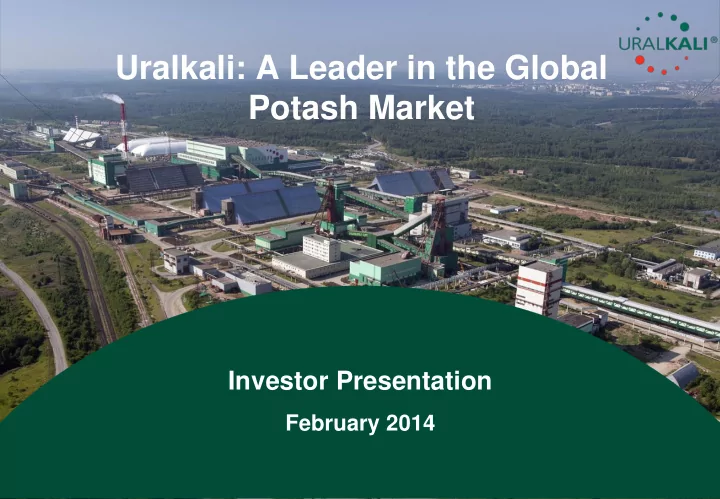
Uralkali: A Leader in the Global Potash Market
- Analyst Presentation
20 August 2007 Moscow
Potash Market Analyst Presentation 20 August 2007 Investor - - PowerPoint PPT Presentation
Uralkali: A Leader in the Global Potash Market Analyst Presentation 20 August 2007 Investor Presentation Moscow February 2014 DRAFT No.1 Disclaimer This presentation has been prepared by JSC Uralkali (the Company). By attending the
DRAFT No.1
20 August 2007 Moscow
This presentation has been prepared by JSC Uralkali (the «Company»). By attending the meeting where the presentation is made, or by reading the presentation slides, you agree to the following limitations and notifications. With respect to any information communicated by the Company, its agents or its representatives (including its directors, officers, employees, members, attorneys, advisors and any affiliates) to you or your agents or representatives (including any directors, officers, employees, members, attorneys, advisors and affiliates), directly or indirectly, whether in written, oral, visual, electronic or any other form, during or constituting the whole or part of this presentation or any presentation meeting or any conversation or discussion relating to or held in connection with this presentation,
directly or indirectly, whether in written, oral, visual, electronic or any other form, for any purpose. The Information communicated does not constitute or form part of, and should not be construed as, an offer, solicitation or invitation to subscribe for, underwrite or otherwise acquire, any securities of the Company or any member of its group nor should it or any part of it form the basis of, or be relied on in connection with, any contract to purchase or subscribe for any securities
purchase of any securities of the Company or any member of its group must inform himself or herself independently before taking any investment decision. The Information communicated has been provided to you solely for your information and background and is subject to amendment. Further, the Information communicated has been compiled on the basis of information from a number of sources and reflects prevailing conditions as of its date, which are subject to change. The medium through which the Information is communicated constitutes neither an advertisement nor a prospectus. The Information communicated has not been independently verified. The Information communicated is subject to verification and amendment without notice and the Company is not under any obligation to update or keep current the Information. Accordingly, no representation or warranty, express or implied, is made or given by or on behalf of the Company or any of its directors, officers, employees, members, attorneys, advisors, affiliates or any other person as to the correctness, accuracy, currency, completeness, adequacy, usefulness, reliability, fairness or otherwise of the Information communicated, and any reliance you place on such Information will be at your sole risk. Neither the Company nor any of its directors, officers, employees, members, attorneys, advisors, affiliates or any other person accepts any liability whatsoever for any loss howsoever arising from any use of the Information communicated. To the fullest extent permitted by applicable law, the Company shall not be liable for any compensatory, punitive, special, consequential or other damages, any loss of income or revenue, any loss of business, any loss of anticipated savings, any loss of goodwill, or any other losses, liabilities, expenses or costs of whatever nature arising from or attributable to your access to, or inability to access, or reliance on Information even if the Company has been advised of the possibility of such damages, losses, liabilities, expenses or costs. Some of the Information may constitute projections or other forward-looking statements regarding future events or the future financial performance of the Company. These statements involve numerous assumptions regarding the present and future strategies of the Company and the environment in which it operates and will operate in the future and involve a number of known and unknown risks and other factors that could cause the Company‟s or its industry‟s actual results, levels of activity, performance or achievements to be materially different from any future results, levels of activity, performance or achievements expressed or implied by such forward-looking statements. Accordingly, the Company provides no assurance whatsoever that its or its industry‟s actual results, levels of activity, performance or achievements will be consistent with the future results, levels of activity, performance or achievements expressed or implied by such forward looking statements. Neither the Company nor any of its directors, officers, employees, members, attorneys, advisors, affiliates or any other person intends or has any duty or obligation to supplement, amend, update or revise any of the forward-looking statements contained herein to reflect any change in the Company‟s expectations with regard thereto or any change in events, conditions or circumstances on which any such statements are based. Multiple factors could cause the actual results to differ materially from those contained in any projections or forward-looking statements, including, among others, potential fluctuations in quarterly or other results, dependence on new product development, rapid technological and market change, acquisition strategy, manufacturing risks, volatility of stock price, financial risk management, future growth subject to risks of political instability, economic growth and natural disasters, wars and acts of terrorism.
1
2
2010 2011 2012 1H 2013 Total Sales, KCl mn t 5.1 8.6 9.4 4.3 Exports Volume,KCl mn t 4.4 7.0 7.3 3.3 Net Revenue2, US$ mn 1,338 2,968 3,343 1,348
800 2,097 2,375 876
59.8% 70.7% 71.0% 65% Total Debt5, US$ mn 369 3,282 3,926 3,987 Net Debt6, US$ mn
2,264 2,257 2.693 Net Debt / LTM EBITDA n/a 1.1x 0.95x 1.5x
Key Metrics1
Notes:
transhipment costs; 3. EBITDA is calculated as Operating Profit plus depreciation and amortization and does not include mine flooding costs and other one-off expenses; 4. Calculated as Adj. EBITDA divided by Net Revenues; 5. Calculated as total bank loans; 6. Net debt is calculated as the total bank loans adjusted for cash and cash equivalents and non-current and current restricted cash
Leading potash producer in fertilizer segment with attractive fundamentals and expected long-term evolution
A blue-chip credit with investment grade corporate ratings from S&P, Moody‟s and Fitch (BBB-/Baa3/BBB-)
Strong profitability and cash flow generation backed by cost efficiency and low capital intensity
Focus on corporate governance and sustainable development
Company Snapshot
Moscow Perm Region
Production Assets
3
Source: Uralkali's audited consolidated financial statements as of FY2010, FY2011, and FY2012, USGS, SRK Consulting, Uralkali data, Companies financial reports and presentations, Fertecon
Global market leader by both production and capacity with capability to respond to market dynamics with existing expansion programme
Note: 1. Operational capability
9.1 Laos
Source: Companies financial reports and presentations, Fertecon
Potash Production (2012), KCl mn t Potash Capacity (2012), KCl mn t
Chinese producers
Arab Potash Company Wachstum erleben
4
13.0 Laos Chinese producers
Arab Potash Company Wachstum erleben 1
5
Note: 1. Including 0.5 mln tonnes of additional capacity and 2.3 million tonnes of new capacity that will substitute the depleting capacity of Berezniki-2 mine 2. Capacity is shown as of year end; the numbers may not add up due to rounding
For more details on Uralkali‟s expansion programme please visit www.uralkali.com/expansion_programme/ 2013 2014 2015 2016 2017 2018 2019 2020 Total Expansion Capex (US$bn) 0.4 0.3 0.4 0.3 0.2 0.2 0.3 0.2 2.3 Project Name Project Capacity, mln t KCI Capex (US$ per tonne) Commissioning/ Full Capacity Date Debottlenecking 1.0 73 2014-2017 Solikamsk-3 (phase 1) 0.4 329 2017 Ust-Yayvinsky field 2.81 596 2020
made in 2015 providing for strategic optionality
Sustaining long-term leadership on the most cost effective basis in the industry
Optionality from additional projects 0.3 0.5 0.2 0.4 0.5 4.2 13.0 13.3 13.8 14.0 14.5 14.5 14.5 15.0 19.2 12 14 16 18 20 mln tonnes KCl
2
73 255 329 376 510 755 778 785 1058 1500 1836 596 770 822 857 1000 1111 1143 1400 1400 1500
Uralkali, Debottlenecking Mosaic, Belle Plaine Uralkali, Solikamsk-3 ICL, Debottlenecking Mosaic, Colonsay Potash Corp, Cory Mosaic, Esterhazy Potash Corp, Allan Potash Corp, Rocanville Agrium, Vanscoy Potash Corp, New Brunswick Uralkali, Ust-Yayvinsky Eurochem, Usolskiy Eurochem, VolgaKaliy Turkmenkhimia, Garlyk Acron, Talitsky Mosaic, Esterhazy K+S, Legacy Mosaic, Belle Plaine Mosaic, Colonsay BHP Billiton, Jansen
Brownfield projects Greenfield projects
1
1 1
6 2012 Global Potash Cash COGS2
Uralkali Unit Cash COGS
Source: Morgan Stanley Report, August 2013
1 1
(US$/tonne)
61 60 58
10 20 30 40 50 60 70 1H2011 1H2012 1H2013
EBITDA Margin 1 64% 76% 65%
10 20 30 40 50 60 70 80
Notes: 1. EBITDA margin is calculated as EBITDA divided by Net Sales 2. Defined as gross cash costs plus royalties, FOB mine (ex freight)
62 77 121 125 145 146 151 188 220
50 100 150 200 250
Uralkali Belaruskali Potash Corp Agrium Mosaic ICL DSW K+S ICL (Spain) ICL (UK)
(US$/tonne)
Global Expansion Costs
71% 53% 47% 41% 29% 28% 26% 16% 71% 58% 51% 48% 31% 31% 29% 17%
2012 2011
Arab Potash Company Wachstum erleben
Source: Goldman Sachs Report, June 2013; Uralkali Source: Company reports, Fertecon
(US$/tonne of annual capacity)
Notes: Equity structure is given as of December 20, 2013
IFRS.
7
Source: Company data
Exchange, Moscow Exchange
(equivalent of 587,203,178 GDRs)
December 20, 2013
(incl. MSCI Russia, RTS / MICEX, FTSE Russia, Market Vector and DAXglobal Agribusiness) Largest publicly traded fertilizer producer listed on the LSE
ONEXIM Group, 21.75% Uralchem OJSC, 19.99% Chengdong Investment Corporation, 12.5%
Free Float, 45.76%1
8
9
Revenue Maximisation Strategy
Price Over Volume Strategy Volume Over Price Strategy
URALKALI CURRENT STRATEGY
As an industry leader Uralkali will grasp market opportunities to maximise its revenue through either price or volume or both
10
Deteriorating potash market conditions
Responsible market leadership started to take its toll on Uralkali‟s market share
demand
supply
competitive landscape
11 Global demand – 10-YR CAGR 0.9%
47 52 52 49 56 52 29 55 57 51
25 50 75 2003 2004 2005 2006 2007 2008 2009 2010 2011 2012 Million tonnes KCI Source: IFA, Fertecon, Companies‟ releases
54 55 59 60 62 64 66 66 68 71
25 50 75 2003 2004 2005 2006 2007 2008 2009 2010 2011 2012 Million tonnes KCI
Global supply – 10-YR CAGR 3.1%
Source: IFA, Fertecon, Companies‟ releases
Widening supply/demand gap brought industry utilization rate down to c. 70%
12
Source: IFA, Uralkali
10% 20% 30% 40% 50% 2005 2006 2007 2008 2009 2010 2011 2012 1H 2013 BPC/UKT¹ PCS/Canpotex FSU producers
through offering lower prices:
share by 8% to 38% yoy in 1H2013
share was up 12% yoy and 8%, respectively by offering the lowest prices in the tenders
market share in India at the expense of traditional suppliers in 2013: 26% in 1H2013 (up 5% yoy) compared to historical market share of 23-24%.
very aggressive in terms of pricing in Brazil and key European markets
contributed to changes in competitive environment Key observations
Source: IFA
K+S-ICL-APC 30%
Uralkali 17%
Belaruskali 17% POT/Canpotex 32% SQM 4% K+S-ICL-APC 29%
Uralkali 22%
Belaruskali 19% POT/Canpotex 27% SQM 3%
1H 2013 1H 2012 13 Uralkali lost global market share implementing price over volume strategy in 1H13
330 380 430 480 530 Jul-11 Aug-11 Sep-11 Oct-11 Nov-11 Dec-11 Jan-12 Feb-12 Mar-12 Apr-12 May-12 Jun-12 Jul-12 Aug-12 Sep-12 Oct-12 Nov-12 Dec-12 Jan-13 Feb-13 Mar-13 Apr-13 May-13 Jun-13 Jul-13 Aug-13 Sep-13 Oct-13 Nov-13 US$/t
Potash standard FOB Vancouver, US$/t
14
The prolonged decline in potash prices made “price over volume” strategy difficult to implement
Source: Argus FMB
Potash price evolution
On July 31, Uralkali announced a new strategy Before Uralkali‟s announcement, prices had been falling for 6 quarters
15 Short Term Impact
Long Term Impact
projects
and farmers‟ economics
Our Customers will continue to be our ultimate priority and will benefit from the market dynamics triggered by Uralkali‟s new strategy
16
the range 58-60Mt driven by pickup in China, India, Brazil, US and South East Asia
Global Potash Sales, 2011-2014F
57 51 53-54 56-57 57 51 53-54 58-60 40 45 50 55 60 65 2011A 2012A 2013E 2014F
Mn metric tonnes
previous estimate current estimate
Source: Argus FMB Source: IFA, Uralkali
Potash prices are close to multi-year lows
250 300 350 400 450 500 550 600
Jan-10 Mar-10 May-10 Jul-10 Sep-10 Nov-10 Jan-11 Mar-11 May-11 Jul-11 Sep-11 Nov-11 Jan-12 Mar-12 May-12 Jul-12 Sep-12 Nov-12 Jan-13 Mar-13 May-13 Jul-13 Sep-13 Nov-13 US$/t Potash standard CFR Southeast Asia, US$/mt Potash granular CFR Brazil, US$/t Potash granular New Orleans barge, US$/st
45 55 65 75 85 95 105 115 2013 2014 2015 2016 2017 2018 2019 2020
Mn metric tonnes Capacity additions based on 2013 forecast Capacity additions based on 2012 forecast
17
higher costs
as prices and industry profits
Long-Term global potash demand
Source: IFA, Uralkali
57 51 53-54 58-60
46 48 50 52 54 56 58 60 62 2011A 2012A 2013E 2014F
Mn metric tonnes
Long-Term potash capacity
Potash supply/demand balance is expected to approach the equilibrium
Source: Fertecon
Revisions in greenfield economics were triggered by recent market developments
10.6 9.4 3 6 9 12 15 2011A 2012A 2013E 2014E Mn tonnes of KCl 10-10.5 12.0-13.0
18 Sales Growth
Uralkali Potash estimated production
next 24 months with particular focus on such fast- growing markets as Latin America, South East Asia, China and India which have historically accounted for c. 60% of the Company‟s total sales
c.1Mt per month FCF Generation and Usage
Net Profit
approve interim dividends on the level of 50% of IFRS Net Profit (2.21 RUB/share or 0.35 USD/GDR1)
9.1
Note:
Restoration of Uralkali‟s market share should ensure stable FCF generation
Enhance global responsible leadership position
Focus on enhanced and more connected access to end customers
Maintain cash cost leadership positions
Balance investment in growth and shareholder return
Focus on people, communities and environmental safety
Continued focus on corporate governance
New strategy consistent with Uralkali‟s continued focus on long-term growth of shareholder value
19
1 2 3 4 5 6
20
21
Highly competitive market environment resulted in decline in both potash prices and sales volumes; new strategy expected to improve Uralkali‟s market position
Notes: 1. Net revenue represents adjusted revenue (sales net of freight, railway tariff and transshipment costs) 2. EBITDA is calculated as Operating Profit plus depreciation and amortization and does not include mine flooding costs and other one-off expenses 3. EBITDA margin is calculated as EBITDA divided by Net revenue
Key Figures Key Highlights
1H2013 Uralkali Sales Structure EBITDA3, mln USD Average export potash price, FCA
IFRS Pro-forma Change (US$ mln) 1H 2013 1H 2012 % Sales volume, mln tonnes 4.3 5.1
1.0 1.0
3.3 4.1
Revenue 1 614 2 234
Net Revenue1 1 348 1 904
EBITDA2 876 1 449
EBITDA margin3, % 65% 76% Net Profit 397 842
CAPEX 199 160 24%
92 87 6%
(US$/tonne)
380 316
1H2012 1H2013
1449 876
1H2012 1H2013
India, 11% China, 29% SEA, 5% USA, 5% Europe, 12% Russia , 23%
Sales Volume, mln t
5.1 4.3
1H2012 1H2013
Notes: 1. EBITDA margin is calculated as EBITDA divided by Net Sales
Unit Cash COGS
(US$/tonne)
61 60 58
10 20 30 40 50 60 70 1H2011 1H2012 1H2013
EBITDA Margin 1 64% 76% 65%
10 20 30 40 50 60 70 80
G&A Costs
101 102 20 40 60 80 100 120 1H2012 1H2013
G&A Costs
1% (US$ mln)
Effective Railway Tariff & Freight
(US$/tonne)
22
40 76 36 20 40 60 80 Effective freight China effective railway tariff SPb effective railway tariff
Maintenance
Polovodovo 4% Ust-Yayva 18% Other expansion, infrastructure 24%
54%
Maintenance
Expansion 46%
(US$ mln)
881 199
400 600 800 1,000 Operating Cash Flow Capex
Capex Breakdown Robust capital structure, stable cash-flow generation, attractive dividend policy
Note: 1. According to the exchange rate of the RF Central Bank as of 23 October 2013, USD 1 = RUB 31.9346
23
Profit (2.21 RUB/share or 0.35 USD/GDR 1)
Cash Flow vs. Capex
1,274 1,055
500 1,000 1,500 2,000 2,500 Liquidity as of 1 Jul'2013
24
Agency Credit Rating Outlook Last Update Issue Date BBB- Negative Dec‟ 2013 Jun‟ 2012 Baa3 Negative Oct‟ 2013 Jun‟ 2012 BBB- Negative Jul‟ 2013 Jun‟ 2012
Effective Interest Rate and Average Maturity Debt Maturities Schedule (as of 30 Jun‟ 2013)
US$ bln 30 June 2013 Debt (bank loans) 4.0 Cash 1.3 Net debt/(cash) 2.7 LTM adjusted EBITDA 1.8 Net debt/LTM EBITDA 1.5x
Note: 1. EBITDA is calculated as Operating Profit plus depreciation and amortization and does not include mine flooding costs and other one-off expenses
3.22%
0.0 0.5 1.0 1.5 2.0 2.5 3.0 3.5 4.0 0.0% 1.0% 2.0% 3.0% 4.0% 5.0% 6.0% 7.0% Jun' 2011 Sep' 2011 Dec' 2011 Mar' 2012 Jun' 2012 Sep' 2012 Dec' 2012 Mar' 2013 Jun' 2013
Effective Rate, % (LHS) Maturity, years (RHS)
2,121 733 798 293 524 435 470 509 559 1,146 361 211 278 78 11
2H 2013 1H 2014 2H 2014 1H 2015 2H 2015 1H 2016 2H 2016 1H 2017 2H 2017 1H 2018 2H 2018 1H 2019 2H 2019 1H 2020 2H 2020
Cash Committed credit lines Debt payments, (incl. loans for refinancing)
Gearing Update
25
Fixed, 57% Floating, 43% PXF, 39% Unsecured, 61% Public, 16% Private, 84% USD2, 100%
Fixed / Floating Rates Type of collateral Currency Breakdown Private vs. Public
Notes:
Credit Portfolio Structure 1
26
The adoption of a more flexible strategy will continue to allow Uralkali to maximise its revenues 27
Source: Uralkali
to-date
Uralkali was implementing „price over volume‟ strategy
full year 2013
100 200 300 400 500 600 700 800 900 1000 Jan Feb Mar Apr May Jun Jul Aug Sep Oct
Thousand metric tonnes
Uralkali‟s Shipments Jan-Oct 2013 The Impact of New Strategy
4
Notes:
28
Источник: оценка БКК Source: Uralkali‟s estimations
2.0 1.9 1.2 0.7 4.9 0.6 1.7 1.6 1.0 1.0 3.5 0.5
0.0 1.0 2.0 3.0 4.0 5.0
N.America SEA Brazil India China² EMEA
Million metric tonnes
end of 2012 end of December 2013E
and SE Asia
significant demand impetus
29
56 57 51 53-54 58-60 40 45 50 55 60 2010 2011 2012 2013E 2014F
Million metric tonnes
Recovery in Potash Demand
Mtpa
200 300 400 500 600 700 Jan-10 Mar-10 Jun-10 Aug-10 Nov-10 Jan-11 Apr-11 Jun-11 Sep-11 Nov-11 Feb-12 Apr-12 Jul-12 Sep-12 Nov-12 Feb-13 Apr-13 Jul-13 Sep-13 Dec-13
US$/mt
Potash cfr Southeast Asia Potash cfr Brazil Potash NOLA barge
Potash Prices are Stabilizing
Source: FMB Source: IFA, Uralkali‟s estimates
Increased demand momentum supports volume and price recovery in 2014
30
China
India
slowdown.
SEA
$350/t cfr - $360/t cfr.
Brazil
Europe and USA
largely depleted inventories.
replenish declining nutrient levels after record crop production in 2013.
Notes:
Source: FMB, Customs statistics (import statistics)
4
projects to be shelved for the time being
well as price recovery and industry profits
decade
31
Источник: оценка БКК
Source: CRU, Fertecon, Uralkali‟s estimates
40% 50% 60% 70% 80% 90% 100% 20 40 60 80 100 2012 2013 2014 2015 2016 2017 2018 2019 2020
Million metric tonnes
Demand Capacity Operating rate
Utilisation rates across the sector expected to see sustained growth
32
33
Revenue maximization strategy enables Uralkali to regain market share and be flexible to satisfy our customers' needs and credibly engage with potential customers
Uralkali will continue to consider options that can generate value for all its stakeholders
34
35
Vertically integrated approach:
36
Production Logistics Sales
Control Over Entire Value Chain - From Reserve Base to End Customer
37
Berezniki-2
mine
standard potash
Berezniki-4
mine
Ust-Yayvinsky Field
tonnes¹
tonnes KCI in launch year 2020
Existing Assets - 5 MINES, 6 POTASH PLANTS, 2 GREENFIELD PROJECTS (Ust-Yayva and Polovodovo)
4 3 3
Solikamsk-2
potash
Solikamsk-1
mine
Polovodovsky Field
KCI in launch year 2021
Solikamsk-3
and mine
2 1 2 4 5
Berezniki-3
potash
Production capacity as of January 2013:
Employees in Uralkali main production unit:
Note 1: JORC as of 1 January 2013
38
COMPANY-OWNED RAILCARS BALTIC BULK TERMINAL (BBT) WAREHOUSES
transhipment terminal with capacity
transportation route from mines to port
can be fully accommodated by BBT„s existing capacity in the mid- term
and marine port terminal sites
tonnes:
up to 400,000 tonnes
railcar fleets in Russia
39
Uralkali is Committed to Continuous Improvement in its Leading Corporate Governance Practices
40
Uralkali Organisational Structure
General Shareholder Meeting CEO (General Director) Management Board
was elected at the AGM on 29 November 2013
committee includes at least three independent directors
Alexander Voloshin Chairman Independent Director Sir Robert John Margetts Chairman of the CSR Committee Senior Independent Director Anna Kolonchina Non-Executive Director Paul James Ostling Chairman of the Audit Committee Independent Director Vladislav Baumgertner Non-executive director Pavel Grachev Chairman of the Appointments and Remuneration Committee Non-Executive Director Viktor Belyakov CFO Anton Averin Chairman of the Investments and Development Committee Non-Executive Director Gordon Holden Sage Independent Director
Board of Directors
Internal Audit Department Appointments and Remuneration Committee Investments and Development Committee Audit Committee Corporate Social Responsibility Committee
Dmitry Osipov CEO Viktor Belyakov CFO
team comprises of highly experienced
and functional professionals
in mining/chemicals as well as potash industry
Management team optimally positioned to drive future growth
41
Elena Samsonova Director of Human Resources Marina Shvetsova Director of Legal and Corporate Affairs Yevgeny Kotlyar COO Stanistav Seleznev Director of Health, Safety and Environment Protection Anna Batarina Head of Investor Relations and Capital Markets Alexander Babinsky Head of Public Relations Vladimir Bezzubov Director of Procurement Oleg Petrov Director of Sales and Marketing Andrey Motovilov Head of Government Relations Valdas Laurinavičius Head of Internal Audit
42
Primary nutrients
Secondary nutrients Micro-nutrients
Ca Mg S B Zn Fe Cu Mg Mo Cl
N P K
H2O CO2 O2
colour and yield
Nitrogen (N)
development and photosynthesis process
Phosphate (P)
resistance to drought, disease, weeds, parasites and cold weather
Potash (K) Each nutrient plays its own role, but only together they ensure a balanced nourishment and cannot replace each other 43
Growing demand Challenging supply Growing demand and high supply visibility make potash a unique industry¹
Income growth in developing countries Biofuels and scientific recommend- ations potential Increasing population Mineral scarcity High capex requirements Declining arable land per person Relatively few top players Changing diets Higher demand for food Limited number of players able to bring additional capacity High barriers to entry New source of demand for crops
44
Source: Fertecon, IFA, PotashCorp Notes: 1. Including fertilizer consumption 2. 1t KCl contains 62% K2O (nutrient) 3. Excluding infrastructure
Potash represents the strongest investment story across the fertilizer industry
Very limited 33.5 million tonnes K2O Profitability Estimated cost of greenfield Capacity3 (NH3)
Potash (K) Phosphate (P) Nitrogen (N)
Market size1 (2013E Demand) (53.9 million tonnes KCl)2 40.0 million tonnes 109.1 million tonnes (N) Geographic availability Limited Readily available Industry members High Low/Medium Low/Medium US$4.2bn for 2 mln tonnes (KCl) US$1.6bn for 1 mln tonnes US$1.7bn for 1 mln tonnes Small number of leading players Several leading players Large number of players ( P2O5 ) ( P2O5 ) Estimated greenfield development time min 7 years ~3-4 years min 3 years
45
46
0.4% Israel 1.4% United States 2.2% China 1.5% Germany 7.9% Belarus 46.3% Canada
Proven reserves of potash are largely concentrated in Canada and Russia Limited access to resources, few high quality large scale ore deposits
Source: USGS, January 2013
Jordan 0.4% Chile 1.6% Spain 0.2% 3.1% Brazil % - Share in world‟s proven reserves 34.5% Russia Canada 46.1% UK 0.2%
Emerging & developing economies World Output Advanced Economies 2 4 6 8 2010 2011 2012F 2013F
200 400 600 800 1,000 1,200 1961 1965 1969 1973 1977 1981 1985 1989 1993 1997 2001 2005 2009 2020F mln tonnes
Meat Dairy
Growing population Needs Higher Crop Yields Arable land per capita is shrinking Global Economic recovery set to continue Food consumption is increasing
Source: Source: U.S. Census Bureau, International Data Base, Source: FAO Source: IMF, World Economic Outlook projections Source: FAO, World Bank (GDP % change to previous year )
2 3 4 5 6 7 8 9 10 1950 1960 1970 1980 1990 2000 2010 2020 2030 2040 2050 Population in bln 0.16 0.18 0.20 0.22 0.24 0.26 0.28 1990 2000 2010 2020 2030 2040 2050 Arable hectares per capita
47
0% 5% 10% 15% 20% 25% 30% 35%
Название диаграммы
Total Wheat Coarse Grains Rice 1,800 1,900 2,000 2,100 2,200 2,300 2,400
1996 1997 1998 1999 2000 2001 2002 2003 2004 2005 2006 2007 2008 2009 2010 2011
Production Utilization
48
World Cereal Production and Utilization World Cereal Stock-to-Use Ratio
Developing countries have a big portion of total crop acreage …though have lower yields compared to developed agricultures
Source: FAO Source: USDA, Source: IFA, FAO, USDA
Mt
Source: USDA
10 20 30 40 50 United States China Brazil India Indonesia United States China Brazil India SEA United States China Brazil India SEA Corn Rice Soybean mln HA 2 4 6 8 10 United States China Brazil India Indonesia United States China Brazil India SEA United States China Brazil India SEA Corn Rice Soybean MT/HA
World Meat Consumption
Source: FAO Source: OECD
Share of Potash in Total Farmer‟s Costs (%) Grain Consumption vs. Meat Production
Source: BPC
49
Global Biofuel Production
2 4 6 8 Poultry Pork Beef Kg of grain needed to produce 1Kg of meat
Source: FAS
50 100 150 200 250
2006 2008 2010 2012 2014 2016 2018 2020 Biodiesel Ethanol
Production, blns of litres 200,000 210,000 220,000 230,000 240,000 250,000 2007 2008 2009 2010 2011 2012 (f) 2.97% 0.87% 2.46% 0.16% 1.55% Metric Tons „000 6% 8% 11% 4% 0% 20% 40% 60% 80% 100% Rice, China Corn, USA Soybean, Brazil Wheat, Europe
50
2.Crushing
Standard Product Compacting
approximate depth of 400 metres
underground, then the extracted one is moved by conveyor belts to the shafts and lifted to the surface
rod mills and screens break ore into smaller particles of the size required for further enrichment
flotation machine, bubbles stick to potassium chloride particles and push them to the mixture surface for subsequent separation
contain up to 96% of the useful component Granular potash
using advanced soil fertilisation methods
the USA and China, where it is applied directly to the soil or blended with nitrogen and phosphate fertilisers
joint solubility of KCI and NaCI in water at different temperatures
it cools down
98% of the useful component
Pink Potash (MOP)
soil
flotation method
primarily to India and Southeast Asia White Potash (MOP)
soil for producing compound NPK fertilisers, and for other industrial needs
mainly to China, Russia and Europe
51
Crushing ORE 30% KCI Leach with Brine Brine Clarification Controlled Crystalisation cooling to 35〫 Product Debringing Drying Slimes Thickener Tailing Debrining Dumping and Mine Backfilling Brine Clarification White MOP 97% KCL or 98% KCL as required
Hot Brine Cooled Brine
52
Crushing ORE 30% KCI Sizing Desliming Slimes Flotation Primary Flotation Reflotation 3 stages Concentrate Debringing Drying Slimes Thickener Tailing Debrining Dumping and Mine Backfilling Compaction Crushing Dry Settlement Post Treatment Reheat Pink MOP 95.8% KCL Granular MOP
53
54
DAXglobal Agribusiness Index
Best Annual Report 2012, 2011, 2010 for Best Level of Disclosure / Best Overall Annual Report Efficiency and Transparency Top-tier Investor Relations Team Widely Traded Shares, MSCI Inclusion Commitment to High Standards
Governance Financial Acumen
Investor Relations Progress Award Strong Local Liquidity + LSE Listed GDRs
GDRs admitted to main Board
local presence at Moscow Exchange
Best IR Strategy
April 2013: Uralkali IR team was awarded for the Best Investor Relations Strategy. The Ceremony was organized by Adam Smith Institute.
Best
55
Annual Report Wins Awards
Best Annual Report 2012,2011 among companies with Market cap over 100 bln RUB
MSCI Russia
MSCI increased Uralkali weighting in its MSCI Russia Index from 2.99% to 4.5% following the completion of combination with Silvinit
INED Received „Director of the 2011 Year‟ National Award
Paul James Ostling received award for his contribution towards the development
Deal of the Year Awards
Russian CFO Awards 2012 Viktor Belyakov - award for Best M&A Deal of the Year Investor Awards 2012 M&A: The deal of the year Best corporate development strategy IR Magazine Russia & CIS Awards 2013 Best overall Investor Relations Vladislav Baumgertner Best investor relations by a CEO Viktor Belyakov Best investor relations by a CFO Anna Batarina Best investor relations officer
September 2012: with a weighting of c.6.2%, Uralkali‟s GDRs were included in the DAXglobal Agribusiness Index and ranked among the top five index constituents. Uralkali is the first Russian company in the Index.
56
Anna Batarina, CFA, Head of Investor Relations and Capital Markets Daria Fadeeva, Senior Investor Relations Manager Uralkali 119034, Russia, Moscow, Butikovsky lane, 7 Tel.: +7 (495) 730-2371 Fax: +7 (495) 730-2393 Web: www.uralkali.com E-mail: ir@msc.uralkali.com
For more information please contact Investor Relations Department: