http: (optional) Calculator (just something that can do square - - PowerPoint PPT Presentation

http
SMART_READER_LITE
LIVE PREVIEW

http: (optional) Calculator (just something that can do square - - PowerPoint PPT Presentation

Teaching team Data Analysis and Statistical Inference Introduction Professor: Dr. Nabanita Mukherjee - nabanita.mukherjee@stat.duke.edu TAs: Sta 101 - Fall 2017 Tessa Johnson (Head TA) tessa.johnson@duke.edu Kai Wang


slide-1
SLIDE 1

Data Analysis and Statistical Inference Introduction

Sta 101 - Fall 2017

Duke University, Department of Statistical Science

  • Dr. Mukherjee

Slides posted at http://www2.stat.duke.edu/courses/Fall17/sta101.002/

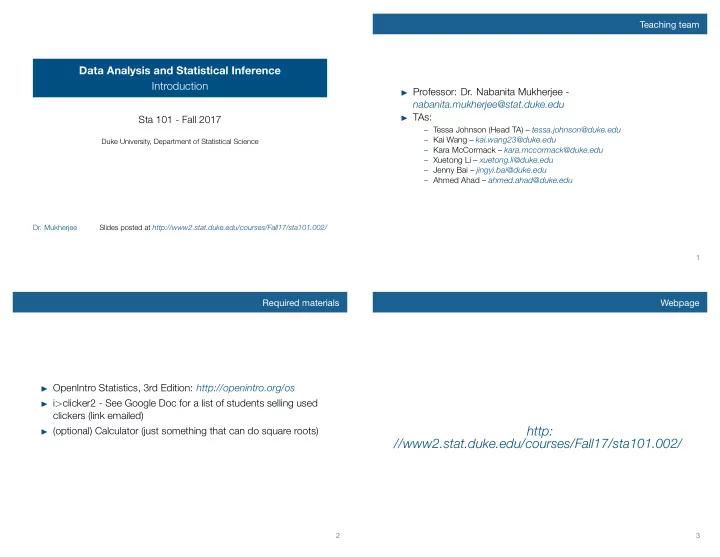
Teaching team ▶ Professor: Dr. Nabanita Mukherjee -

nabanita.mukherjee@stat.duke.edu

▶ TAs:

– Tessa Johnson (Head TA) – tessa.johnson@duke.edu – Kai Wang – kai.wang23@duke.edu – Kara McCormack – kara.mccormack@duke.edu – Xuetong Li – xuetong.li@duke.edu – Jenny Bai – jingyi.bai@duke.edu – Ahmed Ahad – ahmed.ahad@duke.edu

1

Required materials ▶ OpenIntro Statistics, 3rd Edition: http://openintro.org/os ▶ i>clicker2 - See Google Doc for a list of students selling used

clickers (link emailed)

▶ (optional) Calculator (just something that can do square roots)

2

Webpage

http: //www2.stat.duke.edu/courses/Fall17/sta101.002/

3

slide-2
SLIDE 2

Learning units and course outline

▶ Pictures and summaries of data

– Unit 1 - Intro to data: Observational studies & non-causal inference, principles of experimental design & causal inference, exploratory data analysis, introduction to simulation-based statistical inference.

▶ Mathematics behind statistics

– Unit 2 - Probability & distributions: Basics of probability and chance processes, Bayesian perspective in statistical inference, the normal and binomial distributions.

▶ Statistical inference

– Unit 3 - Framework for inference: CLT, sampling distributions, and introduction to theoretical inference. – Midterm 1 – Unit 4 - Statistical inference for numerical variables – Unit 5 - Statistical inference for categorical variables – Midterm 2

▶ Modeling

– Unit 6 - Simple linear regression: Bivariate correlation and causality, introduction to modeling. – Unit 7 - Multiple linear regression: More advanced modeling with multiple predictors. – Final Exam 4

Course structure ▶ Set of learning objectives and required and suggested readings,

videos, etc. for each unit.

▶ Prior to beginning the unit, watch the videos and/or complete

the readings and familiarize yourselves with the learning

  • bjectives.

▶ Begin a new unit with a readiness assessment: individual, then

team.

▶ Class time: split between lecture, discussion/application, and

lab.

▶ Complement your learning with problem sets. ▶ Wrap up a unit with a performance assessment.

5

Teams ▶ Highly functional teams of learners based on survey and

pre-test.

▶ Team members first point of contact. ▶ Application exercises, labs, team readiness assessments,

project.

▶ Study together, but anything that is not explicitly a team

assignment must be your own work.

▶ Peer evaluations to ensure that all team members contribute to

the success of the group and to address any potential issues early on.

– If you feel that there are issues within your team, you are encouraged to discuss it with your team members and to bring it to my or your TA’s attention ASAP ( don’t wait till things get worse).

6

Clickers

Objective: Two-way communication and instant feedback.

▶ Readiness assessments (graded for accuracy) ▶ Questions throughout lecture (graded for participation)

– Get credit for the day you by responding to at least 75% of the questions. – Up to three unexcused late arrivals or absences.

▶ Register your clicker at the class

7

slide-3
SLIDE 3

Project

Objective: Give you independent applied research experience using real data and statistical methods.

▶ Proposal: due mid-semester ▶ Poster session: last lab of semester ▶ Complete in teams, along with peer evaluations to track

contribution of each member

▶ Must complete the project and score at least 30% of the points

  • n each project in order to pass this class

8

Exams

Midterm 1 Oct 3, Tue Midterm 2 Nov 9, Thu Final Dec 17 , Sun - 7-10pm

▶ Exam dates cannot be changed, no make-up exams will be

given

▶ If you cannot take the exams on these dates you should drop

this class

▶ Calculator + cheat sheet allowed

9

Email & Piazza ▶ I will regularly send announcements by email, so make sure to

check your email daily.

▶ All content related (non-personal) questions should be posted

  • n Piazza.

▶ Before posting a new question please make sure to check if

your question has already been answered, and answer others’ questions.

▶ Use informative titles for your posts. ▶ It is more efficient to answer most statistical questions “in

person” so make use of OH.

10

Office Hours ▶ Prof:

– Office hours: Thursdays, 12 - 2 pm, Old Chem 122A (my office)

▶ TAs:

TA Day / time Location Walker Harrison T 12-2pm Old Chem 211A Tessa Johnson W 10 - 11am, 11am - 12 pm Old Chem 211A/025 Yixuan Wang T 2-3pm, F 9-10am Old Chem 221A Jose San Martin Th 9-10am, F 12-1 pm Old Chem 211A Ahmed Ahad T 4 - 5 pm, Th 6-7 pm Old Chem 025 Jenny Bai M 4-6 pm Old Chem 211A Xuetong Li M 11:30 am-12:30 pm, W 9 -10 am Old Chem 211A

11

slide-4
SLIDE 4

Students with disabilities

Students with disabilities who believe they may need accommodations in this class are encouraged to contact the Student Disability Access Office at (919) 668-1267 as soon as possible to better ensure that such accommodations can be made.

http://www.access.duke.edu/students/requesting/index.php

12

Academic Dishonesty

Any form of academic dishonesty will result in an immediate 0 on the given assignment and will be reported to the Office of Student

  • Conduct. Additional penalties may also be assessed if deemed
  • appropriate. If you have any questions about whether something is
  • r is not allowed, ask me beforehand.

Some examples:

▶ Use of disallowed materials (including any form of

communication with classmates or accessing the web) during exams and readiness assessments

▶ Plagiarism of any kind ▶ Use of outside answer keys or solution manuals for the

homework

13

Tips for success ▶ Complete the reading before a new unit begins, and then review again after

the unit is over.

▶ Be an active participant during lectures and labs. ▶ Ask questions - during class or office hours, or by email. Ask me, your TAs,

and your classmates.

▶ Do the problem sets - start early and make sure you attempt and understand

all questions.

▶ Take each PA and complete practice quizzes (on Coursera) for each unit, and

review the feedback for questions you miss.

▶ Start your project early and and allow adequate time to complete them. ▶ Give yourself plenty of time time to prepare a good cheat sheet for exams.

This requires going through the material and taking the time to review the concepts that you’re not comfortable with.

▶ Do not procrastinate - don’t let a unit go by with unanswered questions as it

will just make the following unit’s material even more difficult to follow.

14

To do ▶ Download or purchase the textbook

– Download: http://openintro.org/os – Purchase: http://openintro.org/os/amazon

▶ Obtain and register your clicker in class ▶ Read the syllabus and let me know if you have any questions ▶ Watch/Read/Review the resources for Unit 1

– RA 1 on Thursday – not graded (for practice)

15

slide-5
SLIDE 5

Syllabus quiz (10 minutes). You can refer to the syllabus at http://www2.stat.duke.edu/courses/Fall17/sta101.002/.

16 17