Outline Debating Adjudicating Style Content Strategy - - PowerPoint PPT Presentation

outline
SMART_READER_LITE
LIVE PREVIEW

Outline Debating Adjudicating Style Content Strategy - - PowerPoint PPT Presentation

Debating Adjudicating Style Content Strategy Definitions P .o.I. Scores Panels Feedback Conclusions A DJUDICATING www.learndebating.com A DJUDICATING Debating Adjudicating Style Content Strategy Definitions P .o.I. Scores


slide-1
SLIDE 1

Debating Adjudicating Style Content Strategy Definitions P .o.I. Scores Panels Feedback Conclusions

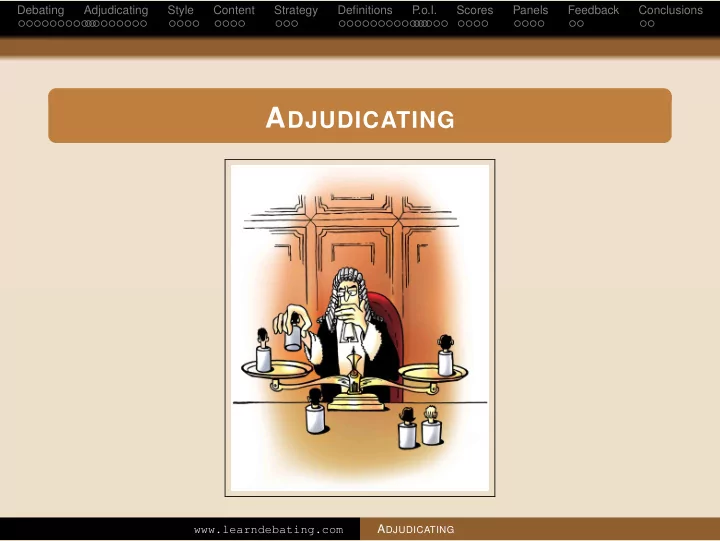
ADJUDICATING

www.learndebating.com ADJUDICATING
slide-2
SLIDE 2

Debating Adjudicating Style Content Strategy Definitions P .o.I. Scores Panels Feedback Conclusions

Outline

Debating Adjudicating Style Content Strategy Definitions Points of Information Scores Panels Feedback Conclusions

www.learndebating.com ADJUDICATING

slide-3
SLIDE 3

Debating Adjudicating Style Content Strategy Definitions P .o.I. Scores Panels Feedback Conclusions The WSDC style

The World Schools Debating Championships

The World Schools Debating Championships have run since 1988, and now involve more than 30 teams every year. The World Schools Debating Championships style is a unique style, different from every separate national style. Rules, principles and intuitions from national tournaments do not necessarily apply in the WSDC style.

www.learndebating.com ADJUDICATING

slide-4
SLIDE 4

Debating Adjudicating Style Content Strategy Definitions P .o.I. Scores Panels Feedback Conclusions The WSDC style

Debate format in the WSDC style

There are two teams of three speakers each. There is a Proposition Team, which must agree with the motion, and an Opposition Team, which must disagree. Speakers speak for eight minutes each, alternating between Proposition and Opposition. After the 3rd Opposition speech, there are two ‘summary speeches’, each of four minutes. Each team can choose its first or second speaker to give the summary speech. The Opposition summary speech comes before the Proposition summary speech.

www.learndebating.com ADJUDICATING

slide-5
SLIDE 5

Debating Adjudicating Style Content Strategy Definitions P .o.I. Scores Panels Feedback Conclusions The WSDC style

The typical layout of a debate

Chairperson PROPOSITION OPPOSITION 1st 2nd 3rd 1st 2nd 3rd Speaking area Audience Adjudicator(s)

www.learndebating.com ADJUDICATING

slide-6
SLIDE 6

Debating Adjudicating Style Content Strategy Definitions P .o.I. Scores Panels Feedback Conclusions The WSDC style

A ‘zig-zag’ format

Debates in the WSDC style run like this. . . PROPOSITION OPPOSITION 1st Proposition − → 1st Opposition ← − 2nd Proposition − → 2nd Opposition ← − 3rd Proposition − → 3rd Opposition ↓ Proposition Summary ← − Opposition Summary

www.learndebating.com ADJUDICATING

slide-7
SLIDE 7

Debating Adjudicating Style Content Strategy Definitions P .o.I. Scores Panels Feedback Conclusions The WSDC style

Roles of the speakers: The First Proposition

The First Proposition speaker must: Define the motion. Outline his or her arguments and the arguments of the Second Proposition. Present arguments (e.g. two or three arguments).

www.learndebating.com ADJUDICATING

slide-8
SLIDE 8

Debating Adjudicating Style Content Strategy Definitions P .o.I. Scores Panels Feedback Conclusions The WSDC style

Roles of the speakers: The First Opposition

The First Opposition speaker must: Respond to the First Proposition (‘rebuttal’). Outline his or her arguments and the arguments of the Second Opposition. Present arguments (e.g. two or three arguments).

www.learndebating.com ADJUDICATING

slide-9
SLIDE 9

Debating Adjudicating Style Content Strategy Definitions P .o.I. Scores Panels Feedback Conclusions The WSDC style

Roles of the speakers: The Second Proposition and Second Opposition

The Second Proposition and Second Opposition speakers must: Respond to the preceding speaker (‘rebuttal’). Outline his or her arguments. Present arguments (e.g. two or three arguments).

www.learndebating.com ADJUDICATING

slide-10
SLIDE 10

Debating Adjudicating Style Content Strategy Definitions P .o.I. Scores Panels Feedback Conclusions The WSDC style

Roles of the speakers: The Third Proposition and Third Opposition

The Third Proposition and Third Opposition speakers must: Respond to arguments from all the speakers on the other team (‘rebuttal’). Relate the main issues of the debate back to his or her

  • wn team’s case.

www.learndebating.com ADJUDICATING

slide-11
SLIDE 11

Debating Adjudicating Style Content Strategy Definitions P .o.I. Scores Panels Feedback Conclusions The WSDC style

Roles of the speakers: Summary speeches

A summary speaker must: Summarise the main issues of the debate:

What were the main issues? How did each team deal with those issues?

Recap his or her own team’s arguments:

First speaker’s arguments; Second speaker’s arguments.

www.learndebating.com ADJUDICATING

slide-12
SLIDE 12

Debating Adjudicating Style Content Strategy Definitions P .o.I. Scores Panels Feedback Conclusions The WSDC style

Time allocation and speaker roles

www.learndebating.com ADJUDICATING

slide-13
SLIDE 13

Debating Adjudicating Style Content Strategy Definitions P .o.I. Scores Panels Feedback Conclusions

Outline

Debating Adjudicating Style Content Strategy Definitions Points of Information Scores Panels Feedback Conclusions

www.learndebating.com ADJUDICATING

slide-14
SLIDE 14

Debating Adjudicating Style Content Strategy Definitions P .o.I. Scores Panels Feedback Conclusions

The role of the adjudicator

The adjudicator decides which team wins the debate. This is not the same as deciding which side of the motion the adjudicator agrees with. It is irrelevant whether the adjudicator personally agrees or disagrees with the proposal. Example The motion may be ‘THIS HOUSE SUPPORTS QUOTAS FOR

WOMEN IN PARLIAMENT’. The adjudicator may personally

disagree with this proposal. However, if the proposition team debates more effectively, the proposition team must win.

www.learndebating.com ADJUDICATING

slide-15
SLIDE 15

Debating Adjudicating Style Content Strategy Definitions P .o.I. Scores Panels Feedback Conclusions

Deciding the winner

The adjudicator must judge the debate rationally. Different adjudicators may disagree about the result of a

  • debate. This is no problem. But every adjudicator must have

sensible, logical reasons for his or her opinion. Example It is legitimate to award higher marks because a speech has more logical arguments. It is not legitimate to award higher marks because a speaker is well dressed.

www.learndebating.com ADJUDICATING

slide-16
SLIDE 16

Debating Adjudicating Style Content Strategy Definitions P .o.I. Scores Panels Feedback Conclusions

There are three criteria for adjudicating. . .

Style The way that the speaker presents Content The material that the speaker presents

Content could — in theory — be adjudicated simply by reading the text of a speech. (We would never actually do this, of course!)

Strategy The organisation of a speech

This includes: – Timing – Recognising the key issues – Teamwork

www.learndebating.com ADJUDICATING

slide-17
SLIDE 17

Debating Adjudicating Style Content Strategy Definitions P .o.I. Scores Panels Feedback Conclusions

How should an adjudicator combine the categories?

In the WSDC style, adjudicators must combine content, style and strategy by assigning scores. (We discuss the marking range later.) A speaker’s total score is the sum of the category scores, plus a mark for points of information: The speaker’s score for style + The speaker’s score for content + The speaker’s score for strategy + The speaker’s score for points of information = The speaker’s total score

www.learndebating.com ADJUDICATING

slide-18
SLIDE 18

Debating Adjudicating Style Content Strategy Definitions P .o.I. Scores Panels Feedback Conclusions

How should an adjudicator combine speaker scores?

The team’s total score is the sum of the speaker scores. The score for the first speech + The score for the second speech + The score for the third speech + The score for the summary speech = The team’s total score

www.learndebating.com ADJUDICATING

slide-19
SLIDE 19

Debating Adjudicating Style Content Strategy Definitions P .o.I. Scores Panels Feedback Conclusions

The team with the highest total marks wins the debate

In the WSDC style, the team that wins is always the team that scores the highest total marks wins the debate. There are no exceptions to this rule. However, an adjudicator should never say, ‘I thought one team won, but when I added my marks, I realised that they had lost’. If this is the case, the adjudicator must adjust the marks.

www.learndebating.com ADJUDICATING

slide-20
SLIDE 20

Debating Adjudicating Style Content Strategy Definitions P .o.I. Scores Panels Feedback Conclusions

The adjudicator’s opinion and the speaker’s scores

The scores should reflect the adjudicator’s conclusions on many different aspects of the debate. Between the teams, the team with the higher total wins. Between different speakers, the speakers who give better speeches should get higher marks. Within each speech, the marks for style, content and strategy should reflect the adjudicator’s assessment of these areas. Example Suppose the 1st Proposition speaker has better content than the 3rd Opposition, but that the 3rd Opposition has better style. Then the speakers’ content and style marks should reflect this.

www.learndebating.com ADJUDICATING

slide-21
SLIDE 21

Debating Adjudicating Style Content Strategy Definitions P .o.I. Scores Panels Feedback Conclusions

Adjudicating requires weighing different factors

There is no such thing as an ‘automatic loss’. There is no one thing that can, by itself, win or lose a debate. Instead, the adjudicator must always weigh a wide variety of relevant factors. Example In some styles of debating, a team will lose if it does not rebut every one of its opposition’s arguments. In the WSDC style, a team should rebut all of the opposition arguments, but a team will not automatically lose if it does not.

www.learndebating.com ADJUDICATING

slide-22
SLIDE 22

Debating Adjudicating Style Content Strategy Definitions P .o.I. Scores Panels Feedback Conclusions

Outline

Debating Adjudicating Style Content Strategy Definitions Points of Information Scores Panels Feedback Conclusions

www.learndebating.com ADJUDICATING

slide-23
SLIDE 23

Debating Adjudicating Style Content Strategy Definitions P .o.I. Scores Panels Feedback Conclusions Overview of style

What is style?

Style is about how well a speaker communicates. That is, leaving aside content and strategy, how engaging and persuasive is the speaker? There is no one ideal style. Different speakers will achieve effective style in different ways.

www.learndebating.com ADJUDICATING

slide-24
SLIDE 24

Debating Adjudicating Style Content Strategy Definitions P .o.I. Scores Panels Feedback Conclusions Overview of style

An overall assessment

As with content and strategy, style must be judged by an adjudicator’s overall assessment. An adjudicator may sometimes be guided by considering: Visual style and Verbal style. Variety is generally an important part of effective style: both for effective visual style and for effective verbal style.

www.learndebating.com ADJUDICATING

slide-25
SLIDE 25

Debating Adjudicating Style Content Strategy Definitions P .o.I. Scores Panels Feedback Conclusions Visual style

Some elements of visual style

Visual style may include: Eye contact, Hand gestures, Movement, etc. These things have to be weighed in an overall assessment. Example Many effective speakers gesture very enthusiastically. But many effective speakers hardly gesture at all. A judge should consider gesture, but there is no single, simple rule about what is best.

www.learndebating.com ADJUDICATING

slide-26
SLIDE 26

Debating Adjudicating Style Content Strategy Definitions P .o.I. Scores Panels Feedback Conclusions Verbal style

Some elements of verbal style

Verbal style may include: Pace, Intonation, Volume, Variation in style, etc. These things have to be weighed in an overall assessment. Example Many effective speakers speak in a loud and ‘assertive’ style. But many effective speakers use a more reserved and ‘analytical’ style. A judge should consider volume, but there is no single, simple rule about what is best.

www.learndebating.com ADJUDICATING

slide-27
SLIDE 27

Debating Adjudicating Style Content Strategy Definitions P .o.I. Scores Panels Feedback Conclusions

Outline

Debating Adjudicating Style Content Strategy Definitions Points of Information Scores Panels Feedback Conclusions

www.learndebating.com ADJUDICATING

slide-28
SLIDE 28

Debating Adjudicating Style Content Strategy Definitions P .o.I. Scores Panels Feedback Conclusions

What is content?

Content concerns the strength of a speaker’s arguments. This is not the same as whether the adjudicator personally agrees with the argument. Content covers both a speaker’s own arguments and rebuttal

  • f the opposition’s arguments.

www.learndebating.com ADJUDICATING

slide-29
SLIDE 29

Debating Adjudicating Style Content Strategy Definitions P .o.I. Scores Panels Feedback Conclusions

Some elements of content

A speaker with strong content will present arguments and rebuttal that are: Logical, Well explained, Supported by examples, statistics, etc. Example Suppose a speaker presents a logical argument, which is clear and explained well. But suppose the argument has no supporting evidence. The adjudicator should reward the speaker for being logical and clear, but penalise the speaker for the lack of supporting evidence. As always, the adjudicator must weigh the overall effect.

www.learndebating.com ADJUDICATING

slide-30
SLIDE 30

Debating Adjudicating Style Content Strategy Definitions P .o.I. Scores Panels Feedback Conclusions

Effective use of examples

Examples that are often effective are: Real, Significant and Carefully analysed. Examples that are rarely effective are: Hypotheticals (‘Imagine if...’), Personal anecdotes (‘My friend...’), Extremes (‘As Hitler illustrates...’), or Religious texts.

www.learndebating.com ADJUDICATING

slide-31
SLIDE 31

Debating Adjudicating Style Content Strategy Definitions P .o.I. Scores Panels Feedback Conclusions

Judging weak arguments

A weak argument is a weak argument even if the other team does not effectively rebut it. Example An adjudicator should never say, ‘This argument was weak, but I rewarded it because it was not adequately rebutted’. A weak argument should be penalised. If the other team effectively rebuts it, that team should be further rewarded.

www.learndebating.com ADJUDICATING

slide-32
SLIDE 32

Debating Adjudicating Style Content Strategy Definitions P .o.I. Scores Panels Feedback Conclusions

Outline

Debating Adjudicating Style Content Strategy Points of Information Scores Panels Feedback Conclusions

www.learndebating.com ADJUDICATING

slide-33
SLIDE 33

Debating Adjudicating Style Content Strategy Definitions P .o.I. Scores Panels Feedback Conclusions

What is strategy?

Strategy concerns: Identification of important issues in the debate, Effective use of time, Consistency between arguments and between speeches. We can think of strategy in terms of ‘role fulfillment’: a speaker has good strategy if he or she has performed his or her roles well — as a speaker in the debate, as a member of a team, etc.

www.learndebating.com ADJUDICATING

slide-34
SLIDE 34

Debating Adjudicating Style Content Strategy Definitions P .o.I. Scores Panels Feedback Conclusions

Identifying important issues

Identification of important issues can include: Choice of issues as part of a team’s own case, Effective choice of issues for rebuttal, Effective comparison of arguments in summary. Example Suppose a speaker has two arguments to rebut: a minor, weak argument and an important, strong argument. The speaker may spend lots of time attacking the weak argument and little time on the strong argument. However, this would be poor strategy: the speaker should spend more time on the argument that is more important.

www.learndebating.com ADJUDICATING

slide-35
SLIDE 35

Debating Adjudicating Style Content Strategy Definitions P .o.I. Scores Panels Feedback Conclusions

Consistency between arguments

Arguments must be consistent: Speakers should not contradict their own arguments; Speakers should not contradict their teammates’ arguments. Further, every speaker must argue the case directly. Example Suppose a team is arguing for sanctions against China. . . 1st: ‘China has a bad human rights record.’ 2nd: ‘Sanctions are an effective response.’ This is poor team strategy (a ‘hung case’): the first speaker did not directly support the case!

www.learndebating.com ADJUDICATING

slide-36
SLIDE 36

Debating Adjudicating Style Content Strategy Definitions P .o.I. Scores Panels Feedback Conclusions

Outline

Debating Adjudicating Style Content Strategy Definitions Points of Information Scores Panels Feedback Conclusions

www.learndebating.com ADJUDICATING

slide-37
SLIDE 37

Debating Adjudicating Style Content Strategy Definitions P .o.I. Scores Panels Feedback Conclusions

Adjudicating definitional disputes

The definition is not a distinct category; it is judged as part of content and strategy. However, disagreements about the definition can be particularly difficult to adjudicate, so we now consider this issue in more detail. Disagreements about the definition should not happen! However, just in case. . .

www.learndebating.com ADJUDICATING

slide-38
SLIDE 38

Debating Adjudicating Style Content Strategy Definitions P .o.I. Scores Panels Feedback Conclusions

The right of definition

The Proposition has the right to define the motion. However, in doing so, it must be reasonable. This means:

1

If the motion poses a clear issue for debate, the Proposition must define the motion to relate to that

  • issue. If the motion poses a clear issue for debate, any
  • ther definition would not be reasonable.

2

If there is no obvious meaning to the motion, the range of possible meanings is limited to those that allow for a reasonable debate.

www.learndebating.com ADJUDICATING

slide-39
SLIDE 39

Debating Adjudicating Style Content Strategy Definitions P .o.I. Scores Panels Feedback Conclusions

Particular issues

Any definition that leaves the Opposition no room for debate — for example, a definition creating a truism or a tautology — is unreasonable. Sometimes, even defining a word literally can be unreasonable — for example, if a motion includes an absolute (‘all’, ‘everyone’, ‘always’, ‘never’, etc). ‘Squirreling’ — the distortion of the definition to enable a team to argue a pre-prepared argument that it wishes to debates regardless of the motion actually set — is not allowed.

www.learndebating.com ADJUDICATING

slide-40
SLIDE 40

Debating Adjudicating Style Content Strategy Definitions P .o.I. Scores Panels Feedback Conclusions

Narrowing and broadening definitions

If the motion poses a clear issue for debate, the Proposition must define the motion to relate to that issue. This implies that the Proposition may not use its definition to make the debate about a narrower issue, nor about a broader issue. Example The motion may be “THIS HOUSE WOULD COMPROMISE CIVIL

LIBERTIES IN THE INTEREST OF SECURITY”. The Proposition

may argue that national ID cards should be introduced; this would be an example of compromising liberties for security. But the Proposition may not limit the debate simply to national ID cards.

www.learndebating.com ADJUDICATING

slide-41
SLIDE 41

Debating Adjudicating Style Content Strategy Definitions P .o.I. Scores Panels Feedback Conclusions

Narrowing and broadening definitions

That is. . . the Proposition may base its case around a single argument (though this is not necessarily a good idea!), but the Proposition may not limit the definition to a single argument.

www.learndebating.com ADJUDICATING

slide-42
SLIDE 42

Debating Adjudicating Style Content Strategy Definitions P .o.I. Scores Panels Feedback Conclusions

Parameters for debate

‘Time setting’ and ‘place setting’ are not allowed. Example The motion may be “THIS HOUSE BELIEVES THAT PRIVATE

SCHOOLS SHOULD BE SUBSIDISED BY THE STATE”. The

Proposition may not limit this motion to relate only to private schools in a particular country. However, some motions implicity require limitation. Example One prepared round in 2001 was on the motion “THIS HOUSE

BELIEVES THAT GAY COUPLES SHOULD BE ALLOWED TO ADOPT CHILDREN”. This motion should be limited: to countries in

which homosexuality is lawful.

www.learndebating.com ADJUDICATING

slide-43
SLIDE 43

Debating Adjudicating Style Content Strategy Definitions P .o.I. Scores Panels Feedback Conclusions

The Opposition’s response

The Opposition may do one of three things:

1

Accept, or

2

Challenge, or

3

Broaden. If the First Opposition does not do any of the three, the Opposition team is taken to have accepted. If the Opposition accepts the definition, either implicitly

  • r explicitly, the adjudicator need not worry about the

reasonableness of the definition.

www.learndebating.com ADJUDICATING

slide-44
SLIDE 44

Debating Adjudicating Style Content Strategy Definitions P .o.I. Scores Panels Feedback Conclusions

Challenging the definition

Merely complaining about the definition is not the same as challenging it. If the First Opposition wishes to challenge the definition, he or she should be very clear that he or she is doing this. If challenging, the Opposition must:

1

Announce clearly that it is challenging,

2

Explain why the Proposition definition is unreasonable,

3

Provide an alternative (and reasonable) definition,

4

Advance a case based on its alternative definition.

www.learndebating.com ADJUDICATING

slide-45
SLIDE 45

Debating Adjudicating Style Content Strategy Definitions P .o.I. Scores Panels Feedback Conclusions

Challenging the definition: An example

Example The motion may be “THIS HOUSE WOULD BREAK A BAD LAW”. Suppose that the Proposition defines ‘bad law’ as meaning ‘a law that is impossible to obey’. The First Opposition may challenge the definition, on the basis that it leaves the Opposition no room to argue. The First Opposition may redefine ‘bad law’ to mean ‘a law that is unjust’. The Opposition would then proceed to provide arguments and examples to show why we should not break laws that are unjust.

www.learndebating.com ADJUDICATING

slide-46
SLIDE 46

Debating Adjudicating Style Content Strategy Definitions P .o.I. Scores Panels Feedback Conclusions

The Opposition’s response

The Opposition may do one of three things:

1

Accept, or

2

Challenge, or

3

Broaden. If the Opposition does not do any of the three, it is taken to have accepted. If the Opposition accepts the definition, either implicitly

  • r explicitly, the adjudicator need not worry about the

reasonableness of the definition.

www.learndebating.com ADJUDICATING

slide-47
SLIDE 47

Debating Adjudicating Style Content Strategy Definitions P .o.I. Scores Panels Feedback Conclusions

Broadening the definition

Merely complaining about the definition is not the same as broadening it. If the First Opposition wishes to broaden the definition, he or she should be very clear that he or she is doing this. If broadening, the Opposition must:

1

Announce clearly that it is broadening,

2

Explain why the Proposition definition is too narrow,

3

Explain how the definition should be broadened,

4

Advance a case based on its broader definition.

www.learndebating.com ADJUDICATING

slide-48
SLIDE 48

Debating Adjudicating Style Content Strategy Definitions P .o.I. Scores Panels Feedback Conclusions

Broadening the definition: An example

Example The motion may be “THIS HOUSE WOULD COMPROMISE CIVIL

LIBERTIES IN THE INTEREST OF SECURITY”. Suppose that the

Proposition limits the debate simply to national ID cards. Then the First Opposition may broaden the definition. The First Opposition may explain that the Opposition will oppose the general principle of compromising civil liberties for national security, including the case of national ID cards.

www.learndebating.com ADJUDICATING

slide-49
SLIDE 49

Debating Adjudicating Style Content Strategy Definitions P .o.I. Scores Panels Feedback Conclusions

Adjudicating definitional debates

When judging a definitional debate, an adjudicator must decide which definition should be preferred. The Proposition has the right to define the motion. Therefore, if the Proposition definition is reasonable, the Proposition definition must be preferred.

www.learndebating.com ADJUDICATING

slide-50
SLIDE 50

Debating Adjudicating Style Content Strategy Definitions P .o.I. Scores Panels Feedback Conclusions

Adjudicating definitional debates

Remember, there are no automatic losses in the WSDC

  • style. It is very important which team’s definition is preferred,

but this decision must not, itself, determine the result. The adjudicator must still weigh many factors; however, in a definitional debate, the decision on which team’s definition is reasonable will be very important for judging both content and strategy.

www.learndebating.com ADJUDICATING

slide-51
SLIDE 51

Debating Adjudicating Style Content Strategy Definitions P .o.I. Scores Panels Feedback Conclusions

Outline

Debating Adjudicating Style Content Strategy Definitions Points of Information Scores Panels Feedback Conclusions

www.learndebating.com ADJUDICATING

slide-52
SLIDE 52

Debating Adjudicating Style Content Strategy Definitions P .o.I. Scores Panels Feedback Conclusions

What are Points of Information?

Points of Information are brief interjections (questions or comments) during an opponent’s speech. The purpose of a Point of Information is to require speakers to respond to objections against their arguments during their

  • speech. They make a debate more interactive and, hopefully,

more interesting. They cannot happen in the first or last minute of a speech, nor in the summary speeches. A speaker may accept or decline an point that is offered. Each speaker should offer 2–4 points per speech; Each speaker should accept 1–2 points.

www.learndebating.com ADJUDICATING

slide-53
SLIDE 53

Debating Adjudicating Style Content Strategy Definitions P .o.I. Scores Panels Feedback Conclusions

Marking Points of Information

In the WSDC style, Points of Information are marked additionally to other categories. An adjudicator must assign a mark from -2 to +2 for Points of

  • Information. This is assigned to change the overall mark to

reflect the impact of Points of Information, if necessary. Example Suppose a speaker gives an excellent speech. Suppose that his or her use of Points of Information is also excellent. Then the speaker should receive ‘0’ for Points of Information.

www.learndebating.com ADJUDICATING

slide-54
SLIDE 54

Debating Adjudicating Style Content Strategy Definitions P .o.I. Scores Panels Feedback Conclusions

Outline

Debating Adjudicating Style Content Strategy Definitions Points of Information Scores Panels Feedback Conclusions

www.learndebating.com ADJUDICATING

slide-55
SLIDE 55

Debating Adjudicating Style Content Strategy Definitions P .o.I. Scores Panels Feedback Conclusions

Allocating scores: General principles

In almost all debates, there will be differences between speakers; that should be reflected in the speakers’ marks. Speakers should be judged relative to what is a reasonable expectation for a speech at the particular level of the debate. Example In many countries, a speech that is ‘excellent’ at a National Schools Championships may only be considered ‘average’ at the World Schools Championships. The speech would — quite rightly — be marked more highly at the National Schools Championships.

www.learndebating.com ADJUDICATING

slide-56
SLIDE 56

Debating Adjudicating Style Content Strategy Definitions P .o.I. Scores Panels Feedback Conclusions

The marking guide

In the WSDC format, adjudicators award a mark out of 40 for each of style and content and a mark out of 20 for strategy: STANDARD STYLE CONTENT STRATEGY Exceptional 32 32 16 Excellent 31 31 15–16 Extremely good 30 30 15 Very good 29 29 14–15 Good 28 28 14 Satisfactory 27 27 13–14 Competent 26 26 13 Pass 25 25 12–13 Improvement needed 24 24 12 ‘Good style’ does not necessarily imply ‘good content’, etc.

www.learndebating.com ADJUDICATING

slide-57
SLIDE 57

Debating Adjudicating Style Content Strategy Definitions P .o.I. Scores Panels Feedback Conclusions

More on allocating scores

Summary speeches are marked on half the scale. Style and content each receive a mark out of 20, and strategy a mark

  • ut of 10, so that the total mark is out of 50.

Adjudicators may award half marks (for example, a mark of 10.5 for style). No other fractions are allowed! (Half marks may also be awarded for the main speeches.)

www.learndebating.com ADJUDICATING

slide-58
SLIDE 58

Debating Adjudicating Style Content Strategy Definitions P .o.I. Scores Panels Feedback Conclusions

Minimum and maximum scores

The absolute minimum score for a main speech is 60. The absolute maximum score for a main speech is 80. The absolute minimum score for a summary speech is 30. The absolute maximum score for a summary speech is 40. Adjudicators should reserve extreme scores for extremely good/poor speeches. Adjudicators may never go outside this range!

www.learndebating.com ADJUDICATING

slide-59
SLIDE 59

Debating Adjudicating Style Content Strategy Definitions P .o.I. Scores Panels Feedback Conclusions

Outline

Debating Adjudicating Style Content Strategy Definitions Points of Information Scores Panels Feedback Conclusions

www.learndebating.com ADJUDICATING

slide-60
SLIDE 60

Debating Adjudicating Style Content Strategy Definitions P .o.I. Scores Panels Feedback Conclusions

Adjudicating on panels

WSDC debates are adjudicated by panels: Each adjudicator still adjudicates the debate separately; The result is by majority vote. Example Suppose that there are three adjudicators. Suppose two adjudicators each award the debate to the Proposition by one

  • mark. Suppose the other adjudicator awards the debate to the

Opposition by ten marks. Then the Proposition wins the debate: it is ‘a majority decision of two to one’.

www.learndebating.com ADJUDICATING

slide-61
SLIDE 61

Debating Adjudicating Style Content Strategy Definitions P .o.I. Scores Panels Feedback Conclusions

Panel decisions are individual decisions

WSDC debates are always adjudicated by each adjudicator separately. All adjudicators must leave their mark sheets with the chair before leaving the room to confer with the panel. Adjudicators may never change their decision after leaving their mark sheet!

www.learndebating.com ADJUDICATING

slide-62
SLIDE 62

Debating Adjudicating Style Content Strategy Definitions P .o.I. Scores Panels Feedback Conclusions

Panel discussions

The adjudication panel will meet after leaving their mark sheets, but before the result is announced. This is an opportunity to compare reasons, in order to facilitate feedback and explanation to the debaters. Adjudicators should not use this time to try to persuade the rest

  • f the adjudication panel to their point of view; this can always

be done later, if at all! (Please meet outside the room; let the debaters, coaches and audience remain in the room!)

www.learndebating.com ADJUDICATING

slide-63
SLIDE 63

Debating Adjudicating Style Content Strategy Definitions P .o.I. Scores Panels Feedback Conclusions

Respect for disagreement

Disagreement is an important part of adjudicating at WSDC. The assigned chair of the panel should present the panel decision, even if the chair disagrees with the result. The chair’s comments should. . .

1

Acknowledge and respect all of the views on the panel,

2

Seek to identify one or more ‘pivot points’ for any disagreement (for example, whether a particular rebuttal point came too late in the debate),

3

Emphasise points of agreement between the panel. These principles should also apply to all adjudicators’ individual feedback!

www.learndebating.com ADJUDICATING

slide-64
SLIDE 64

Debating Adjudicating Style Content Strategy Definitions P .o.I. Scores Panels Feedback Conclusions

Outline

Debating Adjudicating Style Content Strategy Definitions Points of Information Scores Panels Feedback Conclusions

www.learndebating.com ADJUDICATING

slide-65
SLIDE 65

Debating Adjudicating Style Content Strategy Definitions P .o.I. Scores Panels Feedback Conclusions

Feedback: General principles

The most important purpose of feedback is to explain the reasons for the result. Adjudicators should be clear and specific about this. Example Adjudicators should avoid very general comments; they are usually not helpful. For example, ‘I just didn’t really like this argument...’ or ‘Your style just wasn’t very persuasive...’. The other important purpose of feedback is to help and encourage debaters to improve. Adjudicators should give both ‘positive’ and ‘negative’ feedback, and should make all feedback constructive.

www.learndebating.com ADJUDICATING

slide-66
SLIDE 66

Debating Adjudicating Style Content Strategy Definitions P .o.I. Scores Panels Feedback Conclusions

One possible format for presenting the result. . .

Briefly introduce all the adjudicators; Briefly outline style, content and strategy; Briefly compare the teams’ style; Briefly compare the teams’ content; Briefly compare the teams’ strategy; Conclude and announce the result; Invite teams to receive individual feedback separately.

www.learndebating.com ADJUDICATING

slide-67
SLIDE 67

Debating Adjudicating Style Content Strategy Definitions P .o.I. Scores Panels Feedback Conclusions

Outline

Debating Adjudicating Style Content Strategy Definitions Points of Information Scores Panels Feedback Conclusions

www.learndebating.com ADJUDICATING

slide-68
SLIDE 68

Debating Adjudicating Style Content Strategy Definitions P .o.I. Scores Panels Feedback Conclusions

Some guiding principles

Adjudicators must be active judges of the debate, not mere passive observers: There are no automatic results; Arguments are weak or strong regardless of whether they are effectively rebutted; Adjudication always requires weighing of many factors.

www.learndebating.com ADJUDICATING

slide-69
SLIDE 69

Debating Adjudicating Style Content Strategy Definitions P .o.I. Scores Panels Feedback Conclusions

Some guiding principles

Adjudicators must try not to bring to a debate any preconceptions about the participating teams (for example, preconceptions based on past performance). There is no ‘true winner’ of a debate: adjudicators may legitimately disagree. If an adjudicator is impartial and follows the WSDC style, his or her decision will be valid.

www.learndebating.com ADJUDICATING

slide-70
SLIDE 70

Debating Adjudicating Style Content Strategy Definitions P .o.I. Scores Panels Feedback Conclusions

ADJUDICATING

Slides initially prepared by Ryan Goss, Tessa Khan, Simon Quinn & Lewis Turner, March 2009. Artwork by Armand Homsi for the Arabic translation, ‘The Complete Guide to the Art of Debate’, published by QatarDebate.

www.learndebating.com ADJUDICATING