How Not to Write an x86 Platform Driver Core-kernel dev plays with - - PowerPoint PPT Presentation

how not to write an x86 platform driver
SMART_READER_LITE
LIVE PREVIEW

How Not to Write an x86 Platform Driver Core-kernel dev plays with - - PowerPoint PPT Presentation

How Not to Write an x86 Platform Driver Core-kernel dev plays with device drivers.... October 24, 2013 Darren Hart <darren.hart@intel.com> ELC-E Edinburgh 2013 Agenda Platform MinnowBoard Examples Lessons Learned


slide-1
SLIDE 1 ELC-E • Edinburgh • 2013

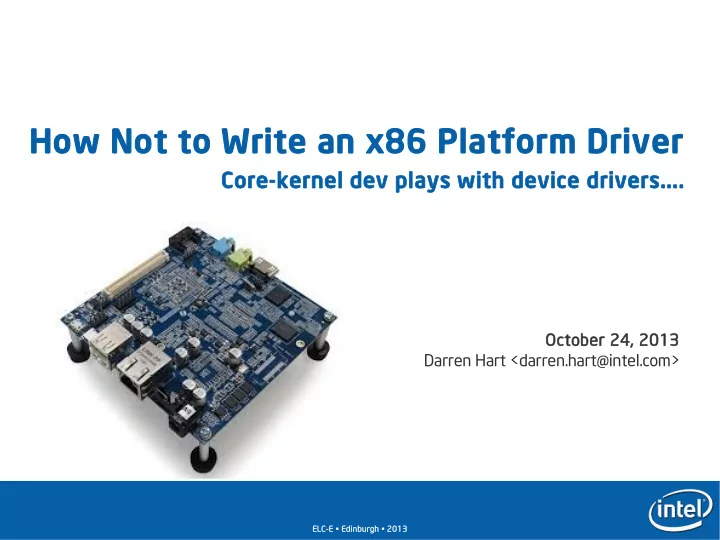
How Not to Write an x86 Platform Driver

October 24, 2013 Darren Hart <darren.hart@intel.com>

Core-kernel dev plays with device drivers....
slide-2
SLIDE 2 2/36 ELC-E • Edinburgh • 2013

Agenda

  • Platform
  • MinnowBoard Examples
  • Lessons Learned
  • MinnowBoard Take 2
  • Next Steps
slide-3
SLIDE 3 3/36 ELC-E • Edinburgh • 2013

Agenda

  • Platform
  • MinnowBoard Examples
  • Lessons Learned
  • MinnowBoard Take 2
  • Next Steps
slide-4
SLIDE 4 4/36 ELC-E • Edinburgh • 2013

Platform

  • Computer architecture (PC)
  • Software frameworks (OS, application framework, etc.)
  • Intel-ese: A CPU and Chipset... or SoC... or...
  • Linux Platform drivers
  • Pseudo-bus drivers
  • Board-fjle drivers
  • (Drivers without hardware enumeration and description)
  • Examples
  • PC BIOS
  • UEFI
  • Android
  • There's just “little bit” of room for confusion here...
slide-5
SLIDE 5 5/36 ELC-E • Edinburgh • 2013

Agenda

  • Platform
  • MinnowBoard Examples
  • Lessons Learned
  • MinnowBoard Take 2
  • Next Steps
slide-6
SLIDE 6 6/36 ELC-E • Edinburgh • 2013

MinnowBoard: Overview

  • Intel Atom E6xx CPU (TunnelCreek)
  • Intel EG20T PCH (Topcliff)
  • TunnelCreek + Topcliff = Queensbay (Platform!)
  • 32bit UEFI Firmware
  • One of the fj

fjrst designs to make full use of all the GPIO

  • Buttons
  • LEDs
  • UART
  • 50MHz clock not the default for the driver (pch_uart)
  • Ethernet
  • Low-cost PHY with no EPROM for the Ethernet Address
slide-7
SLIDE 7 7/36 ELC-E • Edinburgh • 2013

MinnowBoard: Dynamic Baseboard

  • Typical x86 designs have fj

fjxed baseboard

  • Expansion via self-enumerating buses
  • MinnowBoard supports daughter cards called “Lures”
  • USB
  • PCI
  • I2C
  • SPI
  • CAN
  • GPIO
  • Requires an in-fj

fjeld-defj fjned hardware description mechanism

slide-8
SLIDE 8 8/36 ELC-E • Edinburgh • 2013

MinnowBoard: GPIO

  • Three sources of GPIO
  • MFD -> LPC -> GPIO Core (5) and Suspend (8) Wells
  • PCH (12)
  • Both PCI enumerated
  • Uses
  • 4 User Buttons
  • 2 User LEDs
  • PHY Reset
  • Expansion GPIO
slide-9
SLIDE 9 9/36 ELC-E • Edinburgh • 2013

MinnowBoard: Board-Files

  • A board-fj

fjle is a self-describing non-enumerated driver

  • Several examples in the kernel to follow
  • Simple to write
  • Reserve GPIO
  • Buttons, LEDs, PHY Reset
  • Defjne and export platform functions
  • PHY wakeup, board detection
  • Create the Pseudo-bus drivers
  • gpio_keys
  • leds-gpio
  • Export expansion GPIO to sysfs
slide-10
SLIDE 10 10/36 ELC-E • Edinburgh • 2013

MinnowBoard: Board-Files

$ wc -l drivers/platform/x86/minnowboard*[ch] 108 drivers/platform/x86/minnowboard-gpio.c 60 drivers/platform/x86/minnowboard-gpio.h 101 drivers/platform/x86/minnowboard-keys.c 193 drivers/platform/x86/minnowboard.c 462 total static int __init minnow_module_init(void) { ... gpio_request_array(hwid_gpios, ARRAY_SIZE(hwid_gpios)); ... gpio_request_one(GPIO_PHY_RESET, GPIOF_DIR_OUT | GPIOF_INIT_HIGH | GPIOF_EXPORT, "minnow_phy_reset"); ... platform_device_register(&minnow_gpio_leds); ... } bool minnow_detect(void) { const char *cmp; cmp = dmi_get_system_info(DMI_BOARD_NAME); if (cmp && strstr(cmp, "MinnowBoard")) return true; return false; } EXPORT_SYMBOL_GPL(minnow_detect);

slide-11
SLIDE 11 11/36 ELC-E • Edinburgh • 2013

MinnowBoard: Board-Files

$ wc -l drivers/platform/x86/minnowboard*[ch] 108 drivers/platform/x86/minnowboard-gpio.c 60 drivers/platform/x86/minnowboard-gpio.h 101 drivers/platform/x86/minnowboard-keys.c 193 drivers/platform/x86/minnowboard.c 462 total static int __init minnow_module_init(void) { ... gpio_request_array(hwid_gpios, ARRAY_SIZE(hwid_gpios)); ... gpio_request_one(GPIO_PHY_RESET, GPIOF_DIR_OUT | GPIOF_INIT_HIGH | GPIOF_EXPORT, "minnow_phy_reset"); ... platform_device_register(&minnow_gpio_leds); ... } bool minnow_detect(void) { const char *cmp; cmp = dmi_get_system_info(DMI_BOARD_NAME); if (cmp && strstr(cmp, "MinnowBoard")) return true; return false; } EXPORT_SYMBOL_GPL(minnow_detect);

slide-12
SLIDE 12 12/36 ELC-E • Edinburgh • 2013

MinnowBoard: Board-Files Bad

  • Not automatically enumerated and loaded
  • Leads to evil vendor trees
  • Make assumptions about hardware layout
  • Dangerous
  • Reduces image reuse
  • Fragment the platform
  • Don't leverage code reuse
  • Code bloat, added maintenance
  • Add unnecessary dependency to independent drivers
  • pch_uart, pch_gbe, lpc_sch, gpio_sch, gpio_pch
  • DO NOT WRITE X86 BOARD FILES... TO BE CONTINUED...
slide-13
SLIDE 13 13/36 ELC-E • Edinburgh • 2013

MinnowBoard: UART

  • PCI Enumerated
  • Vendor/Device ID insuffj

fjcient

  • Firmware can select the clock
  • Existing precedent uses SMBIOS (not for new drivers)

static struct dmi_system_id pch_uart_dmi_table[] = { ... { .ident = "Fish River Island II", { DMI_MATCH(DMI_PRODUCT_NAME, "Fish River Island II"), }, (void *)FRI2_48_UARTCLK, }, { .ident = "MinnowBoard", { DMI_MATCH(DMI_BOARD_NAME, "MinnowBoard"), }, (void *)MINNOW_UARTCLK, }, };

slide-14
SLIDE 14 14/36 ELC-E • Edinburgh • 2013

MinnowBoard: Ethernet PHY

  • Software confj

fjgured 2ns TX Clock delay

  • Aggressive power saving, must be woken up

/* Wake up the PHY */ gpio_set_value(13, 0); usleep_range(1250, 1500); gpio_set_value(13, 1); usleep_range(1250, 1500); /* Configure 2ns Clock Delay */ pch_gbe_phy_read_reg_miic(hw, PHY_AR8031_DBG_OFF, &mii_reg); pch_gbe_phy_write_reg_miic(hw, PHY_AR8031_DBG_OFF, PHY_AR8031_SERDES); pch_gbe_phy_read_reg_miic(hw, PHY_AR8031_DBG_DAT, &mii_reg); mii_reg |= PHY_AR8031_SERDES_TX_CLK_DLY; pch_gbe_phy_write_reg_miic(hw, PHY_AR8031_DBG_DAT, mii_reg); /* Disable Hibernate */ pch_gbe_phy_write_reg_miic(hw, PHY_AR8031_DBG_OFF, PHY_AR8031_HIBERNATE); pch_gbe_phy_read_reg_miic(hw, PHY_AR8031_DBG_DAT, &mii_reg); mii_reg &= ~PHY_AR8031_PS_HIB_EN; pch_gbe_phy_write_reg_miic(hw, PHY_AR8031_DBG_DAT, mii_reg);

slide-15
SLIDE 15 15/36 ELC-E • Edinburgh • 2013

MinnowBoard: Ethernet PHY

  • How do you identify the PHY?
  • RGMII read
  • But you can't read yet because it's asleep...
  • How do you identify the platform?
  • SMBIOS
  • Device Tree
  • ACPI (actually, this could work well)
  • PCI Subsystem ID (Already PCI Enumerated)
  • How do you describe the hardware?
  • Board-File platform functions (REJECTED)
  • Platform init routine and private driver data per platform
  • Next Steps: PHYLIB
slide-16
SLIDE 16 16/36 ELC-E • Edinburgh • 2013

MinnowBoard: Ethernet PHY

+static struct pch_gbe_privdata pch_gbe_minnow_privdata = { + .phy_tx_clk_delay = true, + .phy_disable_hibernate = true, + .platform_init = pch_gbe_minnow_platform_init, +}; static DEFINE_PCI_DEVICE_TABLE(pch_gbe_pcidev_id) = { + {.vendor = PCI_VENDOR_ID_INTEL, + .device = PCI_DEVICE_ID_INTEL_IOH1_GBE, + .subvendor = PCI_VENDOR_ID_CIRCUITCO, + .subdevice = PCI_SUBSYSTEM_ID_CIRCUITCO_MINNOWBOARD, + .class = (PCI_CLASS_NETWORK_ETHERNET << 8), + .class_mask = (0xFFFF00), + .driver_data = (kernel_ulong_t)&pch_gbe_minnow_privdata + }, {.vendor = PCI_VENDOR_ID_INTEL, .device = PCI_DEVICE_ID_INTEL_IOH1_GBE, .subvendor = PCI_ANY_ID, .subdevice = PCI_ANY_ID, .class = (PCI_CLASS_NETWORK_ETHERNET << 8), +static int pch_gbe_minnow_platform_init(struct pci_dev *pdev) { ... } +static int pch_gbe_phy_tx_clk_delay(struct pch_gbe_hw *hw) { ... } +int pch_gbe_phy_disable_hibernate(struct pch_gbe_hw *hw) { ... }

slide-17
SLIDE 17 17/36 ELC-E • Edinburgh • 2013

MinnowBoard: Ethernet MAC

  • No EEPROM for Ethernet Address
  • Reduced cost
  • Use one from the local allocation pool
  • Where should we store the Ethernet Address?
  • Fixed location in memory
  • EFI Var
  • PCI registers
  • The fj

fjrst implementation used EFI Vars

  • Not quite as horrible as you might think
  • Final solution was done in fj

fjrmware to read a fj fjxed location from the SPI fm fmash and populate the PCI MAC register

  • No driver changes required!
slide-18
SLIDE 18 18/36 ELC-E • Edinburgh • 2013

Agenda

  • Platform
  • MinnowBoard Examples
  • Lessons Learned
  • MinnowBoard Take 2
  • Next Steps
slide-19
SLIDE 19 19/36 ELC-E • Edinburgh • 2013

Lessons: Platform

  • A “Platform” is a reusable building block
  • The less it changes, the more reusable it is
  • Reduces time-to-market
  • x86 has a well established platform
  • Consider the number of systems current Linux Distributions support
  • n the same Linux kernel
  • This must be preserved and upheld
slide-20
SLIDE 20 20/36 ELC-E • Edinburgh • 2013

Lessons: Complexity

  • Core kernel
  • Simple primitives
  • Complex algorithms
  • Drivers
  • Simple algorithms
  • Complex set of primitives
slide-21
SLIDE 21 21/36 ELC-E • Edinburgh • 2013

Lessons: The Front End

  • Many IA products closely follow a reference design
  • High confjdence in reference design
  • Can lead to infmexible driver implementations
  • If you have input into the design phase
  • Consider existing device driver support
  • Component selection
  • Which PHY to use with a given MAC?
  • Layout and confjguration
slide-22
SLIDE 22 22/36 ELC-E • Edinburgh • 2013

Lessons: Identifj fjcation and Description

  • The problem can be reduced to:
  • Identifjcation
  • Description
  • Identifj

fjcation

  • Vendor/Product IDs
  • PCI Subsystem ID
  • Firmware (ACPI, DT)
  • SMBIOS
  • Description
  • PCI Confjg or Registers (USB?)
  • Hardcoded by ID
  • Firmware (ACPI, DT)
slide-23
SLIDE 23 23/36 ELC-E • Edinburgh • 2013

Lessons: It's Not About You!

  • Reduce long-term maintenance
  • Avoid board-fjles, reuse existing platform drivers
  • Avoid creating evil vendor trees
  • Don't lock your customers to a specifj

fjc kernel version

  • Avoid creating unnecessary driver dependencies
  • pch_gbe and minnowboard board-fjles
  • Use device meta-data rather than a new device ID to

distinguish between functionally equivalent devices

  • Such as UART-to-USB devices
  • Simplify existing Linux distribution support
  • Stable trees and distributions will readily pull in device IDs
  • Reusable device IDs are even better
slide-24
SLIDE 24 24/36 ELC-E • Edinburgh • 2013

Lessons: It's Not About You!

“If you're a company that thinks your tiny change to the kernel is what gives you a competitive edge, you'll probably be facing economic problems. You'd be much better off worrying about making the best damn hardware for the lowest price.”

  • - Linus Torvalds, LinuxCon Europe, 2013
slide-25
SLIDE 25 25/36 ELC-E • Edinburgh • 2013

Agenda

  • Platform
  • MinnowBoard Examples
  • Lessons Learned
  • MinnowBoard Take 2
  • Next Steps
slide-26
SLIDE 26 26/36 ELC-E • Edinburgh • 2013

Take 2: GPIO Revisited

  • New approach based on Lessons Learned
  • No Board-Files
  • No new fjles at all
  • Reuse existing code
  • Or at least set the stage to do so in the future
  • Support the platform
  • ACPI device identifjcation and description
slide-27
SLIDE 27 27/36 ELC-E • Edinburgh • 2013

Take 2: Identifj fjcation and Description

  • ACPI 5.0 does:
  • Assign device IDs to pseudo devices
  • Adding ACPI enumeration to PCI devices is trivial and links the pseudo

device with the underlying physical device in the in-kernel device tree

  • Identify GPIO resources (pins, address, interrupt lines)
  • ACPI 5.0 does not (currently):
  • Provide a standard mechanism to describe arbitrary device attributes
  • Keybinding, default trigger, number of queues, etc.
  • Some vendors currently invent their own
  • Acknowledgements:
  • Rafael Wysocki, Mika Westerberg, Mathias Nyman, Robert Moore
  • H. Peter Anvin, Len Brown, Mark Doran
  • Linus Walleij, many more....
slide-28
SLIDE 28 28/36 ELC-E • Edinburgh • 2013

Take 2: ACPI DSDT Example

Scope (\_SB.PCI0.LPC) { Device (LEDS) { Name (_HID, "MNW0003") Method (_CRS, 0, Serialized) { Name (RBUF, ResourceTemplate () { GpioIo (Exclusive, PullDown, 0, 0, IoRestrictionOutputOnly, "\\_SB.PCI0.LPC", 0, ResourceConsumer,,) { 10 // SUS 5 } GpioIo (Exclusive, PullDown, 0, 0, IoRestrictionInputOnly, "\\_SB.PCI0.LPC", 0, ResourceConsumer,,) { 11 // SUS6 } }) Return (RBUF) }}}

  • Defj

fjne a pseudo device LEDS below the LPC device

  • Create the hardware ID “MNW0003”
  • Add GPIO 10 and 11 (relative to the LPC device) to LEDS
  • The kernel can identify, but has no mapping information
slide-29
SLIDE 29 29/36 ELC-E • Edinburgh • 2013

Take 2: ACPI Packages and Properties

Package() { <VALUE1>, <VALUE2> } Package() { Package() { <VALUE1>, <VALUE2> } Package() { <VALUE1>, <VALUE2> } } Package() { Package() { “String”, “Hello World” } Package() { “Number”, 10 } Package() { “List”, Package() { 1, 2 } } } Method (PROPERTIES, 0, NotSerialized) { Return (Package() { Package() { "Key", “Value” } }) }

  • Packages are non-typed arrays
  • Packages can nested
  • Packages can easily implement dictionaries
  • A PROPERTIES method could return a dictionary
slide-30
SLIDE 30 30/36 ELC-E • Edinburgh • 2013

Take 2: ACPI _PRP Method Proposal

Scope (\_SB.PCI0.LPC) { Device (LEDS) { Name (_HID, "MNW0003") Method (_CRS, 0, Serialized) { ... } Method (_PRP, 0, NotSerialized) { Return (Package() { Package() { "label", Package (2) { "minnow_led0", "minnow_led1" }}, Package() { "linux,default-trigger", Package (2) { "heartbeat", "mmc0" }}, Package() {"linux,default-state", Package (2) { "on", "on" }}, Package() { "linux,retain-state-suspended", Package (2) { 1, 1 }}, }) } } }

  • A standardized mechanism is needed
  • Consider an ACPI reserved method _PRP
  • Optionally implemented per device
slide-31
SLIDE 31 31/36 ELC-E • Edinburgh • 2013

Take 2: ACPI Device Enumeration

  • Documentation/acpi/enumeration.txt
  • Add ACPI ID to drivers/acpi/acpi_platform.c
  • Add ACPI enumeration to pseudo-bus driver

drivers/acpi/acpi_platform.c: static const struct acpi_device_id acpi_platform_device_ids[] = { { "PNP0D40" }, + { "MNW0002" }, + { "MNW0003" }, { } }; drivers/leds/leds-gpio.c: +#ifdef CONFIG_ACPI +static inline struct gpio_leds_priv * +gpio_leds_create_acpi(struct platform_device *pdev) +{ ... } +static const struct acpi_device_id acpi_gpio_leds_match[] = { + { "MNW0003" }, + {}, +}; static struct platform_driver gpio_led_driver = { + .acpi_match_table = ACPI_PTR(acpi_gpio_leds_match),

slide-32
SLIDE 32 32/36 ELC-E • Edinburgh • 2013

Take 2: ACPI Device Description

  • New set of ACPI APIs
  • Populate the platform_device with the ACPI Properties

int acpi_dev_get_property_<TYPE>(struct acpi_device *adev, const char *name, <TYPE> *value) int acpi_dev_get_property_array_<TYPE>(struct acpi_device *adev, const char *name, <TYPE> *values, size_t nvalues) drivers/leds/leds-gpio.c: static inline struct gpio_leds_priv * gpio_leds_create_acpi(struct platform_device *pdev) { ... trigger = kcalloc(nleds, sizeof(char *), GFP_KERNEL); error = acpi_dev_get_property_array_string(adev, "linux,default-trigger", trigger, nleds); ... for (i = 0; i < nleds; i++) { struct gpio_led led = {}; led.gpio = acpi_get_gpio_by_index(dev, i, NULL); ... led.default_trigger = trigger[i]; ... } ... return priv; }

slide-33
SLIDE 33 33/36 ELC-E • Edinburgh • 2013

Take 2: ACPI MinnowBoard Example

  • 3.12.0-rc5 + Minnow ACPI V2

cat /sys/kernel/debug/gpio GPIOs 0-4, platform/sch_gpio.33158, sch_gpio_core: gpio-0 (minnow_btn0 ) in hi gpio-1 (minnow_btn1 ) in hi gpio-2 (minnow_btn2 ) in hi gpio-3 (minnow_btn3 ) in hi GPIOs 5-13, platform/sch_gpio.33158, sch_gpio_resume: gpio-10 (minnow_led0 ) out lo gpio-11 (minnow_led1 ) out hi gpio-13 (minnow_phy_reset ) out hi

slide-34
SLIDE 34 34/36 ELC-E • Edinburgh • 2013

Agenda

  • Platform
  • MinnowBoard Examples
  • Lessons Learned
  • MinnowBoard Take 2
  • Next Steps
slide-35
SLIDE 35 35/36 ELC-E • Edinburgh • 2013

Next Steps

  • Formalize and propose the ACPI _PRP method
  • Consider existing implementations
  • One more layer of Linux device property abstraction
  • Abstract Open Firmware (DT) and ACPI (_PRP), allowing pseudo-device

drivers to have a single fjrmware device property API

  • Layered ACPI SSDT tooling
  • Current mechanisms replace rather than augment the fjrmware

provided DSDT

  • Generic ACPI platform device HIDs
  • LNX**** or just more PNP**** IDs
  • Opening up fj

fjrmware

  • At the very least we need to be able to rebuild it with modifjcations
slide-36
SLIDE 36 36/36 ELC-E • Edinburgh • 2013

Comments / Questions

/* */ || ?

(Come see us at the Intel booth for a “Chalk Talk”)