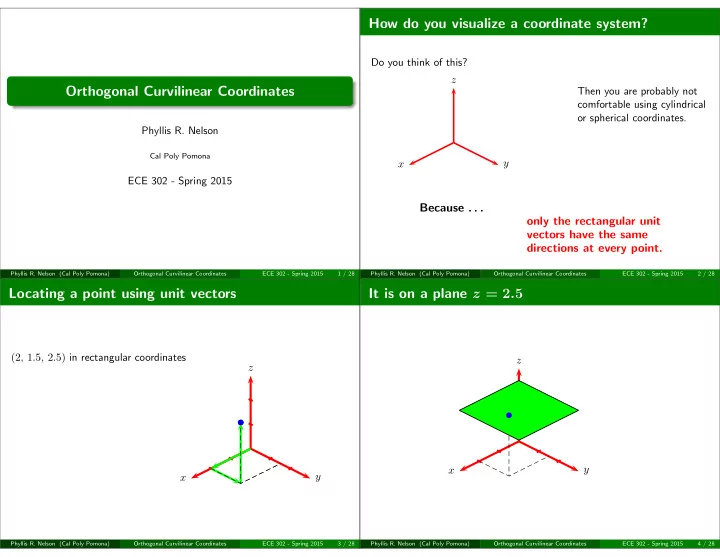
How do you visualize a coordinate system? Do you think of this? z - - PowerPoint PPT Presentation

how do you visualize a coordinate system
SMART_READER_LITE
LIVE PREVIEW

How do you visualize a coordinate system? Do you think of this? z - - PowerPoint PPT Presentation

b b How do you visualize a coordinate system? Do you think of this? z Orthogonal Curvilinear Coordinates Then you are probably not comfortable using cylindrical or spherical coordinates. Phyllis R. Nelson Cal Poly Pomona y x ECE 302 -


slide-1
SLIDE 1

Orthogonal Curvilinear Coordinates

Phyllis R. Nelson

Cal Poly Pomona

ECE 302 - Spring 2015

Phyllis R. Nelson (Cal Poly Pomona) Orthogonal Curvilinear Coordinates ECE 302 - Spring 2015 1 / 28

How do you visualize a coordinate system?

Do you think of this? x y z Then you are probably not comfortable using cylindrical

  • r spherical coordinates.

Because . . .

  • nly the rectangular unit

vectors have the same directions at every point.

Phyllis R. Nelson (Cal Poly Pomona) Orthogonal Curvilinear Coordinates ECE 302 - Spring 2015 2 / 28

Locating a point using unit vectors

(2, 1.5, 2.5) in rectangular coordinates x y z

b Phyllis R. Nelson (Cal Poly Pomona) Orthogonal Curvilinear Coordinates ECE 302 - Spring 2015 3 / 28

It is on a plane z = 2.5

x y z

b Phyllis R. Nelson (Cal Poly Pomona) Orthogonal Curvilinear Coordinates ECE 302 - Spring 2015 4 / 28

slide-2
SLIDE 2

. . . a plane x = 2

x y z

b Phyllis R. Nelson (Cal Poly Pomona) Orthogonal Curvilinear Coordinates ECE 302 - Spring 2015 5 / 28

. . . and a plane y = 1.5

x y z

b Phyllis R. Nelson (Cal Poly Pomona) Orthogonal Curvilinear Coordinates ECE 302 - Spring 2015 6 / 28

Start with surfaces, not unit vectors!

Points can be specified by three surfaces with equations of the form f1(x, y, z) = q1 f2(x, y, z) = q2 f3(x, y, z) = q3 where the numbers qi are the coordinates of the point.

Phyllis R. Nelson (Cal Poly Pomona) Orthogonal Curvilinear Coordinates ECE 302 - Spring 2015 7 / 28

Find the unit vectors at a point from the surfaces.

The unit vectors at the point are normal to the surfaces point toward increasing q.

x = 2 y = 1.5

z = 2.5

ˆ x ˆ y ˆ z

b

Phyllis R. Nelson (Cal Poly Pomona) Orthogonal Curvilinear Coordinates ECE 302 - Spring 2015 8 / 28

slide-3
SLIDE 3

Cylindrical coordinates

f1 = ρ =

  • x2 + y2

f2 = φ = tan−1(y/x) f3 = z x y z Unit vectors: ˆ ρ ˆ φ ˆ z

Phyllis R. Nelson (Cal Poly Pomona) Orthogonal Curvilinear Coordinates ECE 302 - Spring 2015 9 / 28

Spherical coordinates

f1 = r =

  • x2 + y2 + z2

f2 = θ = cos−1(z/r) f3 = φ = tan−1(y/x) x y z Unit vectors: ˆ r ˆ θ ˆ φ

Phyllis R. Nelson (Cal Poly Pomona) Orthogonal Curvilinear Coordinates ECE 302 - Spring 2015 10 / 28

Generalized curvilinear coordinates

Function Coordinate Unit Vector f1 q1 ˆ u f2 q2 ˆ v f3 q3 ˆ w Orthogonal curvilinear coordinates: surfaces of constant fi must everywhere be mutually orthogonal. Right-handedness: ˆ u × ˆ v = ˆ w OLC Rectangular Cylindrical Spherical f1 x ρ r f2 y φ θ f3 z z φ

Phyllis R. Nelson (Cal Poly Pomona) Orthogonal Curvilinear Coordinates ECE 302 - Spring 2015 11 / 28

Finding dl in rectangular coordinates

What is the distance between the surfaces fi = qi and fi = qi + dqi? . . . between the surfaces x = x0 and x = x0 + dx? . . . between the surfaces y = y0 and y = y0 + dy? . . . between the surfaces z = z0 and z = z0 + dz?

  • dl = ˆ

x dx+ ˆ y dy+ ˆ z dz x y z

Phyllis R. Nelson (Cal Poly Pomona) Orthogonal Curvilinear Coordinates ECE 302 - Spring 2015 12 / 28

slide-4
SLIDE 4

Finding dl in cylindrical coordinates

What is the distance between the surfaces ρ = ρ0 and ρ = ρ0 + dρ? . . . between the surfaces φ = φ0 and φ = φ0 + dφ? . . . between the surfaces z = z0 and z = z0 + dz?

  • dl = ˆ

ρ +ˆ φ +ˆ z dz x y z

Phyllis R. Nelson (Cal Poly Pomona) Orthogonal Curvilinear Coordinates ECE 302 - Spring 2015 13 / 28

Finding dl in spherical coordinates

What is the distance between the surfaces r = r0 and r = r0 + dr? . . . between the surfaces θ = θ0 and θ = θ0 + dθ? . . . between the surfaces φ = φ0 and φ = φ0 + dφ?

  • dl = ˆ

r +ˆ θ +ˆ φ x y z

Phyllis R. Nelson (Cal Poly Pomona) Orthogonal Curvilinear Coordinates ECE 302 - Spring 2015 14 / 28

Finding dl: summary

  • dl = ˆ

u h1 dq1 + ˆ v h2 dq2 + ˆ u h3 dq3 OLC Rectangular Cylindrical Spherical h1 1 1 1 h2 1 ρ r h3 1 1 r sin θ

Phyllis R. Nelson (Cal Poly Pomona) Orthogonal Curvilinear Coordinates ECE 302 - Spring 2015 15 / 28

Differential area in cylindrical coordinates

x y z ρ dz ρ dφ

Phyllis R. Nelson (Cal Poly Pomona) Orthogonal Curvilinear Coordinates ECE 302 - Spring 2015 16 / 28

slide-5
SLIDE 5

Differential volume in spherical coordinates

x y z rdθ dr r sin θ dφ

Phyllis R. Nelson (Cal Poly Pomona) Orthogonal Curvilinear Coordinates ECE 302 - Spring 2015 17 / 28

Converting unit vectors

Example: rectangular to cylindrical

  • dl = ˆ

ρ dρ + ˆ φ ρdφ + ˆ z dz = ˆ x dx + ˆ y dy + ˆ z dz = ˆ x ∂x ∂ρdρ + ∂x ∂φdφ

  • + ˆ

y ∂y ∂ρdρ + ∂y ∂φdφ

  • + ˆ

z dz =

  • dρ +
  • ρ dφ + ˆ

z dz x = ρ cos φ ∂x ∂ρ = ∂x ∂φ = y = ρ sin φ ∂y ∂ρ = ∂y ∂φ = ˆ ρ = ˆ φ =

Phyllis R. Nelson (Cal Poly Pomona) Orthogonal Curvilinear Coordinates ECE 302 - Spring 2015 18 / 28

x y ρ φ

b

ˆ ρ ˆ x cos φ ˆ y sin φ x y ρ φ

b

ˆ φ −ˆ x sin φ ˆ y cos φ

Phyllis R. Nelson (Cal Poly Pomona) Orthogonal Curvilinear Coordinates ECE 302 - Spring 2015 19 / 28

Gradient of a scalar field

Given a scalar field S(q1, q2, q3), dS = ∂S ∂q1 dq1 + ∂S ∂q2 dq2 + ∂S ∂q3 dq3 = ∇S · dl

  • dl = ˆ

u h1dq1 + ˆ v h2dq2 + ˆ w h3dq3

  • ∇S =

Phyllis R. Nelson (Cal Poly Pomona) Orthogonal Curvilinear Coordinates ECE 302 - Spring 2015 20 / 28

slide-6
SLIDE 6

Direction of the gradient of a scalar field

dS = ∇S · dl = | ∇S| | dl| cos α dS | dl| = | ∇S| cos α h = x2y

  • 3
  • 2
  • 1

1 2 3-3

  • 2
  • 1

1 2 3

  • 30
  • 20
  • 10

10 20 30 x2 * y 12 10 8 6 4 2

  • 2
  • 4
  • 6
  • 8
  • 10
  • 12

x y

  • 3
  • 2
  • 1

1 2 3

  • 3
  • 2
  • 1

1 2 3 y x

Phyllis R. Nelson (Cal Poly Pomona) Orthogonal Curvilinear Coordinates ECE 302 - Spring 2015 21 / 28

Divergence of a vector field

Given a vector field

  • V (q1, q2, q3)

= ˆ uV1 (q1, q2, q3) + ˆ v V2(q1, q2, q3) + ˆ w V3(q1, q2, q3)

  • ∇ ·

V = 1 h1h2h3 ∂ ∂q1 (V1h2h3) + ∂ ∂q2 (V2h3h1) + ∂ ∂q3 (V3h1h2)

  • Phyllis R. Nelson (Cal Poly Pomona)

Orthogonal Curvilinear Coordinates ECE 302 - Spring 2015 22 / 28

Meaning of the divergence

Let V = ˆ x f(x), dσ+ = ˆ x dy dz, and dσ− = −ˆ x dy dz

  • V ·

dσ+

  • x=x0+

V · dσ−

  • x=x0+dx =

= ∂f ∂x

  • (dx dy dz)

x y z

  • dσ−

b

  • dσ+

x0 dx dz dy

Phyllis R. Nelson (Cal Poly Pomona) Orthogonal Curvilinear Coordinates ECE 302 - Spring 2015 23 / 28

  • V = ˆ

ρ ρ2 (vector plot)

  • 3
  • 2
  • 1

1 2 3

  • 3
  • 2
  • 1

1 2 3

Phyllis R. Nelson (Cal Poly Pomona) Orthogonal Curvilinear Coordinates ECE 302 - Spring 2015 24 / 28

slide-7
SLIDE 7

Divergence of V = ˆ ρ ρ2 (3-D surface plot)

  • ∇ ·

V =

  • 3
  • 2
  • 1

1 2 3-3

  • 2
  • 1

1 2 3 2 4 6 8 10 12 14 Divergence 12 8 4 x y

Phyllis R. Nelson (Cal Poly Pomona) Orthogonal Curvilinear Coordinates ECE 302 - Spring 2015 25 / 28

Curl of a vector field

Let V = ˆ u V1 + ˆ v V2 + ˆ w V3.

  • ∇ ×

V = 1 h1h2h3

  • h1ˆ

u h2ˆ v h3 ˆ w

∂ ∂q1 ∂ ∂q2 ∂ ∂q3

h1V1 h2V2 h3V3

  • Phyllis R. Nelson (Cal Poly Pomona)

Orthogonal Curvilinear Coordinates ECE 302 - Spring 2015 26 / 28

  • V = ˆ

φ(−ρ) (vector plot)

  • 3
  • 2
  • 1

1 2 3

  • 3
  • 2
  • 1

1 2 3 y x

  • ∇ ×

V = 1 ρ

  • ˆ

ρ ρ ˆ φ ˆ z ∂ρ ∂φ ∂z ρ(−ρ)

  • V = ˆ

φ(−ρ) = ˆ x y − ˆ y x

  • ∇ ×

V = ˆ z(−2)

Phyllis R. Nelson (Cal Poly Pomona) Orthogonal Curvilinear Coordinates ECE 302 - Spring 2015 27 / 28

Vector 2nd derivatives

  • ∇S:
  • ∇ · (

∇S) = ∇2S (Laplacian)

  • ∇ × (

∇S) = 0

  • ∇ ·

V :

  • ∇(

∇ · V ) = ∇2 V (!!!)

  • ∇ × (

∇ · V ) = 0

  • ∇ ×

V :

  • ∇ · (

∇ × V ) = 0

  • ∇ ×
  • ∇ ×

V

  • =

  • ∇ ·

V

  • − ∇2

V The last equation above defines ∇2 V , the Laplacian of a vector.

Phyllis R. Nelson (Cal Poly Pomona) Orthogonal Curvilinear Coordinates ECE 302 - Spring 2015 28 / 28