
SLIDE 1
- 3. Matrices
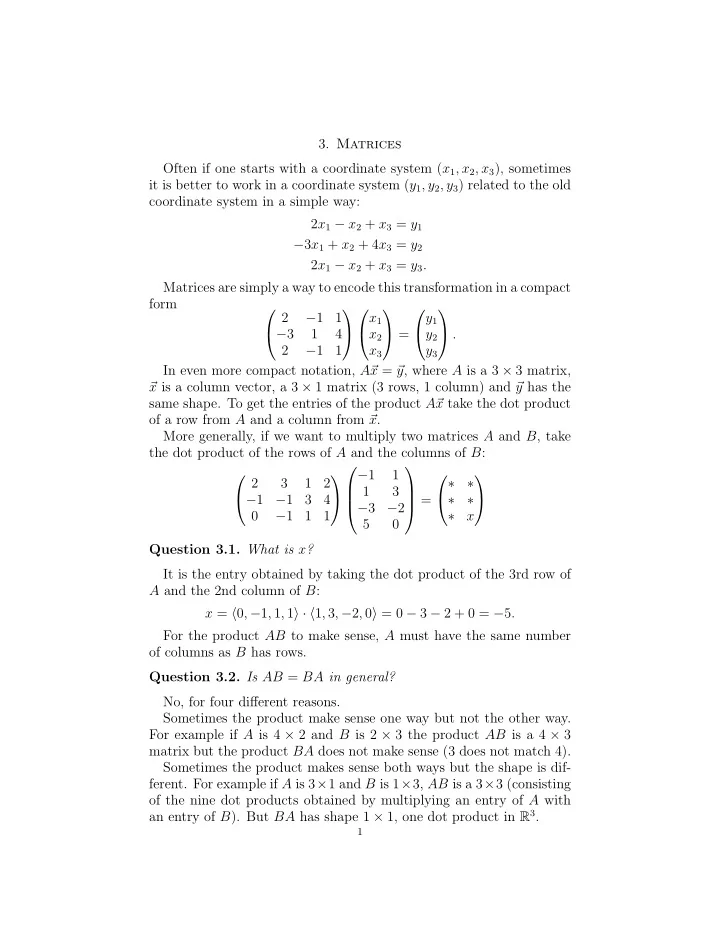
Often if one starts with a coordinate system (x1, x2, x3), sometimes it is better to work in a coordinate system (y1, y2, y3) related to the old coordinate system in a simple way: 2x1 − x2 + x3 = y1 −3x1 + x2 + 4x3 = y2 2x1 − x2 + x3 = y3. Matrices are simply a way to encode this transformation in a compact form 2 −1 1 −3 1 4 2 −1 1 x1 x2 x3 = y1 y2 y3 . In even more compact notation, A x = y, where A is a 3 × 3 matrix,
- x is a column vector, a 3 × 1 matrix (3 rows, 1 column) and
y has the same shape. To get the entries of the product A x take the dot product
- f a row from A and a column from
x. More generally, if we want to multiply two matrices A and B, take the dot product of the rows of A and the columns of B: 2 3 1 2 −1 −1 3 4 −1 1 1 −1 1 1 3 −3 −2 5 = ∗ ∗ ∗ ∗ ∗ x Question 3.1. What is x? It is the entry obtained by taking the dot product of the 3rd row of A and the 2nd column of B: x = 0, −1, 1, 1 · 1, 3, −2, 0 = 0 − 3 − 2 + 0 = −5. For the product AB to make sense, A must have the same number
- f columns as B has rows.
Question 3.2. Is AB = BA in general? No, for four different reasons. Sometimes the product make sense one way but not the other way. For example if A is 4 × 2 and B is 2 × 3 the product AB is a 4 × 3 matrix but the product BA does not make sense (3 does not match 4). Sometimes the product makes sense both ways but the shape is dif-
- ferent. For example if A is 3×1 and B is 1×3, AB is a 3×3 (consisting
- f the nine dot products obtained by multiplying an entry of A with