SLIDE 1 2.3 Characterizations of Invertible Matrices
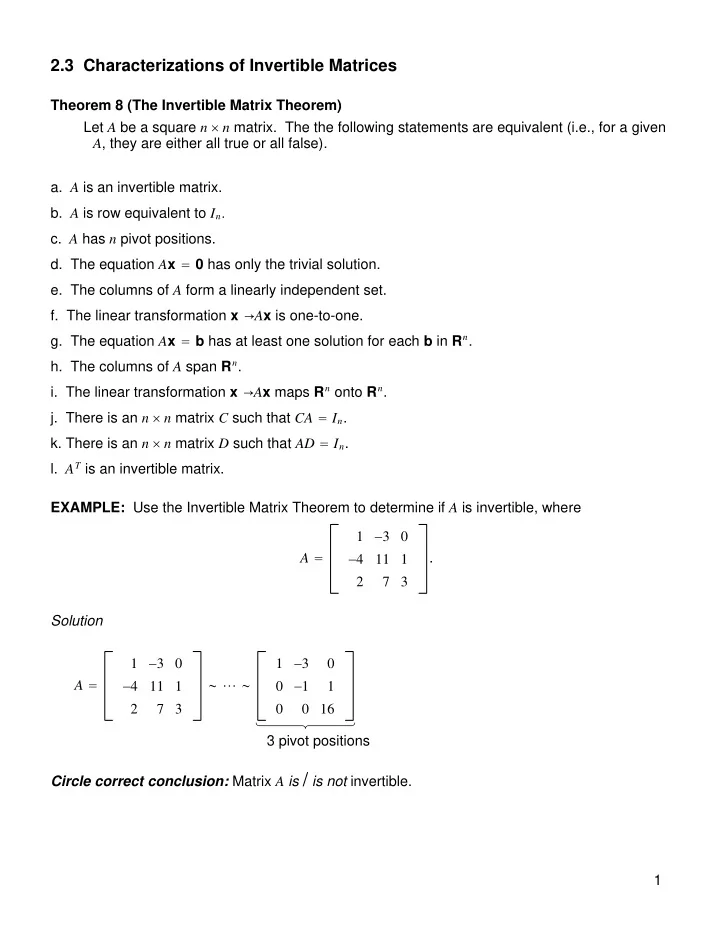
Theorem 8 (The Invertible Matrix Theorem) Let A be a square n × n matrix. The the following statements are equivalent (i.e., for a given A, they are either all true or all false).
- a. A is an invertible matrix.
- b. A is row equivalent to In.
- c. A has n pivot positions.
- d. The equation Ax = 0 has only the trivial solution.
- e. The columns of A form a linearly independent set.
- f. The linear transformation x →Ax is one-to-one.
- g. The equation Ax = b has at least one solution for each b in Rn.
- h. The columns of A span Rn.
- i. The linear transformation x →Ax maps Rn onto Rn.
- j. There is an n × n matrix C such that CA = In.
- k. There is an n × n matrix D such that AD = In.
- l. AT is an invertible matrix.
EXAMPLE: Use the Invertible Matrix Theorem to determine if A is invertible, where A = 1 −3 0 −4 11 1 2 7 3 . Solution A = 1 −3 0 −4 11 1 2 7 3 ∼ ⋯ ∼ 1 −3 0 −1 1 0 16 3 pivot positions Circle correct conclusion: Matrix A is / is not invertible. 1
SLIDE 2
2
Proof: The theorem is proven using this scheme: a.⇒j. Definition of “invertible.” j.⇒d. Exercise 23, Section 2.1 d.⇒e. Box, p. 66 e.⇒f. Theorem 12, Section 1.9 f.⇒d. Theorem 11, Section 1.9 d.⇒c. Exercise 23, Section 2.2 c.⇒b. Exercise 23, Section 2.2 b.⇒a. Exercise 23, Section 2.2 a.⇒k. Definition of “invertible.” k.⇒g. Exercise 24, Section 2.2 g.⇒h. Theorem 4, Section 1.4 h.⇒i. Theorem 12, Section 1.9 i.⇒g. Definition of “onto.” g.⇒a. Exercise 24, Section 2.2 a.⇒l. Theorem 6, Section 2.2 l.⇒a. Theorem 6, Section 2.2
SLIDE 3
EXAMPLE: Suppose H is a 5 × 5 matrix and suppose there is a vector v in R5 which is not a linear combination of the columns of H. What can you say about the number of solutions to Hx = 0? Solution Since v in R5 is not a linear combination of the columns of H, the columns of H do not ___________ R5. So by the Invertible Matrix Theorem, Hx = 0 has _________________________________________.
Invertible Linear Transformations
For an invertible matrix A, A−1Ax = x for all x in Rn and AA−1x = x for all x in Rn. A linear transformation T : Rn → Rn is said to be invertible if there exists a function S : Rn → Rn such that STx = x for all x in Rn and TSx = x for all x in Rn. Theorem 9 Let T : Rn → Rn be a linear transformation and let A be the standard matrix for T. Then T is invertible if and only if A is an invertible matrix. In that case, the linear transformation S given by Sx = A−1x is the unique function satisfying STx = x for all x in Rn and TSx = x for all x in Rn. 3
SLIDE 4
4
Proof: Suppose that T is invertible. Let b ∈ Rn, and let x = S(b). Then T(x) = T(S(b)) = b, so b is in the range of T for all b ∈ Rn, and T is onto. Thus by IMT, A is invertible. Suppose that A is invertible, and let S(x) = A−1(x). Then S is a linear trans- formation, S(T(x)) = A−1(Ax) = x, and T(S(x)) = A(A−1x) = x. So T is invertible. Suppose that S : Rn → Rn and U : Rn → Rn, and that T is invertible with S(T(x)) = x and U(T(x)) = x for all x ∈ Rn. let v ∈ Rn. Since T is onto, there is an x ∈ Rn with T(x) = v. So S(v) = x and U(v) = x for all x ∈ Rn. Thus S = U, and the inverse of T is unique.