Hawai i Health Care Innovation Models Project Workforce Committee - - PDF document

hawai i health care innovation models project workforce
SMART_READER_LITE
LIVE PREVIEW

Hawai i Health Care Innovation Models Project Workforce Committee - - PDF document

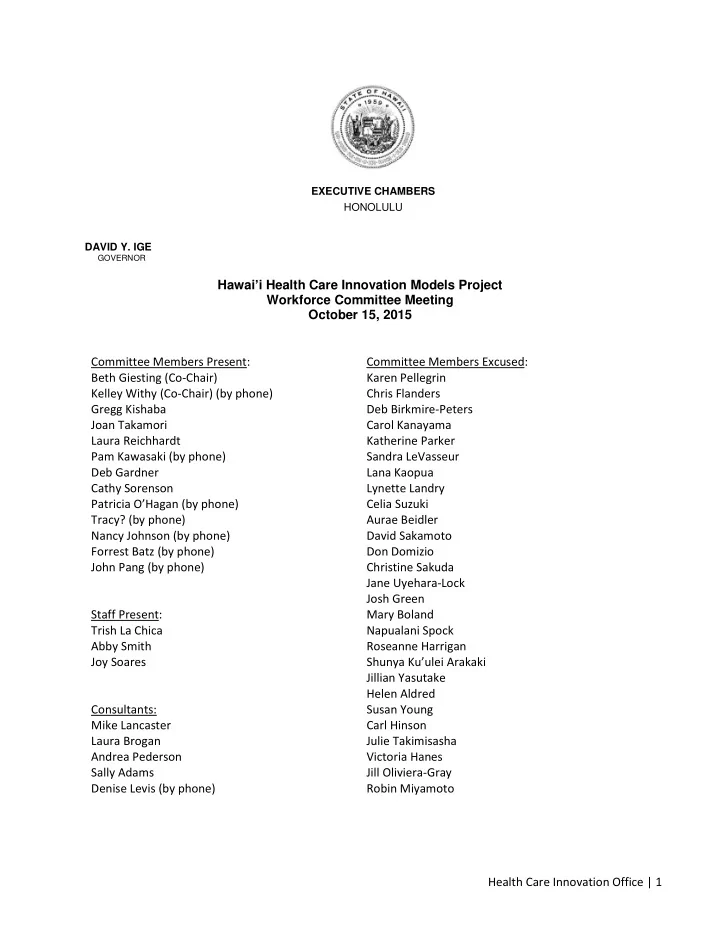
EXECUTIVE CHAMBERS HONOLULU DAVID Y. IGE GOVERNOR Hawai i Health Care Innovation Models Project Workforce Committee Meeting October 15, 2015 Committee Members Present: Committee Members Excused: Beth Giesting (Co-Chair) Karen Pellegrin


slide-1
SLIDE 1

Health Care Innovation Office | 1

EXECUTIVE CHAMBERS HONOLULU DAVID Y. IGE

GOVERNOR

Hawai’i Health Care Innovation Models Project Workforce Committee Meeting October 15, 2015 Committee Members Present: Beth Giesting (Co-Chair) Kelley Withy (Co-Chair) (by phone) Gregg Kishaba Joan Takamori Laura Reichhardt Pam Kawasaki (by phone) Deb Gardner Cathy Sorenson Patricia O’Hagan (by phone) Tracy? (by phone) Nancy Johnson (by phone) Forrest Batz (by phone) John Pang (by phone) Staff Present: Trish La Chica Abby Smith Joy Soares Consultants: Mike Lancaster Laura Brogan Andrea Pederson Sally Adams Denise Levis (by phone) Committee Members Excused: Karen Pellegrin Chris Flanders Deb Birkmire-Peters Carol Kanayama Katherine Parker Sandra LeVasseur Lana Kaopua Lynette Landry Celia Suzuki Aurae Beidler David Sakamoto Don Domizio Christine Sakuda Jane Uyehara-Lock Josh Green Mary Boland Napualani Spock Roseanne Harrigan Shunya Ku’ulei Arakaki Jillian Yasutake Helen Aldred Susan Young Carl Hinson Julie Takimisasha Victoria Hanes Jill Oliviera-Gray Robin Miyamoto

slide-2
SLIDE 2

Hawaii Health Care Innovation Models Project Workforce Committee Meeting October 15, 2015 Health Care Innovation Office | 2 Welcome and Introductions: Beth Giesting Co-chair Giesting opened the meeting with introductions. SIM Deliverables and Roadmap: Laura Brogan (Navigant) Meeting Objectives: Beth Giesting  Outline transformation agenda to improve health of families and communities

  • Triple aim plus one
  • Behavioral health improvement
  • Oral health improvement (through oral health committee)

Update on Medicaid Provider Application Fee: Joy Soares  “The MQD is required to obtain a $500 application fee from all providers EXCEPT for physicians, psychiatrists, podiatrists, optometrists, APRNs, PA’s, RNs, and dentists.”

  • While this is a requirement, it has no impact because it applies exclusively to the very

small, transient MedQUEST Fee-for-Service program. MedQUEST health plans do NOT charge a provider application fee. Updates on APRN’s in schools: Laura Reichhardt  DOE partnered with UH school of nursing (Hawaii Keiki Nurses)

  • Work at the school complex level (districts)
  • Assigned to one school with the highest need for improvement
  • Absenteeism, chronic illness, lava flow crisis, etc
  • DOE asked for support to implement statewide
  • Allocated $1 million
  • A lot of involvement with public health nurses
  • Able to maintain nurses in highest need areas, expanding to 9 schools
  • Long term goal is to have school nursing in complex areas and offload the burden that

the DOE system is currently under

  • Master’s Prepared Nurses have training in behavioral health (mild to moderate).

Possible to identify early in schools

  • 10% increase of APRN’s from 2013-2015

Discussion:  Why is it not being done on Maui?

  • Goal is to get one on Maui in next roll-out. It’s a matter of getting the funds released

and identifying the right person for the role.  APRN’s currently have ability to bill Medicaid directly. Still identifying correct mechanism since they are hired through DOE. Focus is on building the model before determining how to bill through Medicaid.  Screening can also be done through other members on the team in the school.  School health aides have a pathway to CHW program  Question: how much screening is being done right now around behavioral health?

  • Early intervention program does screening for 0-3 years
slide-3
SLIDE 3

Hawaii Health Care Innovation Models Project Workforce Committee Meeting October 15, 2015 Health Care Innovation Office | 3

  • Unclear what is currently being done for older children/youth
  • Would be helpful for UH to reestablish psych nursing program

 Is it possible to get school-aged children to have a physical more than once? Results from focus groups: Dr. Kelley Withy

  • 10 focus groups across islands
  • Asked what are the barriers and what can we do about increasing services and care

coordination

  • Emphasized shortage of BH services
  • Would be helpful to have someone who knows all of the resources
  • Most PCPs are too busy and feel reluctance to screen patients. Have nowhere to send

them when they find something wrong.

  • If each island had a multi-disciplinary team who knew all the resources and had access

to telepsych, it would be more likely that non-CHCs could get people referred to where they need to be

  • Insurance companies should have better network adequacy and care coordination
  • Discussion of training (many practices want it)
  • Severe mental illness discussion came up, especially on neighbor islands, because

resources are so limited

  • Information technology challenges, HIPAA laws, EHR issues
  • Incentives for providers to practice in areas of need, loan repayment
  • Everybody wants more BH services and care coordination
  • Local teams could improve communication and access to resources

 Possibility of going for a grant (Dr. Withy)  Important for team-based care, but ISLAND based (CHWs, Social Workers, etc.)

  • Understand cultural needs and expectations of each island

 We have $250,000 from federal government for loan repayment but we need local match. Only have enough right now to fund 8 students, but we would have enough to fund 30.  All neighbor islands except Lanai considered underserved for mental health needs Project ECHO update: Dr. Withy  Will be introduced in January  Topic will be behavioral health  Partnering with department of psychiatry  Weekly tele-education with review of topic then case discussion  Up to 10 sites interested in participating  3 month commitment  House it at Queen’s hospital (likely)  May not be archived for later viewing (major benefit is experiential)  Will likely be general to start  Target audience is any primary care provider in rural or underserved areas

  • CHC’s, then private practices
  • Could be the starting point to build the team

Behavioral Health Integration Blueprint: Dr. Lancaster

slide-4
SLIDE 4

Hawaii Health Care Innovation Models Project Workforce Committee Meeting October 15, 2015 Health Care Innovation Office | 4 Discussion: Community Health Workers  CHW pilot that has been implemented  Currently busy with stakeholder engagement  Coming up with shared understanding and definition  Potential to have CHW’s in DOH, acute care hospitals, state hospitals, long-term care facilities, prevention of high utilizers  Community education about how they can be utilized  Creating a pathway to get a BA in public health with UH Manoa  One of the goals of the grant is a pathway to higher education

  • Trade Adjustment Assistance Community College Career Training (TAACCCT)

Adjournment at 12:01 pm

slide-5
SLIDE 5

STATE OF HAWAI'I, HEALTH CARE INNOVATION OFFICE

1

State Innovation Model Design 2

WORK FORCE COMMITTEE MEETING OCTOBER 15, 2015

slide-6
SLIDE 6

STATE OF HAWAI'I, HEALTH CARE INNOVATION OFFICE

2

SIM Deliverables & Roadmap

Outline of BHI Blueprint – complete Interim drafts of BHI Blueprint – complete/ October 2015 Stakeholder discussions –

  • n-going

Final BHI Blueprint – November 2015

BH Blueprint

Data request – complete Analysis plan – adjusts based on BHI Blueprint – November 2015 Initial review of claims data; data quality report – November 2015 Finalized database for analysis – December 2015 Preliminary impact model, ROI model, key assumptions and actuarial report – January 2016

Cost Analysis & Return

  • n Investment

Research and stakeholder discussion about quality and outcome measures -

  • n-going

Draft matrix of viable quality and outcome measure options – complete Data collection and reporting strategy - November 2015 Data submission plan - December 2015 Dashboard format for presenting quality/outcome measure results – January 2016

Evaluation & Management Plan

SHIP Report Plan – complete Draft outline of SHIP – complete Expanded outline/interim draft of SHIP – November 2015 Interim draft of SHIP for review with committees – December 2015 Final SHIP report – January 31, 2016

SHIP Report

On-going activities include:

  • Weekly meetings with Governor’s Office staff
  • Monthly meetings with Judy Mohr Peterson
  • Monthly meetings with SIM Committees

Lead: CCNC Lead: Optumas LLC, JEN Associates Lead: Navigant Healthcare Navigant Healthcare Team

slide-7
SLIDE 7

STATE OF HAWAI'I, HEALTH CARE INNOVATION OFFICE

3

Meeting Objectives

To outline a transformation agenda to improve health of families and communities:

  • Primary care and Behavioral Health (children and adults)
  • Value-based payment reform
  • Workforce changes
  • Other system supports
slide-8
SLIDE 8

STATE OF HAWAI'I, HEALTH CARE INNOVATION OFFICE

4

THE TRANSFORMATION AGENDA:

HEALTHY FAMILIES AND COMMUNITIES IN HAWAI‘I

slide-9
SLIDE 9

STATE OF HAWAI'I, HEALTH CARE INNOVATION OFFICE

5

State’s goals for health and care

Triple Aim Beyond Clinical Care Matching Needs to Resources

  • 1. Better health
  • 2. Better care
  • 3. Better value/lower costs
  • 1. Our house, our work, our education
  • 2. Our families and community support
  • 3. Our zip codes and our cultural codes
  • 1. Racial/ethnic identification
  • 2. Geography
  • 3. Economic resources
slide-10
SLIDE 10

STATE OF HAWAI'I, HEALTH CARE INNOVATION OFFICE

6

Transforming components into systems

SIM Focus

slide-11
SLIDE 11

STATE OF HAWAI'I, HEALTH CARE INNOVATION OFFICE

7

Health care transformation

  • 1. System focused on person/family and oriented to health
  • 2. BH improvement advances broader agenda for primary care change
  • New service models and sites
  • Population health and care coordination
  • New members of the work force, such as CHWs, and practicing in teams
  • Use of health information exchange, patient portals, IT, telehealth
  • Support for learning health care system, practice support
  • System alignment – metrics, payment strategies
  • Payment reform
  • 3. Oral health improvement
slide-12
SLIDE 12

STATE OF HAWAI'I, HEALTH CARE INNOVATION OFFICE

8

Update on Medicaid Provider Application Fee

  • “The MQD is required to obtain a $500 application fee from all

providers EXCEPT for Physicians, Psychiatrists, Podiatrists, Optometrists, APRNs, Physician Assistants, RNs, and Dentists.”

  • This applies to the Medicaid Fee-for-Service program only.

Medicaid health plans do NOT charge a provider application fee.

http://www.medquest.us/PDFs/Frequently%20Used%20Forms%20for%20Providers/DHS1139FormInstructions.pdf

slide-13
SLIDE 13

Whole Person Care

Hawai’i SIM Workforce Committee

October 15th, 2015

  • Dr. Mike Lancaster
slide-14
SLIDE 14

Goals for this Discussion:

  • Overview of SIM agreements thus far
  • Overview of the three proposed BHI models
  • Identify any alignment and/or synergy with current

efforts around BHI

  • Recognize the applicability of the models to

populations

  • Consensus on realistic expectations and buy-in for

training and financing the models

slide-15
SLIDE 15

SIM Agreements for Hawai’i Integrated Care:

  • SIM efforts will start with Medicaid and focus on children and

adults (including pregnant women)

  • Focus on three Evidence-Based Models:

– SBIRT – Screening and Treatment of Depression (also focuses on anxiety) – Motivational Interviewing

  • Participation is voluntary. PCP/OB will select a model that fits

their population/interest

slide-16
SLIDE 16

SIM Agreements for Hawai’i Integrated Care:

  • The goals of these evidence-based practices include:

– Increase comfort level of providers in identifying and treating substance abuse, depression, and anxiety in their practices – Provide support for practices through evidence-based practice models of care, education and training, and provider consults – Establish referral pathways for more complex patients that results in timely access to care – Support mild to moderate behavioral health patients to receive care in primary care/prenatal practice settings

slide-17
SLIDE 17

Proposed Evidence Based Practices for BH Integration 1) SBIRT- Screening, Brief Intervention, Referral for Treatment; to help address the hidden issues with substance misuse in a PCP population 2) Screening and Treatment of Depression - based

  • n IMPACT model to identify and treat

depression in a PCP population 3) Motivational Interviewing- educate, engage, empower consumers we serve to be part of their health workforce

slide-18
SLIDE 18

Key Components of Delivery of EBP to Provide Payment:

  • Care Management / Care Coordination
  • Training and Sustaining Knowledge
  • Consults/Triage
  • PCP Referrals
  • Timely access
  • Emergency access
slide-19
SLIDE 19

How to Train and Sustain all EBP Models

  • Models of Training
  • Online/Face-to-Face/CME
  • Academic support: JABSOM? UH Hilo? Others?
  • AHEC, Project ECHO, Addiction Technology

Transfer Center Network (ATTCN) Others?

  • Sustain and Grow Knowledge Base
  • Technical Assistance: academic centers, MCOs
  • Learning Collaboratives: state, MCOs, academic
  • Tele-psych Consultation: JABSOM or private

contracts

slide-20
SLIDE 20

Workforce Issues and Opportunities:

  • Community Health Workers (CHWs)
  • Path to certification
  • Community College – education / job builds
  • Define role of CHWs in the system
  • Pharmacists
  • Inclusion in team based care
  • Pharm2Pharm
  • Medication reconciliation
  • Psychologists
  • Inclusion in behavioral health planning
  • Consider prescribing privileges
  • Tele-psychiatry
  • doc to doc consultation