EXECUTIVE CHAMBERS HONOLULU DAVID Y. IGE GOVERNOR Hawai i Health - - PDF document

executive chambers honolulu david y ige governor hawai i
SMART_READER_LITE
LIVE PREVIEW

EXECUTIVE CHAMBERS HONOLULU DAVID Y. IGE GOVERNOR Hawai i Health - - PDF document

EXECUTIVE CHAMBERS HONOLULU DAVID Y. IGE GOVERNOR Hawai i Health Care Innovation Models Project Delivery and Payment Committee Meeting November 6, 2015 Committee Members Present: Committee Members Excused: Judy Mohr Peterson (Co-chair)


slide-1
SLIDE 1

Health Care Innovation Office | 1

EXECUTIVE CHAMBERS HONOLULU DAVID Y. IGE

GOVERNOR

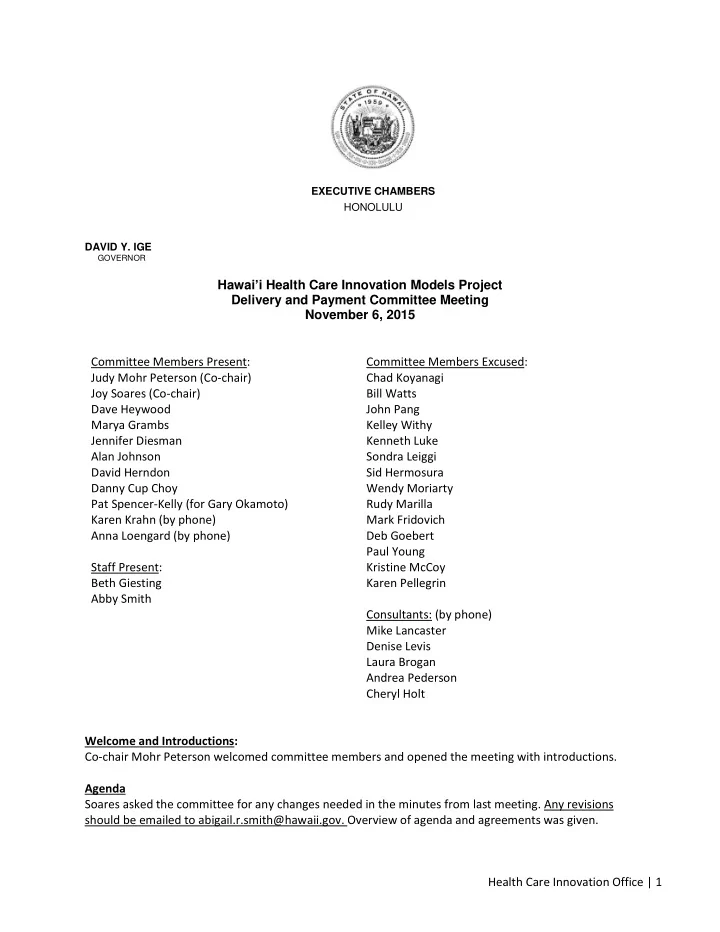
Hawai’i Health Care Innovation Models Project Delivery and Payment Committee Meeting November 6, 2015 Committee Members Present: Judy Mohr Peterson (Co-chair) Joy Soares (Co-chair) Dave Heywood Marya Grambs Jennifer Diesman Alan Johnson David Herndon Danny Cup Choy Pat Spencer-Kelly (for Gary Okamoto) Karen Krahn (by phone) Anna Loengard (by phone) Staff Present: Beth Giesting Abby Smith Committee Members Excused: Chad Koyanagi Bill Watts John Pang Kelley Withy Kenneth Luke Sondra Leiggi Sid Hermosura Wendy Moriarty Rudy Marilla Mark Fridovich Deb Goebert Paul Young Kristine McCoy Karen Pellegrin Consultants: (by phone) Mike Lancaster Denise Levis Laura Brogan Andrea Pederson Cheryl Holt Welcome and Introductions: Co-chair Mohr Peterson welcomed committee members and opened the meeting with introductions. Agenda Soares asked the committee for any changes needed in the minutes from last meeting. Any revisions should be emailed to abigail.r.smith@hawaii.gov. Overview of agenda and agreements was given.

slide-2
SLIDE 2

Hawaii Health Care Innovation Models Project Delivery and Payment Committee Meeting Health Care Innovation Office | 2 Agreements thus far: Agreements on BHI SIM Goals:  Identify behavioral integration delivery and payment models and agree to strategies and tactics to implement models that address improving early detection, diagnosis, and treatment of mild to moderate behavioral health conditions in primary care and prenatal settings.  Improve capacity of primary care providers to address behavioral health issues on a primary care level and/or integrate behavioral health specialty services and community support services in primary care and prenatal practices.  Improve care coordination of people with behavioral health conditions and linkage with treatment and community support services.  SIM efforts are starting with Medicaid and will focus on children and adults, including pregnant women.  System changes proposed in this initiative for BHI are expected to contribute to overall health care transformation in Hawaii  SIM will focus on three evidence-based practice models:

slide-3
SLIDE 3

Hawaii Health Care Innovation Models Project Delivery and Payment Committee Meeting Health Care Innovation Office | 3 Agreements on evidence-based practices:  Provider (PCPs and prenatal care providers) participation is voluntary.  Practices may choose to screen all patients or target populations.  The depression tool kit also addresses anxiety, and will include strategies to avoid unintentionally over medicating patients on the common triad of opioids, benzodiazepines, and muscle relaxers. Proposed Focus on Children (see slides)  Question about what the Childhood Action Strategy covers. SIM will share their plan.  Consensus was reached to focus on routine screening using the three proposed models for individuals ages 12 and over.

  • SBIRT will be new for some pediatricians. Providers concerned about the extra time

needed to implement these models with patients. Review BHI Blueprint: Dr. Lancaster (see slides and Blueprint word document) Please provide feedback on the Blueprint by November 20th. You can email feedback to healthinnovation@hawaii.gov or any SIM team member. BHI System Supports: (see slides) Training and ongoing support, triage and referral, provider consultations  Using physician organizations to manage provider consultations was suggested. A multi- pronged approach would be needed while capacity was built across IPO’s and health plans. BHI Payment Models (Will be discussed next meeting instead) Evaluation Measures Please send feedback on measures to joy.soares@hawaii.gov HIT Plan

slide-4
SLIDE 4

Hawaii Health Care Innovation Models Project Delivery and Payment Committee Meeting Health Care Innovation Office | 4 Sharing information among PCPs and BH providers would be helpful. EHRs have not been much developed for BH use and BH providers have not been incentivized to adopt EHR use. Next Meeting The next Delivery and Payment Committee meeting will be on November 12th from 1:00-2:30 in the State Office Tower, room 1403. Adjournment The meeting was adjourned at 12:33pm

slide-5
SLIDE 5

State Innovation Model Design 2

DELIV ELIVERY Y AND P PAYM YMENT C COM OMMITTEE NOVEMBER 6, 6, 201 2015

1

slide-6
SLIDE 6

Welcome and Introductions

  • 1. Judy Mohr Peterson, Dept of Human Services, Co-

Chair

  • 2. Joy Soares, Office of the Governor, Co-Chair
  • 3. Mark Fridovich, Dept of Health
  • 4. Deborah Goebert, National Center on Indigenous

Hawaiian Behavioral Health

  • 5. Marya Grambs, Mental Health America
  • 6. Sid Hermosura, Waimanalo Health Center
  • 7. David Herndon, HMSA
  • 8. Dave Heywood, UnitedHealth Care
  • 9. Robert Hirokawa, Hawaii Primary Care Association
  • 10. Alan Johnson, Hina Mauka
  • 11. Chad Koyanagi, Institute for Human Services
  • 12. Karen Krahn, Dept of Health
  • 13. Sondra Leiggi, Castle Medical Center
  • 14. Anna Loengard, Queen’s CIPN
  • 15. Rudy Marilla, Kaiser Permanente
  • 16. Kristine McCoy, Hilo Family Practice Residency
  • 17. Wendy Moriarty, `Ohana Health Plan
  • 18. Gary Okamoto, AlohaCare
  • 19. John Pang, Pharmacist
  • 20. Karen Pellegrin, UH Hilo College of Pharmacy
  • 21. Bill Watts, Queen’s Medical Center
  • 22. Kelley Withy, AHEC
  • 23. Paul Young, HAH

SIM Staff: Trish La Chica, Beth Giesting, Abby Smith

2

slide-7
SLIDE 7

Agenda

 Welcome and Introductions Judy Mohr Peterson  Review of Minutes Joy Soares  Proposed Focus for Children Joy Soares  Review Behavioral Health Integration Blueprint

  • Dr. Michael Lancaster

 BHI System Supports

  • Dr. Mike Lancaster
  • Training and ongoing support
  • Provider Consultations
  • Triage and Referral

3

slide-8
SLIDE 8

Agenda Continued

 Behavioral Health Integration Payment Models Navigant Consulting  Evaluation Measures Navigant Consulting  HIT Plan Joy Soares  Adjourn Judy Mohr Peterson

4

slide-9
SLIDE 9

Review of Minutes

  • September 30, 2015
  • October 14, 2015

5

slide-10
SLIDE 10

Agreements on BHI

SIM Goals:

  • Identify behavioral integration delivery and payment models and agree to strategies and tactics to

implement models that address improving early detection, diagnosis, and treatment of mild to moderate behavioral health conditions in primary care and prenatal settings.

  • Improve capacity of primary care providers to address behavioral health issues on a primary care level

and/or integrate behavioral health specialty services and community support services in primary care and prenatal practices.

  • Improve care coordination of people with behavioral health conditions and linkage with treatment and

community support services.

  • SIM efforts are starting with Medicaid and focus will be on children and adults, including

pregnant women.

  • System changes proposed in this initiative for BHI are expected to contribute to overall health

care transformation in Hawaii

6

slide-11
SLIDE 11

Agreements on Evidence-Based Practices

SIM will focus on three evidence-based practice (EBP) models.

7

  • Based on the IMPACT model to identify and treat mild-to

moderate depression and anxiety in a primary care setting.

Screening and Treatment of Depression and Anxiety

  • A collaborative, person-centered form of talking to patients to

elicit and strengthen their motivation for change. MI educates, engages and empowers consumers to be more participatory in their healthcare.

Motivational Interviewing

  • Screening, Brief Intervention, Referral for Treatment; to help

address the hidden issues with substance misuse. SBIRT is a comprehensive approach to systematically identifying, treating and referring individuals who are at risk for alcohol or

  • ther drug use problems.

SBIRT

slide-12
SLIDE 12

Agreements on Evidence-Based Practices

Objectives of EBPs include:

8

Increase comfort level of providers in identifying and treating substance abuse, depression, and anxiety in their practices Provide support for practices through EBP models of care, education and training, and provider consults Establish referral pathways for more complex patients that results in timely access to care Support mild to moderate behavioral health patients to receive care in primary care/prenatal practice settings

slide-13
SLIDE 13

Agreements on Evidence-Based Practices

Provider (PCPs and prenatal care providers) participation is voluntary. Practices choose to screen all patients or target populations. The depression tool kit will address anxiety, and will include strategies to avoid unintentionally

  • ver medicating patients on the common triad of opioids, benzodiazepines, and muscle

relaxers.

9

slide-14
SLIDE 14

Proposed Focus On Children

The three evidence-based practices can also be used with children. Suggested focus on youth ages 12-18

Rationale:

 Consistent with SIM goals:

  • Nurturing healthy families and communities
  • Investing early in children in a multi-generational approach
  • Addressing social determinants of health
  • Addressing the triple aim (better health, better care, better value)
  • Improving health equity and decreasing health disparities
  • Integration of behavioral health

10

slide-15
SLIDE 15

Proposed Focus On Children - Rationale Continued

 Leveraging existing efforts - Builds on SIM behavioral health integration efforts focused on adults  Not duplicating efforts - The Early Childhood Action Strategy and Hawaii Community Foundation are developing comprehensive strategies to improve outcomes for children up to 8 years of age.  Stakeholder feedback revealed that behavioral health services for adolescents need to be strengthened, and a lack of BH training and resources was an obstacle to offering those services at the primary care level.

11

slide-16
SLIDE 16

Hawai‘i Data on Adolescents

The number of suicides for youth ages 15 to 24 more than doubled from 2007 to 2011. Disparities: More than one in ten (11.9%) of Native Hawaii/Pacific Islander high school students attempted suicide one or more times in the past year, the highest proportion among all racial groups in the US. 1 NHPIs ages 12 and older are abusing or dependent upon substances at rates much higher rates (11.3%) than blacks (7.4%), whites (8.4%), and Hispanics (8.6%). 2

1. Asian & Pacific Islander American Health Forum. (2010). Health disparities. http://www.apiahf.org/sites/default/files/NHPI_Report08a_2010.pdf 2. US Department of Health and Human Services (2014). Results from the 2013 national survey on drug use and health: http://www.samhsa.gov/data/sites/default/files/NSDUHresultsPDFWHTML2013/Web/NSDUHresults2013.pdf

12

slide-17
SLIDE 17

Data on Evidence-Based Practices for Adolescents

  • Overall – fewer studies focus specifically on adolescents
  • SBIRT – Growing body of evidence demonstrates the effectiveness of SBIRT for

risky drug use in adolescents1

  • Depression/Anxiety – Fewer studies done to demonstrate evidence in

adolescents

  • MI – Strong evidence to support MI as best practice to be used for all patients,

including children and adolescents

  • 1. Madras et al 2008; Saitz et al 2010; Bernstein et al 2005, SAMHSA 2011 “SBIRT in Behavioral Healthcare”

13

slide-18
SLIDE 18

Behavioral Health Integration Blueprint

Presentation to the Delivery & Payment Committee – 11/6/2015 State of Hawaii Health Care Innovation Office

  • Dr. Mike Lancaster
slide-19
SLIDE 19

Purpose of the BHI Blueprint

  • Intended audience: PCPs
  • Provides recommended clinical practices to implement the three models of

behavioral health integration

  • Discusses the need for focused training and clinical support for adopters

(technical assistance, learning collaboratives)

  • Discusses the need for practice champions who can organize the practice’s

staff and motivate change

  • Discusses the importance of breaking down silos between primary care and

behavioral health providers

slide-20
SLIDE 20

Feedback on Blueprint Email feedback to the Health Care Innovation Team (healthinnovation@hawaii.gov) by Friday, November 20th.

slide-21
SLIDE 21

Approach to Discussion on BHI System Supports

Based on feedback from committees, focus groups and stakeholders, we put together a proposal on universal services needed to support BHI regardless of payer type (Medicaid, commercial, etc.).

17

Training and Ongoing support Provider Consultations Triage and Referral

slide-22
SLIDE 22

Proposed Universal System Supports

Primary care practices told us they would like additional supports in place to assist them to increase screening and treatment of behavioral health conditions. Proposal: The following services would be available to all PCPs in the state, for all BH conditions

  • n the spectrum (mild, moderate, severe), and regardless of payer type (Medicaid,

commercial, etc.). 1) PCP training and ongoing support 2) Provider to provider consultations 3) Triage and referral (FOR BEHAVIORAL HEALTH ONLY)

  • Linking consumers with behavioral health specialty care and community supports

18

slide-23
SLIDE 23

Training and Ongoing Support

Primary care practices need initial training and ongoing learning opportunities to learn how to better screen and treat behavioral health conditions Proposal: One entity accountable for coordinating and providing statewide training Procurement is required

19

Pros Cons Ensure consistency in training across the state Financing of efforts is complicated because multiple payers are involved Potential benefit from cost savings/efficiencies Sustainability and ongoing support is uncertain at this time Training could be tailored to be culturally appropriate for the unique populations of Hawaiʻi Not certain how many PCPs are interested in training at this time All payers benefit Not all payers will be benefit equally

slide-24
SLIDE 24

Provider to Provider Consultations

PCPs want to be able to consult with psychiatrists and BH specialists via phone or telehealth when needed Proposal: One entity accountable for providing consultations for all PCPs in the state, for all BH conditions, for all payer types (Medicaid, commercial, etc.). Procurement is required.

20

Pros Cons Increases timely access to BH specialty providers across the state Financing of efforts is complicated because multiple payers are involved Potential to benefit from cost savings/efficiencies Sustainability and ongoing support is uncertain at this time Potential to efficiently utilize BH workforce Not certain how many PCPs will utilize the service All payers benefit Not all payers will be benefit equally

slide-25
SLIDE 25

Triage and Referral

PCPs need assistance in triaging care and making referrals to BH specialty providers. Proposal: One entity accountable for providing triage and assistance with linking patients to BH specialty providers for all PCPs in the state, for all BH conditions, and for all payer types (Medicaid, commercial, etc.). Procurement is required. Rationale: A more robust system to support PCPs is needed because:

  • There is an acute BH workforce shortage
  • BH referrals and linkages to services require providers to go outside the medical

system and can be more challenging and/or time consuming

21

slide-26
SLIDE 26

Universal Triage and Referral

22

Pros Cons Increases timely access to BH specialty providers across the state Financing of efforts is complicated because multiple payers are involved Assist PCPs in determining what type of service is needed, which can be challenging for some BH services Sustainability and ongoing support is uncertain at this time Potential to benefit from cost savings/efficiencies Linking consumers to BH services and community supports is a function for which health plans are currently responsible All payers benefit Not all payers will be benefit equally

slide-27
SLIDE 27

Combining Universal Services

Discussion Question: Is there benefit to combining any of the universal services so one entity is accountable?

23

Training and Ongoing Support Provider Consultations Triage and Referral

slide-28
SLIDE 28

Proposed Payment Models

Focus of discussion today is a proposal related to behavioral health integration in the primary care setting

24

slide-29
SLIDE 29

Current Primary Care Payment Structure

Fee-for-Service (FFS) Per Member Per Month (PMPM) for providers that meet PCMH requirements Pay-for-Quality (P4Q) for certain measures (not BH- related)

25

slide-30
SLIDE 30

Proposed Primary Care Payment Options

Proposed Structure – 2 Options

26

  • Include behavioral health integration measures in PCP P4Q

programs (e.g., depression screening rates)

Option A

  • Provide a PMPM add-on for practices that adopt one or

more of the three BHI models

  • PMPM could be tiered (practices that adopt all three

models would receive a higher PMPM than practices that

  • nly adopt one)

Option B

  • Option A + Option B
  • Include behavioral health integration measures in P4Q

programs AND provide an add-on PMPM for practices that adopt one or more of the BHI models

Option C

Current FFS Payment Structure remains in place, PLUS:

PMPM add-on would cover the added time that it takes do BH screenings, brief interventions, and motivational interviewing, and time spent making referrals and consulting with BH specialists

slide-31
SLIDE 31

27

slide-32
SLIDE 32

Feedback on Evaluation Measures

Proposed measures fall into four categories:

Preventive Measures Quality of Care/Process Measures Utilization Measures Population Health Measures

28

slide-33
SLIDE 33

Evaluation Measures

Discussion Questions: 1) Which measures should be prioritized? Excluded? 2) Which measures are good candidates for P4P? 3) What is the best way to measure care coordination for people with mild-moderate behavioral health conditions?

29

slide-34
SLIDE 34

HIT Plan

 Identify privacy and security issues related to BH information exchange and develop strategies to address issues

  • Use case: Information exchange between prenatal/perinatal/pediatric settings
  • HHIE is developing paper that describes what can be exchanged legally; the paper will be distributed

to interested stakeholders

  • Distribute sample universal consent forms

 Develop strategies and policies to increase utilization of telehealth  Development of the All Payer Claims Database – increase transparency and analytic capability

30

slide-35
SLIDE 35

HIT Plan Continued

 Increase information exchange during transitions of care - Admit Discharge Transfer (ADT) feeds  Increase the number and percentage of providers using electronic health records, including BH providers  Develop policies that incent or encourage connectivity to the Hawaii Health Information Exchange (HHIE) and exchange of information

31

slide-36
SLIDE 36

Next Meeting

Thursday, November 12th, 12:00-1:30 pm

Capitol, room 329

32