Hawai i Health Care Innovation Models Project Delivery and Payment - - PDF document

hawai i health care innovation models project delivery
SMART_READER_LITE
LIVE PREVIEW

Hawai i Health Care Innovation Models Project Delivery and Payment - - PDF document

EXECUTIVE CHAMBERS HONOLULU DAVID Y. IGE GOVERNOR Hawai i Health Care Innovation Models Project Delivery and Payment Committee Meeting August 13, 2015 Committee Members Present: Committee Members Excused: Judy Mohr Peterson (Co-chair)


slide-1
SLIDE 1

Health Care Innovation Office | 1

EXECUTIVE CHAMBERS HONOLULU DAVID Y. IGE

GOVERNOR

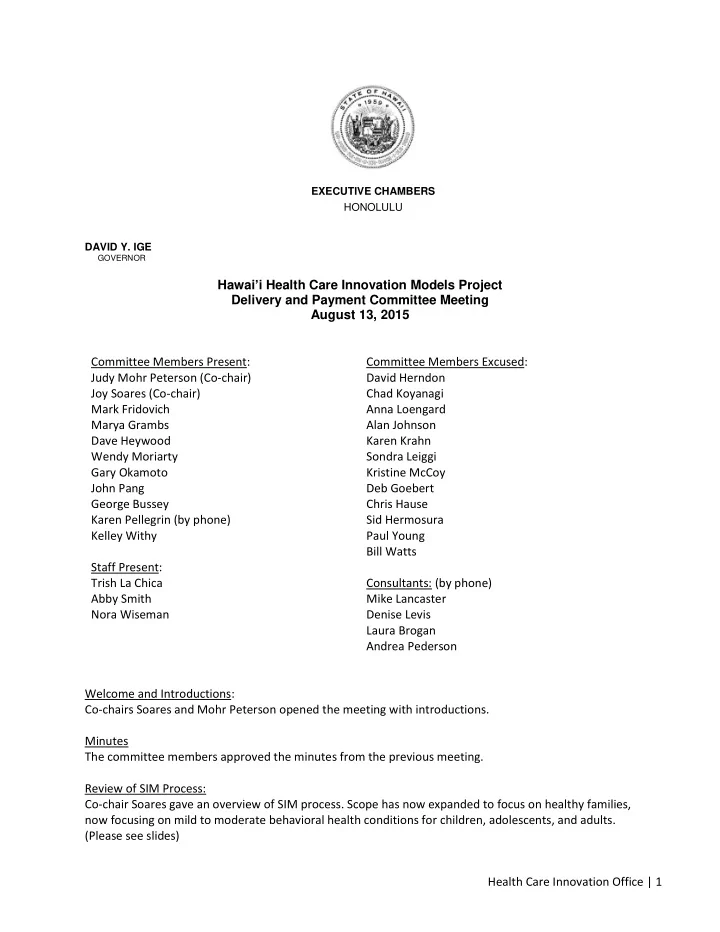
Hawai’i Health Care Innovation Models Project Delivery and Payment Committee Meeting August 13, 2015 Committee Members Present: Judy Mohr Peterson (Co-chair) Joy Soares (Co-chair) Mark Fridovich Marya Grambs Dave Heywood Wendy Moriarty Gary Okamoto John Pang George Bussey Karen Pellegrin (by phone) Kelley Withy Staff Present: Trish La Chica Abby Smith Nora Wiseman Committee Members Excused: David Herndon Chad Koyanagi Anna Loengard Alan Johnson Karen Krahn Sondra Leiggi Kristine McCoy Deb Goebert Chris Hause Sid Hermosura Paul Young Bill Watts Consultants: (by phone) Mike Lancaster Denise Levis Laura Brogan Andrea Pederson Welcome and Introductions: Co-chairs Soares and Mohr Peterson opened the meeting with introductions. Minutes The committee members approved the minutes from the previous meeting. Review of SIM Process: Co-chair Soares gave an overview of SIM process. Scope has now expanded to focus on healthy families, now focusing on mild to moderate behavioral health conditions for children, adolescents, and adults. (Please see slides)

slide-2
SLIDE 2

Hawaii Health Care Innovation Models Project Delivery and Payment Committee Meeting June 16, 2015 Health Care Innovation Office | 2 Co-chair Mohr Peterson Presentation: Focusing on Families: Multiple generations. One future. (Please see slides)  Mohr Peterson was Medicaid Director in Oregon for about 6 years, and was one of the leaders in efforts to transform Oregon’s health care delivery system. A committee member asked about relationship with DPS. Mohr Peterson explained that they are trying to make the transition smoother by working with MCOs to identify relevant clients. Co-chair Soares presented on SIM focus (please see slides) Discussion:  What is the oral health committee is focusing on? Co-chair Soares responded that the committee is exploring strategies to increase dental benefits for Medicaid adults and access to and utilization of preventive services for children.  We have the highest rate of suicidal ideation here.  Those with Medicaid coverage often have less access to needed health care, especially for behavioral health conditions and co-occurring physical health conditions.  Social costs vs. health care costs for addressing BH conditions - maybe we are spending too much on health and not enough on prevention, early intervention and family approaches to mental health and physical health treatment plans. Co-chair Soares explained that a SIM actuarial and return on investment analysis will be done. Additionally, the Hawaii Health Data Center will analyze Medicaid data to better understand the relationship between chronic disease and behavioral health conditions, and the reports will be provided to the committee later this year. Another committee commented that we are now spending more on Medicaid than on education. Part of this discussion is not diverting this money or reallocating that money, but identifying how many services are not necessary, not efficient, and not evidence-based. For some, it’s already too late and we need to spend money on their health care. But if we don’t figure out where to take money from (because there’s not new money), we won’t get to the prevention side.  We should clearly define “behavioral health” and our population so that we can focus how we can improve. Co-chair Soares: The analysis will drill down on the populations: who are they, where are they so we can prioritize our approach. In the meantime we are looking at the larger models to get a sense of the big picture and then provide the committee with more specific information in the future. Co-chair Mohr Peterson: you have to pay attention to the money and return on investment or you won’t be as effective.  The cost of prescription drugs is high. Hawaii has specific laws for behavioral health medications that make efforts to provide cost effective care more challenging.  PCMH’s are falling out of favor on the mainland. It’s worrisome here in Hawaii because the smaller practices can’t adhere to the PCMH requirements.

  • Dr. Lancaster’s presentation on Whole Person Care: (Please see slides)

Co-chair Mohr Peterson asked for feedback about the models.

slide-3
SLIDE 3

Hawaii Health Care Innovation Models Project Delivery and Payment Committee Meeting June 16, 2015 Health Care Innovation Office | 3 Committee member responses included:  It would be helpful to have the information presented in a way that shows how the models would fit or not fit within the different kinds of organizations (CHC’s, large and small practices, etc.).  There might be interest in motivational interviewing  The committee might want to also consider anxiety.  Primary care providers are probably least likely to adopt SBIRT of the three models. Co-chair Mohr Peterson stated DOH is looking into SBIRT with pregnant women, and suggested that the committee consider targeting pregnant women.  The simplest approach should be tried first to show success since primary care providers won’t be adopting them all on at one time.  CHC’s are good at doing screenings, but smaller practices still find it challenging, especially because if someone does need a referral, there isn’t an adequate network to refer to. It would be good to look into telepsychiatry. 

  • Dr. Lancaster: another model is weekly consults with psychiatrist to build capacity for providers.

They learn how to treat people within their practices.  There’s a need for 24-7 emergency access for clients as well.  More than 90% of residents live relatively close to a pharmacy, and utilizing clinical pharmacists to could be a way to increase access. Follow up items: Co-chairs will come up with some additional models to discuss, possibly add a few more meetings, and SIM will send out presentation materials. Next Meeting The next Delivery and Payment Committee meeting will be on September 10th from 1-2:30pm in the State Office Tower. Adjournment The meeting was adjourned at 2:35pm.

slide-4
SLIDE 4

State Innovation Model Design 2

DELIV ELIVERY Y AND P PAYM YMENT C COM OMMITTEE AUGUST 13, 13, 201 2015

slide-5
SLIDE 5

Welcome and Introductions

  • 1. Judy Mohr Peterson, Dept of Human Services, Co-

Chair

  • 2. Joy Soares, Office of the Governor, Co-Chair
  • 3. Mark Fridovich, Dept of Health
  • 4. Deborah Goebert, National Center on Indigenous

Hawaiian Behavioral Health

  • 5. Marya Grambs, Mental Health America
  • 6. Chris Hause, Kaiser Permanente
  • 7. Sid Hermosura, Waimanalo Health Center
  • 8. David Herndon, HMSA
  • 9. Dave Heywood, UnitedHealth Care
  • 10. Robert Hirokawa, Hawaii Primary Care Association
  • 11. Alan Johnson, Hina Mauka
  • 12. Chad Koyanagi, IHS
  • 13. Karen Krahn, Dept of Health
  • 14. Sondra Leiggi, Castle Medical Center
  • 15. Anna Loengard, Queen’s CIPN
  • 16. Kristine McCoy, Hilo Family Practice Residency
  • 17. Wendy Moriarty, `Ohana Health Plan
  • 18. Gary Okamoto, AlohaCare
  • 19. John Pang, Pharmacist
  • 20. Karen Pellegrin, UH Hilo College of Pharmacy
  • 21. Bill Watts, Queen’s Medical Center
  • 22. Kelley Withy, AHEC
  • 23. Paul Young, HAH

SIM Staff: Trish LaChica Nora Wiseman Abby Smith

slide-6
SLIDE 6

Agenda

Welcome and Introductions Joy Soares and Judy Mohr Peterson Review of Minutes Joy Soares SIM 2 Goals Joy Soares Presentation: Healthy Families Judy Mohr Peterson Behavioral Health Integration Models

  • Dr. Michael Lancaster

Navigant Updates Andrea Peterson

Timeline and Deliverables Monitoring and Evaluation

Committee Updates SIM Staff Other Business Joy Soares Adjourn

slide-7
SLIDE 7

How We Got Here: Process

  • Hawaii

Healthcare Project

  • Learning

Sessions

2012

  • SIM 1
  • Stakeholder

Consultation

  • Health

Summit

2013

  • SIM 2

Priorities

  • ACA, NWD,

APCD

  • Transition

2014

  • Getting started
  • PCMH, ACO, Care

Coord.

  • Expanded

discussions

  • High level plan
  • 6 Catalysts
  • SIM 2 Proposal
  • Associated projects
  • New Governor
slide-8
SLIDE 8

SIM Initiative

SIM is based on the premise that state-led innovation, supported by broad stakeholder input and engagement, will accelerate health care delivery system transformation to provide better health and better care at a lower cost. SIM encourages public and private sector collaboration to design and test multi-payer models to transform the health care systems in the state.

slide-9
SLIDE 9

SIM Goals

Triple Aim + 1

  • Better health
  • Reliably good quality care
  • Cost-effective care
  • + Reducing disparities in health status and access to care
slide-10
SLIDE 10

SIM Goals

Nurturing healthy families – Focus on whole-family approach

  • Investing early in keiki and their young parents for future generations.
  • Coordinating systems, programs, and services.
slide-11
SLIDE 11

Focusing on Families

Multiple generations. One future.

Hawaii Health Care Innovation Models Proj ect Delivery & Payment August 13, 2015

slide-12
SLIDE 12

We are asking -

9

What do we want t o see for Hawaii children and families in t hree years? What can and should we - t he healt h care syst em(s) - do different ly t o reach t hat vision?

slide-13
SLIDE 13

Multiple Generations. One Future

10

  • DHS is moving toward a whole-family

approach, and this is providing the framework for all of our work, including SIM.

  • Two generational models* focus on:
  • Changing the trajectories of whole families.
  • Investing early in keiki and their young parents

for future generations.

  • Coordinating systems, programs, and services.

*2Gen is supported by Ascend at the Aspen Institute

slide-14
SLIDE 14

Nurturing ‘ohana

11

slide-15
SLIDE 15

T ransforming components into systems

12

slide-16
SLIDE 16

A comprehensive approach

13

slide-17
SLIDE 17

2Gen Principles

1.

Measure and account for out comes for bot h children and t heir parent s.

2.

Engage and list en t o t he voices of families.

3.

Fost er innovat ion and evidence t oget her.

4.

Align and link syst ems and funding st reams.

5.

Priorit ize int ent ional implement at ion.

6.

Ensure equit y.

14

slide-18
SLIDE 18

2Gen Top 10 Policies

 Help Head Start and Early Head Start fulfill their two-

generation missions by strengthening family supports and increasing the emphasis on parents, not only in their role as mothers and fathers but also as breadwinners. [DOH, DHS ]

 Reform the Child Care Development Block Grant to

increase access to and quality of early childhood settings for children and to ensure greater access to j ob training and education for parents. [GOV-Early Childhood Dev’ t, DHS ]

Increase efforts to support economic security outcomes in home

visiting programs. [DOH, DHS

] Promote cross-system collaboration and partnership

among human services agencies and institutions of higher education, especially community colleges, to increase bundled

services and access to benefits for low-income students, many of whom are

  • parents. [UH, DHS

]

Increase postsecondary education access and completion

through institutional financial aid reform and policies that more accurately reflect the needs of enrolled student parents, a growing national

  • demographic. [UH, DoTax, DHS

]

15

slide-19
SLIDE 19

2Gen Top 10 Policies

Use the 2014 Workforce Innovation and Opportunity Act

(WIOA) to allow for state and local changes that enable two-generation

  • support. [DLIR, DOE, DHS

, DBEDT]

Redesign Temporary Assistance for Needy Families

(TANF) for 21st century families—

mothers or fathers, married or single. [DHS ]

Strengthen family connections through support and promotion of

work opportunities for noncustodial parents. [DLIR, DBEDT

, DHS ]

16

slide-20
SLIDE 20

2Gen Top 10 Policies

 Leverage provisions of the Affordable Care Act

(ACA) to improve economic security and family health and well-being. [GOV-Healthcare Transformation, DOH, DOE, PS D, DHS ]

 Maximize opportunities for whole-family

diagnosis and treatment for mental health. [DOH, DOE, PS D, DHS ]

slide-21
SLIDE 21

18

Wrong focus = wrong results

S hroeder, James; “ We Can Do Bet t er – Improving t he Healt h of t he American People,” NEJM, 2007: 357:1221-1228

slide-22
SLIDE 22

Health Care S ystem Transformation

S

ick care – not health care

Unsustainable Poor outcomes for the dollars that

we spend

Non-integrated or coordinated

care.

Focus on acute care, not

promotion of health and preventitive care

slide-23
SLIDE 23

Delivery system & payment R eform

Whole Family

? ? ? What models of delivery syst em and payment reform? ?

slide-24
SLIDE 24

We can do this!

21

slide-25
SLIDE 25

S IM2 Focus Areas

Two health care delivery areas that can focus us on keiki & ‘Ohana: Behavioral health integration with primary care – effective awareness, diagnosis and treatment

Adult s and children in t he primary care set t ings wit h mild t o moderat e behavioral healt h condit ions

Oral health improvement via increased access to timely and preventive services

Access for children and increase dent al sealant s and fluoride varnishes

S t rat egies t o increase coverage for low-income adult s

FOCUS IS ON MEDICAID

slide-26
SLIDE 26

Rationale for BH focus

Feedback from stakeholders, providers, community

BH conditions disproportionately affect the most vulnerable populations.

Access to behavioral health services is challenging, particularly for the Medicaid population.

While transformation is progressing, BH has largely been left out of innovations.

S takeholder feedback from the S IM first round identified behavioral health services need to be strengthened, and that the lack of BH training and resources was an obstacle to offering those services at the primary care level.

S ynergy with other initiatives: Community Health Needs Assessment (CHNA) identified behavioral health as a priority.

slide-27
SLIDE 27

Data on BH

 Community Health Needs Assessment identified mental illness as number one preventable

cause of hospitalization in 2012.

 S

IM Round 1 actuarial analysis showed the average total cost for individuals with a BH diagnosis was three times the average total cost for individuals without a BH diagnosis.

 In 2013, more than 1 in every 4, or 27.5%

  • f adults in Hawai’ i reported having poor mental
  • health. i

Asian Americans, Native Hawaiians, and Pacific Islanders (AA/ NHPIs) represent 82.5%

  • f the

population in Hawai’ i, yet have the lowest utilization rates for mental services among all populations, regardless of gender, age, and geographical location. ii

The number of suicides for youth ages 15 to 24 more than doubled from 2007 to 2011. iii

slide-28
SLIDE 28

Rationale for Focusing on Mild-Moderate BH Conditions

Data and stakeholder feedback revealed there is an opportunity…

Behavioral health integration with primary care – effective awareness, diagnosis and treatment of mild to moderate behavioral health conditions could improve outcomes and lower costs.

slide-29
SLIDE 29

Rationale for Focusing on Mild-Moderate BH Conditions

PCPs provide 60-70%

  • f psychiatric care for mild to moderate conditions.

Feedback from stakeholders suggest that many PCPs in Hawaii are not screening because of the lack of BH training and resources needed to provide those services at the primary care level.

 Potential return on investment: co-morbidity costs in Hawaii  S

IM HHIC analysis revealed there was a co-existing mental health condition in 34%

  • f hospitalizations (CY2012- $482,676,678).

National behavioral health integration initiatives have demonstrated improved

  • utcomes and a strong return on investment for patients with mild to moderate

behavioral health conditions.

Data on behavioral health integration pilots in Hawaii are not available yet, but anecdotally providers report they think their patients are receiving better care.

slide-30
SLIDE 30

Committee Goals

Identify behavioral integration delivery and payment models and agree to strategies and tactics to implement models that address improving early detections, diagnosis, and treatment of behavioral health conditions in primary care settings.

Improve the capacity of primary care providers to address behavioral health issues on a primary care level and/ or integrate behavioral health specialty services and community support services in primary care practices.

Improve the care coordination of people with behavioral health conditions and linkage with treatment and community support services.

slide-31
SLIDE 31

Whole Person Care

Integration of Primary and Behavioral Health Care Presentation to the Steering Committee – State of Hawaii Health Care Innovation Office

  • Dr. Mike Lancaster
slide-32
SLIDE 32

Why Proceed with Integration?

  • No wrong door
  • Expand limited resources

– Breakdown silos – Address isolation of small practices

  • Provide BH integration support to providers

who are seeing and treating these patients

  • Shared decision making supports

engagement and brings consumers into the health workforce

slide-33
SLIDE 33

Provider Perspective

  • PCPs provide 60-70% of psychiatric care for

mild to moderate conditions

  • PCPs are the initial provider for 40-60% of

patients with a diagnosis of depression

  • 80% of anti-depressants are prescribed by

PCPs

  • Up to 70% of PCP visits have a psychosocial

component

slide-34
SLIDE 34

Common Medical Illnesses and Depression

Major Depression

Stroke Multi- condition Seniors Diabetes

23% 11-15% 30-50%

Heart Disease

15-20%

41

slide-35
SLIDE 35

Co-Morbidities Cost

42

slide-36
SLIDE 36

Goals of the BHI Models

  • Create models of integrated care applicable to

both urban and rural settings

  • Increase coordination of services for BH/PCP

integration through use of Evidence Based Practices (EBPs)

  • Enhance use of tele-psychiatry/medicine to

address workforce issues and provide support to PCPs

slide-37
SLIDE 37
  • Cont. Goals of the BHI Models
  • Training across the state via use of developing

resources- e.g. Project ECHO

  • Expand workforce to involve Advance Practice

Providers (APPs) and Community Health Workers

  • Expand health workforce by engaging consumers

in their own care; shared decision making

  • Other goals from Delivery and Payment

Committee?

slide-38
SLIDE 38

Proposed EBP for PHP/BH Integration 1) SBIRT- Screening, Brief Intervention, Referral for Treatment; to help address the hidden issues with substance misuse in a PCP population 2) Screening and Treatment of Depression - based

  • n IMPACT model to identify and treat

depression in a PCP population 3) Motivational Interviewing- educate, engage, empower consumers we serve to be part of their health workforce

slide-39
SLIDE 39

Why Select These Three EBPs?

  • Population already being seen in PCP practices

but these conditions often not identified- introduce screening tools

  • If conditions identified, treatment not always

complete- make available algorithms to guide treatment

  • While Medicaid is target, EBP are all-payer models
  • Provide provider/MCO choice based on

population served (one size does not fit all)

slide-40
SLIDE 40

SBIRT Model 1: Screening, Brief Intervention, and Referral for Treatment (SBIRT): Early identification and brief intervention for substance use disorders

  • Involves evidence-based screening, score feedback,

expressing non-judgmental clinical concern, offering advice (brief intervention)

  • Community-based approach that can decrease

frequency and severity of drug and alcohol use, reduce risk of trauma and increase percentage of patients who enter specialized substance abuse treatment.

  • Cost-benefit analyses and cost-effectiveness analyses

have demonstrated net-cost savings.

slide-41
SLIDE 41

Screening and Treatment of Depression

Model 2: Treatment of Depression in Primary Care: Depression toolkit based on IMPACT model of care

  • Provides implementation recommendations, an overall

algorithm to help with initial screening of MDD severity and the corresponding recommended treatment approach, critical decision points, medication recommendations and follow up guidelines to measure progress.

  • Highlights what to do when patients are not responding

adequately, including when a referral to a psychiatrist for consultation would be indicated.

  • Introduces providers to the screening tool for depression

PHQ2/9, which is a validated tool for assessment of depression and anxiety in patients.

slide-42
SLIDE 42

Motivational Interviewing

Model 3: Motivational Interviewing (MI) enhances efforts by the caregiver to engage, educate, and empower self-care management behaviors in their consumers/patients

  • The change in health care delivery should include a

significantly different role for patients and families in which there is a more participatory component for their healthcare.

  • Stakeholders, as consumers of care, need to be included in

decision processes to increase "buy-in" of the services

  • ffered.
  • Is a collaborative, person-centered form of talking to

individuals to elicit and strengthen motivation for change.

slide-43
SLIDE 43

Evidence Based Care to Providers and Practices

  • Describe models to practices – three EBPs
  • Practice will identify EBP model that best fits their

patient population and practice

  • Practices that want to change/enhance their

practice will be identified as early adopters

  • Training and support for individual practices as

described in the model blueprint to maximize success of implementation

slide-44
SLIDE 44

What Will We Need to Succeed?

  • Engaged providers and engaged consumers
  • Support and endorsement from stakeholders-

providers, MCO, state, consumers

  • Potential alignment of payment / reimbursement to

support and incentivize changes

  • Potential policy revisions
  • Build on what is already present and working;

enhance and grow existing models proven successful

slide-45
SLIDE 45

Questions?

slide-46
SLIDE 46

Navigant Updates

ANDREA PEDERSON & LAURA BROGAN

slide-47
SLIDE 47

Navigant Updates – Deliverables and Timelines

Task 4: State Health Innovation Plan (SHIP)

SHIP outline and process map Drafts and final report

Task 3: BHI Evaluation and Monitoring Plan

Recommended BHI quality and outcomes/process measures Prototypes for at least 2 dashboards for evaluating the BHI models

Task 2: Cost/Return on Investment Analysis (re: BHI blueprint)

Cost/trend analysis report Actuarial analysis of estimated ROI

Task 1: Behavioral Health Integration (BHI) Blueprint

Present 3-5 options for BHI models Necessary elements for chosen model(s): workforce, HIT, reimbursement, etc.

slide-48
SLIDE 48

Navigant Updates – Deliverables and Timelines

Navigant is the lead contractor, along with the three subcontractors:

1. Community Care of North Carolina (CCNC) to develop the BHI blueprint (Task 1) 2. Optumas LLC to conduct the actuarial / ROI analysis (Task 2) 3. JEN Associates to assist with data analysis in support of the ROI analysis (Task 2)

Navigant will lead the BHI evaluation plan work (Task 3) and the SHIP development (Task 4)

slide-49
SLIDE 49

Navigant Updates – Deliverables and Timelines

BHI Blueprint: July- October Cost/ROI Analysis: September- November Evaluation Planning: September – November SHIP: Full Draft to SC by early December!

slide-50
SLIDE 50

Navigant Updates – Stakeholder Engagement

  • We will attend Steering Committee and Subcommittee Meetings
  • Present at committee meetings:
  • Behavioral Health Integration Options, and for each:
  • Characteristics
  • Potential benefits
  • Needed community resources
  • Best practices and experiences from other states
  • Potential challenges and risks
  • Results of research and data analysis
  • Draft materials (e.g., Integrated Behavioral Health blueprint)
  • Facilitate discussions to collect input and feedback
slide-51
SLIDE 51

Navigant Updates – Stakeholder Engagement

  • Additional stakeholder engagement outside of committee meetings, as needed:
  • Separate conference calls with key providers, MCOs, associations, Hawaii officials, etc. for a “deeper

dive” as needed

  • Document and data requests from key stakeholders
  • Review of focus group comments
  • Other input forums as needed
  • Onsite in Honolulu for face-to-face meetings
  • Tentatively the week of October 12
  • Schedule TBD
slide-52
SLIDE 52

Navigant Updates – Monitoring and Evaluation

  • Our charge: Develop Behavioral Health Integration Evaluation Plan and Dashboard
  • Steps to Develop an Evaluation Plan :
  • Assess currently available data sources for calculating quality/outcomes measures (e.g., administrative

claims, paper/electronic medical records, surveys)

  • Identify gaps and limitations in current data availability vis a vis the potential measures
  • Determine the most feasible subset of quality and outcomes measures
  • Develop data collection/reporting strategy to enable selected quality/outcomes measures
  • Develop a data submission plan
  • Steps to Develop a Dashboard:
  • Develop dashboard prototypes
  • Identify key players who will be responsible for data collection and validation, analytics and report

development

slide-53
SLIDE 53

Steering Committee

  • Discussed the new direction of SIM, which is to focus on behavioral health integration for both

children and adults through the lens of ‘Ohana - Healthy families.

  • Rachael Wong from DHS presented on the 2Gen model which focuses on creating
  • pportunities for families by addressing the needs of parents and children simultaneously
  • Dr. Mike Lancaster from the Community Care Network of North Carolina presented on the

goals of BH Integration and possible models for Hawai‘i

  • Next Steps: Continue discussions on BH Integration as well as identifying value-based measures

as part of the Monitoring & Evaluation Plan.

slide-54
SLIDE 54

Population Health

  • Updated Health Innovation Focus: Nurturing Healthy Families
  • Next steps:
  • Committee will review the SIM Population Health Assessment initial draft and

provide feedback

  • Committee with meet with the Healthcare Association of Hawaii to discuss the

potential for collaboration related to the Community Health Needs Assessment process

  • Continue to look at community-wide approaches to health
slide-55
SLIDE 55

Oral Health

  • Committee agreed to explore getting at least pregnant women and the developmentally

disabled covered for preventive care by Medicaid during the next session, but may be looking into a limited benefit for full adult coverage

  • Next steps are to determine legislation strategies and work with Medicaid to determine

if this is feasible

slide-56
SLIDE 56

Workforce

Workforce Targets and Strategies: To incorporate CHW and clinical pharmacists in workforce expansion plans, as part of the

  • verall coordinated care team approach to addressing behavioral health among children,

adults, and families within the primary care setting. Next steps:

  • Discussion about the recently expanded privileges and responsibilities for APRNs in Hawaii
  • Continue discussion about workforce goals, strategies, and resources
slide-57
SLIDE 57

Health Information Technology

  • Discussion with federal partners regarding the privacy and security governing behavioral health

information exchange

  • Development of potential use cases with HHIE and local providers, including a focus on behavioral

health screening and information exchange among OBGYNs and pediatricians

Next Steps:

  • Develop draft document on privacy security issues related to information exchange between OBGYNs

and pediatricians and circulate for feedback

slide-58
SLIDE 58

Next Meeting

Tuesday, September 10th, 1:00 – 2:30 pm State Office Tower, Leiopapa a Kamehameha, Room 1403

slide-59
SLIDE 59
slide-60
SLIDE 60