Guidelines for Zoom Webinar Format 1. Mute your audio and remain on - - PowerPoint PPT Presentation

guidelines for zoom webinar format
SMART_READER_LITE
LIVE PREVIEW

Guidelines for Zoom Webinar Format 1. Mute your audio and remain on - - PowerPoint PPT Presentation

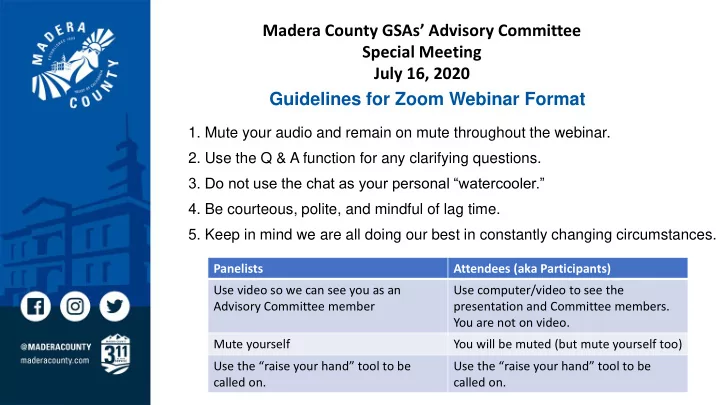
Madera County GSAs Advisory Committee Special Meeting July 16, 2020 Guidelines for Zoom Webinar Format 1. Mute your audio and remain on mute throughout the webinar. 2. Use the Q & A function for any clarifying questions. 3. Do not use


slide-1
SLIDE 1

Guidelines for Zoom Webinar Format

  • 1. Mute your audio and remain on mute throughout the webinar.
  • 2. Use the Q & A function for any clarifying questions.
  • 3. Do not use the chat as your personal “watercooler.”
  • 4. Be courteous, polite, and mindful of lag time.
  • 5. Keep in mind we are all doing our best in constantly changing circumstances.

Panelists Attendees (aka Participants) Use video so we can see you as an Advisory Committee member Use computer/video to see the presentation and Committee members. You are not on video. Mute yourself You will be muted (but mute yourself too) Use the “raise your hand” tool to be called on. Use the “raise your hand” tool to be called on.

Madera County GSAs’ Advisory Committee Special Meeting July 16, 2020

slide-2
SLIDE 2

Agenda for July 16, 2020

  • 1. CALL TO ORDER
  • 2. PLEDGE OF ALLEGIANCE
  • 3. ROLL CALL
  • 4. PUBLIC COMMENT
  • 5. AMBASSADOR REPORT
  • 6. DIRECTOR’S REPORT
  • 7. DOMESTIC WELLS
  • 8. WATER USE DISCUSSION
  • 9. ADJOURNMENT

Next Meeting Dates at 2 p.m. on August 6, October 1, and December 3.

slide-3
SLIDE 3

Item 1: Call to Order

slide-4
SLIDE 4

Item 2: Pledge of Allegiance

slide-5
SLIDE 5

Item 3: Roll Call

Seat Representative Alternate DAC Victoria Ortiz Self-Help DAC Teresa Padilla Mendoza Leadership Council Residential

  • H. Clay Daulton

Jay Quick Residential Jerrold Kazynski Al Solis Permanent Ag Jim Maxwell Karun Samran Permanent Ag Devin Aviles James Unti Non-Permanent Ag Larkin Harman Greg Hooker Non-Permanent Ag Bryant Elkins Albert Guravage Delta Mendota Jared Samarin Sam Lopes Livestock Darcy Vlot Ben Pitman At Large Clay Haynes Mike DeLaGuerra

slide-6
SLIDE 6

Item 4: Public Comment

The first 15 minutes of each regular session is set aside for members of the public to comment on any item within the jurisdiction of the Committee, but not appearing on the agenda. For items appearing on the agenda, the public is invited to comment at the time the item is called for consideration by the Committee. Any person addressing the Committee under public comment will be limited to a 3 minute presentation to ensure that all interested parties have an opportunity to speak.

slide-7
SLIDE 7

Item 5: Ambassador Reports (Committee Members)

slide-8
SLIDE 8

Committee Member Comments

slide-9
SLIDE 9

Public Comment

slide-10
SLIDE 10

Item 6: Director’s Report (Stephanie Anagnoson)

  • Update on Subbasins
slide-11
SLIDE 11

Committee Member Comments

slide-12
SLIDE 12

Public Comment

slide-13
SLIDE 13

Item 7: Domestic Wells (Stephanie Anagnoson)

  • Madera Subbasin Domestic Well Inventory and Installation of Monitoring

Wells

  • Chowchilla Subbasin Domestic Well Inventory and Installation of Monitoring

Wells

  • Domestic Well Ad Hoc Committee (2019)

Make the process easy to use (clear communication, less paperwork, speedy process) Understand the multiple barriers for participation Address data gaps in terms of the extent of the problem Make distinctions between short-term versus longer-term solutions

  • Upcoming Speakers
  • Tami McVay, Self-Help on August 6, 2020
  • State Water Resources Control Board SAFER on September 3, 2020
slide-14
SLIDE 14

Committee Member Comments

slide-15
SLIDE 15

Public Comment

slide-16
SLIDE 16

Item 8: Water Use Discussion (Stephanie Anagnoson and Greg Young)

slide-17
SLIDE 17

Demand Management Options

  • We need to reduce consumptive use:
  • Allocation
  • Allocation + Water Market
  • Land Resting/Retirement Easements
  • Fee structures
  • We need to show good faith to GSA partners
  • We need to avoid state intervention
  • We need to understand trends in terms of the magnitude of

reduction

  • We acquired satellite-based ET analysis for 2010-2019 to look at

recent changes in agricultural water use as it informs an allocation approach

slide-18
SLIDE 18

Overview Satellite-Based ET Estimates

slide-19
SLIDE 19

Image source: Mapping Drought and Evapotranspiration at High Resolution using Landsat/GOES Thermal Imagery M.C. Anderson, W.P. Kustas USDA-ARS, Hydrology and Remote Sensing Laboratory J.M. Norman U Wisconsin-Madison C.M.U. Neale Utah State University https://www.yumpu.com/en/document/view/18460757/mapping- drought-and-evapotranspiration-at-high-landsat

Water Balance v. Remote Sensing

slide-20
SLIDE 20

Proven Approach

4

OpenET

Satellite Archives Consumptive Use

Slides from Open ET presentation downloaded from: http://www.westernstateswater.org/wp-content/uploads/2018/01/Huntington_NASA-and-DRI-The-Open-ET-Project.pdf

slide-21
SLIDE 21

One Platform, Multiple Operational Models

6

Slides from Open ET presentation downloaded from: http://www.westernstateswater.org/wp-content/uploads/2018/01/Huntington_NASA-and-DRI-The-Open-ET-Project.pdf

slide-22
SLIDE 22
  • Remote sensing is the only way to estimate actual ET over large areas and long time

histories

  • Field scale satellite archives combined with availability of climate data and cloud

computing is creating transformative opportunities

  • Rapid processing and visualization tools for simple consumptive use decision support
  • Will allow for all to perform field scale consumptive use analyis
  • Free and open access to objective data where everyone is treated equally will reduce the likelihood for

disputes over data or lack of data

  • Outreach through hands-on training is key for adoption
  • Contact Justin.Huntington@dri.edu if interested in participating or for more details

OpenET

Summary

Slides from Open ET presentation downloaded from: http://www.westernstateswater.org/wp-content/uploads/2018/01/Huntington_NASA-and-DRI-The-Open-ET-Project.pdf

slide-23
SLIDE 23

Madera Water District

Satellite-based ET Analysis

slide-24
SLIDE 24

Madera Water District

Cropped acres ~ 3,250

slide-25
SLIDE 25

Madera Water District

Cropped acres ~ 3,250 One crop: pistachios

(source: Dept. of Water Resource 2016 Crop Layer)

slide-26
SLIDE 26
  • 2,000

4,000 6,000 8,000 10,000 12,000 14,000 2010 2011 2012 2013 2014 2015 2016 2017 2018 2019

Madera Water District GSA

Madera Water District

Cropped acres: ~ 3,250 One crop: pistachios Total ET: ~12,000 af/yr

slide-27
SLIDE 27
  • 2,000

4,000 6,000 8,000 10,000 12,000 14,000 2010 2011 2012 2013 2014 2015 2016 2017 2018 2019

Madera Water District GSA

Madera Water District

2014 Satellite-based ET

(source: Formation Environmental)

slide-28
SLIDE 28
  • 2,000

4,000 6,000 8,000 10,000 12,000 14,000 2010 2011 2012 2013 2014 2015 2016 2017 2018 2019

Madera Water District GSA

Madera Water District

2016 Satellite-based ET

(source: Formation Environmental)

slide-29
SLIDE 29
  • 2,000

4,000 6,000 8,000 10,000 12,000 14,000 2010 2011 2012 2013 2014 2015 2016 2017 2018 2019

Madera Water District GSA

Madera Water District

2019 Satellite-based ET

(source: Formation Environmental)

slide-30
SLIDE 30

Madera County GSA – Chowchilla – West Side

Satellite-based ET Analysis

slide-31
SLIDE 31

Madera GSA Chowchilla - West

Total acres ~ 30,000

2010

slide-32
SLIDE 32

Madera GSA Chowchilla - West

Total acres ~ 30,000

2011

slide-33
SLIDE 33

Madera GSA Chowchilla - West

Total acres ~ 30,000

2012

slide-34
SLIDE 34

Madera GSA Chowchilla - West

Total acres ~ 30,000

2013

slide-35
SLIDE 35

Madera GSA Chowchilla - West

Total acres ~ 30,000

2014

slide-36
SLIDE 36

Madera GSA Chowchilla - West

Total acres ~ 30,000

2015

slide-37
SLIDE 37

Madera GSA Chowchilla - West

Total acres ~ 30,000

2016

slide-38
SLIDE 38

Madera GSA Chowchilla - West

Total acres ~ 30,000

2018

slide-39
SLIDE 39

2012 2018 ~3,400 acres

slide-40
SLIDE 40

2005 Bare/Grazing Alfalfa? Alfalfa?

slide-41
SLIDE 41

2010 Bare/Grazing New Trees/Vines Alfalfa?

slide-42
SLIDE 42

2012 New Trees/Vines New Trees/Vines New Trees/Vines

slide-43
SLIDE 43

2018 Established Trees/Vines Established Trees/Vines Established Trees/Vines

slide-44
SLIDE 44

Madera County GSA

Satellite-based ET Analysis

slide-45
SLIDE 45
  • 50,000

100,000 150,000 200,000 250,000 300,000 2010 2011 2012 2013 2014 2015 2016 2017 2018 2019

Madera County GSA - Madera Subbasin

  • 50,000

100,000 150,000 200,000 250,000 300,000 2010 2011 2012 2013 2014 2015 2016 2017 2018 2019

Madera County GSA - Chowchilla Subbasin

slide-46
SLIDE 46
  • 50,000

100,000 150,000 200,000 250,000 300,000 2010 2011 2012 2013 2014 2015 2016 2017 2018 2019

Madera County GSA - Madera Subbasin

50,000 100,000 150,000 200,000 250,000 300,000 2010 2011 2012 2013 2014 2015 2016 2017 2018 2019

AFY

Madera County GSA - Madera Subbasin

ETPrecip estimated ETAW Linear (Series3)

slide-47
SLIDE 47

March 2015

slide-48
SLIDE 48

August 2017

slide-49
SLIDE 49

2010

slide-50
SLIDE 50

2014

slide-51
SLIDE 51

2016

slide-52
SLIDE 52

2019

slide-53
SLIDE 53

April 2010 August 2012 March 2017 August 2018

slide-54
SLIDE 54

Allocations

  • We need to reduce consumptive use:
  • Allocation
  • Allocation + Water Market
  • Land Resting/Retirement Easements
  • Fee structures
  • We need to show good faith to GSA partners
  • We need to avoid state intervention
  • August 6th Advisory Committee Meeting will include a discussion of

allocations

  • An allocation approach will be brought to the Board of Directors by

the end of the year

slide-55
SLIDE 55

Committee Member Comments

slide-56
SLIDE 56

Public Comment

slide-57
SLIDE 57

Item 9: Adjournment