Mapping decadal land cover changes in northern Namibia using the - - PowerPoint PPT Presentation

mapping decadal land cover changes in northern namibia
SMART_READER_LITE
LIVE PREVIEW

Mapping decadal land cover changes in northern Namibia using the - - PowerPoint PPT Presentation

Mapping decadal land cover changes in northern Namibia using the Landsat satellite archive (1975-2015) Physical Geography and Environmental change University of Basel Vladimir Wingate , vladimir.wingate@unibas.ch V. R. Wingate 2014 Outline


slide-1
SLIDE 1

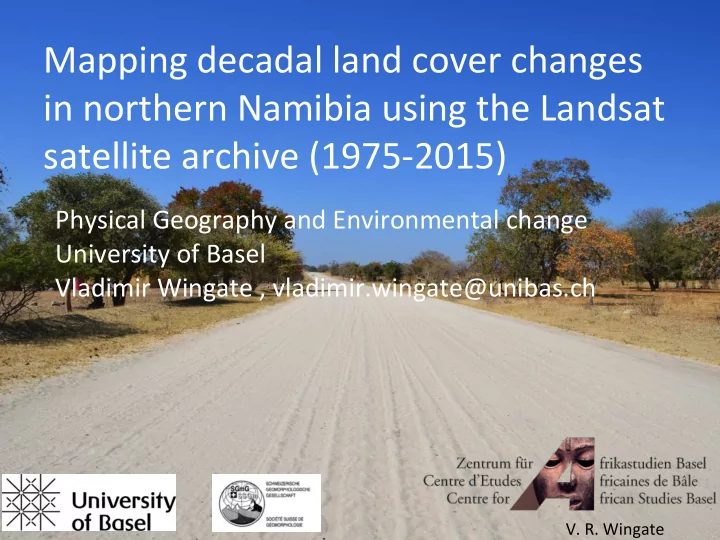
Mapping decadal land cover changes in northern Namibia using the Landsat satellite archive (1975-2015)

Physical Geography and Environmental change University of Basel Vladimir Wingate , vladimir.wingate@unibas.ch

  • V. R. Wingate

2014

slide-2
SLIDE 2

Outline

  • IntroducQon

– Study site and vegetaQon cover change in N Namibia – Landsat satellite data

  • ObjecQves

– Assess the extent of vegetaQon cover change – i.e. deforestaQon, vegetaQon gain

  • Method

– VegetaQon change mapping using the whole Landsat satellite archive – Landsat satellite image analysis tools

  • IniQal results

– MulQ-temporal land cover class maps of vegetaQon cover change – Data on extent of loss and gain of forest cover

  • Next steps

– Mapping fracQonal/percentage vegetaQon cover

slide-3
SLIDE 3

Study site

slide-4
SLIDE 4

northern Namibia

  • VegetaQon change

– Human impact – Reduced savannah woodland – Expansion of arable land – Increased grazing

  • Expand on change work

– Erkkilä et al. (2001) – Röder et al. (2014)

slide-5
SLIDE 5

Landsat data

  • Landsat archive

– Freely available, USGS – Local, regional, and global-scale analysis – VegetaQon change i.e. deforestaQon – Numerous applicaQons – 1972 – Present – RepeQQve, synopQc – High resoluQon (30x30m pixel)

slide-6
SLIDE 6

ObjecQve

  • Map changes in land cover in N Namibia

– Between 1975 and 2014 at decadal intervals – Emphasis on woodland/savannah cover change – Arable/agricultural land expansion

  • V. R. Wingate

2014

slide-7
SLIDE 7

Methods

  • Post-ClassificaQon method

– Land cover is assigned to a class – Easily measure extent (i.e. ha, km2) – TransiQons between classes

slide-8
SLIDE 8

Landsat archive analysis

  • Whole archive available for analysis:

– Google’s earth engine – Select the best quality pixels for given period – Create a new best image – Classify new images into land cover classes for change analysis

hfps://earthengine.google.com

slide-9
SLIDE 9

IniQal results

slide-10
SLIDE 10

IniQal results

slide-11
SLIDE 11

Results and discussion

slide-12
SLIDE 12

Results and discussion

slide-13
SLIDE 13

Results and discussion

  • Land cover change between 1975-2014

– Over all decrease in woodland – Increase in arable land – Variable rates of change – Losses and gains – Small-scale conversion

  • V. R. Wingate

2014

slide-14
SLIDE 14

LimitaQons and further work

  • LimiaQons of post-classificaQon method

– Difficult to produce consistent results – SubjecQvity introduced – operator judgements – Leads to erros – hard to replicate

  • Savannahs environments

– Heterogenous land covers – Inter-intro annual variaQon – Shihs – fire, rainfall, grazing

slide-15
SLIDE 15

FracQonal cover

  • QuanQtaQve analysis of the percentage cover

(0-100%) of live vegetaQon, dry vegetaQon and exposed substrate for each satellite pixel

– ecologically meaningful maps – idenQfy % forest cover – deforestaQon

slide-16
SLIDE 16

Conclusion

  • Decrease in vegetaQon cover
  • Increase in arable land
  • Number of limitaQons with mapping methods
  • Especially true for savannahs environments
  • Probably resulQng in the variable results
  • bserved
  • Next pat of the study will explore the issue

further using FracQonal Cover method