Strategic Issues for Binary/File Format ILDG4 May 21 2004, T.Yoshie - - PowerPoint PPT Presentation

strategic issues for binary file format
SMART_READER_LITE
LIVE PREVIEW

Strategic Issues for Binary/File Format ILDG4 May 21 2004, T.Yoshie - - PowerPoint PPT Presentation

Strategic Issues for Binary/File Format ILDG4 May 21 2004, T.Yoshie CCS,Tsukuna Definition binary format: array format of config. U(3,3,X,,,) numerical format (precision,IEEE,byte-order) file format: format of a file


slide-1
SLIDE 1

1

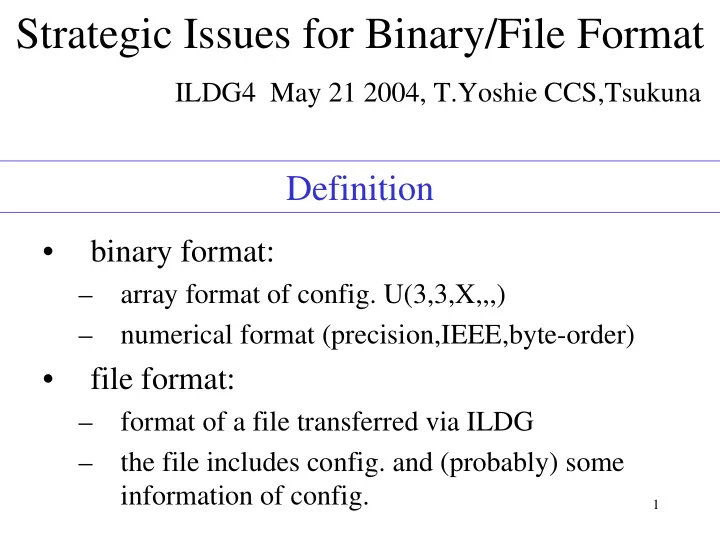
Strategic Issues for Binary/File Format

ILDG4 May 21 2004, T.Yoshie CCS,Tsukuna

Definition

  • binary format:

– array format of config. U(3,3,X,,,) – numerical format (precision,IEEE,byte-order)

  • file format:

– format of a file transferred via ILDG – the file includes config. and (probably) some information of config.

slide-2
SLIDE 2

2

MDWG Proposals (in QCDML draft 4.0)

  • abstract (reference) standard binary format

contributor format-A user format-B standard format C-library (provided by contributor) to read config in standard format convert config. to user's format if necessary BinX description

  • f format-A

BinX description

  • f format-B

conversion tool

enables us to save

– disk space on contributors side – cost of conversion

slide-3
SLIDE 3

3

  • encapsulation (packing) of one binary config.

and corresponding XML IDs in one file

– this enables us to keep identity of files distributed via ILDG – no other header information is added

Issue-1

  • Packing has to be done when config. is

transferred from Grid to user disk

– if we want to avoid “doubled disk space”

slide-4
SLIDE 4

4

Possible Solutions and Comments

  • 1. Give up packing
  • can avoid doubled disk space
  • config. identity is lost (user has to

remember/record information)

  • 2. Packing in advance
  • doubled disk space
  • config. identity is kept
  • XML IDs are duplicated (those in a packed file

and those in metadata catalog), hence they are subject to mismatch

slide-5
SLIDE 5

5

2’ Config.ID header

Add only a short header for unique config.ID e.g. markovChainLFN+series+update

  • (probably) doubled disk space
  • config. identity is kept
  • no duplicated XML documents
  • 3. Packing when transferring
  • no doubled disk space
  • config. identity is kept, no duplicated XML IDs
  • We have to develop an intelligent transfer software

(SRM does not have this function)

slide-6
SLIDE 6

6

note for discussions

  • if we take “packing in advance” or “config.ID

header” strategy, we may change strategy of “abstract binary format”

  • if we take “packing when transferring” strategy,

the transfer software has to be so intelligent that it handles multiple files for space-time decomposed configuration.

  • in future, we may have “Replica” of configurations

among Grids. Our decision has to be compatible with “replica”.

  • If SRM supports directory,

– GDN: top directory of a configuration – place a small file including config.ID at the top directory

slide-7
SLIDE 7

7

Issue-2

  • contributors binary format is a matter independent
  • f ensemble/configuration

– machine (#nodes) and code are placed in config.XML => binary format (in general) depends on config – a common binary format is used for many ensembles

  • We have to develop a mechanism to manage C-

libraries and BinX XML IDs

– if we keep strategy of “abstract binary format” – or convert config. to standard binary format in advance

Conclusions

  • Decide strategy and assign works to WGs
slide-8
SLIDE 8

8

My personal opinion

  • “config ID header “ strategy

– add in addition, “Lattice Size” header

  • convert configurations in advance from

contributors binary format to ILDG standard binary format

– Give up a strategy of “abstract binary format”

Reasons and Drawback

– simple, almost no management issues arise – doubled disk space – users have to download XML IDs in advance, before they use config for measurement.