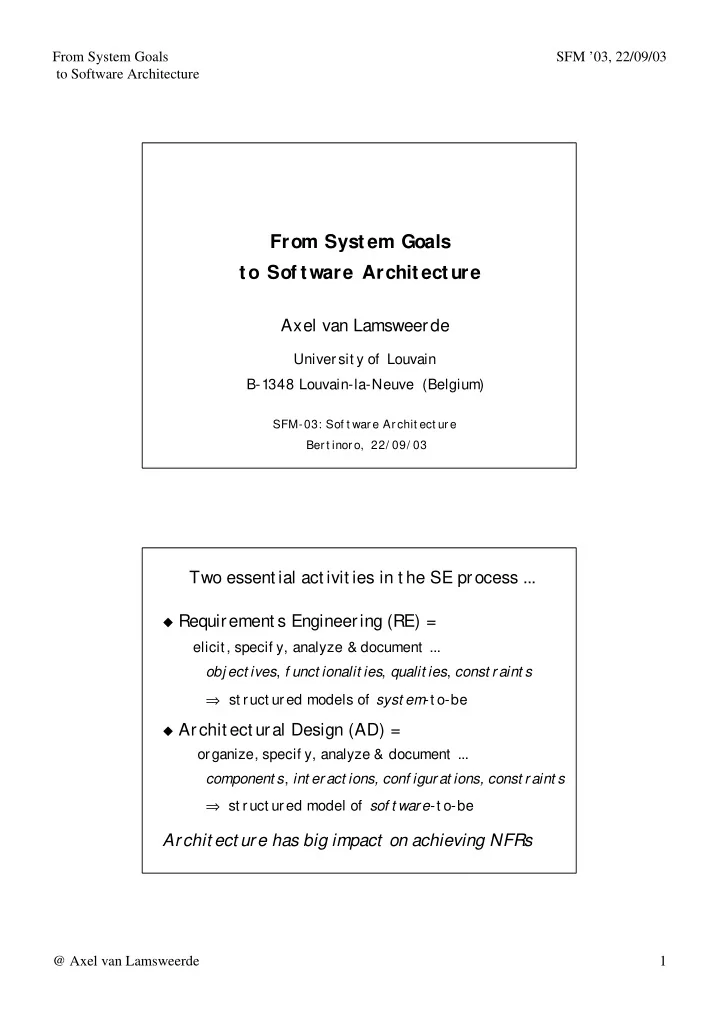
SLIDE 1 From System Goals to Software Architecture SFM ’03, 22/09/03 @ Axel van Lamsweerde 1
From Syst em Goals to Sof tware Architecture
Axel van Lamsweerde
Univer sit y of Louvain B-1348 Louvain-la-Neuve (Belgium)
SFM-03: Sof t war e Ar chit ect ur e Ber t inor o, 22/ 09/ 03
Two essent ial act ivit ies in t he SE process ...
Requirement s Engineering (RE) =
elicit, specif y, analyze & document ...
- bj ect ives, f unct ionalit ies, qualit ies, const r aint s
⇒ st ruct ured models of syst em-t o-be
Archit ect ural Design (AD) =
- rganize, specif y, analyze & document ...
component s, int eract ions, conf igurat ions, const raint s ⇒ st r uct ur ed model of sof t ware-t o-be
Archit ect ure has big impact on achieving NFRs
SLIDE 2 From System Goals to Software Architecture SFM ’03, 22/09/03 @ Axel van Lamsweerde 2
The problem ...
Requirement s Engineering (RE) =
elicit, specif y, analyze & document ...
- bj ect ives, f unct ionalit ies, qualit ies, const r aint s
⇒ st ruct ured models of syst em-t o-be
Archit ect ural Design (AD) =
- rganize, specif y, analyze & document ...
component s, int eract ions, conf igurat ions, const raint s ⇒ st r uct ur ed model of sof t ware-t o-be
Archit ect ure has big impact on achieving NFRs
?
The problem ... (2)
P
– relat ionships requirement s ↔ archit ect ure – int ert wining RE ↔ AD
No syst emat ic way t o ...
– build/ modif y archit ect ure t o meet f unct ional/ non- f unct ional requirement s – int egrat e archit ect ural const raint s in r equir ement s document ⇒ requirement-archit ect ure mismat ch
SLIDE 3
From System Goals to Software Architecture SFM ’03, 22/09/03 @ Axel van Lamsweerde 3
The mismat ch problem: exacerbat ing f act ors ...
Requirement s volat ilit y vs. archit ect ural st abilit y
(e.g. new requirement s f rom using t he sof t ware)
New generat ion sof t ware ...
– ubiquit ous, mobile – het er ogeneous – open – mission-crit ical – operat ing in changing, (host ile) environment s – open source (permanent , dist ribut ed evolut ion)
Resolving t he mismat ch problem: why not j ust f orget about requirement s ??
Survey of 350 US companies, 8000 proj ect s
– success: 16 % – f ailure: 33 % – so so: 51 %
(partial functionalities,
excessive costs, big delays)
maj or source of f ailure:
poor requirement s engineering ≅ 50% responses
(St andish Gr oup, 1995)
SLIDE 4
From System Goals to Software Architecture SFM ’03, 22/09/03 @ Axel van Lamsweerde 4
Resolving t he mismat ch problem: why not j ust f orget about requirement s ?? Maj or source of f ailure: poor requirement s engineering ≅ 50% responses:
– lack of user involvement 13% – incomplet e requirement s 13% – changing requirement s 9% – unrealist ic expect at ions 10% – unclear goals
5%
www.st andishgroup.com/ chaos.ht ml
Resolving t he mismat ch problem: why not j ust f orget about requirement s ??
Survey of 3800 EUR organizat ions, 17 count ries
main sof t war e problems are in... – requirement s specif icat ion
>
50% responses – requirement s management 50% responses
(Eur opean Sof t war e I nst it ut e, 1996)
SLIDE 5
From System Goals to Software Architecture SFM ’03, 22/09/03 @ Axel van Lamsweerde 5
The problem on t he research side ...
Much work on archit ect ural descript ion & analysis
– myriads of ADLs:
ACME, C2, DARWI N, RAPI DE, WRI GHT, UML2.0 (?), ...
t he ar chit ect ur e has t o be t her e – archit ect ural pat t erns & st yles how do you compose t hem t o meet NFRs ?
Some work on archit ect ural ref inement e.g., [Mor iconi' 96]
The problem: on t he research side ... (2)
Lit t le work on archit ect ure derivat ion t o meet
f unct ional & non-f unct ional reqs
some preliminary ef f ort s on goal-orient ed approaches f or... – it erat ive evaluat ion/ t ransf ormat ion against NFRs
[Bosch&Molin ’99]
– archit ect ural ref inement [van Lamsweerde' 00] – NFR-based document at ion of design pat t erns f or select ion [Gross&Yu' 01]
SLIDE 6
From System Goals to Software Architecture SFM ’03, 22/09/03 @ Axel van Lamsweerde 6
Obj ect ives
Support requirement s/ archit ect ure co-design/ co-
evolut ion
Support archit ect ure derivat ion f rom requirement s
models & sof t war e specs
Make der ivat ion pr ocess…
– syst emat ic, increment al – leading t o provably/ arguably cor r ect & “good” archit ect ure – highlight ing archit ect ural views (e.g. securit y view) ⇓ goal-based archit ect ural design process
Out line
Background: some bit s of RE From syst em goals t o sof t ware requirement s
– Building goal-orient ed requirement s models – I nt ert wining bet ween lat e RE & early AD – Goal-levl reasoning f or higher assurance
From sof t ware requirement s t o sof t ware specs From sof t ware specs t o sof t ware archit ect ure
– Derivat ion of abst ract dat af low archit ect ure t o achieve f unct ional specs – St yle-based ref inement t o meet archit ect ural const r aint s – Pat t er n-based r ef inement t o achieve NFRs
SLIDE 7 From System Goals to Software Architecture SFM ’03, 22/09/03 @ Axel van Lamsweerde 7
Background: what is RE about ? goals
WHY? WHAT?
requirements, assumptions
domain knowledge Background: what is RE about ? goals
WHY? WHAT? WHO?
responsibility assignment requirements, assumptions
domain knowledge
SLIDE 8
From System Goals to Software Architecture SFM ’03, 22/09/03 @ Axel van Lamsweerde 8
Background: what is RE about ?
Requirement s elaborat ion is hard ...
– requirement s are not t here, you have t o elicit t hem & st ruct ure t hem – ranges f rom high-level, st rat egic obj ect ives t o det ailed, t echnical requirement s – involves sof t war e + envir onment – requires evaluat ion of alt ernat ives, select ion (= ar chit ect ur al decisions ?) – r aises conf lict ing concer ns – requires ant icipat ion of unexpect ed behaviors (f or r equir ement s complet eness, syst em r obust ness)
Background: goal-orient ed RE
Goal: prescript ive st at ement of int ent
(cf . David ’s not ion of int ent ion/ t ask)
Domain prop: descript ive st at ement about domain Agent : act ive component , cont rols behaviors
sof t ware-t o-be, exist ing sof t ware, device, human Goal achievement requires agent cooperat ion The more f ine-grained a goal is, t he less agent s are required
Requirement : goal assigned t o sof t ware agent Expect at ion: goal assigned t o environment agent
SLIDE 9
From System Goals to Software Architecture SFM ’03, 22/09/03 @ Axel van Lamsweerde 9
Background: goal-orient ed RE (2)
Dif f erent goal cat egories ...
f unct ional: prescribe expect ed services
sat isf act ion, inf ormat ion, ...
non f unct ional, ref ined in applicat ion-specif ic t erms:
– qualit y of service: accuracy securit y: conf ident ialit y, availabilit y, int egrit y, ... usabilit y perf ormance, ... – development goals: maint ainabilit y: min coupling, max cohesion, ... reusabilit y, int eroperabilit y, ... – domain-specif ic archit ect ural const raint s
Background: goal-orient ed RE (3)
Domain-specif ic archit ect ural const raint s ...
– f eat ures of environment agent s & t heir organizat ion – const rain archit ect ural design space e.g. dist ribut ion of human agent s, devices, dat a Meet ing scheduling syst em: dist ribut ion of part icipant s, meet ing init iat or Train syst em: st at ion comput er , on-boar d cont r oller , t racking syst em, ...
SLIDE 10 From System Goals to Software Architecture SFM ’03, 22/09/03 @ Axel van Lamsweerde 10
Background: goal-orient ed RE (4)
Dif f er ent t ypes of goals ...
– Sof t Goal achievement cannot be est ablished in clear -cut sense
→ goal sat isf icing, qualit at ive r easoning
(Mylopoulos' 92, Chung' 00) – Achieve/ Maint ain goal achievement can be ver if ied
→ goal sat isf act ion, f ormal reasoning
(Dardenne' 93, Darimont ' 96) Saf eTr anspor t at ion Tr ainsOnSameBlock Door sClosedWhileMoving BlockSpeedLimit
...
Avoid Sof t
Maint ain
Background: goal-orient ed RE (5)
Goal G is AND-ref ined int o subgoals G1
, ..., Gn if f
achieving G1, ..., Gn cont ribut es t o achieving G
t he set {G
1, ..., G n} is called ref inement of G
Gi is said t o cont ribut e posit ively t o G
The set {G1, ..., Gn} is a complet e AND-r ef inement of G if f
G1, ..., Gn are suf f icient f or achieving G in view of known domain propert ies
{G1, ..., Gn, Dom} |= G
Goal G is OR-ref ined int o ref inement s R1, ..., Gm if f
achieving t he subgoals of Ri is one alt ernat ive t o achieving G (1 ≤i ≤m)
Ri is called alt er nat ive f or G
SLIDE 11
From System Goals to Software Architecture SFM ’03, 22/09/03 @ Axel van Lamsweerde 11
Background: goal-orient ed RE (6)
A goal is realizable by agent if
it amount s t o a r elat ion on variables t hat are monit orable & cont rollable by t he agent monit or ed var s cont rolled var s Agent Goal Goals need t o be ref ined unt il assignable t o single agent s
Background: goal-orient ed RE (7)
Agent responsibilit y:
G is assignable t o Ag if f G is realizable by Ag
Train Controller Train Driver Passenger OR-Assignment DoorsClosed WhileMoving
SLIDE 12
From System Goals to Software Architecture SFM ’03, 22/09/03 @ Axel van Lamsweerde 12
Modeling goals & responsibilit ies
Maintain[Safe Speed/AccelCom'ed] Maintain[WC-SafeDistanceBetwTrains] Maintain[Safe TrainRespToComd] Mt[AccurateEstimate OfSpeed/Position] Mt[SafeComdTo NextTrainFromEstim]
Speed/Accel Control Tracking System Communic Infrastruct OnBoard TrainControl
Achv[ComdMsg SentInTime] Mt[Safe ComdMsg] Achv[SentMsg DeliveredInTime] Mt[Msg Implem]
Const raint s Request ed
Modeling goals & responsibilit ies
Ef f ect iveMeet ingScheduling Const raint sKnown Meet ingPlannedFromConst raint s
Const raint s Collect ed Const raint s Received Const raint s Merged Meet ing Not if ied
SLIDE 13 From System Goals to Software Architecture SFM ’03, 22/09/03 @ Axel van Lamsweerde 13
Modeling obj ect s Goal-orient ed UML class diagrams
Station Train Block On
0..1 0..1 0..1
* At DoorsClosed WhileMoving Concerns
Background: goal-orient ed RE (8)
Goal operat ionalizat ion:
G is correct ly operat ionalized by Op1
, ..., Opn if f t he specs
- f Op1, ..., Opn are necessary & suf f icient f or ensuring G
{Spec(Op1), ..., Spec(Opn)} |= G complet eness
G |= {Spec(Op1), ..., Spec(Opn)} minimalit y OpenDoors Go
DoorsClosed WhileMoving Operationalization
(complete)
CloseDoors
SLIDE 14 From System Goals to Software Architecture SFM ’03, 22/09/03 @ Axel van Lamsweerde 14
Out line
Background: some bit s of RE From syst em goals t o sof t ware requirement s
– Building goal-orient ed requirement s models – I nt ert wining bet ween lat e RE & early AD – Goal-based reasoning f or higher assurance
From sof t ware requirement s t o sof t ware specs From sof t ware specs t o sof t ware archit ect ure
– Derivat ion of abst ract dat af low archit ect ure t o achieve FRs – St yle-based ref inement t o meet archit ect ural const r aint s – Pat t er n-based r ef inement t o achieve NFRs
The KAOS goal-orient ed RE met hod
r ef ine/ abst r act goals
SafeTransportation
NoTrainSameBlock
SafeTransportation
NoCollision NoTrainSameBlock
SLIDE 15 From System Goals to Software Architecture SFM ’03, 22/09/03 @ Axel van Lamsweerde 15
The KAOS goal-orient ed RE met hod
Train Block 0:1 On
r ef ine/ abst r act goals
der ive/ st r uct ur e
SafeTransportation
NoCollision NoTrainSameBlock
The KAOS goal-orient ed RE met hod
Train Block 0:1 On
r ef ine/ abst r act goals
SafeTransportation
der ive/ st r uct ur e
- bj ect s
- 3. S2B analysis:
enr iched goals (alt er nat ives)
SafeComd NoTrainSameBlock
SafeTransportation
SafeComd NoCollision NoTrainSameBlock
SLIDE 16 From System Goals to Software Architecture SFM ’03, 22/09/03 @ Axel van Lamsweerde 16
The KAOS goal-orient ed RE met hod
Train Block 0:1 On
r ef ine/ abst r act goals
der ive/ st r uct ur e
- bj ect s
- 3. S2B analysis:
enr iched goals (alt er nat ives)
Command Driving
enr iched obj ect s f r om new goals
SafeTransportation
SafeComd NoCollision NoTrainSameBlock
The KAOS goal-orient ed RE met hod
Train Block 0:1 On
r ef ine/ abst r act goals
SafeAcceler SafeTransportation
der ive/ st r uct ur e
- bj ect s
- 3. S2B analysis:
enr iched goals (alt er nat ives)
Command Driving
enr iched obj ect s f r om new goals
- 5. Responsibilit y analysis:
agent OR-assignment
SafeComd NoTrainSameBlock
SafeTransportation
SafeComd NoCollision NoTrainSameBlock
SLIDE 17 From System Goals to Software Architecture SFM ’03, 22/09/03 @ Axel van Lamsweerde 17
The KAOS goal-orient ed RE met hod
Train Block 0:1 On
r ef ine/ abst r act goals
SafeAcceler SafeTransportation
der ive/ st r uct ur e
- bj ect s
- 3. S2B analysis:
enr iched goals (alt er nat ives)
Command Driving
enr iched obj ect s f r om new goals
- 5. Responsibilit y analysis:
agent OR-assignment 1-5. Obst acle & conf lict analysis
SafeComd NoTrainSameBlock
SafeTransportation
SafeComd NoCollision NoTrainSameBlock
The KAOS goal-orient ed RE met hod
Train Block 0:1 On
r ef ine/ abst r act goals
SafeAcceler SafeTransportation
der ive/ st r uct ur e
- bj ect s
- 3. S2B analysis:
enr iched goals (alt er nat ives)
Command Driving
enr iched obj ect s f r om new goals
- 5. Responsibilit y analysis:
agent OR-assignment 1-5. Obst acle & conf lict analysis
& behavior analysis
Send Command
OnBoardController :OBC SafeComd NoTrainSameBlock
SafeTransportation
SafeComd NoCollision NoTrainSameBlock
SLIDE 18 From System Goals to Software Architecture SFM ’03, 22/09/03 @ Axel van Lamsweerde 18
The KAOS goal-orient ed RE met hod
Train Block 0:1 On SafeAcceler SafeTransportation Command Driving Send Command
OnBoardController :OBC SafeComd NoTrainSameBlock
At any t ime: abst r act ion (e.g. f r om scenar ios)
SafeTransportation
SafeComd NoCollision NoTrainSameBlock
Specif ying goals, obj ect s & operat ions Formal specif icat ion is opt ional ...
– t o suppor t mor e f or mal analysis & derivat ions – in KAOS:
- only when & where needed
- abst r act language f or goals, r equir ement s,
assumpt ions, domain propert ies: real-t ime t emporal logic
- more operat ional language f or operat ions:
st at e-based spec wit h t raceabilit y t o underlying goals
SLIDE 19 From System Goals to Software Architecture SFM ’03, 22/09/03 @ Axel van Lamsweerde 19
Some bit s of real-t ime t emporal logic
- P: P shall hold in t he next st at e
P
: P shall hold in ever y f ut ur e st at e P
W N: P shall hold in every f ut ure st at e unless N holds
◊ P: P shall hold in some f ut ure st at e
≤T P
: P shall hold in every f ut ure st at e up t o T t ime unit s
ײT P: P shall hold wit hin T t ime unit s
+ past operators: "black" symbols @P: • ¬ P ∧ P
Specif ying goals: f ormal
Goal Maintain [DoorsClosedWhileMoving] ... FormalDef ∀ tr: Train, s: Station
At (tr, st) ∧ o ¬ At (tr, st) ⇒ tr.Doors = "closed" W At (tr, next(st))
Goal Achieve [NoDelay] ... FormalDef ∀ tr: Train, s: Station
At (tr, st) ⇒ ◊≤T At (tr, next(st))
char act er izes maximal set of int ended behaviors
SLIDE 20 From System Goals to Software Architecture SFM ’03, 22/09/03 @ Axel van Lamsweerde 20
Specif ying operat ions: f ormal
Operation OpenDoors Input tr: Train ; Output tr': Train DomPre tr.Doors = "closed" domain description DomPost tr.Doors = "open" ReqPre for DoorsClosedWhileMoving: permission ∃ s: Station At (tr, s) ReqTrig for NoDelay:
Stopped (tr) charact erizes maximal set of int ended st at es at snapshot
Out line
Background: some bit s of RE From syst em goals t o sof t ware requirement s
– Building goal-orient ed requirement s models – I nt ert wining bet ween lat e RE & early AD – Goal-level reasoning f or higher assurance
From sof t ware requirement s t o sof t ware specs From sof t ware specs t o sof t ware archit ect ure
– Derivat ion of abst ract dat af low archit ect ure t o achieve f unct ional specs – St yle-based ref inement t o meet archit ect ural const r aint s – Pat t er n-based r ef inement t o achieve NFRs
SLIDE 21
From System Goals to Software Architecture SFM ’03, 22/09/03 @ Axel van Lamsweerde 21
I nt ert wining bet ween lat e RE & early AD
(1) Alt ernat ive goal ref inement s
Par t icipant s Const r aint sKnown Const r aint sKnown ByEmailRequest s Const r aint sKnown ByE-AgendaAccess
I nt ert wining bet ween lat e RE & early AD
(1) Alt ernat ive goal ref inement s (2) Alt ernat ive agent assignment s
Par t icipant s Const r aint sKnown Const r aint sKnown ByEmailRequest s Const r aint sKnown ByE-AgendaAccess
= early “archit ect ural” choices t o meet QoS goals
Const r aint s Request ed Sof t war eRequest or Meet ingI nit iat or
SLIDE 22
From System Goals to Software Architecture SFM ’03, 22/09/03 @ Axel van Lamsweerde 22
I nt ert wining bet ween lat e RE & early AD
(3) Alt ernat ive granularit ies f or sof t ware agent s
Const r aint s Request ed Sof t war eRequest or Sof t war e-t o-be
Fine, f unct ion-level granularit y will be select ed t o meet NFR Maximize [Cohesion (C)] I nt ert wining bet ween lat e RE & early AD
Maintain[Safe Speed/AccelCom'ed] Maintain[WC-SafeDistanceBetwTrains] Maintain[Safe TrainRespToComd] Mt[AccurateEstimate OfSpeed/Position] Mt[SafeComdTo NextTrainFromEstim]
Speed/Accel Control Tracking System Communic Infrastruct OnBoard TrainControl
Achv[ComdMsg SentInTime] Mt[Safe ComdMsg] Achv[SentMsg DeliveredInTime] Mt[Msg Implem]
SLIDE 23
From System Goals to Software Architecture SFM ’03, 22/09/03 @ Axel van Lamsweerde 23
Alt ernat ive goal ref inement & assignment
Mt[PrecedTrainInfo KnownToNextTrain] Maintain[WC-SafeDistanceBetwTrains] Mt[SafeAccelFrom PrecedTrainInfo] Mt[AccurateEstimate OfSpeed/Position] Achv[PrecedTrainInfo CommunicToNextTrain]
Tracking System Communic Infrastruct OnBoard TrainControl
... dif f erent syst em proposal: f ully dist ribut ed syst em
Out line
Background: some bit s of RE From syst em goals t o sof t ware requirement s
– Building goal-orient ed requirement s models – I nt ert wining bet ween lat e RE & early AD – Goal-level reasoning f or higher assurance
From sof t ware requirement s t o sof t ware specs From sof t ware specs t o sof t ware archit ect ure
– Derivat ion of abst ract dat af low archit ect ure t o achieve f unct ional specs – St yle-based ref inement t o meet archit ect ural const r aint s – Pat t er n-based r ef inement t o achieve NFRs
SLIDE 24
From System Goals to Software Architecture SFM ’03, 22/09/03 @ Axel van Lamsweerde 24
Formal goal-level reasoning f or higher assurance
Early analysis on part ial models, int ert wined wit h
model const ruct ion Wide range of opport unit ies:
checking/ deriving goal ref inement s checking/ deriving operat ionalizat ions generat ing obst acles gener at ing boundar y condit ions f or conf lict goal mining f rom scenarios generat ing st at e machines f rom operat ionalizat ions reusing goal-based specs by analogy
Formal goal-level reasoning f or higher assurance
Early analysis on part ial models, int ert wined wit h
model const ruct ion
Wide range of opport unit ies:
– checking/ deriving goal ref inement s – checking/ deriving operat ionalizat ions – generat ing obst acles – gener at ing boundar y condit ions f or conf lict – goal mining f rom scenarios – generat ing st at e machines f rom operat ionalizat ions – reusing goal-based specs by analogy
SLIDE 25
From System Goals to Software Architecture SFM ’03, 22/09/03 @ Axel van Lamsweerde 25
Checking goal ref inement s
Aim: show t hat ref inement is correct & complet e
R, Ass, Dom |-- G R: conj unct ive set of requirement s or subgoals
Checking goal ref inement s
Aim: show t hat ref inement is correct & complet e
R, Ass, Dom |-- G R: conj unct ive set of requirement s or subgoals
Approach 1: use TL t heorem prover
heavyweight , non-const ruct ive
SLIDE 26 From System Goals to Software Architecture SFM ’03, 22/09/03 @ Axel van Lamsweerde 26
Checking goal ref inement s
Aim: show t hat ref inement is correct & complet e
R, Ass, Dom |-- G R: conj unct ive set of requirement s or subgoals
Approach 1: use TL t heorem prover
heavyweight , non-const ruct ive
Approach 2: use f ormal ref inement pat t erns
light weight , const ruct ive:
- t o complet e part ial ref inement s
- t o explore alt ernat ive ref inement s
Checking goal ref inement s (2) I dea:
Buid library of pat t erns (st ruct ured by t act ics) Prove pat t erns once f or all Reuse t hrough inst ant iat ion, in mat ching sit uat ion
e.g. f requent pat t erns:
C ⇒ C W T C ∧ D ⇒ ◊ T C ⇒ ◊ D C ⇒ ◊ T M ⇒ ◊ T C ⇒ ◊ M C ⇒ ◊ T milest one-dr iven case-dr iven
SLIDE 27
From System Goals to Software Architecture SFM ’03, 22/09/03 @ Axel van Lamsweerde 27
Checking goal ref inement s (3)
Maintain [WorstCaseStoppingDistance] Maintain SafeAcceleration Computed milest one-dr iven Achieve AccelerCommand Sent Achieve SentCommand Received Maintain ReceivedCommand Executed
Checking goal ref inement s (4)
Achieve [TrainProgress] On (tr, b) ⇒ ◊ On (tr, next(b)) Achieve [ProgressWhenGo] On (tr, b) ∧ Go [next(b)] ⇒ ◊ On (tr, next(b)) Achieve [SignalSetToGo] On (tr, b) ⇒ ◊ Go [next(b)] missing subgoal !! det ect able aut omat ically
SLIDE 28
From System Goals to Software Architecture SFM ’03, 22/09/03 @ Axel van Lamsweerde 28
Checking goal ref inement s (4)
Maintain [TrainWaiting] On (tr, b) ⇒ On (tr, b) W On (tr, next(b)) Achieve [TrainProgress] On (tr, b) ⇒ ◊ On (tr, next(b)) Achieve [ProgressWhenGo] On (tr, b) ∧ Go [next(b)] ⇒ ◊ On (tr, next(b)) Achieve [SignalSetToGo] On (tr, b) ⇒ ◊ Go [next(b)] mat hemat ical proof hidden case-dr iven
Checking goal ref inement s (5)
Approach 3: Early bounded model checking
– checking of goal models – part ial models – increment al checking/ debugging – on select ed obj ect inst ances (proposit ionalizat ion) – ouput : OK KO + count er -example scenar io Roundt rip use of SAT solver, NuSMV, t heorem prover Time f or demo...
SLIDE 29 From System Goals to Software Architecture SFM ’03, 22/09/03 @ Axel van Lamsweerde 29
The GRAI L t ool
KAOS model editor Requirements documents generation KAOS model browser
The GRAI L/ FAUST t oolkit
Early Model Checker Goal-Oriented Animator Kaos Assertion Editor AcceptanceTest Case Generator Pattern Reuse Obstacle Generator/Resolver Consistency/Completeness Analyser
KAOS m odel
Runtime Monitor & Reconciler
SLIDE 30
From System Goals to Software Architecture SFM ’03, 22/09/03 @ Axel van Lamsweerde 30
Generat ing obst acles
MovingOnRunway ⇒ o ReverseThrustEnabled MovingOnRunway ⇔ WheelsTurning WheelsTurning ⇒ o ReverseThrustEnabled expectation
? ?
requirement
Generat ing obst acles (2)
Deriving precondit ion f or obst ruct ion
MovingOnRunway ⇒ WheelsTur ning
SLIDE 31 From System Goals to Software Architecture SFM ’03, 22/09/03 @ Axel van Lamsweerde 31
Generat ing obst acles (2)
Deriving precondit ion f or obst ruct ion
MovingOnRunway ⇒ WheelsTur ning
→ goal negat ion:
◊ MovingOnRunway ∧ ¬ WheelsTur ning
Generat ing obst acles (2)
Deriving precondit ion f or obst ruct ion
MovingOnRunway ⇒ WheelsTur ning
→ goal negat ion:
◊ MovingOnRunway ∧ ¬ WheelsTur ning
→ regress t hrough Dom:
? necessary condit ions f or wheels t urning ? WheelsTur ning ⇒ ¬ Aquaplaning
- i. e. Aquaplaning ⇒ ¬ WheelsTurning
SLIDE 32 From System Goals to Software Architecture SFM ’03, 22/09/03 @ Axel van Lamsweerde 32
Generat ing obst acles (2)
Deriving precondit ion f or obst ruct ion
MovingOnRunway ⇒ WheelsTur ning
→ goal negat ion:
◊ MovingOnRunway ∧ ¬ WheelsTur ning
→ regress t hrough Dom:
? necessary condit ions f or wheels t urning ? WheelsTur ning ⇒ ¬ Aquaplaning
- i. e. Aquaplaning ⇒ ¬ WheelsTurning
→ RHS unif iable:
◊ MovingOnRunway ∧ Aquaplaning Warsaw obst acle
Generat ing obst acles (3)
Using f ormal obst ruct ion pat t erns
in f act we j ust used a f r equent pat t er n: T ⇒ N
◊ C ∧ ¬ N
C ⇒ T domain propert y
◊ C ∧ ¬ T
SLIDE 33 From System Goals to Software Architecture SFM ’03, 22/09/03 @ Axel van Lamsweerde 33
Verif ying/ deriving operat ionalizat ions
Build a libr ar y of f or mal operat ionalizat ion pat t erns
f or f requent goal specif icat ion pat t erns
e.g. Achieve goals: C ⇒ ◊≤d T C ⇒ T Maint ain goals: C ⇒ T C ⇒ TW N + ext ensions adapt ed f r om Dwyer et al
Prove pat t ern correct ness once f or all Reuse t hrough inst ant iat ion, in mat ching sit uat ions
Verif ying/ deriving operat ionalizat ions
Operation Op2 DomPre T DomPost ¬ T ReqPre f or Root Goal ¬ C Operation Op1 DomPre ¬ T DomPost T ReqTrig f or Root Goal C C ⇒ T pat t erns proved correct
SLIDE 34
From System Goals to Software Architecture SFM ’03, 22/09/03 @ Axel van Lamsweerde 34
Verif ying/ deriving operat ionalizat ions
WheelsP ulseOn ⇒ RevThrust Enabled
Operation EnableRevThr ust DomPre ¬ RevThrust Enabled DomPost RevThrust Enabled ReqTrig f or Root Goal
WheelsP ulseOn
Operation DisableRevThr ust DomPre RevThrust Enabled DomPost ¬ RevThrust Enabled ReqPre f or Root Goal
¬ WheelsP ulseOn C: WheelsP ulseOn T: RevThrust Enabled
Verif ying/ deriving operat ionalizat ions
Operation Op2 DomPre T DomPost ¬ T ReqPre f or Root Goal ¬ C B (N ∧ ¬ C) Operation Op1 DomPre ¬ T DomPost T ReqTrig f or Root Goal C C ⇒ (T W (N ∧ T)) "T shall hold bet ween C and N"
SLIDE 35 From System Goals to Software Architecture SFM ’03, 22/09/03 @ Axel van Lamsweerde 35 KAOS/ SMs mapping f or goal-orient ed animat ion
Obj ect model Operat ion model FSMs inst ance I nst ant iat ion Compilat ion FSMs class St ruct uring Goal model
Generat ing st at e machines f rom goal operat ionalizat ions Generat ing st at e machines f rom goal operat ionalizat ions (2) Step 1: Build FSM class declarations f or each e: Ent it y ∪ Agent in Obj ect model
- creat e a new FSM class;
- build st at e at t r ibut e declar at ion f or all
behavioural at t ribut es and relat ionships of e ;
- f or each behaviour al at t r ibut e at t r
ident if y all legal st at es of at t r in DomPre/ DomPost ident if y addit ional legal st at es of at t r in Goal
SLIDE 36 From System Goals to Software Architecture SFM ’03, 22/09/03 @ Axel van Lamsweerde 36
Goal Maint ain[DoorsClosedWhileMoving] FormaDef ∀t r: Train, s: St at ion At (t r, s) ∧ H ¬ At (t r , s) ⇒ t r.Doors = ‘closed ’ W At (t r, next (s)) Entity St at ion Entity Train Has Speed: speedUnit Relationship next Links St at ion {card 0:1} Relationship At Links Train {card 0:1}, St at ion {card 0:N} Operation OpenDoors I nput t r: Train; Output tr: Train DomP re t r.Doors = ‘closed ’ DomP
ReqP re f or DoorsClosedWhileMoving ∃ s : St at ion At (t r,s) Operation St art Train I nput t r: Train; Output t r: Train DomP re t r.St at us = ‘st opped’ DomP
- st t r.St at us = ‘moving’
ReqP re f or DoorsClosedWhileMoving t r.Doors = ‘closed’
closed Train
moving stopped St ep1 Station next : Station speed : speedUnit At ¬ At
Generat ing st at e machines f rom goal operat ionalizat ions (3) Step 2: Build transitions For each op in Operat ion model
- cr eat e a new t ransit ion class;
- op.DomPr e → sour ce st at e; (pr oposit ionalizat ion)
- op.DomP
- st → dest inat ion st at e; (pr oposit ionalizat ion)
- op.ReqPr e → guard condit ion;
- op.ReqTr ig → t rigger condit ion;
- op.DomP
- st , op.ReqP
- st → act ion vect or;
- host t he t ransit ion;
SLIDE 37 From System Goals to Software Architecture SFM ’03, 22/09/03 @ Axel van Lamsweerde 37
St ep2 Transit ion St ar t Tr ain SourceSt at e st opped Dest St at e moving Guard closed Act ions null OpenDoors
Goal Maint ain[DoorsClosedWhileMoving] FormaDef ∀t r: Train, s: St at ion At (t r, s) ∧ H ¬ At (t r, s) ⇒ t r.Doors = ‘closed ’ W At (t r, next (s)) Entity St at ion Entity Train Has speed: SpeedUnit Relationship next Links St at ion {card 0:1} Relationship At Links Train {card 0:1}, St at ion {card 0:N} Operation OpenDoors I nput t r: Train; Output t r : Train DomP re t r.Doors = ‘closed ’ DomP
ReqP re f or DoorsClosedWhileMoving: ∃ s : St at ion At (t r, s) Operation St art Train I nput t r : Train; Output t r : Train DomP re t r.st at us = ‘st opped’ DomP
- st t r.st at us = ‘moving’
ReqP re f or DoorsClosedWhileMoving: t r.Doors = ‘closed’
closed Train
moving stopped speed : SpeedUnit At ¬ At St art Train
Generat ing st at e machines f rom goal operat ionalizat ions (4) Step3: Structure the state space
- sour ce st at e st r uct ur ing:
if st at es s1, s2 have same t ransit ion t o same dest st at e t hen aggregat e s1, s2 int o more general st at e;
if guard Grd on t ransit ion T ref ers t o st at e s of host ing
- bj ect t hen move Grd as subst at e s of T.SourceSt at e
(+ i/ o t r ansit ions)
- addit ional st at e space st ruct uring by analyst
SLIDE 38 From System Goals to Software Architecture SFM ’03, 22/09/03 @ Axel van Lamsweerde 38
St ep3 OpenDoors closed Train
moving stopped speed : SpeedUnit At ¬ At St art Train Transit ion St ar t Tr ain SourceSt at e st opped Dest St at e moving Guard closed Act ions null Transit ion St ar t Tr ain SourceSt at e st opped Dest St at e moving Guard Act ions null CloseDoors LeaveStat StopTrain ArriveStat stopped St art Train closed Train
moving speed : SpeedUnit At ¬ At StopTrain ArriveStat LeaveStat
(Tran Van & AvL, 2003)
Out line
Background: some bit s of RE From syst em goals t o sof t ware requirement s
– Building goal-orient ed requirement s models – I nt ert wining bet ween lat e RE & early AD – Goal-based reasoning f or higher assurance
From sof t ware requirement s t o sof t ware specs From sof t ware specs t o sof t ware archit ect ure
– Derivat ion of abst ract dat af low archit ect ure t o achieve FRs – St yle-based ref inement t o meet archit ect ural const r aint s – Pat t er n-based r ef inement t o achieve NFRs
SLIDE 39 From System Goals to Software Architecture SFM ’03, 22/09/03 @ Axel van Lamsweerde 39
From requirement s t o sof t ware specs
Requirement s vs. sof t ware specif icat ions: measuredSpeed I : input data DoorsClosed C: controlled variables TrainMoving doorsState Envir onment M: monit ored variables O: out put result s Sof t war eToBe Out put Devices (e.g. actuators) I nput Devices (e.g. sensors)
Req ⊆ M × C Spec ⊆ I × O Spec = Translat ion (Req) such t hat {Spec, Dom} |= Req
From requirement s t o sof t ware specs (2)
To map Reqs t o Specs:
– t ranslat e goals assigned t o sof t ware agent s in vocabulary
- f sof t ware-t o-be: input -out put variables (if needed)
– map (domain) obj ect model element s t o t heir images in t he sof t ware’s obj ect model (if needed) – int roduce (non-f unct ional) accur acyGoals requiring t he consist ency bet ween monit ored/ cont rolled variables in t he environment & t heir sof t ware image (input / out put
vat iables, dat abase element s)
– int roduce input / out put agent s t o be responsible f or such accuracy goals (sensor , act uat or & ot her input / out put devices)
SLIDE 40
From System Goals to Software Architecture SFM ’03, 22/09/03 @ Axel van Lamsweerde 40
From requirement s t o sof t ware specs (3)
Example:
– Req: MotorReversed ⇔ MovingOnRunway – Target Spec: Reverse = ‘enabled’ ⇔ WheelPulses = ‘on’ – accuracyGoals: MovingOnRunway ⇔ WheelPulses = ‘on’ expect at ion on wheelSensor MotorReversed ⇔ Reverse = ‘enabled’ expect at ion on mot orAct uat or
Out line
Background: some bit s of RE From syst em goals t o sof t ware requirement s
– Building goal-orient ed requirement s models – I nt ert wining bet ween lat e RE & early AD – Goal-level reasoning f or higher assurance
From sof t ware requirement s t o sof t ware specs From sof t ware specs t o sof t ware archit ect ure
– Derivat ion of abst ract dat af low archit ect ure t o achieve f unct ional sw specs – St yle-based ref inement t o meet archit ect ural const r aint s – Pat t er n-based r ef inement t o achieve NFRs
SLIDE 41 From System Goals to Software Architecture SFM ’03, 22/09/03 @ Axel van Lamsweerde 41 Out put of archit ect ure derivat ion process St ruct ure of ...
component s, port s connect ors
– st at ic: channels, roles, const raint s – dynamic: int eract ion prot ocol
conf igurat ions
... t o be...
- cor r ect : f unct ional requirement s are met
- good qualit y: QoS & development goals are met
Assumpt ion: requirement s conf lict s are resolved bef ore
Deriving an abst ract dat af low archit ect ure
For each “f unct ional” or “crit ical” goal assigned t o
sof t ware-t o-be: def ine one dedicat ed component ... – sof t ware agent + all operat ions operat ionalizing t his goal – int erf ace = monit ored & cont rolled variables in goal f ormulat ion
Derive dat af low connect or bet ween component s f rom
dat a dependency links Flows (d, C1, C2) ≡ Cont rols (C1, d) ∧ Monit ors (C 2, d)
SLIDE 42
From System Goals to Software Architecture SFM ’03, 22/09/03 @ Axel van Lamsweerde 42
Const raint s Request ed
Deriving dat af low archit ect ure: example Ef f ect iveMeet ingScheduling Const raint sKnown Meet ingPlannedFromConst raint s ...
Const raint s Collect ed Const raint s Received Const raint s Merged Const raint s Request ed
Deriving dat af low archit ect ure: example Ef f ect iveMeet ingScheduling Const raint sKnown Meet ingPlannedFromConst raint s ...
Const raint s Collect ed Const raint s Received Const raint s Merged
Const r aint sRequest or Const r aint sMer ger Par t icipant
MeetRequest (Plist, m) ∧ p in Plist ⇒ ◊≤ RT ConstrReq (p, m)
SLIDE 43
From System Goals to Software Architecture SFM ’03, 22/09/03 @ Axel van Lamsweerde 43
Const raint s Request ed
Deriving dat af low archit ect ure: example Ef f ect iveMeet ingScheduling Const raint sKnown Meet ingPlannedFromConst raint s ...
Const raint s Collect ed Const raint s Received Const raint s Merged
Const r aint sRequest or Const r aint sMer ger Monit or s Meet Request [Plist ,m] Cont r ols Const r Req[Plist ,m] Par t icipant
Const raint s Request ed
Deriving dat af low archit ect ure: example Ef f ect iveMeet ingScheduling Const raint sKnown Meet ingPlannedFromConst raint s ...
Const raint s Collect ed Const raint s Received Const raint s Merged
Const r aint sRequest or Const r aint sMer ger Monit or s Meet Request [Plist ,m] Cont r ols Const r Req[Plist ,m] Monit or s Const r Req[Plist ,m] Par t Const r Cont r ols Const r aint sTable Par t icipant Monit or s Const r Req[Plist ,m] Cont r ols Par t Const r
SLIDE 44
From System Goals to Software Architecture SFM ’03, 22/09/03 @ Axel van Lamsweerde 44
Const raint s Request ed
Deriving dat af low archit ect ure: example Ef f ect iveMeet ingScheduling Const raint sKnown Meet ingPlannedFromConst raint s ...
Const raint s Collect ed Const raint s Received Const raint s Merged
Const r aint sRequest or Const r aint sMer ger Monit or s Meet Request [Plist ,m] Cont r ols Const r Req[Plist ,m] Monit or s Const r Req[Plist ,m] Par t Const r Cont r ols Const r aint sTable Par t icipant Monit or s Const r Req[Plist ,m] Cont r ols Par t Const r
Result ing dat af low archit ect ure
Const r aint sRequest or Const r aint sMer ger Const r Req[...] Par t Const r Par t icipant
SLIDE 45
From System Goals to Software Architecture SFM ’03, 22/09/03 @ Axel van Lamsweerde 45 Result ing dat af low archit ect ure
Const r aint sRequest or Const r aint sMer ger Const r Req[...] Par t Const r Const r Req[...] Par t icipant
Result ing dat af low archit ect ure
Const r aint sRequest or Const r aint sMer ger Const r Req[...] Par t Const r
Meet ingPlannedFromConst raint s
Const r Req[...] Par t icipant
SLIDE 46
From System Goals to Software Architecture SFM ’03, 22/09/03 @ Axel van Lamsweerde 46 Result ing dat af low archit ect ure
Const r aint sRequest or Const r aint sMer ger Const r Req[...] Planner Const r aint sTable[...] Par t Const r Not if ier P lan[d,loc,CT] Const r Req[...] Par t icipant
Meet ingPlannedFromConst raint s Result ing dat af low archit ect ure
Const r aint sRequest or Const r aint sMer ger Const r Req[...] Planner Meet Request [...] Const r aint sTable[...] Par t Const r Not if ier P lan[d,loc,CT] Not if [d,loc,CT] Const r Req[...] Meet ingI nit iat or Par t icipant
Meet ingPlannedFromConst raint s
SLIDE 47 From System Goals to Software Architecture SFM ’03, 22/09/03 @ Axel van Lamsweerde 47
Out line
Background: some bit s of RE From syst em goals t o sof t ware requirement s
– Building goal-orient ed requirement s models – I nt ert wining bet ween lat e RE & early AD – Goal-level reasoning f or higher assurance
From sof t ware requirement s t o sof t ware specs From sof t ware specs t o sof t ware archit ect ure
– Derivat ion of abst ract dat af low archit ect ure t o achieve f unct ional specs – St yle-based ref inement t o meet archit ect ural const r aint s – Pat t er n-based r ef inement t o achieve NFRs
Ref inement t o meet archit ect ural const raint s
Domain-specif ic const raint s ... – f rom environment agent s: f eat ures, int er-relat ionships – global const raint s on archit ect ural design space e.g. Meet ing scheduling syst em: dist ribut ion of part icipant s, meet ing init iat or
I dea:
Document st yles by rules
(domain condit ions, t arget _NFR) → ef f ect
Apply r ule mat ching archit ect ural const raint Proof obligat ion: rule applicat ion must preserve propert ies
- f component s & connect or s (e.g., dat af lows)
SLIDE 48
From System Goals to Software Architecture SFM ’03, 22/09/03 @ Axel van Lamsweerde 48
Event Pr od Event Cons
C Event Br oker Fr ont EndEvPr od Fr ont EndEvCons
d1 d2 ! d1 ? d2 ! d2 ! d2 ? d1 ! d1 d1
Avoid Knows (Ci, Cj ) Dist ribut ed (Event P rod, Event Cons)
Event Pr od Event Cons
C
d2 St yle-based r ef inement r ule: example publishes subscr ibes
From Meet ingScheduler dat af low archit ect ure ...
Const r aint sRequest or Const r aint sMer ger Const r Req[...] Planner Meet Request [...] Const r aint sTable[...] Par t Const r Not if ier P lan[d,loc,CT] Not if [d,loc,CT] Const r Req[...] Meet ingI nit iat or Par t icipant
SLIDE 49
From System Goals to Software Architecture SFM ’03, 22/09/03 @ Axel van Lamsweerde 49
Meet ingI nit iat or Par t icipant
Event Br oker
Fr ont EndI nit iat or Fr ont Endpar t icipant Const r aint sRequest or Const r aint sMer ger ? Par t Const r [...] Planner Meet Request [...] ? Const r Table[...] Par t Const r Not if ier ? Plan[...] Not if [...] Const r Req[...] ! Meet Request [...] ? Meet Request[...] ! Par t Const r ! Not if [...] ! Not if [...]
Out line
Background: some bit s of RE From syst em goals t o sof t ware requirement s
– Building goal-orient ed requirement s models – I nt ert wining bet ween lat e RE & early AD – Goal-level reasoning f or higher assurance
From sof t ware requirement s t o sof t ware specs From sof t ware specs t o sof t ware archit ect ure
– Derivat ion of abst ract dat af low archit ect ure t o achieve f unct ional specs – St yle-based ref inement t o meet archit ect ural const r aint s – Pat t er n-based r ef inement t o achieve NFRs
SLIDE 50 From System Goals to Software Architecture SFM ’03, 22/09/03 @ Axel van Lamsweerde 50
Archit ect ure ref inement
Many non-f unct ional goals impose const r aint s on component
int er act ion – Accuracy (C1,C2): dat a consist ency – Conf ident ialit y (C1,C2): limit at ion on inf o f low – Usabilit y (C1,C2): requirement on present at ion, dialog – et c: MinCoupling (C1,C2), I nf oHidden (C1, C2), I nt eroperable (C1,C2), ...
Some NFGs impose cont raint s on single component
– MaxCohesion (C): f ine-grained f unct ionalit y
Archit ect ure ref inement (2)
- 1. For each t er minal NFG in goal r ef inement gr aph ...
– ident if y all connect ors/ component s const r ained by it – inst ant iat e it t o t hose connect ors/ component s
Planner Not if ier Plan[d,loc,CT]
...
Securit y
Conf ident ialit y Conf ident ial P art icipConst r ...
... ...
SLIDE 51 From System Goals to Software Architecture SFM ’03, 22/09/03 @ Axel van Lamsweerde 51 Archit ect ure ref inement (3)
- 2. For each NFG-const rained connect or/ component ...
– ref ine it t o meet inst ant iat ed NFG
C1 C2
ch
NFG
C1 C2
ch’
C
ch” Ref inement example: mult i-level securit y
...
Securit y
Conf ident ialit y Avoid[Classif ied Dat aFlowing] ...
SLIDE 52
From System Goals to Software Architecture SFM ’03, 22/09/03 @ Axel van Lamsweerde 52 Ref inement example: mult i-level securit y
...
Securit y
Conf ident ialit y Avoid[Classif ied Dat aFlowing] ...
∀d: Data, C1, C2 Flows (d, C1, C2) ⇒ d.Label ≤ C2.Clearance Ref inement example: mult i-level securit y ∀d: Data, C1, C2 Flows (d, C1, C2) ⇒ d.Label ≤ C2.Clearance
C1 C2 DF
...
Securit y
Conf ident ialit y Avoid[Classif ied Dat aFlowing] ...
SLIDE 53
From System Goals to Software Architecture SFM ’03, 22/09/03 @ Axel van Lamsweerde 53 Ref inement example: mult i-level securit y ∀d: Data, C1, C2 Flows (d, C1, C2) ⇒ d.Label ≤ C2.Clearance
C1 C2 DF C1 C2 DF’ DF” MLS Filt er
...
Securit y
Conf ident ialit y Avoid[Classif ied Dat aFlowing] ...
Ref inement example: mult i-level securit y ∀d: Data, C1, C2 Flows (d, C1, C2) ⇒ d.Label ≤ C2.Clearance
C1 C2 DF C1 C2 DF’ DF” MLS Filt er
ReqPost for Avoid[CDF]: d.Label ≤ C2.Clearance
...
Securit y
Conf ident ialit y Avoid[Classif ied Dat aFlowing] ...
SLIDE 54 From System Goals to Software Architecture SFM ’03, 22/09/03 @ Axel van Lamsweerde 54 Archit ect ure ref inement (4)
- 2. For each NFG-const rained connect or/ component ...
– ref ine it t o meet inst ant iat ed NFG ...
by use of archit ect ural ref inement pat t erns:
- cat alog of ref inement pat t erns
- each pat t ern is annot at ed by underlying design
goals & t radeof f document at ion (cf . [Gross&Yu' 01])
- pat t ern select ion by goal mat ching
(conf lict resolut ion by goal priorit izat ion based on t radeof f analysis à la NFR) A f ew gener al pat t er ns ...
Avoid [Conf ident ial Dat aFlowing (C1, C2)]
C1 C2 DF C1 C2 DF’ Secur it y Filt er DF”
SLIDE 55
From System Goals to Software Architecture SFM ’03, 22/09/03 @ Axel van Lamsweerde 55 A f ew gener al pat t er ns ... (2)
Maint ain [Accurat e Dat a (C1, C2)]
C1 C2 DF C1 C2 DF’ Consist ency Maint ainer DF” DF
cf . Observer, MVC pat t erns A f ew gener al pat t er ns ... (3)
Maint ain [Availabilit y (C1, C2, C3)]
C1 C2 Monit or C3 C1 C2 C3
SLIDE 56
From System Goals to Software Architecture SFM ’03, 22/09/03 @ Axel van Lamsweerde 56 A f ew gener al pat t er ns ... (4)
Maint ain [Fault Tolerant Communicat ion (C1, C2)]
C1 C2 C1 C2 C1 C2
A f ew gener al pat t er ns ... (5)
I nf oHiding (C1,C2)
C1 C2 C1 C2 O DF get put ... put get
SLIDE 57
From System Goals to Software Architecture SFM ’03, 22/09/03 @ Axel van Lamsweerde 57 A f ew gener al pat t er ns ... (6)
MinCoupling (C1,C2)
C1 C2 DF C1 C2 gener at e event Regist r ar not if y event
Dat aI nt egrat ion (C1,C2)
C1 C2 DF C1 C2 Reposit or y wr it e r ead r egist er int er est
A f ew gener al pat t er ns ... (7)
MaxCohesion
C1 C C2 C Use C1 C2 C Use
SLIDE 58
From System Goals to Software Architecture SFM ’03, 22/09/03 @ Axel van Lamsweerde 58 Pat t ern applicat ion: back t o meet ing scheduling
Const r aint sRequest or Const r aint sMer ger Const r Req[...] Planner Meet Request [...] Const r aint sTable[...] Par t Const r Not if ier P lan[d,loc, CT] Not if [d,loc,CT] Const r Req[...] Meet ingI nit iat or Par t icipant
Pat t ern applicat ion: back t o meet ing scheduling
Const r aint sRequest or Const r aint sMer ger Const r Req[...] Planner Meet Request [...] Const r aint sTable[...] Par t Const r Not if ier P lan[d,loc, CT] Not if [d,loc,CT] Maint ain[Conf ident ial Par t icipant Const r aint s] Const r Req[...] Meet ingI nit iat or Par t icipant
SLIDE 59
From System Goals to Software Architecture SFM ’03, 22/09/03 @ Axel van Lamsweerde 59 Pat t ern applicat ion: back t o meet ing scheduling
Const r aint sRequest or Const r aint sMer ger Const r Req[...] Planner Meet Request [...] Const r aint sTable[...] Par t Const r Not if ier P lan[d,loc,CT] Not if [d,loc,CT] Const r Req[...] Par t icI nf o Filt er
d,loc,AnonymCT
Meet ingI nit iat or Par t icipant
Pat t ern applicat ion: back t o meet ing scheduling (2)
Const r aint sRequest or Const r aint sMer ger Const r Req[...] Planner Meet Request [...] Const r aint sTable[...] Par t Const r Not if ier P lan[d,loc,CT] Not if [d,loc,CT] Const r Req[...] Par t icI nf o Filt er
d,loc,AnonymCT
I nf oHiding (Const r aint sTable) Meet ingI nit iat or Par t icipant
SLIDE 60
From System Goals to Software Architecture SFM ’03, 22/09/03 @ Axel van Lamsweerde 60 Pat t ern applicat ion: back t o meet ing scheduling (2)
Const r aint sRequest or Const r aint sMer ger Const r Req[...] Planner Meet Request [...] get put ... Const r aint sTable Par t Const r Not if ier P lan[d,loc,CT] Not if [d,loc,CT] Const r Req[...] Par t icI nf o Filt er
d,loc,AnonymCT
put get Meet ingI nit iat or Par t icipant
Conclusion
Much room f or increment al analysis of part ial
models at goal level
Derivat ion of archit ect ure f rom requirement s ...
– syst emat ic – increment al – localit y principle; composit ional
Ref ined connect ors/ component s explicit ly linked
t o non-f unct ional goals ⇓ view ext ract ion t hrough archit ect ural net queries:
securit y view, accuracy view, reusabilit y view, ...
SLIDE 61 From System Goals to Software Architecture SFM ’03, 22/09/03 @ Axel van Lamsweerde 61
Conclusion
Much room f or increment al analysis of part ial
models at goal level
Derivat ion of archit ect ure f rom requirement s ...
– syst emat ic – increment al – localit y principle; composit ional
Ref ined connect ors/ component s explicit ly linked
t o non-f unct ional goals ⇓ view ext ract ion t hrough archit ect ural net queries:
securit y view, accuracy view, reusabilit y view, ...
Conclusion
Early Model Checker Goal-Oriented Animator Kaos Assertion Editor AcceptanceTest Case Generator Pattern Reuse Obstacle Generator/Resolver Consistency/Completeness Analyser
KAOS m odel
Runtime Monitor & Reconciler
Opport unit ies f or goal-level t ool support
SLIDE 62
From System Goals to Software Architecture SFM ’03, 22/09/03 @ Axel van Lamsweerde 62
Limit at ions & f urt her work
Only ref inement -based:
no bot t om-up propagat ion of middleware requirement s
⇓
need f or complement ary abst ract ion pat t erns
No derivat ion of int eract ion prot ocols
⇓
int egrat ion of previous work on synt hesis of concurrent int eract ion schemes f rom goal-based invar iant s
RE_NET: t owards requirement s/ archit ect ure
co-design & co-evolut ion...
– at development t ime – at run t ime
For more inf o ...
P
apers:
GOOGLE Axel van Lamsweerde goals KAOS
Fort hcoming book