SLIDE 1
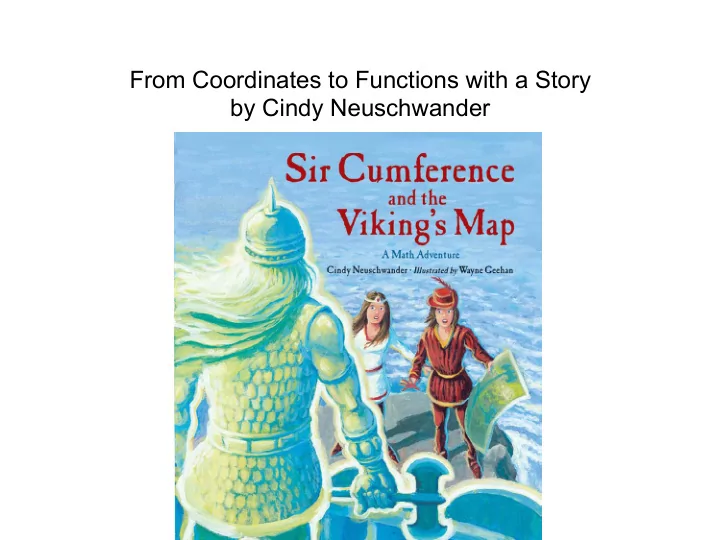
From Coordinates to Functions with a Story by Cindy Neuschwander
SLIDE 2 Common Core Standards
- A-CED-2 “Create equations in two or more variables
to represent relationships between quantities; graph equations on coordinate axes with labels and scales.
- A-REI-10 “Understand that the graph of an equation
in two variables is the set of all its solutions plotted in the coordinate plane, often forming a curve (which could be a line.)”
- 6.EE.9 “Use variables to represent two quantities in
a real-world problem that change in relationship to
- ne another.”
- 8.F.4 “Construct a function to model a linear
relationship between two quantities.”
SLIDE 3 Levels of Mathematical Language Development
- Dr. Calvin Irons
- This is a foundational idea in my math stories and in
my teaching.
SLIDE 4 Level 1: Natural Language
- This is the descriptive language that people use in
every day speaking.
- “Xaxon’s crossed pair of Viking axes forms a space
for finding the treasure.”
- His first name has 2 x’s and his last name has 2 y’s.
- Do you see his initials on his axes? Now check out
his shield. You can see his initials there too.”
SLIDE 5
SLIDE 6 Language of Materials:
- This is communicating math ideas with materials that
people commonly use and understand.
- In this case, it’s a map.
- “Let’s use the x and y axes on Xaxon’s map and
those number pairs to learn how to locate all the places Radius and Per went in the story.”
SLIDE 7
SLIDE 8 Language of Mathematics:
- This is communicating using mathematical names
and terms.
- “Let’s find the locations on the coordinate grid
using the ordered pairs.
- The first number is located on the x axis and the
second number is located on the y axis.”
SLIDE 9
SLIDE 10
SLIDE 11 Written Symbolic Language:
- This is communicating with the special language of
mathematics.
- In this story, we could say, y = x.
SLIDE 12 We can show this equation in a table:
x y 3 3 2 3 1 1
SLIDE 13
We can also show this as ordered pairs:
(3,3) (2,2) (1,1) (0,0) (-1, -1) (-2, -2) (-3, -3)
SLIDE 14 This can be shown as a line graph.
y = x
1 2 3 4
1 2 3 4
SLIDE 15 x and y axes
- Teach all four quadrants and always show all
four, if possible.
- Often students begin their understanding of
this idea with only the (+,+) quadrant and this limits their view of the coordinate plane.
- Xaxon’s shield is designed as a reminder of
all 4 quadrants and their locations.
SLIDE 16
SLIDE 17
SLIDE 18 Which axis is x and which one is y?
- Initially this can be confusing to some students.
- The story can help students remember: x comes
before y in the alphabet.
- Also, thinking of the story, Radius and Per first exit
the Viking’s hut (horizontal movement) and then they look out at the skyline (vertical movement).
- This becomes a way to remember, “First x and then
y.”
SLIDE 19
SLIDE 20 The coordinates:
- These are the two numbers used to locate a point.
- If (x,y) represents a point in a system of rectangular
coordinates, then x and y are the coordinates of that point.
- x is called the ‘domain’ and y is called the ‘range’.
- Inside x’s ‘domain’ are all of its values.
- Since x is the boss, it is called the independent
variable.
- y has to follow x’s lead so it is called the dependent
variable.
- y’s values are inside its range.
SLIDE 21
SLIDE 22
There are two foundational linear functions for students beginning their study of graphing functions:
SLIDE 23 The Mother Function*
- Everything starts here.
- The Mother Function’s math name is y=x.
- This line has a positive slope.
* Thanks to Dr. Phillip Gonsalves for the denotation of this function.
SLIDE 24 The Father Function*
- Everything ends here.
- The Father Function is the reverse of the Mother
Function.
- The Father Function’s math name is y=-x.
- This line has a negative slope.
*Thanks to Dr. Phillip Gonsalves for the denotation of this function.
SLIDE 25
The Mother and Father Functions are opposites.
SLIDE 26 The Mother Function
- When graphed, shows a picture of all the answers to
this equation: y=x.
x y 2 2 1 1
1 2
1 2
SLIDE 27 The Father Function
- When graphed, shows a picture of all the
answers to this equation: y=-x.
x y 2
1
2
1
1 2
1 2
SLIDE 28 Adding Complexity to the Mother Function
- Once students understand these two linear functions,
you can add one more layer of complexity.
- For the Mother Function, y=x + any number makes
the function line shift.
- For example, the picture for y=x+3 looks like this:
SLIDE 29 y=x+3
x y 2 5 1 4 3
2
1
1 2 3 4 5
1 2 3 4 5
SLIDE 30 Adding Complexity to the Father Function
- For the Father Function, y=-x+ any number makes
the function line shift.
- Here the picture of y=-x+3 looks like this:
SLIDE 31 y=-x+3
x y 2 1 1 2 3
4
5
1 2 3 4 5
1 2 3 4 5
SLIDE 32 Other functions can be identified by their distinctive looks:
Quadratic Mother Function: This is the picture of y=x2 and is a smile function.
x y 2 4 1 1
1
4
1 2 3 4
1 2 3 4
SLIDE 33 In the Classroom
- Even third graders can learn the Mother and Father
Functions of y=x and y=-x.
- Here are some pictures of Cindy teaching her third
graders these important functions with t-charts showing patterns they can easily understand.
- Using a SmartBoard worked well for this lesson.
SLIDE 34
SLIDE 35
SLIDE 36
SLIDE 37 Activities
- Here is a jpg file of a fun linear function activity using
the Mother Function line.
- It was developed by Shelley Kriegler at the Center of
Mathematics and Teaching and is part of MathLInks: Linear Functions Cluster.
- She has other fun ways to model math ideas with
functions.
- (Shelley’s email is kriegler@ucla.edu).
SLIDE 38
SLIDE 39
SLIDE 40
SLIDE 41
What You Can Do For Your Students
So run out right now and find some stories that can help you teach coordinates and functions memorably.
SLIDE 42
Coming Attraction……..