
SLIDE 1
18TH INTERNATIONAL CONFERENCE ON COMPOSITE MATERIALS
1 General Introduction For laminated composites, it is well-known that at the free edges interlaminar stresses arise from the mismatch of elastic properties between layers. Hence, the stress distribution in the vicinity of the free edges is three dimensional (3D) state even though the laminates are only subjected to in-plane loading [1, 2]. The interlaminar stresses are important because they have a marked effect on the failure strengths
- f
composite laminates. Accurate determination of interlaminar stresses near the free edge is therefore crucial to correctly describe the laminate behavior and to prevent its early failure, notably the delamination onset. This paper analyzes the stress-strain conditions at free edges of the laminates and using known delamination Tsai criteria predicts delamination occurrence. 2 Stress analysis at free edges of laminates The relation between stress and strain in a laminate layer away from the free edge is represented by the following relation
xy xy y y x x xy xy y y y xy y y y xy x y y yx x x x
G m m m E E m E E τ σ σ γ τ σ ν σ ε τ σ ν σ ε + ⋅ − ⋅ − = ⋅ − ⋅ − = ⋅ − ⋅ − = (1)
Coefficients mx and my in the previous equation represent the coefficients of mutual influence and can be expressed as a function of fiber angle (θ), Young's module (E1, E2), shear modulus (G12) and Poisson ratios (ν12, ν21) in the direction of the principal axes. εij, σij, (i, j = x, y) are the strain and stress components for the plane stress state. Near the free edges values of normal stress can have a large value which can cause damage to the structures at these locations, or can cause the separation of the lamina, a phenomenon known as delamination. In
- rder to obtain accurate stress distribution in these
areas a complete three-dimensional analysis has to be performed [3-5]. The case of [00/900]s laminate is initially
- analyzed. Considering this stack up sequence, when
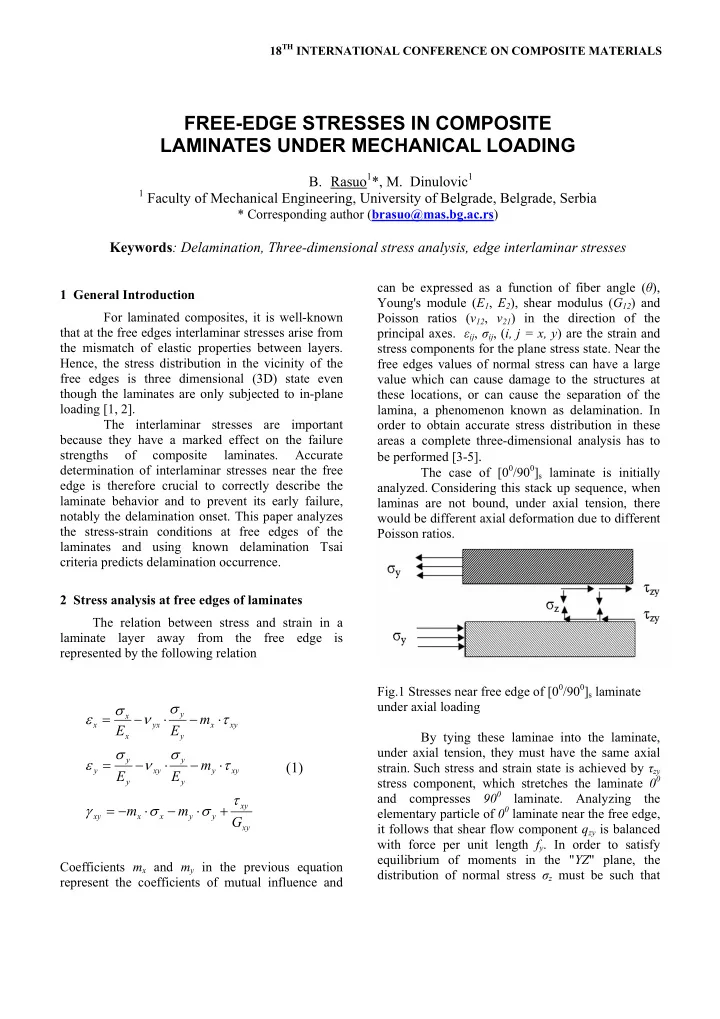
laminas are not bound, under axial tension, there would be different axial deformation due to different Poisson ratios. Fig.1 Stresses near free edge of [00/900]s laminate under axial loading By tying these laminae into the laminate, under axial tension, they must have the same axial
- strain. Such stress and strain state is achieved by τzy
stress component, which stretches the laminate 00 and compresses 900 laminate. Analyzing the elementary particle of 00 laminate near the free edge, it follows that shear flow component qzy is balanced with force per unit length fy. In order to satisfy equilibrium of moments in the "YZ" plane, the distribution of normal stress σz must be such that
FREE-EDGE STRESSES IN COMPOSITE LAMINATES UNDER MECHANICAL LOADING
- B. Rasuo1*, M. Dinulovic1
1 Faculty of Mechanical Engineering, University of Belgrade, Belgrade, Serbia