for Touchscreen Devices Philip Peng <pengp@stwing> Stephen H. - - PowerPoint PPT Presentation

for touchscreen devices
SMART_READER_LITE
LIVE PREVIEW

for Touchscreen Devices Philip Peng <pengp@stwing> Stephen H. - - PowerPoint PPT Presentation

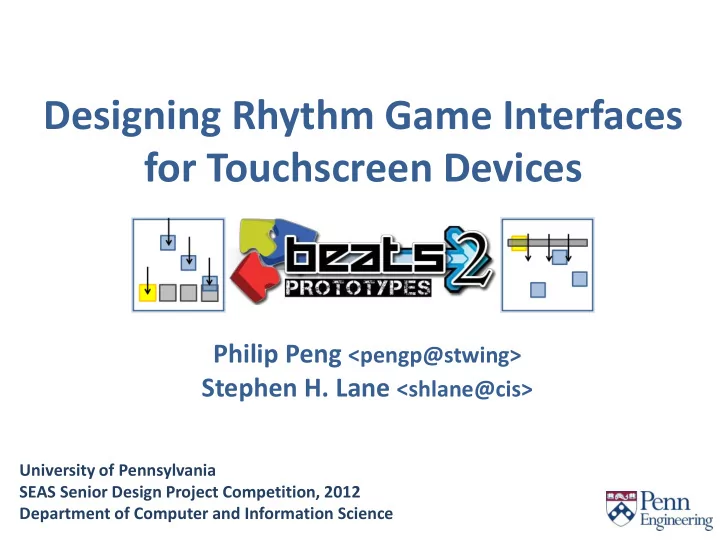
Designing Rhythm Game Interfaces for Touchscreen Devices Philip Peng <pengp@stwing> Stephen H. Lane <shlane@cis> University of Pennsylvania SEAS Senior Design Project Competition, 2012 Department of Computer and Information Science

slide-1
SLIDE 1

Designing Rhythm Game Interfaces for Touchscreen Devices

University of Pennsylvania SEAS Senior Design Project Competition, 2012 Department of Computer and Information Science

Philip Peng <pengp@stwing> Stephen H. Lane <shlane@cis>

slide-2
SLIDE 2
  • Touchscreen devices on the rise

– iPod Touch/iPad – Android phones/tablets – Windows 8 slates

  • New input paradigm

– No mouse/keyboard – New interface designs!

Touchscreens

slide-3
SLIDE 3
  • Rhythm Games

– Timing-critical music games – Measure player’s sense of rhythm

  • Popular examples:

– Dance Dance Revolution – Guitar Hero – Beatmania IIDX – etc.

Rhythm Games

slide-4
SLIDE 4

Rhythm Games + Touch

  • Gameplay

– Action performed in response to note patterns – Better timing = higher score

  • Design Factors
  • 1. User Responsiveness
  • 2. Gameplay Experience
  • Visual-recognition/physical input relation

– Perfect for touchscreen UI study!

slide-5
SLIDE 5

The study focus: The comparison of different user interface designs for the future development of rhythm games on touchscreen devices.

Project - Focus

slide-6
SLIDE 6
  • How?

– Make a prototype rhythm game and collect data!

Project - Solution

slide-7
SLIDE 7
  • Three stages
  • 1. Design
  • 2. Prototype
  • 3. Evaluation

Project – Three Stages

slide-8
SLIDE 8

Design – Analyzing Existing Games

  • Analyze and

categorize existing rhythm games

– 22 analyzed – Layout, Notes, Hitbox, Movement, Design

slide-9
SLIDE 9

Design - Interfaces

  • Eight different rhythm game interface designs
slide-10
SLIDE 10

Design - Interfaces

  • Eight different rhythm game interface designs

Element Mobility: Moving notes, fixed hitboxes

slide-11
SLIDE 11

Design - Interfaces

  • Eight different rhythm game interface designs

Element Mobility: Fixed notes, moving hitboxes

slide-12
SLIDE 12

Design - Interfaces

  • Eight different rhythm game interface designs

Element Mobility: Fixed notes, fixed hitboxes

slide-13
SLIDE 13

Design - Interfaces

  • Eight different rhythm game interface designs

Movement Behaviour: Top to bottom

slide-14
SLIDE 14

Design - Interfaces

  • Eight different rhythm game interface designs

Movement Behaviour: Centre to Corners

slide-15
SLIDE 15

Design - Interfaces

  • Eight different rhythm game interface designs

Movement Behaviour: Corners to centre

slide-16
SLIDE 16

Design - Interfaces

  • Eight different rhythm game interface designs

Movement Behaviour: Fixed grid points

slide-17
SLIDE 17

Implementation - Development

  • Prototype game developed

– “Beats2 Prototypes”

http://git.to/beats2protot

– Simple game for study

  • 4 notes of same colour
  • Tap action

– Featured 8 design as modes – Use same backend and game data

slide-18
SLIDE 18

Implementation - Technical

  • Developed for Unity3

– C#, Cross-platform

  • Target device

– Android tablets – Test device: Samsung Galaxy Tab 10.1 – Could run on iPad (but don’t have one)

slide-19
SLIDE 19

Demo Video

http://www.youtube.com/watch?v=n-pFAVSPj10

slide-20
SLIDE 20

Evaluation – App Release

  • Android app released publically

– Google Play: http://git.to/beats2protot – Website: http://beatsportable.com/2012/04/beats2-prototypes/

  • Total of 100+ players, 30 tablet users
slide-21
SLIDE 21

Evaluation – User Responsiveness

  • To obtain data, built-in tracker implemented
  • Timing Accuracy

(quantitative measure of user responsiveness) – MARVELOUS – PERFECT – GREAT – GOOD – ALMOST – MISS

slide-22
SLIDE 22

Evaluation – Gameplay Experience

  • Feedback Ratings

(qualitative measure of gameplay experience, loosely based

  • n Swetser & Wyeth’s Gameflow model)

– Challenge – Intuitive – Fun – Unique – Overall Rated on 1-5 scale, normalized for comparison

slide-23
SLIDE 23

Results – Timing Accuracy

slide-24
SLIDE 24

Results – Timing Accuracy

slide-25
SLIDE 25

Results – Feedback Ratings

slide-26
SLIDE 26

Results – Feedback Ratings

slide-27
SLIDE 27

Results – Overall

  • Overall results:

– User Responsiveness and Gameplay Experience not correlated but both important (e.g. #1 and #4/#8 – Moving Notes, Fixed Hitboxes > Fixed Notes, Moving Hitboxes

slide-28
SLIDE 28

Results – Conclusion

  • Focus: The comparison of different user

interface designs for the future development

  • f rhythm games on touchscreen devices.
  • Answer: Design #2 is the best candidate for

future rhythm game development

slide-29
SLIDE 29

Thanks

  • Faculty Advisor:

– Stephen H. Lane

  • CIS 401 Professor and TAs:

– Insup Lee – Andrew G. West – Alex Roederer

  • Prototype Testers

– STWingers – Anonymous internet testers – You (in advance if you download and try it out)