FIRST: THE INSPECTION GAME 2 UNCERTAINTY: Employee does not know - - PDF document

first the inspection game
SMART_READER_LITE
LIVE PREVIEW

FIRST: THE INSPECTION GAME 2 UNCERTAINTY: Employee does not know - - PDF document

STRATEGIC THINKING IN GAMES AND MARKETS And The Link With Theory Of Mind CLASS 8 1 FIRST: THE INSPECTION GAME 2 UNCERTAINTY: Employee does not know what employer will do Employer does not know what employee will do 3 PREDICTING


slide-1
SLIDE 1

And The Link With Theory Of Mind CLASS 8

STRATEGIC THINKING IN GAMES AND MARKETS

1

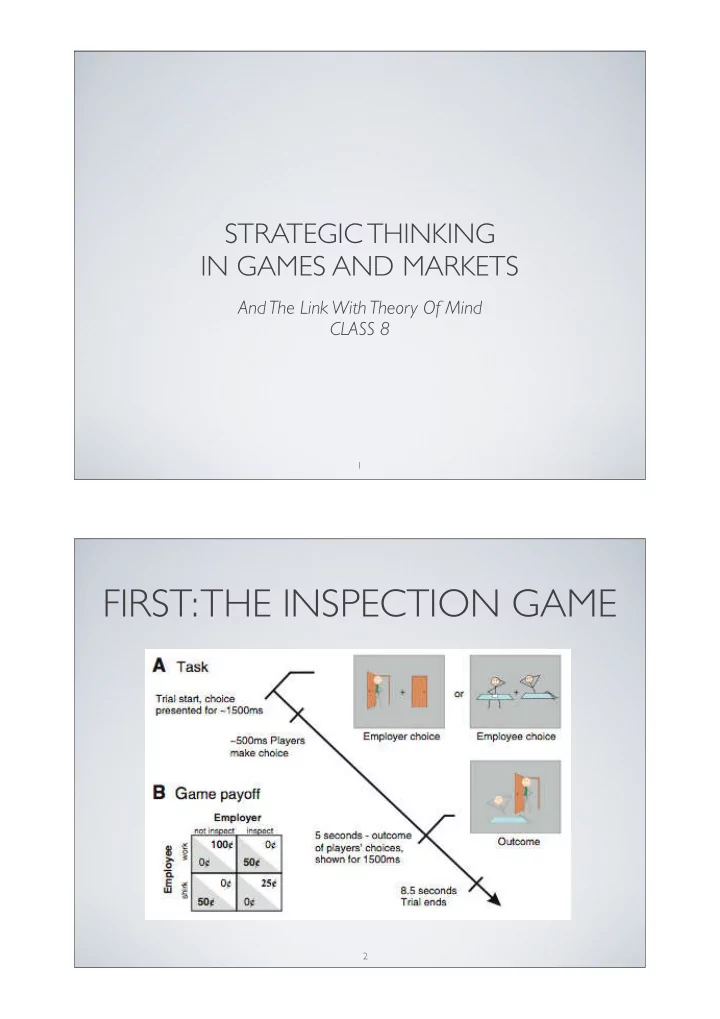
FIRST: THE INSPECTION GAME

2
slide-2
SLIDE 2

UNCERTAINTY:

  • Employee does not know what employer will do
  • Employer does not know what employee will do

3

PREDICTING UNDER THIS UNCERTAINTY

  • This skill is extremely important in modern economic life
  • Yet we don’t understand why (many) humans are good at it
  • Humans seem to apply the right “intuition”
  • Who?
  • What is this intuition?

4

slide-3
SLIDE 3

NASH

  • Subjects do not play the equilibrium strategies from the one-shot

game

  • So, forecasting what the opponent will do cannot be based on this

prediction

  • (Of course, you can try to figure out the Nash equilibrium of the

multi-stage game, but there are lots, lots,...)

5

PSYCHOLOGISTS TALK ABOUT: THEORY OF MIND

  • “Theory of Mind” (or “mentalizing”) is the ability to recognize and

understand intentions or goal-directness in patterns in one’s environment

  • … as opposed to mere expression of physical laws
  • Intention:
  • Malevolent
  • Benevolent
  • Involves (“new”) regions of the cortex, distinct from formal

mathematical and probabilistic brain regions

6

slide-4
SLIDE 4

Example: The intentional stance of a moving object Base Situation New Situation 1 Physics OK New Situation 2: ?!

(Uller, Nichols, Cognition, 2000)

7

REMARKS

  • One-year old infant (and apes) may be able to recognize goal-

directness but cannot use it to its advantage (E.g., chocolate-in- drawer experiment)

  • But:
  • What does Theory of Mind mean formally?
  • Enter Economics…

8

slide-5
SLIDE 5

THEORY OF MIND ENGAGES PART OF THE “SOCIAL BRAIN”

9

IN GAMES:

  • Recently, Theory of Mind brain

regions have been found to be activated also when playing strategic games

  • … such as rock, paper, scissors

(Gallager-Frith, 2003: contrast between playing against human and against simple computer- based rule)

10

slide-6
SLIDE 6

BUT…

  • These are simple contrasts (affectionately called “blobology”)
  • What computations are involved?

Hampton, Bossaerts, O’Doherty, PNAS, 2008

11

MATHEMATICS: REINFORCEMENT LEARNING

Prediction Error Action Value Logit Model for Probability of Action a

12

slide-7
SLIDE 7

MATHEMATICS: FICTITIOUS PLAY

Stochastic (Logit) Best Response Given Beliefs Learning of Opponent’s Strategy Prediction Error

13

MATHEMATICS: “INFLUENCE”

Taylor Expansion of Strategies Getting Opponent’s Beliefs Learning From Action Of Opponent (“Fictitious Play”) Predicted Change In Opponent Actions (“Influence”)

14

slide-8
SLIDE 8

THE REWARD ERROR FROM THE “INFLUENCE” PREDICTION IS ENCODED IN PCC:

Hampton, ea, PNAS 2008

15

(HERE IS THE FICTITIOUS PLAY REWARD PREDICTION ERROR:)

Striatum: Traditionally involved in reinforcement learning (Based on “dopamine”)

16

slide-9
SLIDE 9

DIFFERENCE WITH CLASSICAL GAME THEORY:

  • (Static) Nash equilibrium predicts:
  • Employee works with probability 1/5; shirks with probability 4/5
  • Employer inspects with probability 1/2
  • No need to predict effect of own actions on opponent’s beliefs and

actions!

17

RELATED TO HIGHER-ORDER THINKING

NO correlation with accuracy in the calculation task (r = .009, P >.5) Coricelli and Nagel (2009)

18

slide-10
SLIDE 10

STAG-HUNT

19

  • Complex stag-hunt game
  • Against sophisticated (order

k) computer

  • E.g., Order 2 = “I think that

you think that I will move left”

  • (Cooperation, i.e., stag hunt,

increases when order k increases)

UNCERTAINTY ABOUT INFERENCE OF COMPUTER’S LEVEL IS ENCODED IN MPFC (YOSHIDA EA)

20

slide-11
SLIDE 11

OWN LEVEL OF K CORRELATES WITH NEURAL ACTIVITY

  • Lateral PFC, Superior Parietal Lobule, Superior Frontal Sulcus

21

COMPARING AUTISTIC PATIENTS WITH CONTROLS

  • Patients cannot track changes in

sophistication (order k) of computer

  • Model that assumes fixed k for

computer fits choices better than model that tracks changes in k (“ToM model”)

  • Equivalently: “forgetting

rate” (discarding old observations) is higher for controls

22

slide-12
SLIDE 12

(ANALOGOUS EFFECTS IN TRUST GAME FOR BORDERLINE PERSONALITY DISORDER PATIENTS)

  • King Cases ea: When trust is broken in trust game, BPD patients

cannot re-establish trust

  • Related to different activation in anterior insula (they do not expect

trust to go away, but once it does, they don’t know anymore what world they live in

  • COMPUTATIONAL (NEURO)PSYCHIATRY

23

TOWARDS “MANIPULATION”

24

  • Bhatt ea, PNAS (2010)
  • Beyond influence (taking into account that one is learning about a moving

target)

  • Really “teaching” (belief manipulation)
slide-13
SLIDE 13

OF INCREMENTALISTS, STRATEGISTS AND RATIONALISTS

  • Incrementalists: correlate

price suggestion with value

  • Rationalists: think everyone

is rational, and induce no correlation in relation with value...

  • Strategist: react to

presence of incrementalists by anti-correlating suggested price and value!

25

IQ, SOCIOECONOMIC STATUS AND EARNINGS

26

slide-14
SLIDE 14

IMAGING

  • Differential activation for strategists

(between-group comparison)

  • Compare to

Yoshida’s imaging results!

27

NEXT: FINANCIAL MARKETS WITH “INSIDERS”

  • Even large-scale, anonymous financial markets may be perceived as

intentional, goal-oriented – or “strategic:” there may be “insiders”

  • Questions:

1.

Is this within scope of Theory of Mind?

2.

Does Theory of Mind help?

3.

What does it do?

28

slide-15
SLIDE 15

EXPERIMENT:

  • Markets are re-played in scanner while subject is exposed to risk
  • Subject:
  • Predicts price changes in market replay;
  • Performs Theory of Mind tests;
  • Performs (financial) mathematics test

20

29

MARKET REPLAY

30

slide-16
SLIDE 16

22

Graphical replay of market

31

IMAGING RESULTS

23

Effect of |price-0.25|, contrast between insider and no-insider treatment Bruguier, ea, J Finance 2010

32

slide-17
SLIDE 17

EXPLANATORY VARIABLES FOR BRAIN ACTIVATION

33

PREDICTION PERFORMANCE RESULTS

Against Heider test

2 4 6 8 10 12 14 45 50 55 60 65 70 75 80 85 !=0.348247, p=0.022110, n=43 Heider Test Financial Market Prediction

Against Math test

−1 1 2 3 4 5 6 7 8 45 50 55 60 65 70 75 !=0.060792, p=0.698569, n=43 Mathematical puzzles Financial Market Prediction

34

slide-18
SLIDE 18

WHAT DOES THIS MEAN FORMALLY?

! Theory of Mind brain regions are engaged and financial

performance correlates with Theory of Mind skills

! Now, Theory of Mind = pattern recognition ! So: What patterns are attended to? ! First of all: What distinguishes presence of insiders?

35

PRICING PATTERNS WHEN THERE ARE INSIDERS: VOLATILITY CLUSTERING

36

slide-19
SLIDE 19

“GENERALIZED AUTOREGRESSIVE CONDITIONAL HETEROSKEDASTICITY” (GARCH)

! Typical autocorrelations of absolute price change: GREEN=Insiders;

BLUE=No Insiders

37

(CONTRAST WITH ECONOMIC THEORY)

! Rational Expectations Equilibrium: Uninformed

are supposed to know how prices relate to information

  • f insiders

! Where does this knowledge come from?! ! Here we provide a partial answer

38

slide-20
SLIDE 20

ASSET PRICE BUBBLES

  • Similar activations when there is mis-pricing...

39

TAKE-HOME MESSAGES I

! Playing strategic games engages “Theory of Mind” ! Theory of Mind is about predicting how the opponent

changes strategies because she is learning

! Goes beyond fictitious play and reinforcement learning

(opponent is intentional)

! Theory of Mind is mathematics: pattern recognition ! … which is not the mathematics of Nash equilibrium

40

slide-21
SLIDE 21

TAKE-HOME MESSAGES II

! Theory of Mind also applies to understanding “social

systems” that don’t really have a mind on their own

! We see this in brain activation when exposed to risk in

markets with insiders

! We also see this in correlation of performance

between predicting prices in such markets and traditional Theory of Mind tasks

! … and in the absence of correlation with

mathematical skill (as when playing strategic games)

! Patterns being recognized = GARCH?

41