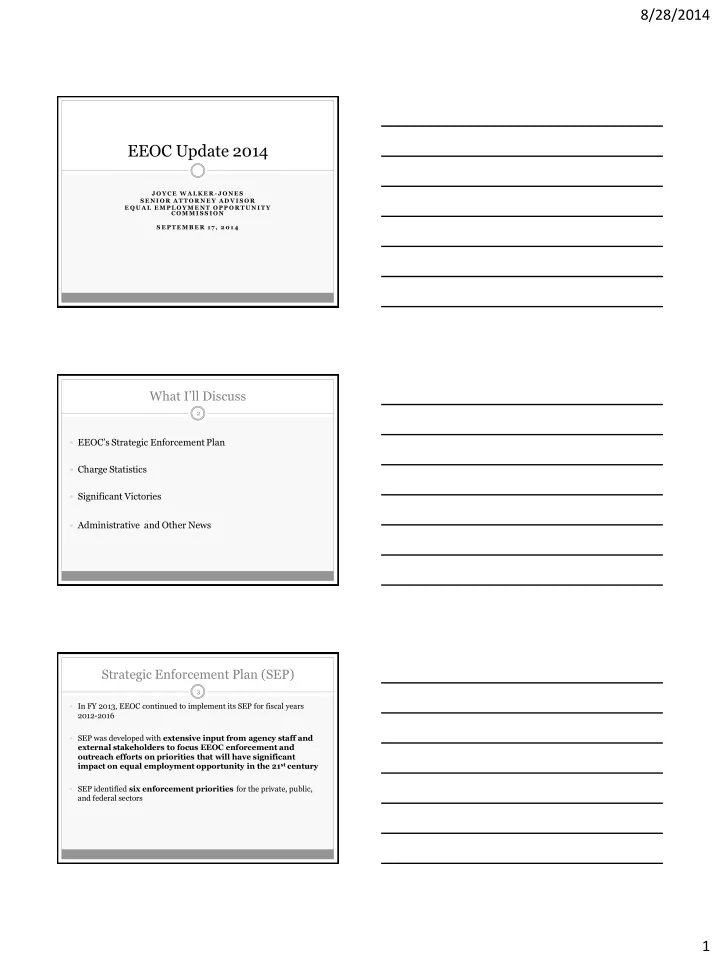
EEOC Update 2014 J O Y CE W A L K E R - J O N E S S E N I O R A T - - PDF document

eeoc update 2014
SMART_READER_LITE
LIVE PREVIEW

EEOC Update 2014 J O Y CE W A L K E R - J O N E S S E N I O R A T - - PDF document

8/28/2014 EEOC Update 2014 J O Y CE W A L K E R - J O N E S S E N I O R A T T O R N E Y A D V I S O R E Q U A L E M P L O Y M E N T O P P O R T U N I T Y CO M M I S S I O N S E P T E M B E R 1 7 , 2 0 1 4 What Ill Discuss 2


slide-1
SLIDE 1

8/28/2014 1

J O Y CE W A L K E R - J O N E S S E N I O R A T T O R N E Y A D V I S O R E Q U A L E M P L O Y M E N T O P P O R T U N I T Y CO M M I S S I O N S E P T E M B E R 1 7 , 2 0 1 4

EEOC Update 2014

What I’ll Discuss

2

 EEOC’s Strategic Enforcement Plan  Charge Statistics  Significant Victories  Administrative and Other News

Strategic Enforcement Plan (SEP)

3  In FY 2013, EEOC continued to implement its SEP for fiscal years

2012-2016

 SEP was developed with extensive input from agency staff and

external stakeholders to focus EEOC enforcement and

  • utreach efforts on priorities that will have significant

impact on equal employment opportunity in the 21st century

 SEP identified six enforcement priorities for the private, public,

and federal sectors

slide-2
SLIDE 2

8/28/2014 2

Six National Enforcement Priorities

4  Eliminating barriers in recruitment and hiring by targeting

class-based recruitment and hiring practices that discriminate against certain groups, such as people with disabilities

 Targeting disparate pay, job segregation, harassment, and

discriminatory policies affecting immigrant, migrant, and other vulnerable workers

 Addressing emerging and developing issues in equal

employment law

Enforcement Priorities (cont.)

5  Enforcing equal pay laws  Preserving access to the legal system  Preventing harassment through systemic enforcement and targeted

  • utreach

1st Wellness Program Suit

6  EEOC v. Orion Energy Systems: EEOC maintains that Orion

violated the ADA by requiring an employee to submit to medical exams and inquiries hat are not job-related and consistent with business necessity as part of a so-called “wellness program.” An employee who refused to participate was forced to pay the entire $413.43 monthly premium for her company-provided health insurance and then fired.

slide-3
SLIDE 3

8/28/2014 3

Charge Statistics

7  In FY 2013, EEOC received 93,727 charges – approx. 6,000 fewer

than previous three fiscal years

 Of those charges, 25,957 alleged a violation of the ADA  We filed 131 merit lawsuits, including 89 individual suits, 21 non-

systemic suits, and 21 systemic suits

 Of those charges, 51 contained ADA claims

Breakdown of ADA Charges

8 

Most frequently cited impairments:

Anxiety Disorders and Depression 13.5%

Orthopedic and Structural Impairments of the Back 9.0%

Diabetes 4.7%

“Other Disability” 29.4%

ADA Charges (cont.)

9  Most frequently cited issues:

 Discharge

23,493 charges

 Reasonable Accommodation

14,197

 Terms & Conditions

8,731

 Harassment

7,580

slide-4
SLIDE 4

8/28/2014 4

EEOC Made Employers Pay

10  EEOC secured a record $372.1 million in monetary relief for victims

  • f employment discrimination in private sector and state and local

government workplaces through mediation, conciliation, and other administrative enforcement

 Legal staff resolved 209 merits lawsuits (including 59 ADA

claims) for a total of $39 million in monetary relief through litigation

 Overall, the agency secured both monetary and non-monetary benefits

for more than 70,522 charging parties through administrative enforcement activities including mediation, settlements, conciliations, and withdrawals with benefits

Who Had to Pay and Why

11  Restrictive Leave Policies:

 EEOC v. Interstate Distributor Company: EEOC alleged that a

trucking company in Colorado maintain a maximum leave policy and 100 percent restriction-free return-to-work policy that operated to deny reasonable accommodations to employees with disabilities; case was resolved by a consent decree providing $4.9 million to 427 claimants + injunctive relief

 EEOC v. Princeton Health Care System (PHCS): EEOC

alleged that PCHS’s fixed leave policy failed to consider leave as a reasonable accommodation; resolved by a consent decree, PCHS will pay $1.35 million to employees who were unlawfully terminated

12  Other significant cases involving leave:

 EEOC v. Supervalu ($3.2 million challenging termination of

  • approx. 1,000 employees at the end of medical leave)

 EEOC v. Sears: ($6.2 million challenging automatic termination

policy

slide-5
SLIDE 5

8/28/2014 5

13  Unlawful Requests for Medical Information:

 EEOC v. Dillards: EEOC alleged that the department store’s policy

requiring employees to disclose medical information or face discipline violated the ADA; case was resolved by a consent decree providing $2 million to more than 6,000 individuals + injunctive relief.

14  Failure to Provide a Reasonable Accommodation:

 EEOC v. Baptist Health South Florida: EEOC alleged that the

hospital discriminated against a general practitioner when it reversed its decision to let a doctor with epilepsy limit her workday to eight hours/day. Hospital will pay $215,000 to settle suit and furnish other relief.

 EEOC v. Upper Chesapeake Health System: Healthcare system

failed to reassign a technician with Usher’s syndrome (a genetic disorder characterized by varying levels of vision and hearing loss) based on its perception that she could not do her job. Upper Chesapeake will pay $180,000 to settle suit

15  Refusal to Hire/Termination:

 EEOC v. Professional Freezing: EEOC charged that the

company failed to hire an applicant with prostate cancer based on its fear that he “would end up wearing diapers.” Company will pay $80,000 under a consent decree

 EEOC v. Christian Care Center: EEOC alleged that a nursing

home fired a LPN, who had worked for one month, when it learned that she is HIV-positive. The center agreed to pay $90,000 to settle the lawsuit

slide-6
SLIDE 6

8/28/2014 6

16  Violation of the Genetic Information in Discrimination Act:

 EEOC v. Founders Pavilion, Inc.: EEOC charged that a nursing

and rehabilitation center requested family medical history as part

  • f its post-offer, pre-employment medical exam of applicants; EEOC

also alleged that Founders fired two employees because they were perceived to be disabled. Founders agreed to pay $370,000 to settle the lawsuit

New Pregnancy Discrimination Guidance

17  EEOC issued updated Enforcement Guidance on Pregnancy

Discrimination and Related Issues, along with a question-and- answer document and Fact Sheet for Small Businesses

 Issues discussed:

 Leave for pregnancy and for medical conditions related to

pregnancy

 When employers may have to provide a reasonable

accommodation for workers with pregnancy-related impairments under the ADA

Other Significant Accomplishments

18  Extensive Outreach and Public Education Activities: Our

  • utreach programs reached more than 280,000 person in FY 2013

through sponsorship and participation in more than 3,800 no-cost educational, training, and outreach events, including:

 850 events on disability issues attended by 60,936 participants  93 events that addressed the Pregnancy in Discrimination Act and

the ADA were offered to 5,801 attendees

slide-7
SLIDE 7

8/28/2014 7

Administrative and Other News

19  General Counsel David Lopez was reconfirmed  Commissioner Jenny Yang was appointed EEOC Vice Chair  Chair Jacqueline Berrien announced that she was not seeking re-

nomination