Drafting Severance and Confidentiality Agreements Amid New EEOC and - - PowerPoint PPT Presentation

drafting severance and confidentiality agreements amid
SMART_READER_LITE
LIVE PREVIEW

Drafting Severance and Confidentiality Agreements Amid New EEOC and - - PowerPoint PPT Presentation

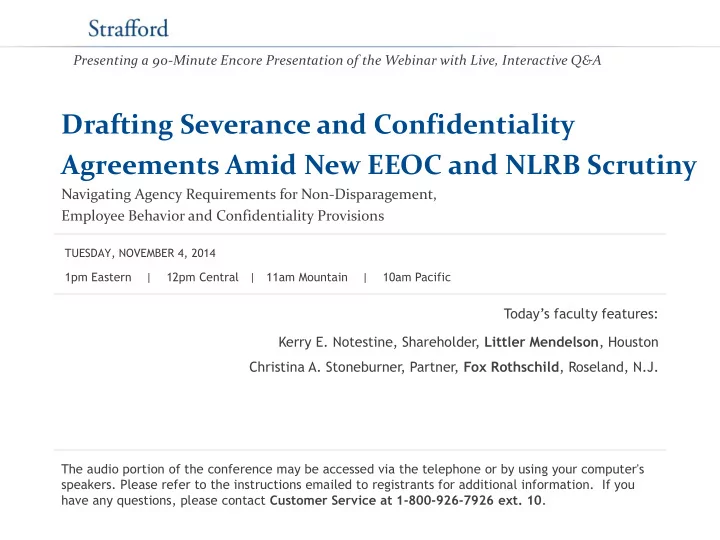
Presenting a 90-Minute Encore Presentation of the Webinar with Live, Interactive Q&A Drafting Severance and Confidentiality Agreements Amid New EEOC and NLRB Scrutiny Navigating Agency Requirements for Non-Disparagement, Employee Behavior


slide-1
SLIDE 1

Drafting Severance and Confidentiality Agreements Amid New EEOC and NLRB Scrutiny

Navigating Agency Requirements for Non-Disparagement, Employee Behavior and Confidentiality Provisions

Today’s faculty features:

1pm Eastern | 12pm Central | 11am Mountain | 10am Pacific

The audio portion of the conference may be accessed via the telephone or by using your computer's

  • speakers. Please refer to the instructions emailed to registrants for additional information. If you

have any questions, please contact Customer Service at 1-800-926-7926 ext. 10.

TUESDAY, NOVEMBER 4, 2014

Presenting a 90-Minute Encore Presentation of the Webinar with Live, Interactive Q&A Kerry E. Notestine, Shareholder, Littler Mendelson, Houston Christina A. Stoneburner , Partner, Fox Rothschild, Roseland, N.J.

slide-2
SLIDE 2

Sound Quality If you are listening via your computer speakers, please note that the quality

  • f your sound will vary depending on the speed and quality of your internet

connection. If the sound quality is not satisfactory, you may listen via the phone: dial 1-866-370-2805 and enter your PIN when prompted. Otherwise, please send us a chat or e-mail sound@straffordpub.com immediately so we can address the problem. If you dialed in and have any difficulties during the call, press *0 for assistance. Viewing Quality To maximize your screen, press the F11 key on your keyboard. To exit full screen, press the F11 key again.

FOR LIVE EVENT ONLY

slide-3
SLIDE 3

For CLE purposes, please let us know how many people are listening at your location by completing each of the following steps:

  • In the chat box, type (1) your company name and (2) the number of

attendees at your location

  • Click the word balloon button to send

FOR LIVE EVENT ONLY

slide-4
SLIDE 4

Drafting Severance and Confidentiality Agreements Amid New EEOC and NLRB Scrutiny

Tuesday, November 4, 2014

slide-5
SLIDE 5

Presented by:

Kerry E. Notestine Littler, Dallas knotestine@littler.com 713.652.4748 Christina A. Stoneburner Fox Rothschild, Roseland, N.J. cstoneburner@foxrothschild.com 973.994.7551

5

slide-6
SLIDE 6

Agenda

  • EEOC requirements and

legal framework for severance agreements

  • NLRB requirements and

legal framework – Confidentiality provisions – Employee behavior and conduct policies – Non-disparagement provisions

  • Drafting best practices

6

slide-7
SLIDE 7

EEOC Requirements and Legal Framework for Severance Agreements

Kerry Notestine, Littler

A

7

slide-8
SLIDE 8

Background to Current Issues

  • This is NOT just about the OWBPA and Age

issues

  • EEOC Enforcement Guidance on non-waivable

employee rights under EEOC enforced statutes, EEOC Notice 915.002 (4/10/97)

  • 29 USC § 626(f)(4) codifies this obligation for

claims under the ADEA.

  • EEOC v. Eastman Kodak, 2006 case under

Title VII and the ADEA.

8

slide-9
SLIDE 9

Kodak Consent Decree

“Except as described below, you agree and covenant not to file any suit, charge or complaint against Releasees in any court or administrative agency, with regard to any claim, demand, liability or

  • bligation arising out of your employment with Kodak or separation
  • therefrom. You further represent that no claims, complaints, charges,
  • r other proceedings are pending in any court, administrative agency,

commission or other forum relating directing or indirectly to your employment by Kodak. Nothing in this Agreement shall be construed to prohibit you from filing a charge with or participating in any investigation or proceeding conducted by the EEOC or a comparable state or local agency. Notwithstanding the foregoing, you agree to waive your right to recover monetary damages in any charge, complaint, or lawsuit filed by you or by anyone else on your behalf.”

Consent Decree, EEOC v. Eastman Kodak (W.D.N.Y. October 11, 2006).

9

slide-10
SLIDE 10

EEOC v. Baker & Taylor

  • EEOC sues Baker & Taylor May 20, 2013
  • EEOC and Baker & Taylor enter into sweeping

consent decree July 2013

  • “Employees retain the right to participate in

any action [before the EEOC or comparable state or local agencies] and to recover any appropriate relief.”

10

slide-11
SLIDE 11

CVS and CollegeAmerica Cases

11

slide-12
SLIDE 12

EEOC v. CVS Pharmacy

  • EEOC sues CVS

Pharmacy on February 7, 2014

  • EEOC alleges “Pattern or

Practice” of unlawful conduct

  • Release agreement

attached to Complaint

  • Covenant not to Sue

includes Charge Carve-

  • ut

12

slide-13
SLIDE 13

EEOC v. CVS Pharmacy

  • Provisions challenged
  • Covenant not to Sue
  • Non-Disparagement and Non-

Disclosure

  • Notification
  • Remedies including Attorneys’

Fees

  • Five-Page Single Spaced

Document

13

slide-14
SLIDE 14

EEOC v. CVS Pharmacy

  • Motion to Dismiss Filed
  • n 4/18/14
  • No Unlawful Discrimination
  • No Pattern & Practice
  • EEOC failed to Conciliate
  • Amicus Curiae Brief by

Retail Litigation Center

  • Five Page Release is not

Burdensome

  • Fully Briefed and

Awaiting Decision

14

slide-15
SLIDE 15

EEOC v. CollegeAmerica

  • EEOC Phoenix District Office sues

CollegeAmerica in Denver on 4/30/14

  • Employee (Potts) Resigned
  • Signed Settlement Agreement
  • $7000 payment and No Dispute on Unempl.
  • Agreement Not to Contact Gov’t Agency
  • Forward Complaints and Non-Disparagement

15

slide-16
SLIDE 16

EEOC v. CollegeAmerica

  • Allegedly disparaging emails with another

former employee that are forwarded to Company

  • Potts files Charge
  • Company sues Potts 7 days later
  • Potts files two Retaliation Charges

16

slide-17
SLIDE 17

EEOC v. CollegeAmerica

  • Potts and 4 Form Agreements Attached to

Complaint

  • Prohibits Filing Charge/No Carve Out
  • EEOC challenges Additional Provisions
  • No Claims
  • Certification of Non-Compliance Disclosure
  • Severability Clause
  • CollegeAmerica filed MTD which is fully

briefed and awaiting Decision

  • MeToo Motion to CVS

17

slide-18
SLIDE 18

NLRB Requirements and Legal Framework

Christina A. Stoneburner, Fox Rothschild

A

slide-19
SLIDE 19

Can a Severance Agreement Waive Claims Under the NLRA?

  • General Rule is that Severance Agreements should be

treated as any other non-Board settlement and Board would defer after examining:

─ Whether the parties have agreed to be bound, and the position

taken by the General Counsel regarding the settlement;

─ Whether the settlement is reasonable in light of the violations

alleged, the risks inherent in litigation, and the stage of litigation;

─ Whether there has been any fraud, coercion, or duress by any

party in reaching the settlement; and

─ Whether the respondent has a history of violations of the Act or

has breached past unfair labor practice settlement agreements (Independent Stave Co., 287 NLRB 740, 743 (1987)

19

slide-20
SLIDE 20

Can a Severance Agreement Waive Claims Under the NLRA? (cont.)

  • NLRB may or may not defer to the

terms of the severance agreement

  • Even an employee who signed a

severance agreement may later file an unfair labor practice charge or recover money in the event a charge is filed on the employee’s behalf

20

slide-21
SLIDE 21

Why Has the NLRB Been Actively Reviewing Severance Agreements?

  • Memorandum OM 08-13

(December 5, 2007)

  • Issued to all Regional

Directors Calling for them to Actively Investigate Waivers

21

slide-22
SLIDE 22

Confidentiality and Non-disparagement Provisions: Why Does the NLRB Care?

  • NLRA Section 7:

“Employees shall have the right to self-

  • rganization, to form, join, or assist labor
  • rganizations, to bargain collectively through

representatives of their own choosing, and to engage in other concerted activities for the purpose of collective bargaining or other mutual aid or protection . . .”

22

slide-23
SLIDE 23

Confidentiality and Non-disparagement Provisions: When Did the NLRB Start Caring?

  • Not a new concept
  • See, for example, Metro Networks, Inc,. and American

Federation of Radio and Television Artists, Philadelphia Locals, AFL-CIO, Cases 4-CA-26812 and 4-CA-27207 (September 28, 2001)

  • Violation of Section 8(a)(4) where fired employee for

union activity and then gave release with unlawful confidentiality provision:

─ Stating employee would not “publish, publicize, disseminate,

communicate or cause to be published, information concerning your employment . . . , the existence of this Agreement or the terms described herein except to your immediate family, attorneys, accountants, or tax advisors.”

23

slide-24
SLIDE 24

But Why the Sudden Focus?

  • In part, because this has become

an enforcement issue at the federal level with the EEOC

  • As overall union representation

declines (now approximately 8%), NLRB has been more aggressive about enforcing rights to engage in concerted activity in actively reviewing handbooks, social media policies and severance agreements

24

slide-25
SLIDE 25

Confidentiality and Non-disparagement Provisions: What Does the NLRB Care About?

  • Broad provisions that prohibits or would

reasonably lead an employee to believe that they are prohibited from saying anything about the employer or that restrict right to concerted activity

25

slide-26
SLIDE 26

Confidentiality and Non-disparagement Provisions: How Much Does the NLRB Care?

  • Not uncommon for NLRB to include in Notices

to Employees where violation is found that the employer “will not require you to sign a severance agreement or any agreement that contains confidentiality or non-disparagement clauses that restrict you from engaging in protected concerted activities

─ See Board Decision in Pratt (Corrugated Logistics),

LLC and Teamsters Local 773, Cases 04-CA-07963, 04-CA-079858, 04-CA-079976, and 04-RC-080108 (February 21, 2014)

26

slide-27
SLIDE 27

Problems With Severance Agreements in Pratt

  • Extensive discussion in the ALJ decision (JD-

08-13) of problem provisions:

─ Provision that prevented the employee from disclosing

the “contents” of the agreement with anyone except family or financial or legal

─ Provision that prevented the employee from making

statements or engaging in conduct that “disparages, criticizes . . . or otherwise cases a negative characterization upon . . . any Pratt Entity . . . nor encourage or assist anyone else to do so.”

27

slide-28
SLIDE 28

Problems With Severance Agreements in Pratt (Cont.)

  • Non-disparagement clause was not saved by

provision saying that is does not prevent signatory from testifying in a legal proceeding

  • r complying with a subpoena

─ Employees must be able to consult with other

employees and their union on employment matters

28

slide-29
SLIDE 29

Drafting Best Practices

Kerry Notestine, Littler Christina A. Stoneburner, Fox Rothschild

A

slide-30
SLIDE 30

Drafting Best Practices

  • Don’t overreact

─ EEOC does not seem to be challenging the validity of

the releases themselves

─ BUT: Companies that make themselves a target must

either litigate or make the EEOC their drafting partner

  • n future releases

30

slide-31
SLIDE 31

What You CANNOT Include

“In exchange for the consideration contained in this Release Agreement, I agree not to file any claim, action, complaint, charge or other proceeding against the Company”

31

slide-32
SLIDE 32

Why Not?

  • 29 U.S.C. §626 (f)(4): “No waiver agreement

may affect the Commission’s rights and responsibilities to enforce this chapter. No waiver may be used to justify interfering with the protected right of any employee to file a charge or participate in an investigation or proceeding conducted by the Commission.”

  • EEOC Enforcement Guidance on non-waivable

employee rights under EEOC enforced statutes, EEOC Notice 915.002 (4/10/97).

32

slide-33
SLIDE 33

What You CANNOT Include

“I agree that if I hereafter bring any action or proceeding of any kind against the Company, the Company shall have the right to recover from me all sums paid pursuant to this Release Agreement, in addition to any damages the Company shall suffer”

33

slide-34
SLIDE 34

Why Not?

  • 29 U.S.C. §1625.23 (Waivers of Rights and

Claims: Tender Back of Consideration); Oubre

  • v. Entergy Operations, Inc., 522 U.S. 422

(1998).

  • However, it is permissible to include a tender-

back provision for violation of other provisions of the Release Agreement, including disclosure of confidential information, non-disparagement of Company, non-solicitation, etc.

34

slide-35
SLIDE 35

What You CANNOT Include

“I agree that I shall not at any time hereafter give testimony to, or otherwise cooperate with, the EEOC or any individual bringing a claim against the Company”

35

slide-36
SLIDE 36

Why Not?

  • “Agreements that attempt to bar individuals from

filing a charge or assisting in a Commission investigation run afoul of the anti-retaliation provisions because they impose a penalty upon those who are entitled to engage in protected activity under one or more of the statutes enforced by the Commission.”

─ EEOC Enforcement Guidance on non-waivable employee

rights under EEOC enforced statutes, EEOC Notice 915.002 (4/10/97).

─ EEOC v. Astra USA, Inc., 94 F. 3d 738 (1st Cir. 1996).

36

slide-37
SLIDE 37

What You CANNOT Include

“I agree that in order to receive the payment set forth in this Release Agreement, I must first withdraw the charge I previously filed with the EEOC, Charge No. XXXXXX”

37

slide-38
SLIDE 38

Why Not?

  • To require a person to withdraw her EEOC

charge as a condition of receiving severance pay violates the anti-retaliation provisions contained in the ADEA (29 U.S.C. §623(d)) and Title VII (42 U.S.C. §2000e-3(a).

─ EEOC V. Lockheed Martin Corp., 444 F. Supp. 2d 414

(D.C. MD 8/8/06).

38

slide-39
SLIDE 39

Drafting Best Practices

  • Continue to include release of claims for

individual relief in agency proceedings

  • Continue to require representation of whether

a charge is pending

  • Continue to require agreement not to reapply
  • Consider requiring employee disclosure of

known company non-compliance with regulatory obligations

39

slide-40
SLIDE 40

Drafting Best Practices

  • For pending charge, weigh risks of requiring

employee to request withdraw charge and right to sue

  • For pending charge, consider having employee advise

EEOC of settlement and employee’s satisfaction therewith, with no explicit request for file closure

  • For pending charge:

─ Do not make actual withdrawal of charge a condition precedent to

payment

─ Consider making EEOC approval of settlement a condition of

having a settlement (generally not advised)

─ Unless seeking EEOC approval as a condition of the settlement,

do not make actual closure of charge a condition precedent to payment

40

slide-41
SLIDE 41

Drafting Best Practices

  • Include carve out of agency charges

(regardless of other release terms)

─ Cover all governmental complaints (EEOC, NLRB,

state agencies, others)

─ Consider using a separate, highlighted paragraph

(omnibus carve out)

─ Consider referring to the carve out in each section that

might restrict assistance to an agency, e.g., confidentiality and nondisparagement

41

slide-42
SLIDE 42

Sample Agency Charge Carve Out

Nothing in this Agreement including but not limited to the release of claims, proprietary information, confidentiality, cooperation, and non-disparagement provisions, prevents Employee from filing a charge or complaint with or from participating in an investigation or proceeding conducted by the EEOC, NLRB, or any other federal, state or local agency charged with the enforcement of any laws, although by signing this release Employee is waiving rights to individual relief based on claims asserted in such a charge or complaint, except where such a waiver of individual relief is prohibited.

42

slide-43
SLIDE 43

Drafting Best Practices

  • Consider foregoing the covenant not to sue
  • Revise or eliminate troublesome terms

─ Noncooperation with agency ─ Cooperation with employer ─ Confidentiality ─ Nondisparagement ─ Claims for breach by employee (prevailing party

attorney fees, etc.)

43

slide-44
SLIDE 44

Drafting Best Practices

  • CVS: “Among other things, the five-page

single spaced Separation Agreement states . . ..” (emphasis in original).

  • The lesson:

─ Simplify ─ Simplify ─ Simplify ─ Simplify ─ Simplify

44

slide-45
SLIDE 45

Resources

  • March 4, 2014 ASAP
  • n CVS
  • May 13, 2014 ASAP on

CollegeAmerica

45

slide-46
SLIDE 46

Drafting Best Practices

  • Give employees sufficient time to review the

Agreement

─ Decisions applying the Independent Stave analysis

have upheld waivers of claims where employees had 45 days to review to the Agreement

  • See BP Amoco Chemical – Chocolate Bayou, 351

NLRB No. 39 (September 29, 2007)

  • Hughes Christensen Co., 317 NLRB 633 (1995)

46

slide-47
SLIDE 47

Drafting Best Practices

  • Set forth in the Agreement that the employee

has the right to consult with an attorney

  • Consider also adding “union representative”
  • Be careful that other provisions of the

Agreement may not be read to restrict concerted activity such as:

─ Statements that no further legal action will be filed ─ Non-cooperation and/or non-solicitation clauses

47

slide-48
SLIDE 48

Drafting Best Practices

  • Add a Section 7 savings clause that nothing in

the Agreement is intended to interfere with an employee’s Section 7 rights

48

slide-49
SLIDE 49

Drafting Best Practices

  • Confidentiality provisions should be narrowly

drafted.

─ Generally the money is really what an employer wants to

keep confidential.

  • Confidentiality provision can lawfully provide that

employee cannot disclose the amount paid except to family, tax or legal advisors

─ Be careful about including broad provisions that forbid an

employee from discussing his or her employment

─ If there are specific things that you require to be confidential

such as trade secrets and proprietary business information, provide specific examples of what those terms mean

49

slide-50
SLIDE 50

Drafting Best Practices

  • Non-disparagement clauses should not just

say that an employee may not say “anything negative”

─ Consider saying that the employee can not “defame”

the employer or any released party

─ Can still prevent the employee from “disparaging”

customers, suppliers, or vendors

50

slide-51
SLIDE 51

THANK YOU

Kerry Notestine, knotestine@littler.com  Christina Stoneburner, cstoneburner@foxrothschild.com

51