Financial Disclosures Melancholia none Descartes Li, M.D. - - PowerPoint PPT Presentation

financial disclosures
SMART_READER_LITE
LIVE PREVIEW

Financial Disclosures Melancholia none Descartes Li, M.D. - - PowerPoint PPT Presentation

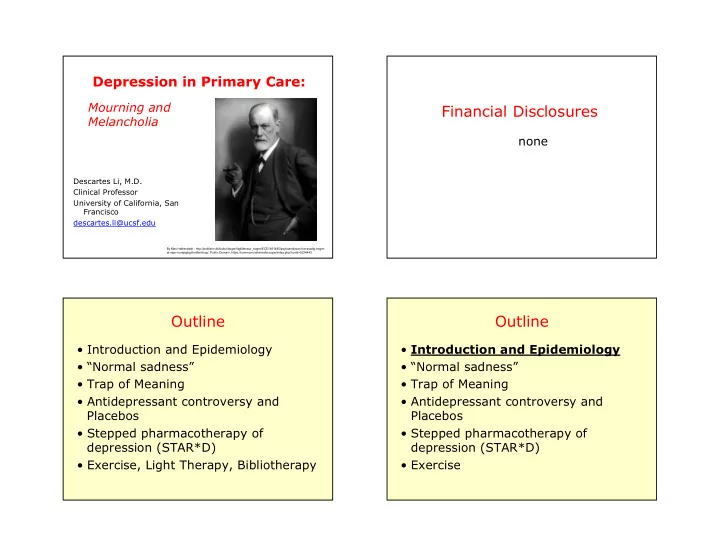
Depression in Primary Care: Mourning and Financial Disclosures Melancholia none Descartes Li, M.D. Clinical Professor University of California, San Francisco descartes.li@ucsf.edu By Max Halberstadt -


slide-1
SLIDE 1

1

Depression in Primary Care:

Descartes Li, M.D. Clinical Professor University of California, San Francisco descartes.li@ucsf.edu

By Max Halberstadt - http://politiken.dk/kultur/boger/faglitteratur_boger/ECE1851485/psykoanalysen-har-stadig-noget- at-sige-i-noejagtigt-betitlet-bog/, Public Domain, https://commons.wikimedia.org/w/index.php?curid=5234443

Mourning and Melancholia

Financial Disclosures

none

Outline

  • Introduction and Epidemiology
  • “Normal sadness”
  • Trap of Meaning
  • Antidepressant controversy and

Placebos

  • Stepped pharmacotherapy of

depression (STAR*D)

  • Exercise, Light Therapy, Bibliotherapy

Outline

  • Introduction and Epidemiology
  • “Normal sadness”
  • Trap of Meaning
  • Antidepressant controversy and

Placebos

  • Stepped pharmacotherapy of

depression (STAR*D)

  • Exercise
slide-2
SLIDE 2

2

Kessler, RC et al. The Epidemiology of Major Depressive Disorder: Results From the National Comorbidity Survey Replication (NCS-R). JAMA. 2003;289:3095-3105. Face-to-face household survey, n = 9090

Prevalence in U.S.:

1 year = 6.6%

(13.1-14.2 million)

Lifetime = 16.2%

(32.6 – 35.1 million)

Prevalence of Psychiatric Disorders*

Disorder Lifetime prevalence(%) Any mood disorder 19.54 Major depression 16.54 Dysthymia 4.30 Bipolar I 3.31 Bipolar II 2.33

Any anxiety disorder 16.16 Social anxiety 4.97 Any drug use disorder 10.33

*Conway KP et al. Lifetime Comorbidity of DSM-IV Mood and Anxiety Disorders and Specific Drug Use Disorders: Results of the National Epidemiologic Survey on Alcohol and Related Conditions. J Clin Psychiatry 2006;67:247-257. Challenging the myth of an "epidemic"

  • f common mental disorders: trends in

the global prevalence of anxiety and depression between 1990 and 2010.

The prevalence of MDD:

4.4%

in both 1990 (4.2–4.7%) and 2010 (4.1–4.7%).

https://www.ncbi.nlm.nih.gov/pubmed/24448889

slide-3
SLIDE 3

3

Outline

  • Introduction and Epidemiology
  • “Normal sadness”
  • Trap of Meaning
  • Antidepressant controversy and

Placebos

  • Stepped pharmacotherapy of

depression (STAR*D)

  • Exercise

Case Vignette A

72yo man is depressed in the context of the death of his wife.

How long would you wait before diagnosing MDD? Assume he meets DSM-5 criteria for MDE. a) Two weeks b) One month c) Two months d) Six months e) One year or more

Mourning and Melancholia

Outwardly can look the same Melancholia:

  • No conscious object

loss

  • Loss of self-regard, but

not ashamed

  • Difficulty with

nourishment, digesting

  • Difficulty with sleeping

“Normal Sadness”

Per Horvitz and Wakefield, 3 criteria:

  • 1. Has an environmental trigger
  • 2. Roughly proportionate in intensity to

loss

  • 3. Ends when loss situation ends

Horwitz AV, Wakefield JC. The Loss of Sadness: How Psychiatry Transformed Normal Sorrow into Depressive Disorder. New York, NY:Oxford University Press; 2007. (p.16)

slide-4
SLIDE 4

4

Problems with “normal sadness”

  • 1. What constitutes a trigger?
  • 2. When is the response proportionate

to the loss?

  • 3. Does the presence of a recent major

loss somehow make it more likely that depression will spontaneously resolve?

Resilience to Spousal Loss

New York Times online Accessed October 8, 2016 http://nyti.ms/2cPiePQ

“…resilience in the face of spousal bereavement is less common than previously thought”

  • Only 8% showed resilience across all five indicators of life satisfaction and

general health functioning

Infurna FJ and Luthar SS. Resilience to Major Life Stressors Is Not as Common as Thought. Persp Psychol Sci. 2016 Mar;11(2):175-94. doi: 10.1177/1745691615621271.

Depression vs. Grief

Individuals who fulfill MDD criteria after loss of significant other have NOT been shown to recover at a greater rate than MDD alone

What the DSM-5 says about bereavement

Grief is still exists, but depressive episodes must be diagnosed independently of loss Grief and MDD are different and therefore they should be distinguished separately

http://www.dsm5.org/Documents/Bereavement%20Exclusion %20Fact%20Sheet.pdf

slide-5
SLIDE 5

5

Depression vs. Grief Case Vignette A

72yo man is depressed in the context of the death of his wife.

How long would you wait before diagnosing MDD? Assume he meets DSM-5 criteria for MDE. a) Two weeks b) One month c) Two months d) Six months e) One year or more

Outline

  • Introduction and Epidemiology
  • “Normal sadness”
  • Trap of Meaning
  • Antidepressant controversy and

Placebos

  • Stepped pharmacotherapy of

depression (STAR*D)

  • Exercise

Case vignette B

http://commons.wikimedia.org/wiki/File:Portrait-as-an-artist-as-a-young-man.jpg

28yo man, recently married 6m ago, appears well, but quickly breaks down: He says he’s made a terrible mistake for imposing himself on his wife. “I’m a terrible person who cheated on my wife and on my taxes.” He reports two months of depressed mood, crying spells, as well as oversleeping and not being able to get out of bed. In addition, his energy has been low, he has no appetite, and he can’t focus at work.

Would you diagnose him with Major Depressive Disorder? Would you prescribe an antidepressant?

slide-6
SLIDE 6

6

Case vignette

http://commons.wikimedia.org/wiki/File:Portrait-as-an-artist-as-a-young-man.jpg

“I cheated on my wife and on my taxes.” Do we accept his reasons as the causes of his depression? Even when confronted with an intuitively plausible set of reasons, we must look for

  • bjective causes.

Reason vs. Cause

What the difference? Reason : (noun)

( 1 ) Motive or justification for something “Give me the reason for your going.” “He has adequate reason for doing so.”

Cause : (noun)

( 1 ) That which produces an effect, thing, event, person, etc…make something happen What was the cause of the fire? Smoking is one of the causes of heart disease.

The Trap of Meaning

“Finding an explanation that appears meaningful and adopting it as causal.”

Lyketsos CG, Chisolm MS. The trap of meaning: a public health

  • tragedy. JAMA. 2009 Jul 22;302(4):432-3. doi:

10.1001/jama.2009.1059.

"...humans are incredibly good at linking cause and effect—sometimes too good..."

"... it means that when you see something occur in a complex adaptive system, your mind is going to create a narrative to explain what happened—even though cause and effect are not comprehensible in that kind of system."

Embracing Complexity, An interview with Michael Mauboussin by Tim Sullivan Harvard Business Review 2011

https://hbr.org/2011/09/embracing-complexity/

slide-7
SLIDE 7

7

Life Events have NOT been associated with MDD

Kendler KS, Gardner CO. Dependent Stressful Life Events and Prior Depressive Episodes in the Prediction of Major Depression: The Problem of Causal Inference in Psychiatric Epidemiology. Arch Gen Psychiatry. 2010;67(11):1120-1127. Kendler KS, Myers J, and Halberstadt LJ. Do reasons for major depression act as causes? Molecular Psychiatry (2011) 16, 626– 633; doi:10.1038/mp.2011.22; published online 8 March 2011. Kendler KS, Myers J, and Halberstadt LJ. Should the Diagnosis of Major Depression made Independent of or Dependent upon the Psychosocial Context? Psychol Med. 2010 May ; 40(5): 771–780. doi:10.1017/S0033291709990845. Lyketsos CG, Chisolm MS. The trap of meaning: a public health tragedy. JAMA. 2009 Jul 22;302(4):432-3. doi: 10.1001/jama.2009.1059.

"in general, MD can be diagnosed independently of the psychosocial context in which it arises."

What are the Validated Risk Factors for Depression? Take Home Message

Be aware of "explaining away" mood episodes. Anticipate patient’s explanatory model and adherence implications

Lyketsos CG, Chisolm MS. The trap of meaning: a public health tragedy. JAMA. 2009 Jul 22;302(4):432-3. doi: 10.1001/jama.2009.1059.

http://jama.jamanetwork.com/article.aspx?articleid=184281

Outline

  • Introduction and Epidemiology
  • “Normal sadness”
  • Trap of Meaning
  • Antidepressant controversy and

Placebos

  • Stepped pharmacotherapy of

depression (STAR*D)

  • Exercise
slide-8
SLIDE 8

8

The Crazy State of Psychiatry, by Marcia Angell

Prevalence of antidepressant usage

How about insulin, Lipitor? Is there a glut of coffee, alcohol? http://well.blogs.nytimes.com/2013/08/12/a

  • glut-of-antidepressants/?_r=0

http://psychcentral.com/blog/archives/2013/08/19/is-a- glut-of-antidepressants-really-so-bad/

Increased antidepressant usage associated with a decrease in overall suicide rates

Olfson M, Shaffer D, Marcus SC et al. (2003), Relationship between antidepressant medication treatment and suicide in adolescents. Arch Gen Psychiatry 60(10):978- 982. Gunnell D, Middleton N, Whitley E et al. (2003), Why are suicide rates rising in young men but falling in the elderly?--A time-series analysis of trends in England and Wales 1950-1998. Soc Sci Med 57(4):595-611

slide-9
SLIDE 9

9

In Defense of Antidepressants

American Psychiatric Association Practice Guidelines for Depression Agency for Health Care Policy and Research, Clinical Practice Guidelines Cochrane Review http://www2.cochrane.org/reviews/en/ab0079 54.html “In Defense of Antidepressants”, by Peter Kramer (The New York Times, July 9, 2011)

Bottom Line: Antidepressants often do help, but for mild depression, watchful waiting is a reasonable option

http://www.nytimes.com/2011/07/10/opinion/sunday/10antidepressants.html?pagewanted=all

Placebos

Adherence to placebo is associated with decreased mortality A confounder?

Simpson SH et al. A meta-analysis of the association between adherence to drug therapy and mortality. BMJ 2006; 333 doi: https://doi-org.ucsf.idm.oclc.org/10.1136/bmj.38875.675486.55 (Published 29 June 2006)

Response to Placebo and Clinical Management Declines with Initial Severity

Mean Standardized Improvement as a Function of Initial Severity

Kirsch et al. PLoS Medicine 2008 Papakostas GI, Fava M. Eur Neuropsychopharmacol. 2009;19:34-40.

Antidepressant and Placebo Response Rates

(N=36,385; 251 drug-placebo pair-wise comparisons)

OR=1.49, 95% CI 1.39-1.50, p < 0.0001

slide-10
SLIDE 10

10

Another example: the largest placebo- controlled antidepressant trial in late life depression

45 35 20 40 60 80 100 ITT Sample Sertraline Placebo Schneider L, Nelson JC et al. Am J Psychiatry 2003;160:1277-1285. CGI responders = much or very much improved

P=.005

728 Patients with Late Life Depression

Placebos are NOT nothing

45 35 20 40 60 80 100 ITT Sample Sertraline Placebo Schneider L, Nelson JC et al. Am J Psychiatry 2003;160:1277-1285. CGI responders = much or very much improved

P=.005

The Largest Drug vs Placebo Study in 728 Patients with Late Life Depression

Medication clinic visits + placebo account for 78% of response in the drug group

How do placebos work?

Opioid receptors Expectancy and conditioning Regression to the Mean

Placebos

Time average participant in an 8-week trial spends with top experts and highly trained caregivers:

20 hours

slide-11
SLIDE 11

11

Placebos: Bottom Line

Placebos are potent. The “placebo” in any study should be examined carefully. Bottom Line: The milder the depression, the more difficult it is for treatments to separate from placebo.

Outline

  • Introduction and Epidemiology
  • “Normal sadness”
  • Trap of Meaning
  • Antidepressant controversy and

Placebos

  • Stepped pharmacotherapy of

depression (STAR*D)

  • Exercise

Disclosures

still none

slide-12
SLIDE 12

12

STAR*D

Sequenced treatment alternatives to relieve depression

2,876 outpatients started on citalopram

  • exclusions: schizophrenia, bipolar disorder,

eating disorders, OCD

  • Not placebo-controlled, therefore unblinded

Evaluation of Outcomes with Citalopram for Depression Using Measurement-Based Care in STAR*D: Implications for Clinical Practice. Trivedi et al. Am J Psychiatry 2006; 163:28-40.

*Defined as nonremission

Obtain Consent

Level 2

Follow-up

Satisfactory Response Unsatisfactory Response*

CIT

Level 1

Randomize

SER BUP-SR VEN-XR CT CIT + BUP-SR CIT + BUS CIT + CT

Level 2

Augmentation Options Switch Options

slide-13
SLIDE 13

13

Level 3

MRT NTP L-2 Tx + Li L-2 Tx + THY Switch Augmentation

Randomize

Level 4

TCP VEN-XR + MRT

Randomize

Switch

Medication Average dose

N, number of subjects

Remit rate QIDS-SR < 5 Response rate

50% reduction of baseline QIDS-SR

Level 1 Citalopram 41.8mg/d

2,876

33% 47% Level 2 Switch Buproprion-SR 283mg/d

239

25.5% 26.1% Sertraline 136mg/d

238

26.6% 26.7% Venlafaxine XR 194mg/d

250

25.0% 28.2% Augment Bupropion SR 268mg/d

279

39.0% 321.8% Buspirone 40.9mg/d

286

32.9% 26.9% Level 3 Switch Mirtazapine 42.1mg/d

114

12.3% 13.4% Nortriptyline 96.8mg/d

121

19.8% 16.5% Augment Lithium carbonate 900mg/d

69

13.2% 16.2% T3 50mcg/d

73

24.7% 23.3% Level 4 Tranylcypromine 36.9mg/d

58

13.8% 12.1% Venlafaxine+mirtazapine 210.3mg/d+35.7mg/d

51

15.7% 23.5%

Take homes from STAR*D

  • Switching to Bupropion-SR, Sertraline, or

Venlafaxine XR equally efficacious (remit rate for all: about 25%);

  • No difference between different classes of

antidepressants

  • Augmentation with Bupropion (39% remission

rate) slightly better than buspirone (33%)

  • Third and fourth level remission rates less than

20%, except T3 augmentation.

slide-14
SLIDE 14

14

Remember Tricyclics

desipramine

(Norpramin)

imipramine

(Tofranil)

amitriptyline

(Elavil)

nortriptyline

(Pamelor)

Thyroid augmentation T-3, (Cytomel)

Dosing schedule: 12.5mcg/day x2days 25mcg/day x2days 37.5mcg/day x2days 50mcg/day x2days

In STAR*D, T3 was started at 25 μg/day for 1 week and then increased to the recommended dose of 50 μg/day.

Li v T3 in STAR*D

Results: Remission rates were 15.9% with lithium augmentation and 24.7% with T3 augmentation *not statistically significant

Bonus tip#1: Light Therapy

Check out the Center for Environmental Therapeutics: www.cet.org More on this in Sleep talk

slide-15
SLIDE 15

15

Lam RW et al. Efficacy of Bright Light Treatment, Fluoxetine, and the Combination in Patients With Nonseasonal Major Depressive Disorder A Randomized Clinical

  • Trial. JAMA Psychiatry.

2016;73(1):56-63. doi:10.1001/jamapsychiatr y.2015.2235

58

Bonus tip#2

Bibliotherapy:

  • Feeling Good, by David Burns
  • Mind Over Mood, by Greenberger and Padefsky

Outline

  • Introduction and Epidemiology
  • “Normal sadness”
  • Trap of Meaning
  • Antidepressant controversy and

Placebos

  • Stepped pharmacotherapy of

depression (STAR*D)

  • Exercise

“Lack of activity destroys the good condition of every human being, while movement and methodical physical exercise save it and preserve it.”

~Plato

slide-16
SLIDE 16

16

Exercise: Lack of exercise associated with anxiety and depression

Goodwin RD. Association between physical activity and mental disorders among adults in the United States. Preventive Medicine. 2003;36(6):698-703. doi:10.1016/S0091- 7435(03)00042-2

How much exercise is enough?

Dunn, A L, Trivedi, M H, Kampert, J B, et al. (2005). Exercise treatment for depression: efficacy and dose response. American journal of preventive medicine, 28(1), 1-8.

Exercise Dosage: High vs. Low

3x/week “control”  flexibility exercises “low-dose” (LD)  7 kcal/kg/week (490 kcal*) “public health dose” (PHD)  17.5 kcal/kg/wk (1225*) Total patients = 80 *for 154 lb person

Calories per hour by activity

Weight of person Activity (1-hr) 160 lbs 200 lbs 240 lbs Bicycling, < 10 mph, leisure 292 364 436 Basketball game 584 728 872 Running, 5 mph 606 755 905 Running, 8 mph 861 1,074 1,286 Swimming, laps 423 528 632 Walking, 2 mph 204 255 305 Walking, 3.5 mph 314 391 469

slide-17
SLIDE 17

17

Findings: LD vs PHD

Dunn, A L, Trivedi, M H, Kampert, J B, et al. (2005). Exercise treatment for depression: efficacy and dose response. American journal of preventive medicine, 28(1), 1-8.

Exercise 2012: A Systematic Review

Overall long-term (> 6m) adherence to exercise program is poor at 50% Some studies had adherence rates better than 50% but likely product of selection bias (i.e. patients volunteered for study, motivated to exercise)

Rimer J, Dwan K, Lawlor DA, et al (2012). Exercise for depression. Cochrane Database of Systematic Reviews.doi: 10.1002/14651858.CD004366.pub5

Exercise 2012: A Systematic Review

Conclusions: Exercise improves depressive symptoms Unclear by how much Probably have to maintain

Rimer J, Dwan K, Lawlor DA, et al (2012). Exercise for depression. Cochrane Database of Systematic Reviews.doi: 10.1002/14651858.CD004366.pub5

More info on Exercise

For info on starting exercise, including frequency and intensity, see uptodate.com’s public access patient website: https://www.uptodate.com/contents/exercise-beyond-the-basics

slide-18
SLIDE 18

18

Exercise: Bottom Line

  • Easy to say, not easy to

do

  • Subject selection in

studies may be key.

Summary

  • Introduction and Epidemiology
  • “Normal sadness”
  • Trap of Meaning
  • Antidepressant controversy and

Placebos

  • Stepped pharmacotherapy of

depression (STAR*D)

  • Exercise

“My treatment fails only in incurable cases.”

  • Galen

129 AD – c. 216

More slides on exercise

slide-19
SLIDE 19

19

Findings: LD vs PHD

Dunn, A L, Trivedi, M H, Kampert, J B, et al. (2005). Exercise treatment for depression: efficacy and dose response. American journal of preventive medicine, 28(1), 1-8.

Where did the study individuals come from?

Had to “pre-screen” 1664 people to get 80

Exercise in care homes 2013

Intervention:

  • depression awareness training for care-

home staff , 45 min group exercise sessions (delivered twice weekly)

  • whole home component designed to

encourage more physical activity in daily life.

Control:

  • depression awareness training only

Underwood M, Lamb SE, Eldridge S, et al. Exercise for depression in elderly residents of care homes: a cluster-randomised controlled trial. The Lancet. 2013;382(9886):41-49. doi:10.1016/S0140-6736(13)60649-2

slide-20
SLIDE 20

20

Selection process

Underwood M, Lamb SE, Eldridge S, et al. Exercise for depression in elderly residents of care homes: a cluster- randomised controlled

  • trial. The Lancet.

2013;382(9886):41- 49. doi:10.1016/S0140- 6736(13)60649-2

Findings

no evidence of a difference for

  • GDS-15 scores*
  • MMSE
  • fear of falling
  • EQ-5D (tables 5, 6)
  • Antidepressant use
  • mental health
  • care team visits

*irrespective of whether residents were depressed at baseline.

Conclusion

“This evidence does not support the use of this type of intervention to reduce the burden of depressive symptoms in residents of care homes, and alternative strategies for this common and important problem are needed.”

Underwood M, Lamb SE, Eldridge S, et al. Exercise for depression in elderly residents of care homes: a cluster-randomised controlled trial. The Lancet. 2013;382(9886):41-49. doi:10.1016/S0140-6736(13)60649-2

2015 Exercise for depressed elders

Murri MB, Amore M, Menchetti M, et al. Physical exercise for late-life major depression. The British Journal of Psychiatry. 2015;207(3):235-242. doi:10.1192/bjp.bp.114.150516

Inclusion criteria Exclusion criteria

  • Age 65–85 years
  • Major depressive

disorder with (HRSD) >18

  • Being sedentary*
  • other Axis I diagnoses,
  • substance or alcohol

misuse

  • cognitive impairment,

with MMSE < 24

  • physical illness that

prevents exercise

*less than 30 min on five days each week or less than 20 min on three days each week vigorous intensity aerobic activity (2007 AHA)

slide-21
SLIDE 21

21

2015 exercise for depressed elders

Murri MB, Amore M, Menchetti M, et al. Physical exercise for late-life major depression. The British Journal of Psychiatry. 2015;207(3):235-242. doi:10.1192/bjp.bp.114.150516

Protocol for the non- progressive exercise intervention Each session Protocol for the progressive aerobic exercise intervention Each session 10 min warm-up: walking, strengthening exercises, quiet calisthenics 2 reps X10 min each: mat work: stretching, calisthenics, breathing exercises 2 reps X5 min each: instrumental exercises (first w/ ball, then w/ stick) 2 reps X5 min each: balance exercises (e.g. toe walking, heel to toe, single limb stance, staggered stance) 10 min cool down: walking, quiet calisthenics rest when >70% of peak heart rate, or whenever they felt exhausted 10 min warm-up: breathing exercises, slow cycling. Exercise to percentage of the peak heart rate (PHR) per Vmax test Then 5–10 min of cool-down cycling. weeks 0–4: cycling at 60–70% PHR, 30–40 min weeks 5–8: treadmill exercise at 70–80% of PHR, 40–50 min weeks 9–12: 5 sessions of 5 min at 85% of PHR or 40 min of continuous treadmill at 70% of PHR weeks 13–24: five interval training sessions of 6 min at 85%

  • f PHR, or 40 min of continuous

treadmill at 70% of PHR

Remission rates

@12 weeks @24 weeks Sertraline only, n = 42 45% 45% Ser+nonprogressive exercise, n = 37 54% 73% Ser+progressive aerobic exercise, n = 42 83% 81%

P-value 0.001 0.001

2015 exercise for depressed elders

Sertraline only = 50mg/day Exercise Groups = three sessions per week (60 min duration) for 24 weeks Nonprogressive exercise (NPE) Progressive aerobic exercise (PAE)

slide-22
SLIDE 22

22

2015 exercise for depressed elders

Discussion

  • beneficial effect independent of the severity and

chronicity of depression

  • Exercise best along with an antidepressant
  • After adjusting for confounders, the outcomes of

depression were similar in the two exercise arms

  • did NOT observe significant improvement in

aerobic capacity in the exercise groups

Murri MB, Amore M, Menchetti M, et al. Physical exercise for late-life major

  • depression. The British Journal of Psychiatry. 2015;207(3):235-242.

doi:10.1192/bjp.bp.114.150516