12/16/16 SECTION HEADING Disclosures I have no relevant financial - - PDF document

12 16 16
SMART_READER_LITE
LIVE PREVIEW

12/16/16 SECTION HEADING Disclosures I have no relevant financial - - PDF document

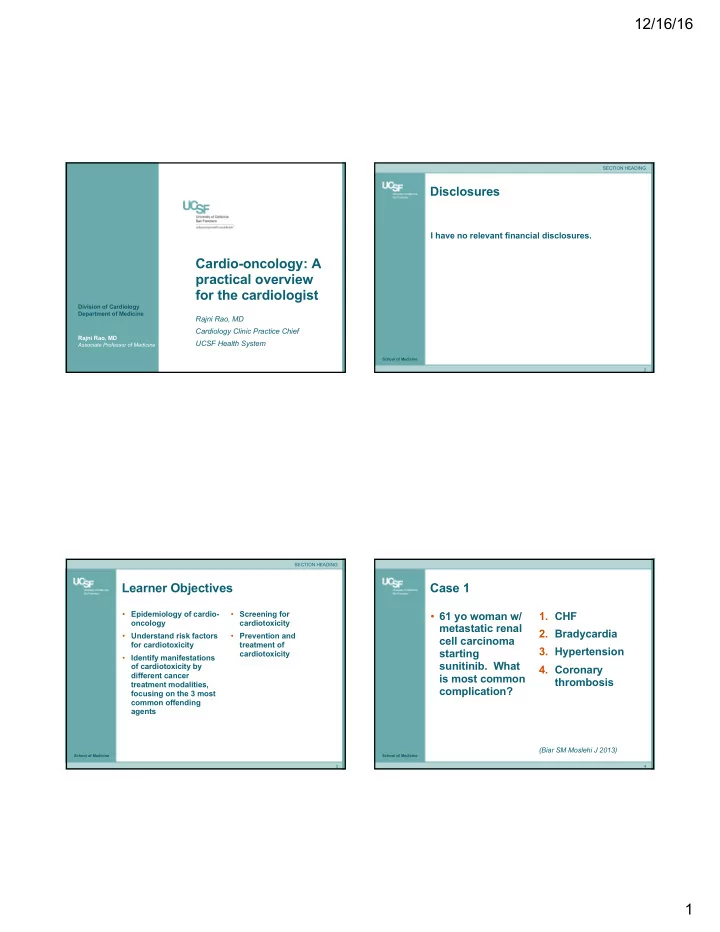
12/16/16 SECTION HEADING Disclosures I have no relevant financial disclosures. Cardio-oncology: A practical overview for the cardiologist Division of Cardiology Department of Medicine Rajni Rao, MD Cardiology Clinic Practice Chief Rajni


slide-1
SLIDE 1

12/16/16 1

Cardio-oncology: A practical overview for the cardiologist

Rajni Rao, MD Cardiology Clinic Practice Chief UCSF Health System

Rajni Rao, MD Associate Professor of Medicine Division of Cardiology Department of Medicine

School of Medicine 2

Disclosures

I have no relevant financial disclosures.

SECTION HEADING

School of Medicine 3

Learner Objectives

  • Epidemiology of cardio-
  • ncology
  • Understand risk factors

for cardiotoxicity

  • Identify manifestations
  • f cardiotoxicity by

different cancer treatment modalities, focusing on the 3 most common offending agents

  • Screening for

cardiotoxicity

  • Prevention and

treatment of cardiotoxicity

SECTION HEADING

School of Medicine

Case 1

  • 61 yo woman w/

metastatic renal cell carcinoma starting

  • sunitinib. What

is most common complication?

  • 1. CHF
  • 2. Bradycardia
  • 3. Hypertension
  • 4. Coronary

thrombosis

(Biar SM Moslehi J 2013)

4

slide-2
SLIDE 2

12/16/16 2

School of Medicine

Case 2

  • 48 year old woman with

HER2+ breast cancer, s/p lumpectomy, receiving adjuvant chemotherapy and

  • trastuzumab. 12 weeks

into treatment, EF drops from 56% at baseline to 33%. No HF sxs.

  • BP 130/87, HR 77. RRR

no m/r/g. No JVD or edema.

  • What do you do?

1.

  • Cont. w/ treatment –

cancer will progress

  • therwise. Repeat

echo in 1 month. 2. Start carvedilol, lisinopril, continue with treatment. 3. Prescribe a Life Vest for primary prevention of SCD. 4. Hold chemo; start ACEI/BB, repeat echo in 4 weeks. (Biar SM Moslehi J 2013)

5 School of Medicine 6

What is cardio-oncology?

  • Cardiac subspecialty focusing on the

screening, evaluation, prevention, and treatment of CV complications during or after cancer therapy

  • Cancer treatments are progressing rapidly –

more drugs being developed for cancer than any other condition---cardiologists must keep up and provide recommendations tailored to each patient and their cancer treatment plan

SECTION HEADING

School of Medicine

Rapid pace of change

7 School of Medicine

“This is our moonshot…to end cancer as we know it.”

One of the 10 recommendations for the 2016 Cancer Moonshot initiative

Minimize cancer treatment’s debilitating side effects…This recommendation calls for research to support development of guidelines for managing patient- reported symptoms and side effects of cancer treatment in adults and children, with the goal of helping patients stay

  • n their drug regimens and

improve their quality of life.

8

slide-3
SLIDE 3

12/16/16 3

School of Medicine 9

What’s the connection?

  • In childhood cancer survivors, CV mortality is 5-fold

higher than general population

  • HF patients with cancer have 56% increased

mortality

  • Cancer treatment accelerates the development of CV

disease

  • RF’s overlap: obesity, tobacco, age, inflammation,

poor nutrition

  • Like HIV and other diseases, cancer is often a

chronic condition and patients may live to suffer from heart disease

  • CV health is essential for good cancer treatment
  • utcomes

SECTION HEADING

School of Medicine 10

Types of CV complications and toxicities from cancer treatment

  • Arrhythmia
  • Myocyte necrosis à dilated cardiomyopathy (DCM)
  • Vascular: VTE, ATE, vasospasm, accelerated

atherosclerosis à angina, MI

  • Hypertension

SECTION HEADING

School of Medicine 11

Cancer timeline

SECTION HEADING 1963 1st anthracycline discovered 1966 cardiotoxicity reported from daunorubicin 1977 dose- dependency identified 1998 Trastuzumab (herceptin) cardiotoxicty identified 1999 Gleevec (imatinib) revolutionizes tx of CML and kickstarts the development of targeted therapies and kinase inhibitors 2007 TK/multikinase inhibitors found to cause HTN, HF, ATE, VTE

School of Medicine 12

Anthracyclines

  • Daunorubicin 1963 – initially a childhood leukemia

treatment

  • CHF developed with maintenance treatment
  • Dose dependent (>300-400 mg/m2)
  • 30% of children had cardiac dysfunction at long-term

follow-up

  • Anthracyclines block topoisomerase II to prevent

DNA replication. Why should that affect terminally differentiated cardiac myocytes?

SECTION HEADING

slide-4
SLIDE 4

12/16/16 4

School of Medicine 13

Anthracyclines

  • Anthracyclines generate toxic hydroxyl radicals
  • They bind to promoters that regular gene

transcription and block them

  • Acute toxicity: uncommon

– SVT, VT, heart block, acute LV dysfxn

  • Subacute

  • Esp. with CHOP treatment of lymphoma in elderly patients

– A fib, LV dysfunction, HF, ischemia

  • Chronic

– Asymptomatic LV dysfunction à clinical HF

– Can present in first year, in first 5 years, and even late (>10 yrs) – Risk factors: cumulative dose (usu >400 mg/m2), age, concomitant trastuzumab (Herceptin), XRT, pre-existing CV disease (CAD, HTN, DM, PAD)

SECTION HEADING

School of Medicine 14

Trastuzumab

Revolution in breast cancer chemotherapy

  • Treatment of metastatic ERBB2 (HER2)-positive

breast cancer

  • ERBB2 belongs to the family of human epidermal

growth factor receptors (EGFRs). Trastuzumab inhibits the dimerization of ERBB2/ERBB3

  • However, ERBB2 is also expressed on

cardiomyocytes, and deletion of it causes DCM

SECTION HEADING

School of Medicine 15

Trastuzumab, the revolution in breast cancer chemotherapy

SECTION HEADING

Drug NYHA II or IV Heart Failure Incidence Anthracycline + cyclophosphamide + trastuzumab 27% Anthracycline or cyclophosphamide alone 8% Paclitaxel + trastuzumab 13% Paclitaxel 1%

  • Toxicity is synergistic with anthracyclines
  • Cardiotoxic on its own
  • Not dose dependent
  • Often reversible with cessation of therapy
  • Rechallenge is often well tolerated
  • Pertuzumab (Perjeta) targets a different domain often added

for synergy/resistance; well tolerated without cardiotoxicity

School of Medicine

Aromatase inhibitors

  • Used for ER+ and/or PR+ breast cancer
  • Block aromatase which turns androgens into

estrogens

  • Oral daily medications, taken for years to

suppress cancer recurrence

– Arimidex (anastrozole) – Aromasin (exemestane) – Femara (letrozole)

  • Cardiotoxicity: vasodilation, edema, endothelial

dysfunction, angina/worsening of ischemic heart disease

16

slide-5
SLIDE 5

12/16/16 5

School of Medicine 17

UCSF breast cancer echo protocol

  • For trastuzumab – obtain baseline echo and echo q 3 mo

until completion of trastuzumab

  • For doxorubicin alternating w/ HER2 agents, then obtain

baseline echo and prior to switching from anthracycline to HER2 targeted agent.

  • If 10% drop in EF and asymptomatic à hold agent x 4 wks,

repeat echo.

  • If EF improves, consider resuming chemo, consider

referral to cardiology.

  • If EF drop is significant, HF sxs, refer to cardiology.

SECTION HEADING

School of Medicine 18

Treatment of anthracycline or trastuzumab toxicity

  • Cease the use of anthracyclines
  • Treat with ACEI, carvedilol/BB
  • Reassess LVEF in 4 weeks
  • Rechallenge with trastuzumab once EF

normalizes (>50%)

Kalay N et al. Protective effects of carvedilol against anthracycline-induced cardiomyopathy. J Am Coll Cardiol 2006;48:2258-2262. Cardinale D et al. Prevention of high-dose chemotherapy-induced cardiotoxicity in high-risk patients by angiotensin-converting enzyme inhibitors. Circulation 2006;114:2474-2481. SECTION HEADING

School of Medicine

Can cardiomyopathy be predicted?

  • Holding chemo for 4 weeks and being told

you have cardiac dysfunction when you are already dealing with a cancer diagnosis can be frightening.

  • Are there ways to identify at-risk patients

earlier, and intervene?

19 School of Medicine

The role of strain imaging

  • Strain = dimensionless parameter. Change in length of

myocardial segment compared to its baseline length, expressed as a percentage. Strain rate = Rate at which myocardial deformation takes place. 1/s. Less influenced by loading conditions, less influenced by global function, thus a more sensitive assessment of true regional function.

  • Helps detect more subtle myocardial problems.

20 Salvo GD, Pergola V, Fadel B, Bulbul ZA, Caso P. Strain echocardiography and myocardial mechanics: From basics to clinical

  • applications. J

Cardiovasc Echography 2015;25:1-8

slide-6
SLIDE 6

12/16/16 6

School of Medicine

The role of strain imaging Speckle tracking

Pitfalls:

  • VERY dependent
  • n 2D image

quality

  • Interobserver and

intraobserver variability / reproducibility

21 Salvo GD, Pergola V, Fadel B, Bulbul ZA, Caso P. Strain echocardiography and myocardial mechanics: From basics to clinical applications. J Cardiovasc Echography 2015;25:1-8 School of Medicine

Strain to detect cardiotoxicity

  • Can you identify the

ACC/AHA Stage A patient (“at risk” for HF but without

  • vert LV

dysfunction) using strain imaging?

  • Relative change in

strain by 10-15% compared to prior study is the most useful parameter for predicting cardiotoxicity from chemotherapy.

22 School of Medicine

Strain to detect cardiotoxicity

  • “Expert Consensus for

Multimodality Imaging Evaluation of Adult Patients during and after Cancer Therapy: A Report from the American Society of Echocardiography and the European Association of Cardiovascular Imaging”

  • Recommend strain at baseline

for potentially cardiotoxic chemo agent.

  • For trastuzumab, repeat strain

every echo

  • For anthracycline, at baseline,

completion of treatment, and 6 months later

  • Relative decline in strain by

>15% = suggestive of subclinical LV dysfunction

  • Consider modifying chemo
  • Consider starting

cardioprotective meds

23 School of Medicine

Cardio-oncology echo pearls

  • Carefully measure

LVEF esp. if EF has dropped >10 points from last echo

  • Beware of the

borderline or low- normal EF

  • Use contrast if needed
  • Consider taking into

account strain imaging

  • Keep mind of strain

imaging limitations

24

slide-7
SLIDE 7

12/16/16 7

School of Medicine

Other markers

  • Mixed results on

whether troponin can predict cardiotoxicity

  • Pro-BNP did not

predict cardiotoxicity

  • Cardiac MRI and

molecular imaging may be helpful in the future to detect subclinical cell death

  • ERNA (MUGA)

25 School of Medicine 26

Tyrosine kinase inhibitors – a major advance in designer drugs…with CV costs

SECTION HEADING

from cancer.gov

School of Medicine 27

Tyrosine kinase inhibitors – a major advance in designer drugs…with CV costs

  • The pre- and post-Gleevec era
  • A magic bullet to cure CML, a once-fatal disease
  • “Gleevec opened a new door for cancer therapeutics.

The rational synthesis of a molecule to kill cancer cells – a drug designed to specifically inactivate an

  • ncogene…”
  • Some tyrosine kinase inhibitors (TKIs) have specific

targets and others target multiple kinases. Off-target effects à off-target side effects

SECTION HEADING

School of Medicine 28

Tyrosine kinase inhibitors – a major advance in designer drugs…with CV costs

  • The “—ib’s”
  • Sunitinib – multikinase inhibitor - treatment for RCC
  • Inhibit angiogenesis and cell growth (affect VEGF,

fibroblast growth factor receptors, and platelet- derived growth factor receptors (PDGFRs))

  • Hypertension (systolic and diastolic)
  • QT prolongation (dasatinib, nilotinib)
  • Pulmonary hypertension (nilotinib, dasatinib)
  • Atherosclerosis
  • Arterial and venous thromboembolism
  • …sometimes leading to heart failure (esp. imatinib)

SECTION HEADING

slide-8
SLIDE 8

12/16/16 8

School of Medicine 29

VEGF signaling pathway inhibitors

  • Another bench to bedside breakthrough: Reduce

cancer angiogenesis

  • Hypertension almost universal
  • Dose-dependent, often transient, within a week
  • Incidence 20-25% with bevacizumab (Avastin) and up

to 50% with sunitinib

  • Treatment with ACEI, calcium channel blockers often

effective

  • Uncommon to have to discontinue the chemo agent

for HTN

SECTION HEADING

School of Medicine 30

Fluoropyrimidines (5FU, capecitabine)

  • 3rd most commonly used chemotherapeutic

for solid tumors

  • GI, breast, head and neck
  • Cardiotoxicity uncommon but be aware

(<10%)

  • Angina, MI, HF, pericarditis, myopericarditis
  • Idiosyncratic
  • Avoid repeat administration

SECTION HEADING

School of Medicine

Case 3

  • 51 y/o previously healthy, fit patient

who had an uncomplicated partial colectomy for sigmoid colon cancer

  • n 8/18/15. He started FOLFOX for

stage III colon cancer and developed chest pain during his first 5FU

  • infusion. EKG changes were noted.

31 School of Medicine

5-FU

32

slide-9
SLIDE 9

12/16/16 9

School of Medicine 33 School of Medicine

5FU stopped; nitro, dilt drips

34

Patient now on surveillance alone after 2 cycles of adjuvant

  • FOLFOX. No radiographic evidence of recurrent or metastatic

disease on current CT scan. Followed in GI Onc Survivorship Clinic.

School of Medicine 35

Fluoropyrimidines (5FU, capecitabine)

  • Chest pain may be due to coronary spasm
  • Usually reversible, usually IS recurrent if re-

adminstered

  • Risk factors: preexisting CAD, older age
  • Treatment: nitrates, calcium channel

blockers, revascularization

  • Avoid premature/unnecessary cessation as

that may affect cancer curability

– Screening treadmill may not be sufficient – Think about coronary CT angio, cath

SECTION HEADING

School of Medicine 36

Types of complications and toxicities from fluorouracil

  • Arrhythmia
  • Myocyte necrosis à dilated cardiomyopathy

(DCM)

  • Vascular: VTE, ATE, vasospasm,

accelerated atherosclerosis à angina, MI

  • Hypertension
  • Valvular disease

SECTION HEADING

slide-10
SLIDE 10

12/16/16 10

School of Medicine

Case 1

  • 61 yo woman w/

metastatic renal cell carcinoma starting

  • sunitinib. What

is most common complication?

  • 1. CHF
  • 2. Bradycardia
  • 3. Hypertension
  • 4. Coronary

thrombosis

(Biar SM Moslehi J 2013)

37 School of Medicine

Case 2

  • 48 year old woman with

HER2+ breast cancer, s/p lumpectomy receiving adjuvant chemotherapy and

  • trastuzumab. 12 weeks

into treatment, EF drops from 56% at baseline to 33%. No HF

  • sxs. BP 130/87, HR 77.

RRR no m/r/g. No JVD. No edema.

  • What do you do?

1.

  • Cont. w/ treatment –

cancer will progress

  • therwise. Repeat

echo 3 months. 2. Start carvedilol, lisinopril, continue with treatment. 3. Life Vest for SCD prevention. 4. Hold chemo; start ACEI/BB, repeat echo in 4 weeks. (Biar SM Moslehi J 2013)

38 School of Medicine 39

Future directions - immunotherapy

SECTION HEADING

1963 1st anthracycline discovered 1966 cardiotoxicity reported from daunorubicin 1977 dose- dependency identified 1998 Trastuzumab (herceptin) cardiotoxicty identified 1999 Gleevec (imatinib) revolutionizes tx

  • f CML and

kickstarts the development of targeted therapies and kinase inhibitors 2007 TK/multikinase inhibitors found to cause HTN, HF, ATE, VTE 2016 Checkpoint inhibitors (Immunotherapy) – case reports of fulminant myocarditis

D.B. Johnson, et al. Fulminant myocarditis with combination immune checkpoint

  • blockade. N. Engl. J. Med., 375 (2016), pp. 1749–1755

School of Medicine

Autoimmune myocarditis with cancer immunotherapy

40

PD-1 checkpoint inhibitors: Pembr

  • lizumab

(Keytruda) Nivolu mab (Opdivo)

Feixiong Cheng,Joseph Loscalzo. Autoimmune cardiotoxicity of cancer immunotherapy. Trends in Immunology. December 2, 2016.

slide-11
SLIDE 11

12/16/16 11

School of Medicine

Summary

  • Anthracyclines – DCM, early and late
  • Trastuzumab – DCM, usually when on treatment
  • EF drop >10 points or to <50%; stop; treat HF; repeat echo;

consider resuming chemo. Consider using strain imaging

  • TK inhibitors – optimize pts with pre-existing CAD, HTN
  • VEGF signaling pathway inhibitors – Treatment related

HTN

  • Fluorouracils -- optimize pts with pre-existing CAD, HTN;

think about vasospasm

  • Stay abreast of newer agents
  • Work as a team with oncologist to see how to optimize

cardiac status to facilitate continued cancer treatment

41