FABRICATION OF MICRO-PATTERN OF QUARTZ GLASS IN INJECTION MOLDING - - PDF document

fabrication of micro pattern of quartz glass in injection
SMART_READER_LITE
LIVE PREVIEW

FABRICATION OF MICRO-PATTERN OF QUARTZ GLASS IN INJECTION MOLDING - - PDF document

18 TH INTERNATIONAL CONFERENCE ON COMPOSITE MATERIALS FABRICATION OF MICRO-PATTERN OF QUARTZ GLASS IN INJECTION MOLDING PROCESS K.Honta 1, 2 , E.Ono 2 , T.Takayama 2 , H.Ito 2 * 1 Tosoh Quartz Co.,Ltd, Yamagata,Japan 2 Department of Polymer


slide-1
SLIDE 1

18TH INTERNATIONAL CONFERENCE ON COMPOSITE MATERIALS

1 Introduction Recently, demand for high precision and miniaturezation of glass parts has been enhanced. Powder injection molding(PIM) is extremely promising as a production process for microparts because the technique enables near-net-shape fabrication of micro-structured parts with nearly no post-processing[1] . One advantage of PIM is that complicated three-dimentional parts are producible with high productivity. The authors have investigated miniaturization of metal injection molding(MIM) products and have realized mass production metal microinjection molding(µ-MIM)products with a fine structure[2-4]. Recently, using various composite materials research into detailed molding or thin-wall PIM has been pursued actively; creation of a new device substrate has been examined [6-8]. As a nano-filler

  • f composite materials, silica─silicon dioxide─is
  • attractive. The silica glass created from silica shows

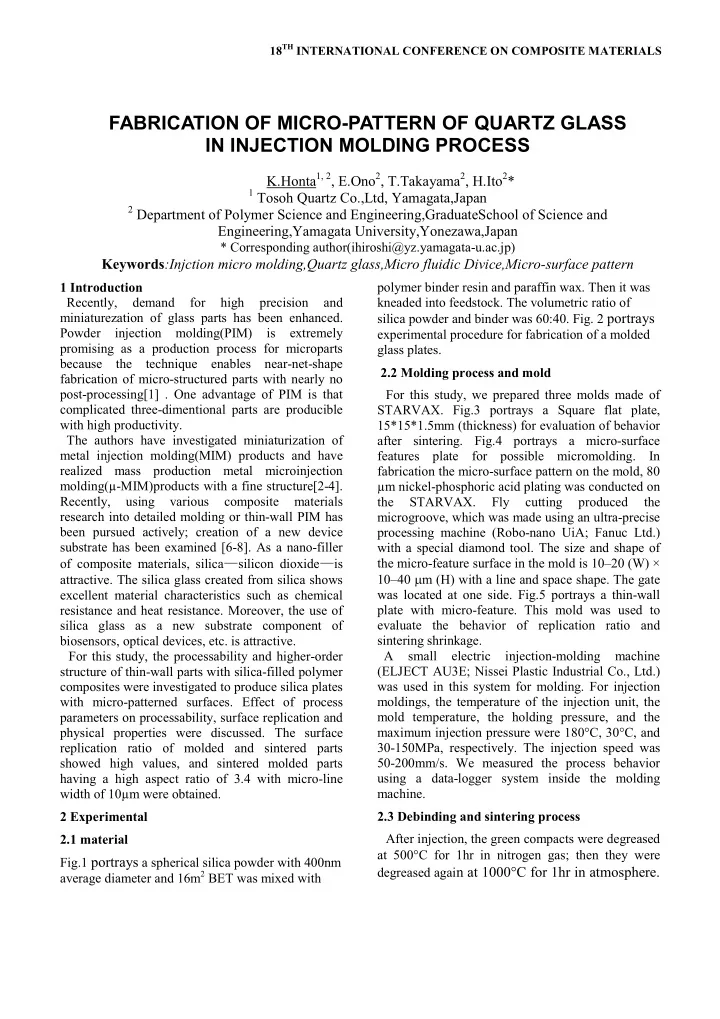
excellent material characteristics such as chemical resistance and heat resistance. Moreover, the use of silica glass as a new substrate component of biosensors, optical devices, etc. is attractive. For this study, the processability and higher-order structure of thin-wall parts with silica-filled polymer composites were investigated to produce silica plates with micro-patterned surfaces. Effect of process parameters on processability, surface replication and physical properties were discussed. The surface replication ratio of molded and sintered parts showed high values, and sintered molded parts having a high aspect ratio of 3.4 with micro-line width of 10µm were obtained. 2 Experimental 2.1 material Fig.1 portrays a spherical silica powder with 400nm average diameter and 16m2 BET was mixed with polymer binder resin and paraffin wax. Then it was kneaded into feedstock. The volumetric ratio of silica powder and binder was 60:40. Fig. 2 portrays experimental procedure for fabrication of a molded glass plates. 2.2 Molding process and mold For this study, we prepared three molds made of

  • STARVAX. Fig.3 portrays a Square flat plate,

15*15*1.5mm (thickness) for evaluation of behavior after sintering. Fig.4 portrays a micro-surface features plate for possible micromolding. In fabrication the micro-surface pattern on the mold, 80 µm nickel-phosphoric acid plating was conducted on the STARVAX. Fly cutting produced the microgroove, which was made using an ultra-precise processing machine (Robo-nano UiA; Fanuc Ltd.) with a special diamond tool. The size and shape of the micro-feature surface in the mold is 10–20 (W) × 10–40 mm (H) with a line and space shape. The gate was located at one side. Fig.5 portrays a thin-wall plate with micro-feature. This mold was used to evaluate the behavior of replication ratio and sintering shrinkage. A small electric injection-molding machine (ELJECT AU3E; Nissei Plastic Industrial Co., Ltd.) was used in this system for molding. For injection moldings, the temperature of the injection unit, the mold temperature, the holding pressure, and the maximum injection pressure were 180°C, 30°C, and 30-150MPa, respectively. The injection speed was 50-200mm/s. We measured the process behavior using a data-logger system inside the molding machine. 2.3 Debinding and sintering process After injection, the green compacts were degreased at 500°C for 1hr in nitrogen gas; then they were degreased again at 1000°C for 1hr in atmosphere.

FABRICATION OF MICRO-PATTERN OF QUARTZ GLASS IN INJECTION MOLDING PROCESS

K.Honta1, 2, E.Ono2, T.Takayama2, H.Ito2*

1 Tosoh Quartz Co.,Ltd, Yamagata,Japan 2 Department of Polymer Science and Engineering,GraduateSchool of Science and

Engineering,Yamagata University,Yonezawa,Japan

* Corresponding author(ihiroshi@yz.yamagata-u.ac.jp)

Keywords:Injction micro molding,Quartz glass,Micro fluidic Divice,Micro-surface pattern

slide-2
SLIDE 2

Finally, the molded part was sintered at 1450°C in vacuum.

2.4 Dimensions and surface measurements of green and sintered parts Dimensions of these parts of green compacts and sintered parts were measured using the three- dimensional micrometer for investigating the relation between holding pressure, injection speed and injection volumes. We examined the shrinkage behavior of molded parts. Moreover, we defined the replication ratio as the ratio of the height of the product surface pattern to the depth of the mold

  • pattern. The height of the product surface pattern

was measured using a confocal laser scanning micrometer. 3 Results and Discussion Fig.6 portrays measurement point for shrinkage

for square plate. Table1 presents Shrinkage value for square plate. In the square model parts,

the shrinkage between the mold and green parts shows low values in both directions: the flow and transverse directions. On the other hand, the thickness of molded parts increases up to more than that of the designed value. After sintering, great shrinkage occurs in every direction because the polymer binder was degreased in degrees and because of the sintering processes. Fig.7 portrays photographs of the molded green and the sintered

  • plate. The sintered plate has high transparency.

Fig.8 portrays a photograph of a micro-surface features plate product and an SEM image of the micro-surface of the sintered molded part near the

  • gate. The product length increases concomitantly

with increasing injection speed as a general trend. The silica fillers are observed and glittered inside thin-wall products. Amounts of silica powder become larger toward the flow end of thin-wall products. The polymer flow near the cavity wall indicates a high shear stress attributable to rapid cooling. Therefore, the injection molded product reveals a structural distribution inside the cross-sectional area. Table 2 presents replication and shrinkage ratios at different micro-feature heights with 10µm width. They have a high replication ratio at a low depth

  • ratio. At 40µm depth, the replication ratio showed

98.0%. After sintering, shrinkage at micro-features also occurs and the height of the molded surface decreases 16–20%. The sintered parts’ height is 34µm at the designed 40µm depth. We confirmed that the sintered molded part had a high aspect ratio

  • f 3.4 with micro-line width of 10µm.

Fig.9 shows a replication ratio of holding pressure and injection speed at height aspect thin-wall

  • features. In this case, the replication ratio increases

with increasing holding pressure, and slightly increased with increasing injection speed.

4 Conclusions

We investigated the processability, structure, and properties of quartz glass/polymers composites used to fabricate a new microfluidic plate with glass. The product length increased concomitantly with increasing injection speed and holding pressure as a general trend. The shrinkage between the mold and green parts became a low value at both directions: the flow and transverse directions. On the other hand, the thickness of molded parts increased, becoming greater than the designed value. The internal morphology affected the shrinkage of green molded

  • composites. The surface replication ratio of molded

and sintered parts showed high values, and sintered molded parts having a high aspect ratio of 3.4 with micro-line width of 10 µm were obtained. 5 References

[1] R.M. German “Powder injection molding, MPIF”, Princeton, New Jersey, 1990 [2] K. Okubo, S. Tanaka, H. Hamada, H. Ito, Asia Pacific Journal of Chemical Engineering, 4(2), 133- 139, 2009 [3] K. Okubo, S. Tanaka, H. Ito, Microsystem Tech., 15(6), 887-892, 2009 [4] K. Okubo, S. Tanaka, H. Ito, ANTEC 2009 Tech. Paper, 2592-2597, 2009 [5] R.M. German, Powder Metallurgy Science, Metal Powder Industry Co., Ltd., 1996, 215 [6] H. Ito, K. Kazama, T. Kikutani, Proc. 2007 International Manufacturing Science and Engineering Conference, MSEC2007-31035, 2007 [7] Y.W. Leong, S. Thumsorn, A. Nakai, H. Hamada, H. Ito, Proc. 2008 International Manufacturing Science and Engineering Conference, 2008, CDROM, MSEC ICM&P 2008-72056, 2008 [8] T. Watanabe, H. Suzuki, H. Ito, Americas Regional Meeting Polymer Processing Society, PPS-2008, (CDROM-M1 200), 2008 (2008, America)

slide-3
SLIDE 3

3

  • Fig. 2 Experimental procedure for fabrication
  • f a molded glass plates

Fig.3 Simple square flat plate Fig.4 Microsurface feature plate Fig.4 Thin-wall plate with micro-feature Fig.5 Thin-wall plate with micro-feature

slide-4
SLIDE 4

Mold/green molded part (%) Molded part / Sintered part (%) FD ①

  • 0.1
  • 17.9

② 0.0

  • 17.8

③ 0.0

  • 17.8

TD ①

  • 0.1
  • 17.6

  • 0.1
  • 17.5

③ 0.0

  • 17.6

Thickness

Ave. +4.6

  • 15.0

Depth Molded green part (%) Sintered part (%) 10 μm 97.0 77.4 20 μm 100.2 84.6 40 μm 98 82

Table 1 Shrinkage value for square mold Fig.8 Micro-surface pattern of

molded quartz glass

Table 2 Replication ratio for micro-surface

feature molded parts (10 mm width)

  • Fig. 6 Measurement point for

shrinkage for square molded green sintered

  • Fig. 7 Pictures of molded green and

sintered parts Fig.9 Replication ratio of the high aspect feature in injection molding