Evaluating Learnability of - User interface and inline help - - - PDF document

evaluating learnability of user interface and inline help
SMART_READER_LITE
LIVE PREVIEW

Evaluating Learnability of - User interface and inline help - - - PDF document

INF3280, 10 March, 2016 Evaluating Learnability of - User interface and inline help - Inline/Online Tutorials Aim: Evaluate learnability Basis for Assignment 5 Core literature Chapter 6.4 Grossman et.al. (2009) A Survey of


slide-1
SLIDE 1

Jens Kaasbøll INF3280, 10 March, 2016

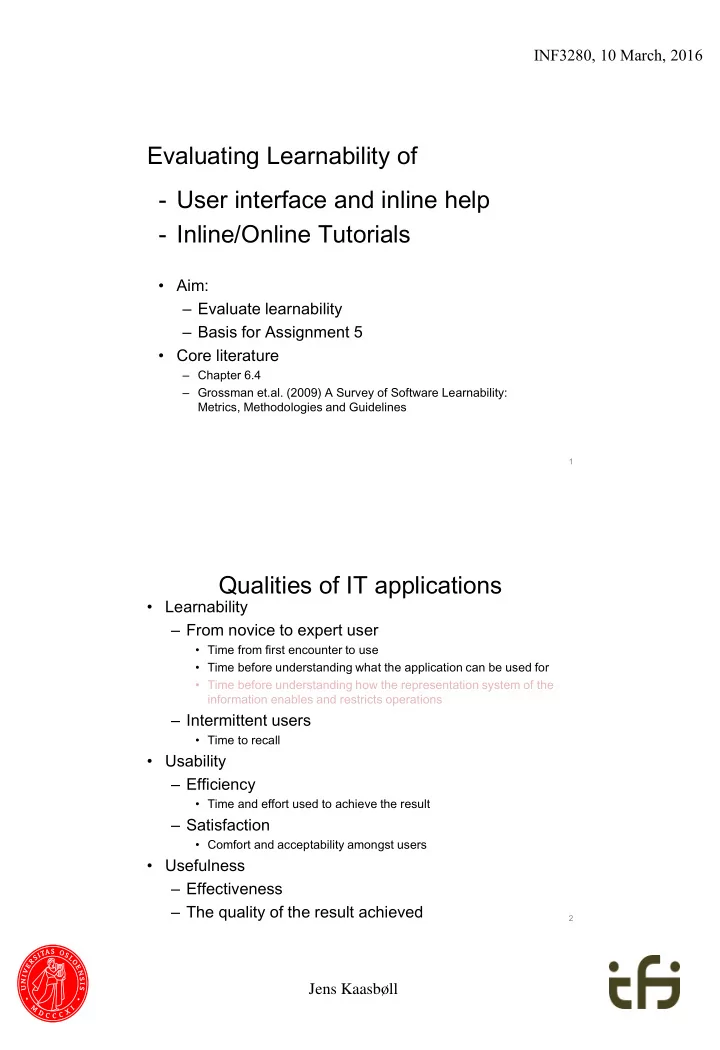
Evaluating Learnability of

  • User interface and inline help
  • Inline/Online Tutorials
  • Aim:

– Evaluate learnability – Basis for Assignment 5

  • Core literature

– Chapter 6.4 – Grossman et.al. (2009) A Survey of Software Learnability: Metrics, Methodologies and Guidelines

1 2

Qualities of IT applications

  • Learnability

– From novice to expert user

  • Time from first encounter to use
  • Time before understanding what the application can be used for
  • Time before understanding how the representation system of the

information enables and restricts operations

– Intermittent users

  • Time to recall
  • Usability

– Efficiency

  • Time and effort used to achieve the result

– Satisfaction

  • Comfort and acceptability amongst users
  • Usefulness

– Effectiveness – The quality of the result achieved

slide-2
SLIDE 2

Jens Kaasbøll INF3280, 10 March, 2016

Learnabi nability ity evaluatio ation

  • Qualities of help functions to evaluate

– Ease of use

– way of accessing the help – understandability of the help contents

– Usefulness

– does the help fix the problem?

3

Software Help functionality Heuristic evaluation Specialists checking software Specialists checking help functions Question-suggestion Software tasks Help tasks Measuring learning Software tasks Help tasks

4

Heuristic evaluation – software and help

  • 2 - 3 usability specialists
  • Inspect every detail of the application
  • Compare to known guidelines (heuristics)

– Each guideline broken – a possible problem of learning is noted

  • Cheap, first evaluation

Software Help Guidelines (heuristics): Rogers, Sharp, Preece (2007) Interaction Design: Beyond Human - Computer Interaction Chapter 2-6. Furnas et.al (1987)

slide-3
SLIDE 3

Jens Kaasbøll INF3280, 10 March, 2016

5

Question-suggestion – software (incl. Help)

  • Small number of test persons, stop when no news

– Right selection of users?

  • Design tasks to perform

Question

  • n-sug

ugges esti tion

  • n Protoc
  • col – Instr

truc uction

  • ns to P

Participa pant: nt:

  • 1. Ask relatively specific, procedural questions.
  • 2. Try to answer your own questions first

Software only: but do not engage in extensive problem solving. Help: Look for help if needed

  • 3. Focus on getting the task done, as you would in the real world.
  • Video-recording, time taking, notes
  • Possible interview before and after the session
  • Analysis of the users’ understanding, misunderstandings and mistakes
  • Consumes more time than heuristic evaluation
  • For systems to be extensively used
  • Web services

6

Measuring skills learning – software incl. help

  • Design tasks to perform
  • Representative selection of users
  • Way of measuring

– Time taking – Counting keystrokes – Counting errors – Scaled response to questionnaires

slide-4
SLIDE 4

Jens Kaasbøll INF3280, 10 March, 2016

7

Number of test users for measuring time for learning for novices The number increases with standard deviation 80% confidence level 20% confidence interval  9 users Example

Mean 5 minutes 80% surety that the real mean lies within the 4 – 6 minutes interval

Jakob Nielsen (1993) Usability Engineering. AP Professional, Boston, p.168

80% 80%