Optimization X Heuristic Optimization R Lecture 1 f : X R - - PowerPoint PPT Presentation

optimization
SMART_READER_LITE
LIVE PREVIEW

Optimization X Heuristic Optimization R Lecture 1 f : X R - - PowerPoint PPT Presentation

Optimization X Heuristic Optimization R Lecture 1 f : X R Algorithm Engineering Group Hasso Plattner Institute, University of Potsdam Goal: 14 April 2015 Find z X such that f ( z ) f ( x ) for all x X (minimization) Find z


slide-1
SLIDE 1

Heuristic Optimization

Lecture 1

Algorithm Engineering Group Hasso Plattner Institute, University of Potsdam

14 April 2015

Optimization

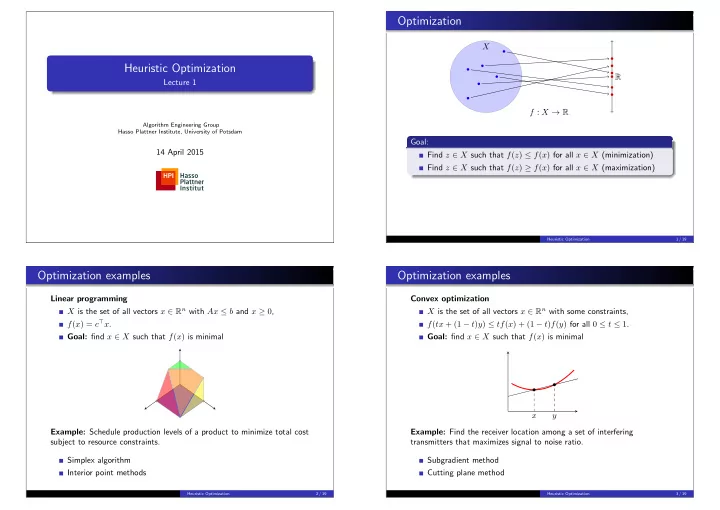
X R f : X → R Goal: Find z ∈ X such that f(z) ≤ f(x) for all x ∈ X (minimization) Find z ∈ X such that f(z) ≥ f(x) for all x ∈ X (maximization)

Heuristic Optimization 1 / 19

Optimization examples

Linear programming X is the set of all vectors x ∈ Rn with Ax ≤ b and x ≥ 0, f(x) = c⊤x. Goal: find x ∈ X such that f(x) is minimal Example: Schedule production levels of a product to minimize total cost subject to resource constraints. Simplex algorithm Interior point methods

Heuristic Optimization 2 / 19

Optimization examples

Convex optimization X is the set of all vectors x ∈ Rn with some constraints, f(tx + (1 − t)y) ≤ tf(x) + (1 − t)f(y) for all 0 ≤ t ≤ 1. Goal: find x ∈ X such that f(x) is minimal x y Example: Find the receiver location among a set of interfering transmitters that maximizes signal to noise ratio. Subgradient method Cutting plane method

Heuristic Optimization 3 / 19

slide-2
SLIDE 2

Optimization examples

Find the shortest route between two cities X is the set of feasible paths f measures the length of a path Goal: find x ∈ X such that f(x) is minimal Example: Navigation software. Dijkstra’s algorithm Bellman-Ford

Heuristic Optimization 4 / 19

The black-box scenario

Suppose we know nothing (or almost nothing) about the function f(x) measures some complex (e.g., industrial) process f(x) value depends on the result of an expensive simulation process of assigning f-values to X is noisy/unpredictable x f(x) in

  • ut

How should we approach these problems?

Heuristic Optimization 5 / 19

Heuristic Optimization

Approaches Take a best guess at a good solution and “live with it” Try each possible solution and keep the best Start with a good guess and then try to improve it iteratively Heuristic Optimization Can be inspired by human problem solving

Common sense, rules of thumb, experience

Can be inspired by natural processes

Evolution, annealing, swarming behavior

Typically rely on a source of randomness to make decisions General purpose, robust methods Easy to implement Can be challenging to analyze and prove rigorous results

Heuristic Optimization 6 / 19

Some success stories

NASA communication antennas on ST-5 mission (evolutionary algorithm) deployed on spacecraft in 2006

REFERENCE: Jason D. Lohn, Gregory S. Hornby and Derek S. Linden, “Human-competitive evolved antennas”, Artificial Intelligence for Engineering Design, Analysis and Manufacturing, volume 22, issue 3, pages 235–247 (2008).

Heuristic Optimization 7 / 19

slide-3
SLIDE 3

Some success stories

Boeing 777 GE engine: turbine geometry evolved with a genetic algorithm

REFERENCE: Charles W. Petit, “Touched by nature: putting evolution to work on the assembly line.” US News & World Report, volume 125, issue 4, pages 43–45 (1998).

Heuristic Optimization 8 / 19

Some success stories

Oral B cross-action toothbrush design optimized by Creativity Machine (evolutionary algorithm)

REFERENCE: Robert Plotnick, “The Genie in the Machine: How Computer-Automated Inventing Is Revolutionizing Law and Business”, Stanford Law Books, (2009)

Heuristic Optimization 9 / 19

Some success stories

Nutech Solutions improved car frame for GM (genetic algorithms, neural networks, simulated annealing, swarm intelligence) BMW

  • ptimized acoustic and safety parameters in car bodies (simulated

annealing, genetic and evolutionary algorithms)

REFERENCE: Fabian Duddeck, ”Multidisciplinary Optimization of Car Bodies”, Structural and Multidisciplinary Optimization, volume 35, pages 375–389 (2008).

Heuristic Optimization 10 / 19

Some success stories

Hitachi improved nose cone for N700 bullet train (genetic algorithm)

REFERENCE: Takenori Wajima, Masakazu Matsumoto and Shinichi Sekino, “Latest System Technologies for Railway Electric Cars”, Hitachi Review volume 54, issue 4, pages 161–168 (2005).

Heuristic Optimization 11 / 19

slide-4
SLIDE 4

Some success stories

Merck Pharmaceutical Company discovered first clinically-approved antiviral drug for HIV (Isentress) using AutoDock software (uses a genetic algorithm)

REFERENCE: http://autodock.scripps.edu/news/autodocks-role-in-developing-the- first-clinically-approved-hiv-integrase-inhibitor

Heuristic Optimization 12 / 19

Heuristics

Assumptions

1 Solutions encoded as length-n bitstrings (elements of {0, 1}n), 2 want to maximize some f : {0, 1}n → R.

Random Search Choose x uniformly at random from {0, 1}n; while stopping criterion not met do Choose y uniformly at random from {0, 1}n; if f(y) ≥ f(x) then x ← y; end

Heuristic Optimization 13 / 19

Heuristics

Random(ized) Local Search (RLS) Choose x uniformly at random from {0, 1}n; while stopping criterion not met do y ← x; Choose i uniformly at random from {1, . . . , n}; yi ← (1 − yi); if f(y) ≥ f(x) then x ← y; end

Heuristic Optimization 14 / 19

Local Optima

How to deal with local optima? Restart the process when it becomes trapped (ILS) Accept disimproving moves (MA, SA) Take larger steps (EA, GA)

Heuristic Optimization 15 / 19

slide-5
SLIDE 5

Simple Randomized Search Heuristics

Metropolis Algorithm Choose x uniformly at random from {0, 1}n; while stopping criterion not met do y ← x; Choose i uniformly at random from {1, . . . , n}; yi ← (1 − yi); if f(y) ≥ f(x) then x ← y; else x ← y with probability e(f(x)−f(y))/T ; end Method developed for generating sample states of a thermodynamic system (1953) T is fixed over the iterations

Heuristic Optimization 16 / 19

Simple Randomized Search Heuristics

Simulated Annealing Choose x uniformly at random from {0, 1}n; while stopping criterion not met do y ← x, t ← 0; Choose i uniformly at random from {1, . . . , n}; yi ← (1 − yi); if f(y) ≥ f(x) then x ← y; else x ← y with probability e(f(x)−f(y))/Tt; t ← t + 1; end Heating and controlled cooling of a material to increase crystal size and reduce their defects. High temperature ⇒ many random state changes Low temperature ⇒ system prefers “low energy” states (high fitness) Idea is to carefully settle the system down over time to its lowest energy state (highest fitness) by cooling Tt is dependent on t, typically decreasing.

Heuristic Optimization 17 / 19

Evolutionary Algorithms

initialize population P(1) select parents from P(t) apply recombination

  • perators to parents

to create offspring apply mutation op- erators to offspring evaluate each individual select individuals to form population P(t + 1) terminate? t ← 1 yes no t ← t + 1 variation selection

Heuristic Optimization 18 / 19

Evolutionary Algorithms

Allow larger jumps Long (destructive) jumps should be rare (1+1) EA Choose x uniformly at random from {0, 1}n; while stopping criterion not met do y ← x; foreach i ∈ {1, . . . , n} do With probability 1/n, yi ← (1 − yi); end if f(y) ≥ f(x) then x ← y; end

Heuristic Optimization 19 / 19