Heuristic Methods and Metaheuristics for 2. Heuristic Methods - - PowerPoint PPT Presentation

heuristic methods and metaheuristics for
SMART_READER_LITE
LIVE PREVIEW

Heuristic Methods and Metaheuristics for 2. Heuristic Methods - - PowerPoint PPT Presentation

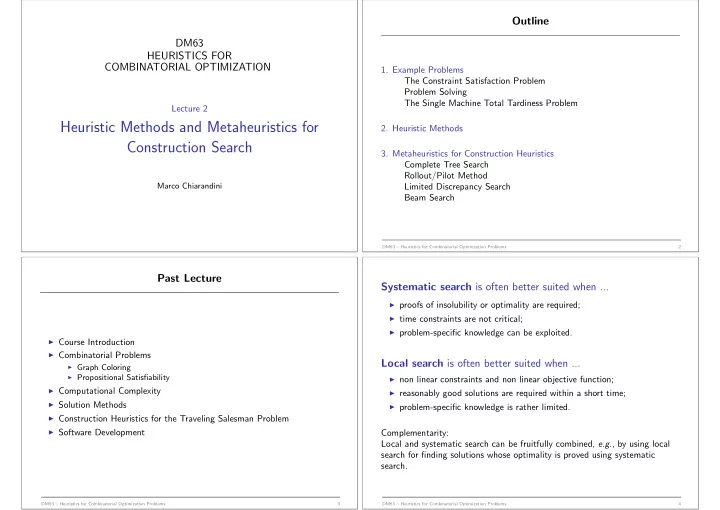
Outline DM63 HEURISTICS FOR COMBINATORIAL OPTIMIZATION 1. Example Problems The Constraint Satisfaction Problem Problem Solving The Single Machine Total Tardiness Problem Lecture 2 Heuristic Methods and Metaheuristics for 2. Heuristic


slide-1
SLIDE 1

DM63 HEURISTICS FOR COMBINATORIAL OPTIMIZATION

Lecture 2

Heuristic Methods and Metaheuristics for Construction Search

Marco Chiarandini

Outline

  • 1. Example Problems

The Constraint Satisfaction Problem Problem Solving The Single Machine Total Tardiness Problem

  • 2. Heuristic Methods
  • 3. Metaheuristics for Construction Heuristics

Complete Tree Search Rollout/Pilot Method Limited Discrepancy Search Beam Search

DM63 – Heuristics for Combinatorial Optimization Problems 2

Past Lecture

◮ Course Introduction ◮ Combinatorial Problems

◮ Graph Coloring ◮ Propositional Satisfiability

◮ Computational Complexity ◮ Solution Methods ◮ Construction Heuristics for the Traveling Salesman Problem ◮ Software Development

DM63 – Heuristics for Combinatorial Optimization Problems 3

Systematic search is often better suited when ...

◮ proofs of insolubility or optimality are required; ◮ time constraints are not critical; ◮ problem-specific knowledge can be exploited.

Local search is often better suited when ...

◮ non linear constraints and non linear objective function; ◮ reasonably good solutions are required within a short time; ◮ problem-specific knowledge is rather limited.

Complementarity: Local and systematic search can be fruitfully combined, e.g., by using local search for finding solutions whose optimality is proved using systematic search.

DM63 – Heuristics for Combinatorial Optimization Problems 4

slide-2
SLIDE 2

Outline

  • 1. Example Problems

The Constraint Satisfaction Problem Problem Solving The Single Machine Total Tardiness Problem

  • 2. Heuristic Methods
  • 3. Metaheuristics for Construction Heuristics

Complete Tree Search Rollout/Pilot Method Limited Discrepancy Search Beam Search

DM63 – Heuristics for Combinatorial Optimization Problems 5

Example Problems

◮ They are chosen because conceptually concise, intended to illustrate the

development, analysis and presentation of algorithms

◮ Although real-world problems tend to have much more complex

formulations these problems capture their essence

DM63 – Heuristics for Combinatorial Optimization Problems 6

Preprocessing Rules

Polynomial simplifications

SAT (CNF formulae)

◮ elimination of duplicates ◮ elimination tautological clauses ◮ elimination subsumed clauses ◮ elimination clauses with pure literals ◮ elimination unit clauses and unit propagation

k-coloring

◮ Remove under-constrained nodes ◮ Remove subsumed nodes ◮ Merge nodes that must have the same color

DM63 – Heuristics for Combinatorial Optimization Problems 7

Constraint Satisfaction Problem

◮ Given: a triple X, D, C, where X is a set of variables, D is a domain

  • f values, and C is a set of constraints. Every constraint is a pair t, R,

where t is a tuple of variables and R is a relation (or a set of tuples of values; all these tuples having the same number of elements) An evaluation of the variables is a function from variables to v : X → D. Such an evaluation satisfies a constraint (x1, . . . , xn), R if (v(x1), . . . , v(xn)) ∈ R.

◮ Task: A solution is an evaluation that satisfies all constraints.

DM63 – Heuristics for Combinatorial Optimization Problems 8

slide-3
SLIDE 3

Problem Solving as by George P´

  • lya

George P´

  • lya’s 1945 book How to Solve It:

◮ First, you have to understand the problem. ◮ After understanding, then make a plan. ◮ Carry out the plan. ◮ Look back on your work. How could it be better?

DM63 – Heuristics for Combinatorial Optimization Problems 9

  • lya’s First Principle: Understand the Problem

◮ Do you understand all the words used in stating the problem? ◮ What are you asked to find or show? ◮ Can you restate the problem in your own words? ◮ Can you think of a picture or a diagram that might help you understand

the problem?

◮ Is there enough information to enable you to find a solution?

DM63 – Heuristics for Combinatorial Optimization Problems 10

  • lya’s Second Principle: Devise a plan

There are many reasonable ways to solve problems. The skill at choosing an appropriate strategy is best learned by solving many problems. You will find choosing a strategy increasingly easy. A partial list of strategies is included:

◮ Guess and check ◮ Make an orderly list ◮ Eliminate possibilities ◮ Use symmetry ◮ Consider special cases ◮ Use direct reasoning

Also suggested:

◮ Look for a pattern ◮ Draw a picture ◮ Solve a simpler problem ◮ Use a model ◮ Work backward ◮ Be ingenious

DM63 – Heuristics for Combinatorial Optimization Problems 11

  • lya’s third Principle: Carry out the plan

Need is care and patience, given that you have the necessary skills. Persist with the plan that you have chosen. If it continues not to work discard it and choose another. Don’t be misled, this is how mathematics is done, even by professionals.

  • lya’s fourth Principle: Review/Extend

Much can be gained by taking the time to reflect and look back at what you have done, what worked and what didn’t. Doing this will enable you to predict what strategy to use to solve future problems.

DM63 – Heuristics for Combinatorial Optimization Problems 12

slide-4
SLIDE 4

”If you can’t solve a problem, then there is an easier problem you can solve: find it”

DM63 – Heuristics for Combinatorial Optimization Problems 13

The Single Machine Total Tardiness Problem

Given: a set of n jobs {J1, . . . , Jn} to be processed on a single machine and for each job Ji a processing time pi, a weight wi and a due date di. Task: Find a schedule that minimizes the total weighted tardiness n

i=1 wi · Ti

where Ti = {Ci − di, 0} (Ci completion time of job Ji) Example: Job J1 J2 J3 J4 J5 J6 Processing Time 3 2 2 3 4 3 Due date 6 13 4 9 7 17 Weight 2 3 1 5 1 2 Sequence φ = J3, J1, J5, J4, J1, J6 Job J3 J1 J5 J4 J1 J6 Ci 2 5 9 12 14 17 Ti 2 3 1 wi · Ti 2 15 3

DM63 – Heuristics for Combinatorial Optimization Problems 14

Outline

  • 1. Example Problems

The Constraint Satisfaction Problem Problem Solving The Single Machine Total Tardiness Problem

  • 2. Heuristic Methods
  • 3. Metaheuristics for Construction Heuristics

Complete Tree Search Rollout/Pilot Method Limited Discrepancy Search Beam Search

DM63 – Heuristics for Combinatorial Optimization Problems 15

Heuristic Paradigms Construction Heuristics

They are closely related to search tree techniques but correspond to a single path from root to leaf

◮ search space = partial candidate solutions ◮ search step = extension with one or more solution components

Construction Heuristic (CH): s := ∅ While s is not a complete solution: | | choose a solution component c ⌊ add the solution component to s

DM63 – Heuristics for Combinatorial Optimization Problems 16

slide-5
SLIDE 5

Construction Heuristics

An important class of Construction Heuristics are greedy algorithms.

◮ Strategy: always make the choice which is the best at the moment. ◮ They are not generally guaranteed to find globally optimal solutions

(but sometimes they do: Minimum Spanning Tree, Single Source Shortest Path, etc.)

DM63 – Heuristics for Combinatorial Optimization Problems 17

Heuristic Paradigms Perturbative search

◮ search space = complete candidate solutions ◮ search step = modification of one or more solution components ◮ iteratively generate and evaluate candidate solutions

◮ decision problems: evaluation = test if solution ◮ optimization problems: evaluation = check objective function value

◮ evaluating candidate solutions is typically computationally much cheaper

than finding (optimal) solutions Iterative Improvement (II): While s has better neighbors: | | choose a neighbor s′ of s | | such that f(s′) < f(s) ⌊ s := s′

DM63 – Heuristics for Combinatorial Optimization Problems 18

Example: Uninformed random walk for SAT

procedure URW-for-SAT(F,maxSteps) input: propositional formula F, integer maxSteps

  • utput: model of F or ∅

choose assignment ϕ of truth values to all variables in F uniformly at random; steps := 0; while not((ϕ satisfies F) and (steps < maxSteps)) do select x uniformly at random from {x′|x′ is a variable in F and changing value of x′ in ϕ decreases the number of unsatisfied clauses}; steps := steps+1; end if ϕ satisfies F then return ϕ else return ∅ end end URW-for-SAT

DM63 – Heuristics for Combinatorial Optimization Problems 19

Heuristic Methods

Meta-heuristics are general purpose guidance criteria to enhance these two heuristic paradigms.

Meta-heuristics

General guidance criteria over lower level heuristics. Metaheuristics Construction Heuristics Perturbative Search In order to obtain very high quality solutions it is often successful to combine these heuristic paradigms into an hybrid algorithm

DM63 – Heuristics for Combinatorial Optimization Problems 20

slide-6
SLIDE 6

A note on terminology

Heuristic Methods ≡ Metaheuristics ≡ Local Search Methods ≡ Stochastic Local Search Methods ≡ Hybrid Metaheuristics Method = Algorithm Stochastic Local Search (SLS) algorithms allude to:

◮ Local Search: informed search based on local or incomplete knowledge

as opposed to systematic search

◮ Stochastic: use randomized choices in generating and modifying

candidate solutions. They are introduced whenever it is unknown which deterministic rules are profitable for all the instances of interest.

DM63 – Heuristics for Combinatorial Optimization Problems 21

Outline

  • 1. Example Problems

The Constraint Satisfaction Problem Problem Solving The Single Machine Total Tardiness Problem

  • 2. Heuristic Methods
  • 3. Metaheuristics for Construction Heuristics

Complete Tree Search Rollout/Pilot Method Limited Discrepancy Search Beam Search

DM63 – Heuristics for Combinatorial Optimization Problems 22

Uninformed Complete Tree Search

◮ Breadth-first search ◮ Depth-first search ◮ Depth-limited search ◮ Iterative deepening depth-first search ◮ Bidirectional Search

DM63 – Heuristics for Combinatorial Optimization Problems 23

Informed Complete Tree Search

◮ Informed search algorithm: exploit problem-specific knowledge ◮ Best-first search: node that “appears” to be the best selected for

expansion based on an evaluation function f(x)

◮ Implemented through a priority queue of nodes in ascending order of f

DM63 – Heuristics for Combinatorial Optimization Problems 24

slide-7
SLIDE 7

Informed Complete Tree Search Greedy best-first search

◮ Evaluates nodes on the basis of an heuristic function f(n) = h(n) ◮ Incomplete version: perform only one descent ◮ Complete version: need to avoid repeated states

DM63 – Heuristics for Combinatorial Optimization Problems 25

Greedy best-first search

DM63 – Heuristics for Combinatorial Optimization Problems 26

Informed Complete Tree Search A∗ best-first search

◮ The priority assigned to a node x is determined by the function

f(x) = g(x) + h(x) g(x): cost of the path so far h(x): heuristic estimate of the minimal cost to reach the goal from x.

◮ It is optimal if h(x) is an

◮ admissible heuristic: never overestimates the cost to reach the goal ◮ consistent: h(n) ≤ c(n, a, n′) + h(n′) DM63 – Heuristics for Combinatorial Optimization Problems 27

A∗ best-first search

DM63 – Heuristics for Combinatorial Optimization Problems 28

slide-8
SLIDE 8

A∗ best-first search

Possible choices for admissible heuristic functions

◮ optimal solution to an easily solvable relaxed problem ◮ optimal solution to an easily solvable subproblem ◮ learning from experience by gathering statistics on state features ◮ preferred heuristics functions with higher values (provided they do not

  • verestimate)

◮ if several heuristics available h1, h2, . . . , hm and not clear which is the

best then: h(x) = max{h1(x), . . . , hm(x)}

DM63 – Heuristics for Combinatorial Optimization Problems 29

A∗ best-first search

Drawbacks

◮ Time complexity: In the worst case, the number of nodes expanded is

exponential, but it is polynomial when the heuristic function h meets the following condition: |h(x) − h∗(x)| ≤ O(log h∗(x)) h∗ is the optimal heuristic, i.e. the exact cost to get from x to the goal.

◮ Memory usage: In the worst case, it must remember an exponential

number of nodes. Several variants: including iterative deepening A∗ (IDA∗), memory-bounded A∗ (MA∗) and simplified memory bounded A∗ (SMA∗) and recursive best-first search (RBFS)

DM63 – Heuristics for Combinatorial Optimization Problems 30

Rollout/Pilot Method

Derived from A∗

◮ Each candidate solution is a collection of m components

s = (s1, s2, . . . , sm).

◮ Master process add components sequentially to a partial solution

Sk = (s1, s2, . . . sk)

◮ At the k-th iteration the master process evaluates seemly feasible

components to add based on a look-ahead strategy based on heuristic algorithms.

◮ The evaluation function H(Sk+1) is determined by sub-heuristics that

complete the solution starting from Sk

◮ Sub-heuristics are combined in H(Sk+1) by

◮ weighted sum ◮ minimal value DM63 – Heuristics for Combinatorial Optimization Problems 31

Speed-ups:

◮ halt whenever cost of current partial solution exceeds current upper

bound

◮ evaluate only a fraction of possible components

DM63 – Heuristics for Combinatorial Optimization Problems 32

slide-9
SLIDE 9

Limited Discrepancy Search

◮ A discrepancy is a branch against the value of an heuristic ◮ Ex: count one discrepancy if second best is chosen

count two discrepancies either if third best is chosen or twice the second best is chosen

◮ Explore the tree in order of an increasing number of discrepancies

DM63 – Heuristics for Combinatorial Optimization Problems 33

Beam Search

Possible extension of tree based construction heuristics:

◮ maintains a set B of bw (beam width) partial candidate solutions ◮ at each iteration extend each solution from B in fw (filter width)

possible ways

◮ rank each bw × fw candidate solutions and take the best bw partial

solutions

◮ complete candidate solutions obtained by B are maintained in Bf ◮ Stop when no partial solution in B is to be extend

DM63 – Heuristics for Combinatorial Optimization Problems 34