
SLIDE 1
Ethiopian Renaissance and TVET Reform at a Glance
September 2014
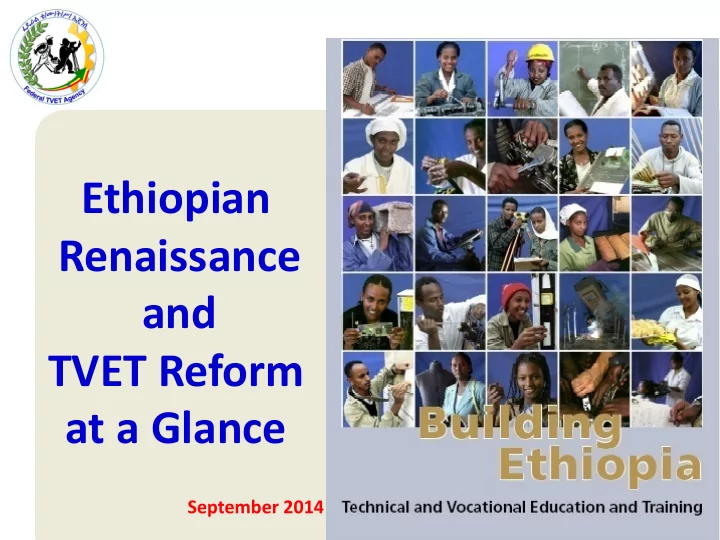
Ethiopian Renaissance and TVET Reform at a Glance September 2014 - - PowerPoint PPT Presentation
Ethiopian Renaissance and TVET Reform at a Glance September 2014 Ethiopian TVET Reform in Retrospect Outline 1. Background 2. TVET Strategy Aims, Principles & Key Issues Outcome Based Approach GTP Priority Sectors 3.
September 2014
Outline
1. Background 2. TVET Strategy
Aims, Principles & Key Issues Outcome Based Approach GTP Priority Sectors
3. Industry, Research Institute & University Linkage 4. Achievements so far and 2014 TVET Data 5. International Cooperation Modalities Ethiopian TVET Reform in Retrospect
1. Background 2. TVET Strategy
Aims, Principles & Key Issues Outcome Based Approach GTP Priority Sectors
3. Industry, Research Institute & University Linkage 4. Achievements so far and 2014 TVET Data 5. International Cooperation Modalities Ethiopian TVET Reform in Retrospect
Our goal is implemented at the era where
Globalization laws are prevailing at
international level, This implies, to continue as a country in a globalized world, competitiveness is required; if not Failed State position is inevitable, High performing human resource
development and being technology innovator are pivotal factors,
Growth will be realized under the influence of Globalization
0.1 10 5 1
Risk falling to the Low-Income Trap
Challenge to imitate a wide range of different Products & Technologies Challenge to expand Productive Capacities into new Products, Technologies and manage the Transformation Process
Risk falling to the Middle-Income Trap
Lower Middle Income Upper Middle Income Low Income High Income
55 25 Per Capita Income
(‘000 ‘000 US$) $)
Yrs.
Ethiopian Renaissance
02/03 07/08 12/13 17/18 22/23 27/28 32/33 37/38 42/43 47/48 52/53 57/58
0.1 10 5 1
Lower Middle Income Upper Middle Income Low Income High Income
55 25 Per Capita Income
(‘000 ‘000 US$) $)
Yrs.
Ethiopian Renaissance
02/03 07/08 12/13 17/18 22/23 27/28 32/33 37/38 42/43 47/48 52/53 57/58
TVET Led by Education & Training Sector
TVET Led by Industry & Education & Training Sector
TVET Fully led by Industry (Chambers)
Core Problems persisted (e.g.)
Training: Not focused towards Industry’s & Development Program’s Demand , Training provisions: Only Formal Training & center based, All Training areas: Time Bound, Quality Assurance: Centralized Curriculum, Trained graduates: Couldn’t get employment, Industries: Not competitive (locally, internationally), Stakeholders participation: Non-existent, Background (up to 2005/ 2006)
1. Background 2. TVET Strategy
Aims, Principles & Key Issues Outcome Based Approach GTP Priority Sectors
3. Industry, Research Institute & University Linkage 4. Achievements so far and 2014 TVET Data 5. International Cooperation Modalities Ethiopian TVET Reform in Retrospect
Centers of Technology Transfer, Life – Long – Learning, Flexible Training Provision, Co-operative & In-Company Training Delivery, Stakeholders’ Participation, Decentralization, Integration of all sectors to the TVET system, 1 Policy & System Development 2 Occupational Standards, Assessment & Certification 3 Human Resource Development 4 Institutional Capacity Development 5 Cooperative & In - Company Training 6 Industry Extension & Technology Transfer Creating One Coherent Outcome - Based TVET System which includes Formal, Non-Formal, Informal, Initial & Further Training for All Sectors
Aim Principles Key Issues
National TVET Strategy 2007/8
Occupational Standard Setting
Assessment & Certification
Cooperative & In-Company Training Provision (70/30) in Industry & TVET
Demand
(Industry & Development Programs )
Supply
(Competent Workforce & Technology)
Industry led
Outcome-Based TVET System
TVET led
Priority Sec Sector
1.1 Crop Production 1.2 Animal Production 1.3 Natural Resources Development & Conservation
2.1 Leather 2.2 Textile and Garments 2.3 Metals 2.4 Cement 2.5 Sugar 2.6 Chemical Manufacturing 2.7 Agro-Processing 2.8 Wood & Bamboo Processing
3. Economic Infrastructure
3.1 Road Construction 3.2 Railway Construction & Transport 3.3 Road Transport 3.4 Maritime Transport & Operation
Priority Sec Sector
3.5 Air Transport 3.6 Energy 3.7 Water and Irrigation Construction 3.8 Water Resource/Utility and Irrigation 3.9 Information & Communication Technology 3.10 Urban Development & Construction
Service Priority Sectors of the Growth & Transformation Plan
Highly labor-intensive construction projects:
The “Cobblestone Project”, (now fully private), The 85 thousand km universal rural road access program, inter-regional road initiatives, (becoming private), The Grand Renaissance Dam, (Government), 3 expansion and 9 new Sugar Manufacturing Plants with expected demand for competent workforce around 500 thousand in the area of house construction, sugar plantation and sugar manufacturing plant erection, (60/ 40: Gov./ Pvt.) The Growth & Transformation Plan (GTP)
1. Background 2. TVET Strategy
Aims, Principles & Key Issues Outcome Based Approach GTP Priority Sectors
3. Industry, Research Institute & University Linkage 4. Achievements so far and 2014 TVET Data 5. International Cooperation Modalities Ethiopian TVET Reform in Retrospect
Industr try E y Extension Cooperativ ive T Trainin aining
TVE VET Education, Training, Research Industry
Micro, Small, Medium & Large Enterprises
AgricultureIndustry
Economi mic c
InfrastructureTrade Health Culture/ Tourism Mine
Market Dir irect t Suppl pply Sub-Co Contract acting
Competent Workforce & Competitive MSE GTP Priority Sectors
Competitive Product & Services
Demand of Competent Workforce & Technology
Assure and sustatin International Competitiveness
Investigate Industry’s demand and its problems, analyze existing world best practices & approaches and revise and improve present education and training system, Associate directly with development and produce competent workforce which can suitably contribute to growth, Facilitate requirements for teachers and students to participate in technology adaptation and transfer inside industry, Accumulate technological capability which can determine fast and continuous growth, Education &Training and Research Institutions’ Linkage
TVET analyze Value Chain for identified Industry based on GTP
Identifying process constrains
Technology demand Identification
Best Technology Identification & Analysis Impact Assessment Technology Transfer
MSEs, capacitate them and transfer best technology accordingly
through industry extension support supervision enter to manufacturing
Prototype Development
Sector Bureaus conduct impact assessment & identify new demands UNI / Research Select best demanded Technology, formulate design & develop blue print
prototype based on formulated design & blue print
the development sector from the economic corridor conduct series of tests
Education, Training and Research Institutes Coordination
1. Background 2. TVET Strategy
Aims, Principles & Key Issues Outcome Based Approach GTP Priority Sectors
3. Industry, Research Institute & University Linkage 4. Achievements so far and 2014 TVET Data 5. International Cooperation Modalities Ethiopian TVET Reform in Retrospect
No Key Issues Planned Achieved %
1 Industry Lead Assessors’ Develp’t (L3 & 4) 2,708 2,410 89 2 Accredited Industry Competency Assessment Centers (medium & big) 178 258 145 3 Industry Workers’ Competency Assessm’t
Medium & Big Industries MSE Operators Farmers 145,176 309,580 1,621,908 81,262 44,404 44,022 60 14.4 2.7
4 TVET Trainees’ Competency Assessment
Formal Training Short Term Training 174,821 66.272 121,990 51,842 70 78.2
5 Cooperative Training Coverage 300,132 247,289 82 6 Short Term Demand Oriented Training 2,488,339 1,950,677 78 7 Industry Extension Service to MSE Operators 608,952 559,674 91.9 9 Technology Transferred to MSEs 1,417 1,432 101 10 Wealth Generated by MSEs (Eth. Birr) 126.0 Mil. 138Mil. 109
General TVET Data (status: April / May 2013)
Public TVET Institutions
Oromia 126 Amhara 67 Tigray 27 SNNPR 23 Addis Ababa 32 Dire Dawa 2 Afar 4 Beni-S Gumuz 4 Gambela 2 Somali 6 Harari 2
Nationwide 13,533 Trainers in 9 Regions C Level = 9,596 B Level = 3,533 A Level = 404
Current trainees Enrollment 404,041 Male: 50.2% Female: 49.8%
TVET Institutions
Public 365 Private 538 NGO 31 Total 934
No Partner Country
Key Intervention Areas
Remark Policy & System Development TVET Trainer’s/ Leader’s Development Institutional Development Technology Transfer & Ind.
Development
(Top Priority) 1 Germany Dual Training Study Tours Financial Co. 2 China FTI Study Tours 3 Korea Polytechnic Study Tours 4 Italy Polytechnic 5 Australia Study Tours 6 Japan KAIZEN 7 Cuba Trainers
1. Background 2. TVET Strategy
Aims, Principles & Key Issues Outcome Based Approach GTP Priority Sectors
3. Industry, Research Institute & University Linkage 4. Achievements so far and 2014 TVET Data 5. International Cooperation Modalities Ethiopian TVET Reform in Retrospect
TVET Institutions Twinning, Institutional Capacity Building:
provision of specialized machines & equipments for selected priority areas,
Deployment of Expat Trainers (short & long term) & Technology Capacity Developers [Fabricators] in priority areas:
Focus on distinctive GTP industrial sub sector areas (Textile, Leather, Metal etc..)
Co- management of selected TVET Institutions,
Partnership matters need: to reflect on demand, be focused and prioritized, to consider sense of urgency of the needs of the specific prioritized sector, to comprehend that human resource development predominantly TVET Trainers’ capacity development is a critical intervention area,