
SLIDE 1
Relevance of Todays Paper to Tanzania TZ has more FDI than Ethiopia - - PowerPoint PPT Presentation
Relevance of Todays Paper to Tanzania TZ has more FDI than Ethiopia (24% in Census of Industrial Production 2013 vs 18% in Ethiopia) Moreover, 68% of foreign firm entered TZs mfg sector since 1998 So, the potential for learning
Intro Simple Model Data Estimation and Main Evidence Inside the Black Box of TT Further Evidence Conclusions Extra
Foreign Direct Investment and Knowledge Diffusion in Poor Locations: Evidence from Ethiopia
Girum Abebe (EDRI, Ethiopia), Margaret McMillan (Tufts), Michel Serafinelli (Toronto)
Girum Abebe (EDRI, Ethiopia), Margaret McMillan (Tufts), Michel Serafinelli (Toronto) Foreign Direct Investment and Knowledge Diffusion in Poor Locations: Evidence from Ethiopia
Intro Simple Model Data Estimation and Main Evidence Inside the Black Box of TT Further Evidence Conclusions Extra
The research questions
To what extent is the productivity of domestic plants affected
by foreign direct investment (FDI)?
Girum Abebe (EDRI, Ethiopia), Margaret McMillan (Tufts), Michel Serafinelli (Toronto) Foreign Direct Investment and Knowledge Diffusion in Poor Locations: Evidence from Ethiopia
Intro Simple Model Data Estimation and Main Evidence Inside the Black Box of TT Further Evidence Conclusions Extra
The research questions
To what extent is the productivity of domestic plants affected
by foreign direct investment (FDI)?
Can domestic plants assimilate knowledge from (superior)
foreign plants through observation, imitation and interaction?
Girum Abebe (EDRI, Ethiopia), Margaret McMillan (Tufts), Michel Serafinelli (Toronto) Foreign Direct Investment and Knowledge Diffusion in Poor Locations: Evidence from Ethiopia
Intro Simple Model Data Estimation and Main Evidence Inside the Black Box of TT Further Evidence Conclusions Extra
The research questions
To what extent is the productivity of domestic plants affected
by foreign direct investment (FDI)?
Can domestic plants assimilate knowledge from (superior)
foreign plants through observation, imitation and interaction?
(new look at quite old questions)
Girum Abebe (EDRI, Ethiopia), Margaret McMillan (Tufts), Michel Serafinelli (Toronto) Foreign Direct Investment and Knowledge Diffusion in Poor Locations: Evidence from Ethiopia
Intro Simple Model Data Estimation and Main Evidence Inside the Black Box of TT Further Evidence Conclusions Extra
Motivation
Productivity gaps large between developed and developing
countries; FDI could be powerful tool for reducing them
Attracing FDI key element of Ethiopian governments industrial
policy (also other countries)
Previous literature effects not well identified (Handbook DevEC,
Harrison and Rodriguez-Clare 2010)
Key question is whether knowledge assimilated through observation,
imitation and (formal and informal) interaction
Similarity between research on FDI spillovers and that on
agglomeration advantages (e.g. Greenstone, Hornbeck & Moretti 2010)
Our research design exploits geograpic location of FDI
Girum Abebe (EDRI, Ethiopia), Margaret McMillan (Tufts), Michel Serafinelli (Toronto) Foreign Direct Investment and Knowledge Diffusion in Poor Locations: Evidence from Ethiopia
Intro Simple Model Data Estimation and Main Evidence Inside the Black Box of TT Further Evidence Conclusions Extra
This Paper
Uses insights from literature on agglomeration to identify causal
impact of FDI on domestic plant prody
Quantify magnitude of spillovers from FDI using plant-level panel
data from Annual Census of Manufacturers
Production functions allow total factor productivity (TFP) of
domestic plants to depend on presence of large greenfield foreign plant in the district
Two research designs addressing issue that district chosen by FDI
likely different from average
RD1: planned vs actual FDI and RD2: exploits government
assignment of land
Mechanisms: Technology Transfer survey designed by us
Girum Abebe (EDRI, Ethiopia), Margaret McMillan (Tufts), Michel Serafinelli (Toronto) Foreign Direct Investment and Knowledge Diffusion in Poor Locations: Evidence from Ethiopia
Intro Simple Model Data Estimation and Main Evidence Inside the Black Box of TT Further Evidence Conclusions Extra
Preview of Results
increase in TFP in ’treated’ domestic plants
knowledge transfer through (i) labor flows (ii) learning by
Serafinelli 2017; Fons-Rosen 2012; Javorcik 2004)
foreign plants attract new economic activity Some evidence of increased within firm employment, no changes in
wages
similar results with RD 1 & 2 (despite different potential omitted
variables biases)
Girum Abebe (EDRI, Ethiopia), Margaret McMillan (Tufts), Michel Serafinelli (Toronto) Foreign Direct Investment and Knowledge Diffusion in Poor Locations: Evidence from Ethiopia
Intro Simple Model Data Estimation and Main Evidence Inside the Black Box of TT Further Evidence Conclusions Extra
Outline
A Simple Model Data and Descriptive Stats Estimation and Main Evidence Robustness, and Further Evidence
Girum Abebe (EDRI, Ethiopia), Margaret McMillan (Tufts), Michel Serafinelli (Toronto) Foreign Direct Investment and Knowledge Diffusion in Poor Locations: Evidence from Ethiopia
Intro Simple Model Data Estimation and Main Evidence Inside the Black Box of TT Further Evidence Conclusions Extra
Consider a domestic plant j ’s optimization problem:
max
L f (A, L) − wL nationally traded good whose price normalized to 1; L: labor;
w: wage [see paper for more general framework] A = A(p)
p: geographical, temporal and economic proximity to FDI
(Rosenthal and Strange 2004, Greenstone Hornbeck and Moretti 2010)
FDI spillovers: ∂A/∂p > 0
Girum Abebe (EDRI, Ethiopia), Margaret McMillan (Tufts), Michel Serafinelli (Toronto) Foreign Direct Investment and Knowledge Diffusion in Poor Locations: Evidence from Ethiopia
Intro Simple Model Data Estimation and Main Evidence Inside the Black Box of TT Further Evidence Conclusions Extra
Let L∗ denotes the optimal level of labor given wage
π∗ = f [A(p), L∗(w(p))] − w(p)L∗(w(p))
totally differentiate
dπ∗ dp = ∂f ∂A ∂A ∂p + ∂w ∂p [ ∂L∗ ∂w ( ∂f ∂L − w) − L∗]
If all domestic plants wage takers and labor paid MP
dπ∗ dp = ∂f ∂A ∂A ∂p − ∂w ∂p L∗
Girum Abebe (EDRI, Ethiopia), Margaret McMillan (Tufts), Michel Serafinelli (Toronto) Foreign Direct Investment and Knowledge Diffusion in Poor Locations: Evidence from Ethiopia
Intro Simple Model Data Estimation and Main Evidence Inside the Black Box of TT Further Evidence Conclusions Extra
Outline
A Simple Model Data and Descriptive Stats Estimation and Main Evidence Robustness, and Further Evidence
Girum Abebe (EDRI, Ethiopia), Margaret McMillan (Tufts), Michel Serafinelli (Toronto) Foreign Direct Investment and Knowledge Diffusion in Poor Locations: Evidence from Ethiopia
Intro Simple Model Data Estimation and Main Evidence Inside the Black Box of TT Further Evidence Conclusions Extra
Data
Central Statistical Agency (CSA) Large and Medium Scale
Manufacturing Establishment Census; link up plants for 1997-2013 to estimate TFP regressions [Descriptives Sample, Descriptives ETH Economy]
In principle, any formal manufacturing plant with L ≥ 10 that
uses electricity forms part of target population (⇒)
Feb 2014 technology transfer survey module implented by
CSA with LMSM Census
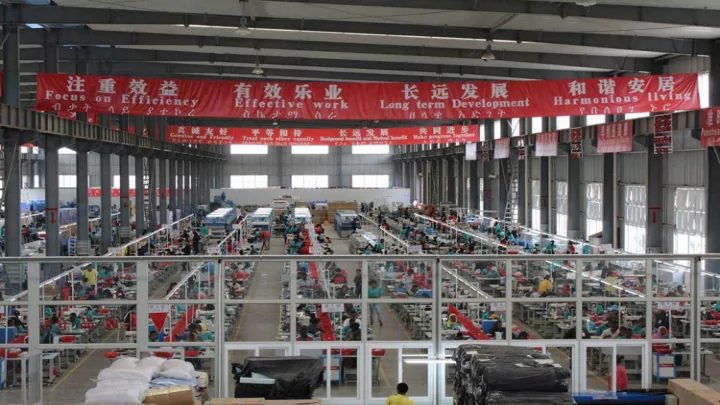
June 2016 we visited several plants [Pictures] In-depth interviews with EIC, Ministry of Industry, managers
at foreign & domestic plants
Restricted administrative data from Ethiopian Investment
Commission (EIC)
Girum Abebe (EDRI, Ethiopia), Margaret McMillan (Tufts), Michel Serafinelli (Toronto) Foreign Direct Investment and Knowledge Diffusion in Poor Locations: Evidence from Ethiopia
Intro Simple Model Data Estimation and Main Evidence Inside the Black Box of TT Further Evidence Conclusions Extra
Table: Size, performance and technology indicators by ownership type (2013)
(1) (2) (3) (4) Full Sample FDI Domestic p-value of diff. (2)-(3) Number of workers 86.7 150.1 72.7 0.00 Value added per worker 143 188 133 0.06 Percent of output sold to FDI (%) 2.9 5.1 2.4 0.00 Percent of plants that export 5.6 14.2 3.7 0.00 Percent share of export in total sales 2.5 6.6 1.8 0.00 Conducted R & D in the last three years 7.1 11.0 6.3 0.00 Hold internationally recognized patent 1.9 4.2 1.4 0.00 Use technology licensed from abroad 10.8 13.6 10.2 0.08 Number of observations 1,708 310 1,398 Note: Author’s compilation based on CSA census and FDI survey module Girum Abebe (EDRI, Ethiopia), Margaret McMillan (Tufts), Michel Serafinelli (Toronto) Foreign Direct Investment and Knowledge Diffusion in Poor Locations: Evidence from Ethiopia
Intro Simple Model Data Estimation and Main Evidence Inside the Black Box of TT Further Evidence Conclusions Extra
Outline
A Simple Model Data and Descriptive Stats Estimation and Main Evidence
Robustness, and Further Evidence
Girum Abebe (EDRI, Ethiopia), Margaret McMillan (Tufts), Michel Serafinelli (Toronto) Foreign Direct Investment and Knowledge Diffusion in Poor Locations: Evidence from Ethiopia
Intro Simple Model Data Estimation and Main Evidence Inside the Black Box of TT Further Evidence Conclusions Extra
Outline
A Simple Model Data and Descriptive Stats Estimation and Main Evidence
Robustness, and Further Evidence
Girum Abebe (EDRI, Ethiopia), Margaret McMillan (Tufts), Michel Serafinelli (Toronto) Foreign Direct Investment and Knowledge Diffusion in Poor Locations: Evidence from Ethiopia
Intro Simple Model Data Estimation and Main Evidence Inside the Black Box of TT Further Evidence Conclusions Extra
Actual vs Planned FDI Investments
treated district: where foreign plant actually invested control district: location in which foreign plant in same
industry and around same time, applied for a license, got approval but then did not produce during the period of 1-4 years
Girum Abebe (EDRI, Ethiopia), Margaret McMillan (Tufts), Michel Serafinelli (Toronto) Foreign Direct Investment and Knowledge Diffusion in Poor Locations: Evidence from Ethiopia
Intro Simple Model Data Estimation and Main Evidence Inside the Black Box of TT Further Evidence Conclusions Extra
"Currently 2 out of 3 potential FDIs are not realized. Even
though a One Stop Shop service is operational its record is
implementation [...]. Further research is needed to identify those factors that facilitate the conversion of successful FDI in Ethiopia" (World Bank, 2015)
similar discussion in and Chen, Geiger & Fu 2015 Foreign currency shortages and financing issues also
sometimes cited (Altenburg, 2010; U.S. Department of Commerce 2017; Moller & Wacker 2015) [Descriptives]
Girum Abebe (EDRI, Ethiopia), Margaret McMillan (Tufts), Michel Serafinelli (Toronto) Foreign Direct Investment and Knowledge Diffusion in Poor Locations: Evidence from Ethiopia
Intro Simple Model Data Estimation and Main Evidence Inside the Black Box of TT Further Evidence Conclusions Extra
ln(Ypidrt) = βK ln(Kpidrt) + βM ln(Mpidrt) + βL ln(Lpidrt) + +δ1(OPENING)p + κ1(τ ≥ 0)t + ϕ(1(OPENING)p · 1(τ ≥ 0)t) +αp + µit + Trendrt + εpidrt
p references plant, i industry, d district, r region, and t year identifying assumption: domestic plants in districts where FDI
production delayed form valid counterfactual, after conditioning on plant FE, industry by year FE, etc
[Sample of FDI Openings]
Girum Abebe (EDRI, Ethiopia), Margaret McMillan (Tufts), Michel Serafinelli (Toronto) Foreign Direct Investment and Knowledge Diffusion in Poor Locations: Evidence from Ethiopia
Intro Simple Model Data Estimation and Main Evidence Inside the Black Box of TT Further Evidence Conclusions Extra
Table: Plant Characteristics by Treatment Status, One Year Prior to a FDI Plant Opening
Treatment Control p-value p-value Districts Districts (1)-(2) (1)-(2) (Cameron) (1) (2) (3) (4) Output 12230 11325 .78 .77 Capital 4932 6404 .5 .53 Employees 82.1 93.2 .51 .57 Plant Age 12.9 11 .08* .11 Output per Worker 120.72 125.14 .84 .84 Capital per Worker 75 62.7 .43 .47
P-values in Col 1 are calculated from standard errors clustered at the district level. P-values in Col 2 are obtained using the bootstrap procedure developed by Cameron et al (2008). All monetary amounts are in 1000s of birr. Girum Abebe (EDRI, Ethiopia), Margaret McMillan (Tufts), Michel Serafinelli (Toronto) Foreign Direct Investment and Knowledge Diffusion in Poor Locations: Evidence from Ethiopia
Intro Simple Model Data Estimation and Main Evidence Inside the Black Box of TT Further Evidence Conclusions Extra
Figure: Difference in domestic plants’ productivity in treated vs control districts, relative to the year of a FDI plant opening (Research Design: Actual vs Planned).
.2 .4 Difference in TFP relative to year of opening
1 2 3 Years since opening
TFP Difference: Treatment - Control Districts
Girum Abebe (EDRI, Ethiopia), Margaret McMillan (Tufts), Michel Serafinelli (Toronto) Foreign Direct Investment and Knowledge Diffusion in Poor Locations: Evidence from Ethiopia
Intro Simple Model Data Estimation and Main Evidence Inside the Black Box of TT Further Evidence Conclusions Extra
Figure: Domestic plants’ productivity, relative to the year of a FDI plant
.1 .2 .3 TFP
1 2 3 Years since opening Treatment Districts Control Districts Girum Abebe (EDRI, Ethiopia), Margaret McMillan (Tufts), Michel Serafinelli (Toronto) Foreign Direct Investment and Knowledge Diffusion in Poor Locations: Evidence from Ethiopia
Intro Simple Model Data Estimation and Main Evidence Inside the Black Box of TT Further Evidence Conclusions Extra
Outline
A Simple Model Data and Descriptive Stats Estimation and Main Evidence
Robustness, and Further Evidence
Girum Abebe (EDRI, Ethiopia), Margaret McMillan (Tufts), Michel Serafinelli (Toronto) Foreign Direct Investment and Knowledge Diffusion in Poor Locations: Evidence from Ethiopia
Table 7: FDI-related outcomes of domestic plants (% of domestic plants) (1) Directly adopted production processes by observing foreign plants in same industry 12.6 foreign plants did not try to prevent the observation/adoption 77.3 (% of plants answering ”YES” to above question) (2) Benefited from employing Former FDI workers 7.2 (3) Technology transfer from FDI customers 4.5 (4) Technology transfer from FDI suppliers 1.79 (5) Use technology licensed from foreign plants 10.2 (6) Changed production technologies due to competition from FDI 15.3 At least one of the above outcomes (1) to (4) 17.8 At least one of the above outcomes (1) to (6) 24.6 Number of 1,398
Note: Author’s compilation based on and FDI survey module 1
Table 8: Linkages and Change of Technology by Domestic Plants
Labor link Customer link Supply link Any link (1) (2) (3) (4) (5) (6) (7) (8) (9) (10) (11) (12) Yes No p-value Yes No p-value Yes No p-value Yes No p-value
Directly adopted production processes .37 .11 .00 .27 .12 .00 .24 .11 .00 .28 .09 .00 by observing FDI plants in the same industry Use technology licensed .31 .09 .00 .18 .10 .01 .17 .09 .01 .20 .08 .00 from foreign plants Changed production technologies due to .45 .13 .00 .39 .14 .00 .38 .13 .00 .38 .10 .00 competition from FDI N 97 1,298 90 1,305 125 1,270 255 1,140
Labor linked plants are defined as those hiring a former FDI employee, supply-linked plants are defined as those selling output to FDI plants, and customer-linked plants are defined as those buying raw material from FDI plants. Columns compare plants reporting each type of linkage to those who do not.
2
Table 9: Reported Benefits from Domestic Firms’ Linkages to FDI Firms
Benefit Share of observations Labor Linkages Production Technologies 0.65 Management and Organizational Practices 0.14 Knowledge of How to Export 0.09 Others 0.11 Customer Linkages Production Technologies 0.65 Management and Organizational Practices 0.17 Knowledge of How to Export 0.01 Others 0.16 Supply Linkages Product Design 0.40 Worker Training 0.19 Production Technologies 0.18 Logistics 0.11 Organization Structure 0.12 Any Linkage Production Technologies 0.45 Product Design 0.20 Management and Organizational Practices 0.13 Logistics Including Exporting 0.07 Worker Training 0.07 Others 0.08 Notes: The total number of firms included is equal to 179. Product design includes increases in the variety and quality of products. Worker training includes training of managers and those they supervise. Supply chain logistics includes better marketing and distrubution of products as well as supply chain management. Management and organizational practices include managerial practices, organizational structures and physical upkeep of premises.
3
Intro Simple Model Data Estimation and Main Evidence Inside the Black Box of TT Further Evidence Conclusions Extra
Outline
Data and Descriptive Stats RD 1: Exploiting assignment of land by Gov’t Survey Module Evidence RD2: Actual vs Planned FDI Investments Robustness, and Further Evidence
Girum Abebe (EDRI, Ethiopia), Margaret McMillan (Tufts), Michel Serafinelli (Toronto) Foreign Direct Investment and Knowledge Diffusion in Poor Locations: Evidence from Ethiopia
Intro Simple Model Data Estimation and Main Evidence Inside the Black Box of TT Further Evidence Conclusions Extra
What have we learned?
We presented evidence on FDI effects, in particular on the way
in which knowledge is transferred from FDI to domestic plants
knowledge transfer through labor flows; also evidence for
learning by observation, customer/supplier relationships
foreign plants attract new economic activity Cannot completely rule out possibility that some of estimated
effect reflects correlated unobservables
But similar results with RD 1 & 2, and overall evidence
supports hypothesis of positive FDI effect
Girum Abebe (EDRI, Ethiopia), Margaret McMillan (Tufts), Michel Serafinelli (Toronto) Foreign Direct Investment and Knowledge Diffusion in Poor Locations: Evidence from Ethiopia
Intro Simple Model Data Estimation and Main Evidence Inside the Black Box of TT Further Evidence Conclusions Extra Girum Abebe (EDRI, Ethiopia), Margaret McMillan (Tufts), Michel Serafinelli (Toronto) Foreign Direct Investment and Knowledge Diffusion in Poor Locations: Evidence from Ethiopia