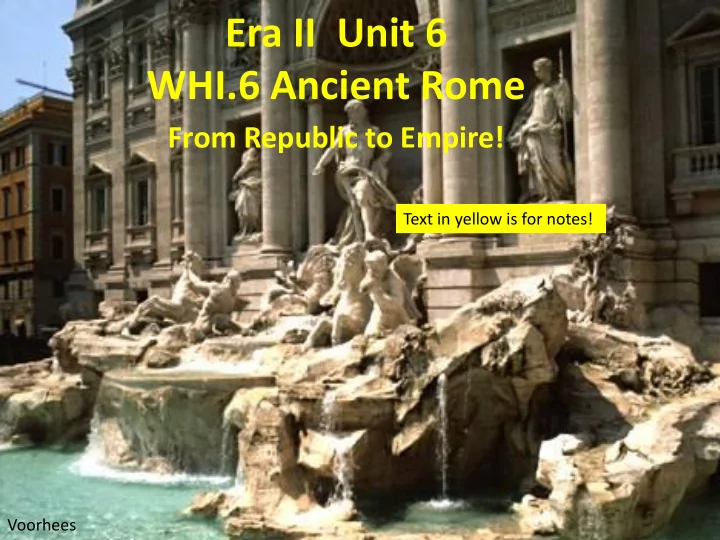
SLIDE 1 Era II Unit 6 WHI.6 Ancient Rome
From Republic to Empire!
Voorhees Text in yellow is for notes!
SLIDE 2 http://www.youtube.com/watch?v=740lQVgUWM4
SLIDE 3
Symbolism- Western Civilization
SLIDE 4 SIC SEMPER TYRRANUS= Thus always to tyrants
- Quote- Brutus upon slaying of Julius Caesar
- May 1776- Virginia declared independence
- July 1, 1776- committee of four appointed to make
seal- who were they? – Richard Henry Lee, George Mason, George Wythe, and Robert Carter Nicholas
- Because of the strong admiration for the Roman
Republic felt by the Virginia leaders, the design of the new seal was taken from the mythology of Ancient Rome
SLIDE 5 The student will apply social science skills to understand ancient Rome from about 700 B.C. (B.C.E.) to 500 A.D. (C.E.) in terms
- f its impact on Western civilization by
- a) locating Roman civilizations in time and place and
describing their major geographic features;
SLIDE 6
- Volcanoes made the region more fertile for
agricultural development
Pompeii destroyed by an eruption in 79 CE
SLIDE 7
Rome; Vesuvius (Pompeii)
SLIDE 8
SLIDE 9
(Italy= a peninsula shaped like a boot)
SLIDE 10
- I. Geography-
- A. Italian Peninsula Mediterranean Sea
SLIDE 11
See where Rome is located…
SLIDE 12
The Mediterranean Basin today
SLIDE 13 Ancient Rome
- B. The city of Rome, with its central location on
the Italian peninsula, was able to extend its influence over the entire Mediterranean Basin
SLIDE 14
Rome’s timeline in brief
power
democracy
- 2. REPUBLIC
- Elected leaders
- Representatives
- Indirect
democracy
- 700 BCE- 27 BCE
- 3. EMPIRE
- Centralized
power
- Emperor
- No democracy
- 27 BCE- 476 CE
SLIDE 15
began in Italy and then spread to other parts of the Mediterranean world
The Greek states came under the protection of Rome
SLIDE 16 The student will apply social science skills to understand ancient Rome from about 700 B.C. (B.C.E.) to 500 A.D. (C.E.) in terms
- f its impact on Western civilization by
- b) describing the social and religious structure of
ancient Rome;
SLIDE 17
Romulus and Remus
SLIDE 18
- II. Roman Mythology
- A. The Pantheon- for many gods
SLIDE 20 gods and goddesses had very human emotions and behaviors
- C. explanations of natural phenomena,
human qualities, and life events
SLIDE 21
- D. Symbols and images in literature, art,
monumental architecture, and politics
Roman Mythology…
SLIDE 22
- 1. Jupiter (Zeus)
- “King” of the gods, ruler
- f the sky
- Frequently associated
with the emperor
goddesses: (the same six from Greece)
Augustus Caesar as Jupiter
SLIDE 23
ruler of the Roman pantheon
gods
famous Roman temple for all the gods
Jupiter
SLIDE 24
- 2. Juno (Hera)
- “Queen” of the gods,
patron of family and marriage
Rome than in Greece
Roman mythology…
SLIDE 25
healing, light and the hunt
Roman mythology…
SLIDE 26
- 4. Diana (Artemis)
- Sister of Apollo,
goddess of the moon and hunting
Roman mythology…
SLIDE 27
- 5. Minerva (Athena)
- Goddess of wisdom and
skilled labor
Roman mythology…
SLIDE 28
- 6. Venus (Aphrodite)
- Goddess of love and
beauty
Roman mythology…
SLIDE 29 The student will apply social science skills to understand ancient Rome from about 700 B.C. (B.C.E.) to 500 A.D. (C.E.) in terms
- f its impact on Western civilization by
- c) describing the social structure and cultural
development of the Roman Republic;
SLIDE 30
- A. Democracy
- 1. the Roman Republic made major strides
in the development of representative democracy
- 2. a foundation of modern democracy
- 3. Not allowed to participate: women, most
aliens (non-citizen foreigners), and slaves
SLIDE 31
- 4. Representative democracy
a) Assemblies b) The Senate c) Consuls
- 5. Laws of Rome codified as Twelve Tables
ROME; democracy
SLIDE 32
- B. Social structure in the
Roman Republic
nobility (few in number)
ROME
SLIDE 33
Patricians in the Senate of Rome
SLIDE 34 ROME; plebeians- the common people
- 2. Plebeians—Majority
- f population
SLIDE 35
–Involuntary service –not based on race
ROME; slavery
SLIDE 36
–Patrician and plebeian men –Selected foreigners –Rights and responsibilities of citizenship (taxes, military service)
ROME; citizens
SLIDE 37
SLIDE 38
SLIDE 39 The student will apply social science skills to understand ancient Rome from about 700 B.C. (B.C.E.) to 500 A.D. (C.E.) in terms
- f its impact on Western civilization by
- d) describing and evaluating the political and
military structure of the Roman Republic under the rule of Julius Caesar;
SLIDE 40
Carthage (264-146 BCE)
in competition for trade
Hannibal invaded the Italian Peninsula
be won by Rome
- IV. The Punic Wars and Julius Caesar
SLIDE 41
SLIDE 42 Who were the Carthaginians?
- Punic means Phoenician! Phoenician merchants
established Carthage about 800 BCE
- The city quickly grew to become the greatest
military and naval power of the western Mediterranean and Rome's most dangerous rival
SLIDE 43
SLIDE 44
- With the victory over Carthage in the Punic
Wars, Rome was able, over the next 100 years, to dominate the Mediterranean basin, leading to the diffusion of Roman culture
- 1. Roman victory
- 2. The destruction of
Carthage
wealth for Rome
Three Punic Wars:
SLIDE 45
Roman Republic; the country
SLIDE 46
The City of Rome; The Roman Republic (8th – 1st centuries BCE)
SLIDE 47
a) Pompey controlled the prosperous east b) Crassus controlled Italy c) Caesar controlled the less wealthy west –Pompey and Crassus plot against Julius Caesar but he defeats them
- 2. Julius Caesar gains control of the
entire Republic
SLIDE 48 a) Spread of slavery in the agricultural system b) Migration of small farmers into cities and unemployment c) Civil war over the power of Julius Caesar d) Devaluation of Roman currency; inflation
- 3. End of the Republic- CAUSES:
SLIDE 49 a) Julius Caesar rules as “Dictator” a temporary position b) He brings many positive reforms c) He becomes dictator for life, jeopardizing Rome’s democracy d) Eventually he is assassinated by members
- f the Senate
- 4. Julius Caesar is assassinated
SLIDE 50
Julius Caesar was assassinated when the some feared he would next declare himself king
SLIDE 51
and economic conditions
imperial regime= the Roman Empire
End of the Republic…
SLIDE 52
- 5. From Republic to Empire
- Octavian= Caesar’s
nephew a) Octavian and two other generals defeat the Senators who killed Julius b) They seize control = Second Triumvirate
Augustus Caesar!
SLIDE 53 The student will apply social science skills to understand ancient Rome from about 700 B.C. (B.C.E.) to 500 A.D. (C.E.) in terms
- f its impact on Western civilization by
- e) describing and evaluating the political structure
- f the Roman Empire under the rule of Augustus
Caesar
SLIDE 54
SLIDE 55
- A. Civil war
- B. Octavian defeats Marc Antony and becomes
sole ruler of Rome
- Octavian takes the titles “Augustus Caesar”
- The Roman Republic is dead, the Empire begins
- C. Rome’s first emperor= Augustus Caesar
(Octavian)
SLIDE 56
–Unified and enlarged –Using imperial authority and the military
- Roman Empire and spread of Roman culture:
–Mediterranean basin (Africa, Asia, Europe, including the Hellenistic world of the Eastern Mediterranean) –Western Europe (Gaul, British Isles)
Roman Empire
SLIDE 57
SLIDE 58
- D. Augustus Caesar established the Roman
Empire by instituting:
- 1. civil service
- 2. rule by law
- 3. a common coinage
- 4. secure travel and trade throughout the
Empire
The Roman Empire
SLIDE 59
SLIDE 60
various emperors…
SLIDE 61
- Created a civil service system,
- Built aqueducts
- Drained marshes around Rome
- Constructed a nearby harbor
- He also opened Roman citizenship to certain people
in the provinces
- His fourth wife, Agrippina, poisoned him so that Nero,
her son by a former marriage, could succeed as emperor
Claudius
SLIDE 62
- Nero was declared Roman emperor at age 17
- He had many of his political enemies murdered or
executed, including his own mother, who criticized his mistress
- Much of Rome burned during Nero’s reign, and
according to the historian Tacitus, Nero blamed the fire on the Christians
- He rebuilt the city, instituting fire precautions
Nero
SLIDE 63
Rome’s success in holding the Empire together= soldiers
SLIDE 64
- Amusement center popular from 600 BCE to 600 CE
- Events seen at the Circus Maximus included chariot
races and combats between men and wild beasts
Rome; The Roman Empire (Circus Maximus)
SLIDE 65
Mosaic- gladiators
SLIDE 66 https://www.youtube.com/watch?v=PTX3vm_rhvs
SLIDE 67
hunters
SLIDE 68 The student will apply social science skills to understand ancient Rome from about 700 B.C. (B.C.E.) to 500 A.D. (C.E.) in terms
- f its impact on Western civilization by
- f) assessing the economic structure of Rome,
Rome’s imperial conquests, and the Pax Romana;
SLIDE 69
- Following Augustus Caesar, the Roman Empire
enjoyed 200 years of peace and prosperity known as the Pax Romana
- A. The Pax Romana= “The Roman Peace”
- 1. Two centuries of peace and prosperity under
imperial rule
- 2. Expansion and solidification of Roman
Empire
- VI. Conquests and the The Pax Romana
SLIDE 70
SLIDE 71
Palmyra, Syria
SLIDE 72
Rome; The Roman Empire (theater)
SLIDE 73
Rome; The Roman Empire (amphitheater in Tunisia)
SLIDE 74
Rome; The Roman Empire (Algeria)
SLIDE 75
Rome; The Roman Empire (Hadrian’s Villa)
SLIDE 76
Temple of Jupiter, Lebanon
SLIDE 77
SLIDE 78
SLIDE 79
SLIDE 80
a) Uniform system of money (helps trade) b) Safe travel and trade on Roman roads c) Prosperity and stability
a) Returned stability to social classed b) Increased emphasis on the family
a) Created a civil service b) Developed a uniform rule of law
The Pax Romana…
SLIDE 81
SLIDE 82 ROME
Diffusion:
spread Roman cultural and technological achievements throughout the Empire Through time, as well:
influenced by the cultural achievements of Rome
SLIDE 83
a) Pantheon
- A Temple to “all gods”
- The largest dome of the ancient world
–The key ingredient in the Pantheon’s dome was the Roman invention of concrete!
Contributions
SLIDE 84
SLIDE 85
then
Roman Contributions…
now
SLIDE 86
b) Coliseum
- Site of thousands of free gladiatorial “games”
- The nearby Hippodrome (Race Track) also
provided free entertainment
Roman Contributions…
SLIDE 87
SLIDE 88
SLIDE 89
then
Roman Contributions…
now
SLIDE 90
then
Roman Contributions…
now
SLIDE 91
Roman Contributions…
SLIDE 92
c) The Forum- public meeting space –The Roman version of social media
ROME; Contributions
SLIDE 93
SLIDE 94
a) Roads
Roman Contributions...
SLIDE 95
ROME
SLIDE 96
b) Aqueducts
Roman Contributions…
SLIDE 97
SLIDE 98
SLIDE 99
c) Roman arches
ROME; Contributions
SLIDE 100
Roman Arch, France
SLIDE 101
The Arch of Constantine
SLIDE 102
SLIDE 103
SLIDE 104
SLIDE 105
SLIDE 106
a) Ptolemy
Roman Contributions…
SLIDE 107
Science- b) Medicine: Emphasis on public health (public baths, water system, medical schools)
Roman Contributions…
SLIDE 108
Romance languages
Roman Contributions…
SLIDE 109
Latin languages= English, Spanish, etc.
SLIDE 110 Roman Contributions
Aeneid
SLIDE 111
– Roman mythology – Adoption of Christianity as the imperial religion
Roman Contributions…
SLIDE 112
and the principle of “innocent until proven guilty”
Roman Contributions…
SLIDE 113
SLIDE 114 The student will apply social science skills to understand ancient Rome from about 700 B.C. (B.C.E.) to 500 A.D. (C.E.) in terms
- f its impact on Western civilization by
- g) evaluating the fall of the Western Roman Empire
and the Germanic invasions.
SLIDE 115
- A. Over a 300-year period, the western part of
the Roman Empire steadily declined because
- f internal and external problems
- VII. The Fall of the Roman Empire
SLIDE 116 The Fall…
for peaceful succession of Emperors
SLIDE 117
a) defense b) administration
The Fall…
SLIDE 118
- 3. Economy— the cost of defense and
devaluation of Roman currency
The Fall…
SLIDE 119
losing integrity –starting to include non-Romans –resulting in decline of discipline
The Fall…
SLIDE 120
- 5. Moral decay- people’s loss of faith in Rome
and the family
The Fall…
STANDARD WHI.6k
SLIDE 121
a) Civil conflict b) Weak administration
The Fall…
SLIDE 122
a) Attacks on borders b) Germanic peoples (barbarians)
ROME
SLIDE 123
SLIDE 124
- B. Diocletian
- 1. Tries to save empire
- Ended “Crisis of the Third
Century”
- Tetrarchy (rule of four)
- Diocletianic Persecution
–last big persecution of Christians
The Fall…
SLIDE 125 2) Split Roman Empire in half!
- easier to manage
- the Western Roman Empire and the Eastern
Roman Empire
- each side had a ruler in charge of it
- the ruler who was in charge of Rome was
the senior ruler
The Fall- Diocletian
SLIDE 126
Diocletian’s palace in Nicomedia
SLIDE 127
SLIDE 128
- C. Constantine
- 1. moves capital to the East
- 2. from Rome to Byzantium
- 3. renamed it Constantinople
- D. Survival of Western Roman Empire
until 476 CE, when it ceased to have a Roman Emperor
The Fall…
SLIDE 129 Roman Empire- split in two
this side fails this side lives
SLIDE 130
Byzantine Empire
The Fall…
SLIDE 131 REVIEW QUESTIONS
Now it is time for
SLIDE 132
- 1. The city of Rome is located
a) On an island in the Mediterranean Sea b) On the Peloponnesian Peninsula c) On the Mediterranean Coast of North Africa d) On the Italian Peninsula
SLIDE 133
a) Included some foreigners b) Included slaves c) Included women d) Included only people born in Rome
SLIDE 134
a) Plebeians were the upper class b) Patricians were the upper class c) Slavery was based on race d) Included only people born in Rome
SLIDE 135
- 4. Rome had this kind of democracy
a) Indirect with representatives b) Direct like in Greece c) Did not have representatives d) Did not look like what we have today
SLIDE 136
- 5. The Twelve Tables was, for Rome, the
a) The Constitution b) The Laws c) The Senate d) The best diner in all of Rome
SLIDE 137
a) The first emperor of Rome b) Leader of the Punic Slave Rebellion c) Dictator in the Republic d) King of Rome during monarchy times
SLIDE 138
- 7. Rome invented this
- Arches
- Concrete
- Domes
- Roads
SLIDE 139
- 8. Rome’s religion was
- Polytheistic mythology
- Monotheistic mythology
- Mythological Hebrewism
- Animism Mythology
SLIDE 140
- 9. Augustus Caesar
- Was Dictator of Rome
- Championed democracy
- Developed the Twelve Tables
- Was the first emperor of Rome
SLIDE 141
- 10. The democracy of the modern world
- Comes from the Roman Republic
- Is directly connected to Athens, Greece
- Comes from the Roman Empire
- Is modeled after the Spartans of Greece
SLIDE 142 LET’S SEE HOW YOU DID!
Okay…
SLIDE 143
- 1. The city of Rome is located
a) On an island in the Mediterranean Sea b) On the Peloponnesian Peninsula c) On the Mediterranean Coast of North Africa d) On the Italian Peninsula
SLIDE 144
a) Included some foreigners b) Included slaves c) Included women d) Included only people born in Rome
SLIDE 145
a) Plebeians were the upper class b) Patricians were the upper class c) Slavery was based on race d) Included only people born in Rome
SLIDE 146
- 4. Rome had this kind of democracy
a) Indirect with representatives b) Direct like in Greece c) Did not have representatives d) Did not look like what we have today
SLIDE 147
- 5. The Twelve Tables was, for Rome, the
a) The Constitution b) The Laws c) The Senate d) The best diner in all of Rome
SLIDE 148
a) The first emperor of Rome b) Leader of the Punic Slave Rebellion c) Dictator in the Republic d) King of Rome during monarchy times
SLIDE 149
- 7. Rome invented this
- Arches
- Concrete
- Domes
- Roads
SLIDE 150
- 8. Rome’s religion was
- Polytheistic mythology
- Monotheistic mythology
- Mythological Hebrewism
- Animism Mythology
SLIDE 151
- 9. Augustus Caesar
- Was Dictator of Rome
- Championed democracy
- Developed the Twelve Tables
- Was the first emperor of Rome
SLIDE 152
- 10. The democracy of the modern world
- Comes from the Roman Republic
- Is directly connected to Athens, Greece
- Comes from the Roman Empire
- Is modeled after the Spartans of Greece