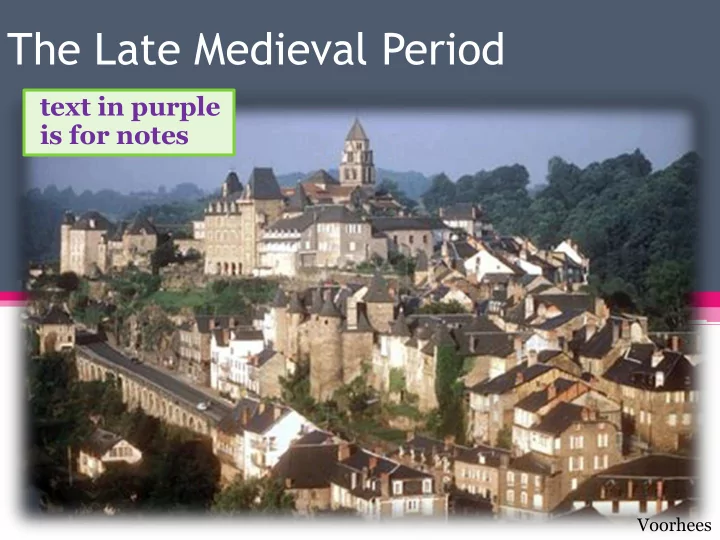
SLIDE 1 The Late Medieval Period
Voorhees
text in purple is for notes
SLIDE 2
SLIDE 3 ERA IV Unit WHI.14 Late Middle Ages
Introduction: Trade increases Kings become powerful England, France, Spain, and Russia
The Middle Ages in 3.5 Minutes:
https://www.youtube.com/watch?v=6EAMqKUimr8
SLIDE 4
Languages of Europe
SLIDE 5 WHI.14 The student will apply social science skills to understand the social, economic, and political changes and cultural achievements in the high and late medieval periods by
- a) describing the emergence of centralized monarchies
(England, France, Spain, and Russia) and distinctive political developments in each;
SLIDE 6
- I. Nation-states appear
- European monarchies consolidated power and began forming
“nation-states” in the late medieval period
- Nation-state: a politically independent country/ citizens share
the same language, culture, and nationality)
strengthen national feeling
SLIDE 7
- II. feudalism declines
- breakdown of the
system
trade to gain more direct authority over the nobles and the people
- Trade= money and end
- f the manorial system
- Kings gain power=
breakdown of feudalism
SLIDE 8
the pope’s power decreases the monarch’s power increases
Bummer! That’s right.
SLIDE 9
IV England
SLIDE 10
- A. Unifying VIP: William the Conqueror
- 1. Leader of the Norman Conquest
- 2. United most of England
▫ The Normans were “North Men” or Vikings who had settled in France
SLIDE 11
- B. Common Law
- 1. law made by royal
judges, not local lords
during the reign of Henry II
led the establishment
and Parliament
SLIDE 12
signs the Magna Carta
- 1. 1215 CE
- Limited the King’s
power
tax without the consent of his subjects
- 2. Road to democracy
- These rights were later
expanded by Parliament
SLIDE 13
SLIDE 14
- D. The Hundred Years’ War
1337- 1453
- 1. England versus France
- 2. Helped define
England as a nation
- The defeat by France caused
the English to have a civil war called the War of the Roses
- After the war England was
reunited by a powerful new royal family (the Tudors) and a strong Parliament
SLIDE 15 Hundred Years’ War…
king of England and son
declared himself king of France
Years’ War between England and France
Edward, seated, wearing a robe decorated with English and French emblems
The painting is by Jean Froissart
SLIDE 16 England during the War of the Roses
- Dynastic civil wars
- 1455- 1485
- Rival houses:
▫ Lancaster ▫ York
▫ House of Lancaster was a red rose ▫ House of York was a white rose
SLIDE 17
- E. Evolution of Parliament
- 1. Named from the French word parler (“to talk”)
given to meetings of the English king’s council in the mid-13th century
- 2. The Anglo-Saxon witan or witenagemot
- 3. The king’s feudal council, the Curia Regis
- 4. Resorted to by the medieval kings to help them
in running their governments
- 5. Reflected the idea that the king should consult
with his subjects
SLIDE 18
V France
SLIDE 19 Who was Joan of Arc?
- Research and record 3 facts
SLIDE 20
- A. Unifying VIP: Hugh Capet
- 1. established the French throne in Paris, and his
dynasty gradually expanded their control over most of France
- 2. Founder of the Capetian Dynasty
▫ Line of French kings ▫ Ruled from 987 to 1328 ▫ Changed France converted the loose feudal monarchy of France into a centralized government laid the foundations of the modern French state
SLIDE 21
Hugh Capet…
SLIDE 22
- B. The Hundred Years’ War
- 1. England versus France
- 2. Helped define France as a nation
SLIDE 23
- C. VIP: Joan of Arc
- 1. A unifying factor for
France
sense of French nationalism
SLIDE 24
SLIDE 25
SLIDE 26 Joan of Arc…
https://www.youtube.com/watch?v=iaixO6NYMps
SLIDE 27 VI Spain
https://www.youtube.com/watch?v=NsMs4ATkteA&feature=y
SLIDE 28
- A. Unifying VIPs: Ferdinand and
Isabella
and expelled Jews and Muslim Moors
- 2. The Reconquista
- (was seen as an extension of
the Crusades)
SLIDE 29
Ferdinand and Isabella sponsored Columbus!
SLIDE 30 Ferdinand and Isabella
- castle of Simancas, Spain.
- built as a defensive fortress and was later converted into a prison
- At the end of the 15th century, Queen Isabella I and King Ferdinand V bought
the castle, and their grandson, Charles, later converted it into the royal archive.
SLIDE 31
- B. VIP: Charles V
- 1. Expanded the
Spanish Empire in the Western Hemisphere (conquering)
challenging the Ottomans for control
Sea
SLIDE 32
SLIDE 33
SLIDE 34
VII Russia
SLIDE 35
- A. Unifying VIP: Ivan the Great
- Grand prince of Muscovy Ivan
III Vasilyevich
- 1.threw off the rule of the
Mongols
Moscow
nation
SLIDE 36
Ivan the Great Bell Tower
SLIDE 37
- 4. The tsar (czar)
- Power was centralized in the hands of the tsar
▫ Development of a small but effective bureaucracy that was loyal to the tsars alone ▫ The tsars gave estates to cavalry-men who pledged continual military service in return ▫ In the 1500s a regular infantry corps armed with firearms was formed ▫ The tsars now had an army of their own and were no longer dependent on the military forces raised by the Russian nobles
SLIDE 38
SLIDE 39
- B. Orthodox Church=
- 1. From Byzantine Empire
- 2. UNIFYING FORCE FOR
RUSSIA
SLIDE 40 WHI.14 The student will apply social science skills to understand the social, economic, and political changes and cultural achievements in the high and late medieval periods by
- b) explaining conflicts across Europe and Asia,
including the Crusades and the fall of Constantinople;
SLIDE 41
VIII The Crusades
SLIDE 42 So what were the Crusades?
▫ 1. control of the Holy Lands (Jerusalem) ▫ 2. Carried out by Christian political and religious leaders to take control of the Holy Land from the Muslims! ▫ After 500 years of relatively little trade and cultural exchange (ideas and technology) the Crusades reopened contact between Europe, Asia, and Africa. ▫ 3. Begins trade!
SLIDE 43
- B. Saladin
- Saladin was a Muslim ruler
in the 12th century, during the time Europeans led Crusaders to the Middle East
Crusaders several times
Jerusalem for Muslims in 1187
SLIDE 44
- C. Pope Urban’s Speech
- 1. Pope Urban II called
for Christian princes to unite
to drive the Muslims
Holy Lands”)
the pope the central leader in Europe
- 2. The Crusades also allowed
the pope to gain influence
SLIDE 45
The First Crusade
SLIDE 46 King Richard the Lion-Hearted
- England’s King Richard I,
along with France’s King Philip II Augustus, and the Holy Roman Emperor, Frederick I Barbarossa, led the Third Crusade (1189-1192)
failed to defeat the Muslims, Richard I negotiated a treaty granting Christian pilgrims free access to Jerusalem.
SLIDE 47 Knights of the Templar
- Established to protect Christian
pilgrims to the city of Jerusalem after the First Crusade (1095-1099)
- They later became a powerful
political and military force in both Palestine and Europe
- Templars traditionally wore a white
tunic with a red cross on it
- Numbering around 20,000 at their
peak, the Templars established fortresses in many cities in Palestine and came to be very important in defending the Crusader states, especially the Latin Kingdom of Jerusalem, from attacks by Muslim forces
SLIDE 48
Conquest of Damietta (Egypt)
SLIDE 49
- D. The capture of Jerusalem
- Using organization from the pope, military
expertise from western Christian knights, and funding from the Byzantine Empire
- 1. Crusaders defeated the Muslim during the
First Crusade
- 2. The Crusaders established a “foothold” for
trade and political influence for 200 years
SLIDE 50
Sack of Jerusalem
SLIDE 51
SLIDE 52
- E. Founding of Crusader States
- 1. Europeans carved out four states in Palestine, on
the eastern coast of the Mediterranean Sea
- 2. Many castles and fortresses were built to protect
the states from Muslim forces
- The Muslims gradually recaptured the territory
SLIDE 53
Second Crusade
SLIDE 54
- F. Loss of Jerusalem to Saladin
- Saladin was a Muslim
military leader who united various Islamic groups and gained control of Egypt, Syria, and eventually Jerusalem at the end of the Second Crusade
- The Third Crusade failed to
win Jerusalem back for the Christians
- 1. 2nd Crusade= Islam wins
- 2. 3rd Crusade= Islam wins
SLIDE 55
- G. Effects of the Crusades
- After the disappointments of the Third Crusade, Western
forces would never again threaten the real bases of Muslim
- power. From that point on, they were only able to gain
access to Jerusalem through diplomacy, not arms
- 1. Weakened the Pope and nobles; strengthened
monarchs
- 2. Stimulated trade throughout the Mediterranean
area and the Middle East
- 3. Left a legacy of bitterness among Christians,
Jews, and Muslims
- 4. Weakened the Byzantine Empire
SLIDE 56
- IX. The Mongols
- A. Mongol armies invaded
Russia, Southwest Asia, and China, creating an empire
Islamic Empire at the same time as the Crusaders were invading from the west
to reopen the “Silk Road”
Asia, like the Seljuk and Ottoman Turks to the Muslim world
SLIDE 57 Mongol armies
built his alliances simply to avenge his father’s death but eventually ruled an empire stretching across Asia from the Pacific to the Black Sea Genghis Khan
SLIDE 58 Mongol Expansion
MONGOL EMPIRE
(At Genghis Khan’s Death)
Russia
India
Song Dynasty
(China)
Mongolia GOBI DESERT
Arabia Asia Minor
SLIDE 59
- X. The fall of Constantinople
- Sack of Constantinople by western
Crusaders during the “Fourth Crusade”
- “Crusaders” from Venice attacked
the Byzantines instead of the Muslims to gain control of critical eastern Mediterranean Sea trade routes (Silk Road)
- A series of lesser Crusades in the
1200’s only caused the Christians to lose more land to the Turks
- The Seljuk Turks dominated the
Muslim world by the end of the Crusades
SLIDE 60
- A. Ottoman Turks
- 1. Dominated the Islamic world after the end
- f the Crusades and the expulsion of the
Mongols
- 2. Conquered the Byzantine Empire
- 3. Seized control of the Bosporus and the
western parts of the old “Silk Road”
SLIDE 61
- B. Constantinople
- Muhammad II, known as The
Conqueror, took the city in 1453, crushing the remains of the Byzantine Empire
- He rebuilt and repopulated the city
while extending the Ottoman Empire
- 1. Fell to the Ottoman Turks
in 1453, ending the Byzantine Empire
Ottoman Empire
- The Ottomans became the dominant
power in the Mediterranean Sea
SLIDE 62
SLIDE 63 Late Medieval Period
and effects of the Crusades?
- What were the effects
- f the Mongol
invasions?
- What were the effects
- f the Ottoman
invasions of Europe?
SLIDE 64 WHI.14 The student will apply social science skills to understand the social, economic, and political changes and cultural achievements in the high and late medieval periods by
- c) explaining patterns of crisis and recovery related to
the Black Death (bubonic plague); and
SLIDE 65
XI the Black Death
(Bubonic plague)
SLIDE 66 The Black Death A.(Bubonic Plague)
- 1. In the fourteenth century, the Black Death
(bubonic plague) decimated the population of much of Asia and then the population of much of Europe
SLIDE 67
SLIDE 68
SLIDE 69
SLIDE 70 Black Death
▫ between 75 and 200 million people died in Europe of the Black Death ▫ between 20% of the population (in northern Europe) to 80% (in Italy and southern Europe) ▫ China- decreased from 125 million to 65 million ▫ Urban areas were hit hardest
SLIDE 71 Plague= labor decrease
▫ Scarcity= not enough
▫ The large number of deaths reduced the work force and even led to the abandonment of some towns and villages ▫ Skilled workers (from cities) had the highest death rates, especially doctors and priests
SLIDE 72 Plague= Towns freed from feudal obligations
▫ The shortage of workers forced towns (and kings) to end many feudal laws limiting changing
SLIDE 73 Plague= decline of the Church
- 5. Decline of church influence
▫ People questioned why God was “punishing” them ▫ The pope’s inability to find a solution led to a decline in his authority ▫ The lack of priest to comfort the dying led people to question the need for priests and the papacy
SLIDE 74 Plague= disruption of trade
- 6. trade hindered
- The Late Middle Ages and the Crusades had led
to a resurgence in trade (but allowed for quick transmission of the plague)
- The decline in population led to a decline in
the demand for goods and the ability for people to move and trade easily
SLIDE 75
It took a century for Europe’s population to rebound and for trade to recover
SLIDE 76
question:
How did the Black Death alter economic and social institutions in much of Asia and then in Europe?
SLIDE 77 WHI.14 The student will apply social science skills to understand the social, economic, and political changes and cultural achievements in the high and late medieval periods by
- d) evaluating and explaining the preservation and
transfer to Western Europe of Greek, Roman, and Arabic philosophy, medicine, and science.
SLIDE 78 Education
clergy during the Middle Ages
uneducated, while the nobility was concerned with feudal obligations
preserved ancient literature in monasteries in the East and West
SLIDE 79 XII Church scholars
few who could read and write ▫ During most of the Middle Ages cathedrals and monasteries were the only schools in Western Europe
SLIDE 80 Church Scholars
▫ Most scholars were monks who translated or transcribed (copied) books by hand ▫ Transcribing a Bible could take a single monk more than a year ▫ Libraries were few and far between and rarely had more than a few dozen books
SLIDE 81
SLIDE 82 Church Scholars-Translators
Arabic works into Latin ▫ Trade with the Byzantines and Arabs during the Crusades brought classical learning back to Western Europe
SLIDE 83 Church Scholars- Translators
- D. Made new knowledge in philosophy,
medicine, and science available in Europe ▫ New developments from China (compass and paper), India, (“Arabic numerals”), and Arabia (algebra, chemistry, medicine, astronomy) ▫ Were brought to Western Europe on the Silk Road
SLIDE 84 Church Scholars- Universities
- E. Church scholars laid the foundation for the
rise of universities in Europe
▫ As trade increased both monarchs and merchants needed more education ▫ Universities were founded to provide an education for people who were not planning on becoming priests or monks ▫ The curriculum was a combination of traditional church teaching and the “new” classical learning based on Greek and Roman models (with new ideas from Arabia) ▫ This new school of thought was known as “scholasticism”
SLIDE 85
SLIDE 86
University of Oxford, England
SLIDE 87
Yale University, Connecticut
SLIDE 88
Harvard University, Massachusetts
SLIDE 89
SLIDE 90
SLIDE 91 All Souls College, University of Oxford
- England’s oldest institution of higher education, the
University of Oxford was established in the 12th century by English scholars
SLIDE 92 question…
- How did European scholars begin to interpret and
value ancient learning?
SLIDE 93 Let’s see what you know…
SLIDE 94
- 1. England limited the powers of
kings and increased the power of the nobility with
- A. the Codex Justinian.
- B. the Magna Carta.
- C. the English Constitution.
- D. the Civil Constitution.
SLIDE 95
- 2. The Black Death first came to
Europe through
- A. trade.
- B. exploration.
- C. the Church.
- D. the New World.
SLIDE 96
- 3. The Hundred Years’ War was
between which countries?
- A. France and Spain
- B. Russia and France
- C. England and the Holy Roman Empire
- D. England and France
SLIDE 97
- 4. The effects of the Crusades are all
- f the following except
- A. increased trade between Asia and Europe.
- B. decreased power of the nobility in many
countries.
- C. increased tolerance and respect among
religions.
- D. increased demand for Asian imports.
SLIDE 98
- 5. With the help of Ivan the Great,
Russia was freed from the
- A. Mongols.
- B. Indians.
- C. French.
- D. Turks.
SLIDE 99 Let’s see how you did…
SLIDE 100
- 1. England limited the powers of
kings and increased the power of the nobility with
- A. the Codex Justinian.
- B. the Magna Carta.
- C. the English Constitution.
- D. the Civil Constitution.
SLIDE 101
- 2. The Black Death first came to
Europe through
- A. Trade.
- B. exploration.
- C. the Church.
- D. the New World.
SLIDE 102
- 3. The Hundred Years’ War was
between which countries?
- A. France and Spain
- B. Russia and France
- C. England and the Holy Roman Empire
- D. England and France
SLIDE 103
- 4. The effects of the Crusades are all
- f the following except
- A. increased trade between Asia and Europe.
- B. decreased power of the nobility in many
countries.
- C. increased tolerance and respect among
religions.
- D. increased demand for Asian imports.
SLIDE 104
- 5. With the help of Ivan the Great,
Russia was freed from the
- A. Mongols.
- B. Indians.
- C. French.
- D. Turks.
SLIDE 105 Choose one of the following essays for 5 points:
- 1. Using three countries, describe how nation-
states were formed in the late medieval period.
- 2. Describe three major changes that took place in the late
medieval period. Consider such factors as government, religion, and society.
- 3. Discuss the major causes and effects of the
Crusades.
- 4. Every era has “turning points” in which pivotal and
important actions occur. Discuss an important “turning point” in the late Middle Ages.
- 5. Describe three individuals who changed the
course of European and/or world history during the late medieval period.