Medieval Europe: Myth and Reality In film and in literature, - - PDF document

medieval europe
SMART_READER_LITE
LIVE PREVIEW

Medieval Europe: Myth and Reality In film and in literature, - - PDF document

Medieval Europe: Myth and Reality In film and in literature, medieval life seems heroic, entertaining, and romantic. We think of knights in shining armor, banquets, minstrels, kings, queens, and glorious pageantry. In reality, life in


slide-1
SLIDE 1

Medieval Europe:

Myth and Reality

We think of knights in shining armor, banquets, minstrels, kings, queens, and glorious pageantry.

  • In reality, life in the Middle Ages could also be harsh, uncertain, and dangerous.

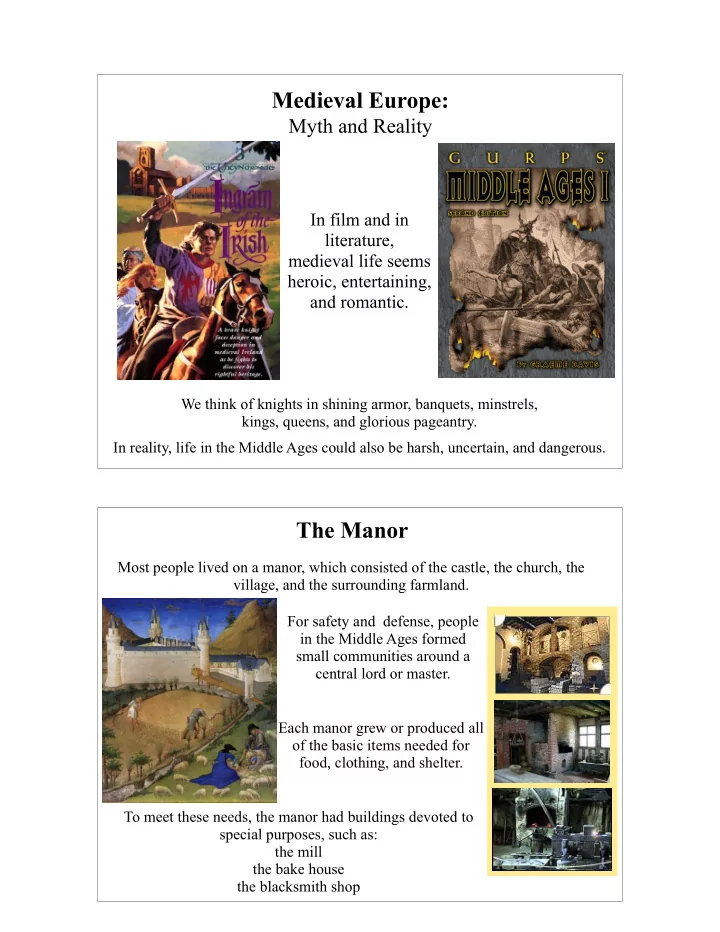
In film and in literature, medieval life seems heroic, entertaining, and romantic.

The Manor

To meet these needs, the manor had buildings devoted to special purposes, such as: the mill the bake house the blacksmith shop Most people lived on a manor, which consisted of the castle, the church, the village, and the surrounding farmland. Each manor grew or produced all

  • f the basic items needed for

food, clothing, and shelter. For safety and defense, people in the Middle Ages formed small communities around a central lord or master.

slide-2
SLIDE 2

The Feudal System

Under the feudal system, the king awarded land grants or fiefs to nobles in return for their contribution of soldiers.

  • Nobles and Vassals
  • Nobles divided their land among the lesser nobility, who

became their vassals. Peasants

  • At the lowest level of society were the peasants.
  • The lord offered his peasants protection in

exchange for living and working on his land.

  • Peasants worked hard but they were heavily

taxed and had to give much of what they harvested back to the lord of the manor.

KING LORDS (VASSALS TO KING) KNIGHTS (VASSALS TO LORDS) Fief and Peasants Military Aid Food Protection Shelter Food Protection Shelter PEASANTS (SERFS) Pay Rent Fief and Peasants Food Protection Shelter Farm the Land Homage Military Service Loyalty

The Feudal System

FEUDALISM: 
 POLITICAL SYSTEM

  • Local government
  • Dependent upon the relationship

between members of the nobility

  • Lord and his vassals

administered justice MANORIALISM: 
 ECONOMIC SYSTEM

  • Agriculture the basis for wealth
  • Lands divided up into manors
  • Peasants worked the land and

paid rent in exchange for protection

  • Used bartering for trade
slide-3
SLIDE 3

Medieval Homes

Medieval homes were cold, damp, and dark. Sometimes it was warmer and lighter outside the home than within its walls. Peasant Homes

  • Many peasant families ate, slept, and spent

time together in very small quarters, rarely more than one or two rooms with floors strewn with rushes and herbs. The houses had thatched roofs and were easily destroyed.

slide-4
SLIDE 4

Homes of the Wealthy

Windows were very small openings with wooden shutters that were closed at night or in bad weather.

  • The small size of the windows allowed those inside to see out,

but kept outsiders from looking in. The homes of the rich were more elaborate than the peasants’ homes. Tapestries were hung

  • n the walls.

Their floors were paved and sometimes decorated with tiles.

slide-5
SLIDE 5

Clothing

The outer clothes were almost never laundered, but the linen underwear was regularly washed. The smell of wood smoke that permeated the clothing seemed to act as a deodorant. Most people in the Middles Ages wore woolen clothing with linen undergarments. Peasant men wore stockings and tunics, while women wore long gowns with sleeveless tunics and wimples to cover their hair. Leather boots were covered with wooden patens to keep the feet dry. Brighter colors, better materials, and longer jackets were usually signs of wealth.

Clothing of the Wealthy

The clothing of the aristocracy and wealthy merchants tended to be elaborate.

  • Women of the wealthy classes wore flowing

gowns and elaborate headwear, such as headdresses shaped like hearts or butterflies. Men sported hose and a jacket, often with pleating or skirting, or a tunic with a surcoat.

slide-6
SLIDE 6

Medieval Medicine

In Medieval Europe, the body was viewed as a part of the universe. Four humors, or body fluids, were directly related to the four elements: Fire: yellow bile Water: phlegm Earth: black bile Air: blood Bloodletting was a popular method of restoring a patient’s health and “humors.”

  • Fun Facts:
  • Diseases were almost impossible to cure - no antibiotics.
  • Early surgery was often done by barbers without anesthesia.
  • These four humors had to be balanced,

for example, too much black bile could create melancholy.

Medieval Economy

The tradesmen established guilds to gain higher wages for their members. As the guilds grew in number, wealth, and power, they began taking an active role in civic affairs. As peace and order grew, peasants began to expand their farms and villages further into the countryside.

  • A merchant class of peddlers went from village

to village selling their goods.

  • Tradesmen became wealthier and began to

resent having to give their profits to their lords. A new merchant class included artisans, masons, bakers, shoemakers, dyers, and other skilled workers.

  • As a result of this, the power of feudalism declined.