20-Mar-17 The Height of Medieval Europe The Crusades The Economy - - PDF document

20 mar 17
SMART_READER_LITE
LIVE PREVIEW

20-Mar-17 The Height of Medieval Europe The Crusades The Economy - - PDF document

20-Mar-17 The Height of Medieval Europe The Crusades The Economy The Monarchy The Church 1 1 2 2 The Crusades -- an Overview Latin = Crux (Cross) Crusading Period = 1095 1291 1095 - Council of Clermont, France (Pope Urban


slide-1
SLIDE 1

20-Mar-17 1

The Height of Medieval Europe

The Crusades The Economy The Monarchy The Church

1

1

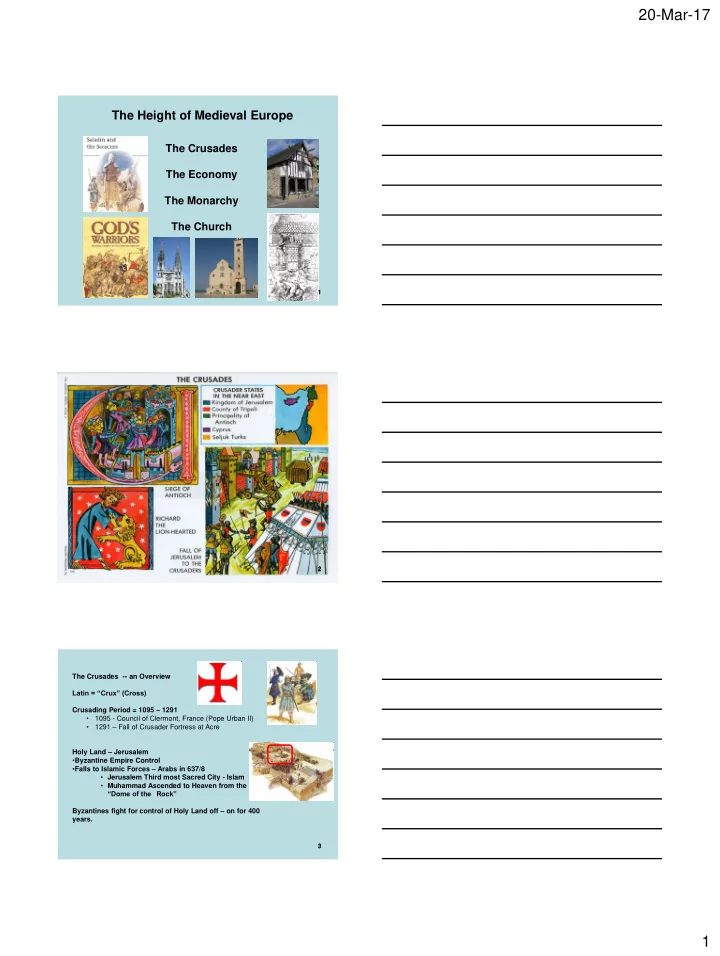
2

2

3

The Crusades -- an Overview Latin = “Crux” (Cross) Crusading Period = 1095 – 1291

  • 1095 - Council of Clermont, France (Pope Urban II)
  • 1291 – Fall of Crusader Fortress at Acre

Holy Land – Jerusalem

  • Byzantine Empire Control
  • Falls to Islamic Forces – Arabs in 637/8
  • Jerusalem Third most Sacred City - Islam
  • Muhammad Ascended to Heaven from the

“Dome of the Rock” Byzantines fight for control of Holy Land off – on for 400 years.

3

slide-2
SLIDE 2

20-Mar-17 2

Our Focus: Eight Numbered Crusades

Others with different names: Peasants (People’s) Crusade (April – October 1096) Children's Crusade (1212 / Tragic End!) Focused on Recapturing the Holy Land (Jerusalem) Begins with:

  • Seljuk Turks Capture Baghdad 1055
  • Seljuk Turks – Manzikert – 1071 Defeat Byzantine Army
  • Seljuk's Capture Jerusalem in 1073
  • No Further Pilgrim Visits – Very Dangerous
  • Byzantine Emperor Alexius Comnenus
  • Realizes the Threat of the Seljuk’s to His Empire
  • Seeks Help from the West (Remember Great Schism!)

4

  • 20,000 Pilgrims / Unarmed
  • Peter the Hermit
  • Majority Killed by Turks

4

Council of Clermont, France 1095 – Pope Urban II

19 – 28 November 1095

  • Approx. 300

Bishops, Abbots, Religious

“Deus Vult” = “God Wills It!” Papal Promises

  • Indulgences
  • Protection of

the Church

5

5

6

The Eight Major Crusades

6

slide-3
SLIDE 3

20-Mar-17 3

First Crusade: 1096 – 1099

 French Nobility (No Kings)  Goal to Capture Jerusalem  Meet in Constantinople (Move Eastward)  Capture Islamic / Arab Fortified Coastal Cities along Eastern Mediterranean.  Conquer Jerusalem 15 July 1099  Begin 88 Years of Christian Occupation

7

7

8

15 July 1099

8

First Crusade: 1096 – 1099

 French Nobility (No Kings)  Goal to Capture Jerusalem  Meet in Constantinople  Capture Islamic / Arab Fortified Coastal Cities along Eastern Mediterranean.  Conquer Jerusalem 15 July 1099  Begin 88 Years of Christian Occupation  Four Latin Kingdoms of the West established  County of Edessa  County of Tripoli  Principality of Antioch  Kingdom of Jerusalem

9

9

slide-4
SLIDE 4

20-Mar-17 4

10

The Holy Land after the First Crusade – Peace Reigns 1099 – 1187

10

10

11

Crusaders build castles Throughout the Holy Land Nearly all will come under siege.

11 The fall of Arsuf 1265 Monastery NE

  • f Damascus

11

12

The “Big Three” Crusades

12

12

slide-5
SLIDE 5

20-Mar-17 5

13

Athens – Parthenon Catholic Church = 6th Century Cathedral of the Duchy of Athens (1208 – 1458) Cave Fortress of the “Cave de Sueth”

13

Frankish tower / church removed in 1874 from the Acropolis

14

Krak des Chevaliers, Syria

  • Arab stronghold 1031
  • Taken by Crusaders in

1099

  • Strategic Location
  • Falls under control of

Knights Hospitallers

  • Rebuilt and Expanded

1150 – 1250

  • Garrison of 2,000 Knights
  • Eventually captured in

1271 by Islamic forces through deceit! (Forged letter – No reinforcements coming = surrender) 14

14

15

Religious Military Orders that will emerge during the Crusades

Major Two Orders

  • Hospitallers
  • Knights Templar

15

slide-6
SLIDE 6

20-Mar-17 6

16

Military Religious Orders will be throughout Europe and the Middle East

Segovia, Spain Portugal 17

13th Century Ethiopian Church at Lalibela

Carved from one solid block – 40’ High!

Second Crusade: 1147 – 1149

Preached by St. Bernard of Clairvaux

  • Speyer, Germany

King Louis VII of France Holy Roman Emperor Conrad III Conrad’s Army arrives early, marches across the interior of Turkey

  • Is destroyed at Dorylaeum 25 October 1147

Later Louis VII and remnants of Conrad’s Army attack Damascus and are defeated. Louis returns to France Saladin Emerges from Egypt – Conquers The Middle East

18

18

slide-7
SLIDE 7

20-Mar-17 7

The Battle of Hattin

  • 4 July 1187
  • Major Shift in the Balance of Power

in the Holy Land

  • Latin Kingdoms vs. Islamic

Reconquest  Note names of local towns!! Hattin Today

19

20

Saladin Defeats Crusader Army - 4 July 1187 Saladin Subsequently Recaptures Jerusalem - 2 October 1187

20

Third Crusade: 1189 – 1192

“Crusade of the Kings”

 Richard the Lionhearted (England)  Philip II (France)  Frederick I (Holy Roman Emperor)

  • Drowns enroute to Constantinople
  • Richard insults Duke Leopold of Austria

Richard and Philip Argue

  • Philip returns to France
  • Usurp Richard’s Lands?

Richard campaigns against Saladin

  • Series of battles that are split between

both armies

  • Richard’s greatest victory at Arsuf

7 September 1191

21

21

slide-8
SLIDE 8

20-Mar-17 8

22

Richard’s Organizational Skills and Leadership are Demonstrated

  • During Richard’s March to Jerusalem
  • Attacked and Harassed by Saladin’s Men
  • Richard’s Knights Charge and Devastate

Turkish Army

22

22

The Third Crusade concludes with a peace treaty and open access to Jerusalem for 10 years

  • Richard is the only monarch who completes the

Crusade -- Richard returns home

  • Lands in Northern Italy with small escort
  • Must travel through Austria -- recognized
  • Captured by Duke Leopold

 (Later Excommunicated for taking captive a fellow Crusader)

  • “Sold” to H.R.E. Henry VI
  • Spends 14 months in captivity

 Trifels Castle, Germany

  • Released returns to England
  • Dies during a siege in France in 1199
  • Buried at Fontevaurd Abbey on the Loire River

next to Henry II (later Eleanor is also buried here)

Trifels Castle Richard’s Grave Effigy

23

Unusual – Legs not Crossed!

Fourth Crusade: 1202 – 1204

24

In 1199 Pope Innocent III issued new call to recover the Holy Land French nobility respond with 25,000 Engaged the Venetians to provide transport

  • French unable to pay
  • Capture Zara (Adriatic Coast) for Venetians
  • Venetian trade rivals

End up in Constantinople

  • Siege April 1204 – Crusaders / Venetians

Capture City

  • Large scale looting and destruction

(Shroud of Turin?)

  • Venetians establish a Latin Empire

1204 – 1261

  • Retaken by Byzantines - 1261

Never Make it to the Holy Land!!

24

slide-9
SLIDE 9

20-Mar-17 9

Fifth Crusade: 1218 – 1221

25

  • King John of Jerusalem
  • Cardinal Pelagius (Papal Legate)
  • 46,000 Crusaders
  • Invade Egypt – Nile Delta - Damietta
  • Siege was Failure
  • Armies break up and return home.

Sixth Crusade: 1228 – 1229

Frederick II – Holy Roman Emperor

  • Makes Oath to go on Crusade
  • Delays departure –

Excommunicated by Pope

  • Arrives in Holy Land – Acre
  • Negotiates with Egyptian Sultan
  • Gains a ten-year treaty for

pilgrims to visit Jerusalem

  • No Fighting!
  • Still under Excommunication by

Pope! Goes Home

25

Seventh Crusade 1248 – 1254

26

King (St.) Louis IX – France Response to Islamic Recapture of Jerusalem Lands in Egypt – Attack again from South Minor successes Captured – Ransomed ($$$) Stays in Jerusalem four years -- Purchases Relics

  • Crown of Thorns?

26

27

Eighth Crusade 1270

King (St.) Louis IX – France Make-up for earlier failure French nobility not supportive Sail to Tunis, Tunisia Suffers from Typhus ?

  • Dies

Crusaders return to France

No further Crusades Europe prepares for The Hundred Years War

Fall of Acre 1291 Last Stronghold

27

slide-10
SLIDE 10

20-Mar-17 10

28

The end of the era of the Crusades

Sarcophagus Effigies

  • Who has been on Crusade
  • Who has NOT been on Crusade

Robert, Eldest son of William the Conqueror

28

29

Results of the Crusades

Improvements in Art of Warfare

  • Innovations
  • Learned things from the Arabs
  • Better ships / maps / compass

Serves to initiate the decline of Feudalism People travel to different parts of the world – new view of world Development and improvement in trade with the east

  • Luxury goods
  • Prosperity for Venice & Genoa
  • Foster the start of the Italian

Renaissance Unified the Muslims against a common enemy

29

30

The Revival of the Medieval Culture and Economy

Advances in Productivity in Agriculture Heavier Plow

  • Deeper Furrows

Horse Collar Harness

  • Higher Crop Yields
  • Contributes to Population Growth

30

slide-11
SLIDE 11

20-Mar-17 11

31

Trade Improves Crusades – Awareness of Trade

  • Venice; Pisa; Genoa – Italy
  • Become Prosperous

European Demand for Goods

  • Italy Becomes Important
  • Spreads to all of Europe

Goods Travel from the Middle East and Asia

  • Spices
  • Silks
  • Furs

31

32

Remember Marco Polo

From Venice 1271 - 1295 Imprisoned on Return Tells Story to Cellmate = “The Travels of Marco Polo” Becomes Wealthy Dies 1324

32 33

Trade Routes of the Medieval World

slide-12
SLIDE 12

20-Mar-17 12

34

Regional European Trade Centers Develop

  • Flanders – Northern Europe – Wool / Textile Center
  • Champagne – France (mid-point for Europe)

 Spring / Fall Trade Fairs … Why?

  • On Major Trade Routes – Road Networks

Money Economy Emerges Again

  • Banks (“Banca” = Bench)
  • Towns Mint Coins – Florins (Florence)
  • Letters of Credit
  • Non-Catholics as Bankers (Bible Prohibitions / Jewish Bankers)

34

35

The Rise of the Medieval Towns

Roman Influence in Location Near Waterways / Crossroads Construction of Walls for Protection in Troubled Times Poor Sanitation

35

36

Examples of Medieval Towns

Markets / Businesses held in Center of Town – Next to Church Some Cities Elevated due to Surrounding Terrain Contribute to Growth of Medieval Economy

Cascia, Italy Assisi, Italy

36

slide-13
SLIDE 13

20-Mar-17 13

37

Poor Sanitation = Severe Health Problems

“Black Death / “Bubonic Plague”

  • 1347 – 1351
  • Spread South to North
  • Warmer Climates
  • Higher Death Rates
  • Mediterranean = 2/3’s

Died

  • Central Europe = ½ Died
  • Northern Europe = ¼ to

1/3 Died

37

38

Detailed Study of the Spread of the “Black Death”

Start Crimea / Black Sea End

38

39

The Flagellants

  • Religious Group
  • 13th/14th

Centuries

  • Extreme

Penance

  • Traveled

Countryside

  • Later Banned by

Catholic Church as Heretical

39

slide-14
SLIDE 14

20-Mar-17 14

40

The Rise of the Guild System

Central to the Medieval Economy Similar to Modern Unions Various Crafts / Endeavors (in Ex.)

  • Artisans (Gold / Silver)
  • Smiths
  • Weavers
  • Tailors
  • Shoemakers
  • Butchers

Responsibilities of the Guilds

  • Regulate Quality
  • Regulate Training
  • Regulate Price / Maintain Monopoly

Contribute to the Emergence of the Middle Class / “Burgs”

Street performance or busking is the practice of performing in public places, for gratuities, which are generally in the form of money and edibles. People engaging in this practice are called street performers, buskers, street musicians, minstrels, or troubadours

40

41

Three Levels in the Guild System

Guilds are Usually Located in One Part

  • f the Town With All Together

Apprentice

  • (3 – 5 Years)
  • Train Under a Master

Journeyman

  • (5 – 15 Years)
  • Work Throughout Europe in Shop
  • Paid by the Day
  • (French = “Jour” = Day)

Master

  • (15 – 20 Years)
  • Open own Business

41

Example of English Iron Worker Guilds

Romsey, England 42

slide-15
SLIDE 15

20-Mar-17 15

43

Emergence of the Middle Class

Medieval Towns or “Burgs” Wealthy People of the Town

  • Through Business / Merchant / Bankers
  • Trade / Artisan

Burghers = Germany Bourgeoisie = France Burgesses = England Become Involved in Town Government Provide Advice to Monarchs and Nobles Smaller Cities Gather Together = Communes (Community!) Receive Charters – Govern their own Affairs

43

44

Medieval Education – Emergence of Universities

Monasteries – Schools

  • Training for Clergy or

Church Officials

  • Begin to Decline in

Status Towns Grow – Need for Educated Officials Universities Emerge in Cities

  • Bologna, Italy – Law
  • Montpelier, France –

Medicine

  • Paris, France – Theology

44

45

Medieval Education – Emergence of Universities

 Subjects: Roman Law; Works of Aristotle; Muslim Writings  Scholasticism = Aristotle’s Philosophy + Theological Questions  Peter Abelard - Monk – University of Paris  (St.) Thomas Aquinas – University of Paris  Doctor of the Church / “Summa Theologica” (Use of “Reason”)

45

slide-16
SLIDE 16

20-Mar-17 16

46

Medieval Art and Literature

Stories from the Early Middle Ages are put into Writing

  • Old English – “Beowulf”
  • French – “Song of Roland”
  • German – “Wisdom / Insights – Hildegard of Bingen”

Not written in Latin – Rather Local Language Not About Religious Theme – Secular in Nature Troubadours Spread these Tales through their Travels 14th Century Brought New Forms of Literature Dante (Italian) “Divine Comedy” Chaucer (English) “Canterbury Tales”

46

47

Architecture Styles Emerge

Romanesque

Identify the

  • Round Arches
  • Barrel Vaults
  • Thick Walls

47

48

Architecture Styles Emerge

Gothic

Theology of Light

  • Airy Spaces
  • Let the Light in

Identify the

  • Pointed Arches
  • Ribbed Vaults
  • Thin Walls

(Flying Buttresses)

48

slide-17
SLIDE 17

20-Mar-17 17

49

A Troubled Century 14th Century Europe England vs. France

49

50

The Hundred Years War* 1337 – 1453 (116 Years!)

*Name first used in 1853 by a French historian 50

51

Why the Hundred Years War ?

English Kings Attempt to Regain Lands Lost to France

  • Normans – William the Conqueror
  • Richard / John (England) vs. Philip II (France)
  • Lose Lands to France

1337 Remaining English Lands in France (Guyenne) “Confiscated” by Philip VI (France) Edward III (England) Responds by Claiming the Throne of France Through his Mother (Isabella of France – Daughter of Philip IV (France) The War is ON!

51

slide-18
SLIDE 18

20-Mar-17 18

52

Battle of Crecy, (in France) 1346

26 August 1346 English = 10,000 French = 35,000 English Victory Longbow 8 – 10 arrows per minute in the air

52

53

Battle of Agincourt (in France) 1415

25 October 1415 English = 6,000 French = 36,000

  • English

Victory

  • Longbow

 France’s Fortunes Very Low  English Control much of France

53

54

Notice the Change in the Possession of the Lands of France during The Hundred Years War

Start 1429

54

slide-19
SLIDE 19

20-Mar-17 19

55

Joan de’ Arc (1412 – 1431)

A Very Real Personality in the Hundred Years War Born to a Middle Class Family in Domremy, France

55

56

Joan de’ Arc

Begins to Reverse the Misfortunes of the French  Battle of Orleans, 1429 King of France – Charles VII Crowned at Reims

  • Captured by the Burgundians 1430
  • Sold to the English
  • Tried as a “Heretic”

Burned at the Stake, Rouen, France - 30 May 1431

  • Retrial in 1456 = “Not Guilty”
  • Patron Saint of France 1920

56

57

Results of the Hundred Years War

  • England Loses all Claims in France
  • England Focuses Internally
  • English Nobility Dissatisfied – Lost

Lands in France

  • War of Roses Begins (Next Slide)
  • French Countryside is Destroyed
  • Farming disrupted
  • France is Finally United -- Burgundy / Will

Become French

 Feudalism is Ended!

  • Monarchs have Gained Power
  • People are Involved in government
  • Face of Warfare has Changed

57

slide-20
SLIDE 20

20-Mar-17 20

58

The War of the Roses (1455 – 1485)

Fought over the Succession to the English Crown

  • Henry VI – Unstable
  • Edward IV (York ) Comes to Power (1483)

Final Phase  Richard III -- House of York (White Rose)

  • Brother – Murders Edwards two Sons?

Vs.  Henry Tudor -- House of Lancaster (Red Rose)

  • Gains Support of Many Nobles

Battle of Bosworth Field 1485 (Next Slide)

  • Richard III Killed
  • Henry Tudor Becomes Henry VII
  • Established the Tudor Dynasty

 Marries Elizabeth of York Result: English Monarchy is Strengthened

58

59

Battle of Bosworth Field -- 22 August 1485

59

Decides the Kingship of England!

Islamic Spain in 756

60

slide-21
SLIDE 21

20-Mar-17 21

61

Asturias – Northern Spain Oviedo – Visigothic Kingdom Reconquest Begins

Pre-Romanesque Style April 2009

62

Spanish Re-conquest of Spain (“Reconquista”)

63

Spanish Re-conquest of Spain (“Reconquista”)

Islamic Arab / Berber (Moors) Invasions 8th Century Eight Centuries of Islamic Presence Christian Kingdoms Emerge to Regain Spain Rodrigo Diaz = “El Cid” ( 1099) Fought for Both the Christians and Islamic Moors Became a National Hero of Spain

63

slide-22
SLIDE 22

20-Mar-17 22

Portugal / Castile / Aragon 1469 = Ferdinand of Aragon + Isabella of Castile Establish a Christian Kingdom 1492 Last Islamic State is Conquered (Granada) All Spain Must be Catholic Muslims / Jews Converted

  • r Left Spain

Inquisition = Heretics

64

Holy Roman Empire

Holy Roman Emperor Charles IV Decrees Monarch will be Elected Holy Roman Emperor Issues the “Golden Bull”

  • f 1356

Seven Prince Electors Established Archbishops: Trier; Cologne; Mainz Princes: King of Bohemia; Duke of Saxony; Count of the Palatine; Margrave of Brandenburg

65

 Meet Throughout Germany for Elections  Hapsburg Family of Austria is Elected Repeatedly  Hapsburg Family Makes a Series of Dynastic Marriages with the Royal Houses of Europe  Holy Roman Empire; Low Countries; Spain; Italy  Capital = Vienna, Austria

Prince - Electors

66

slide-23
SLIDE 23

20-Mar-17 23

67

The Catholic Church in the High Middle Ages

Start of the 14th Century People Still Religious and Support the Popes Pilgrimages Important = Visit Holy Locations / Shrines

  • Rome, Italy
  • Santiago de Compostela, Spain
  • Canterbury, England

End of the 14th Century the Catholic Church is in Decline / Losing Influence

67

68

Pope Clement V (French) Escapes the Turmoil of Rome

  • Family Feuds / Mobs

Moves to Avignon, France

  • French King Philip IV

1309 - Babylonian Captivity*

* 586 BC - Chaldeans

& 1378 – The Great Schism

68

69

Papal Palace, Avignon, France

69

slide-24
SLIDE 24

20-Mar-17 24

70

Gregory XI Dies - 1378

  • Urban VI (Italian-Naples) Elected by

Cardinals - 1378 (Pressure?) (Remains in Rome)

  • Clement VII (Swiss/French) Elected by

Cardinals - 1378 (Goes to Avignon) Council of Pisa – 1409 (Italy)

  • Elects new Pope – Alexander V

(Remains in No. Italy)

  • Rome & Avignon Popes will not Step

Down! 70

Council of Constance - 1414

  • Deposes all Three Popes
  • Elects Martin V (Returns to

Rome) Result: Monarchs Gain Power Catholic Church’s Authority Weakened

Constance, Germany

71

72

Papal Support in the Great Schism 1378 - 1417

Constance 1414 Pisa - 1409 72

slide-25
SLIDE 25

20-Mar-17 25

Movements Emerge to Attack Abuses

  • f the Catholic Church

Abuses: Taxes

  • Simony – Buying and Selling of Church Offices
  • Luxury / Wealth
  • Lack of Spirituality

73

Movements Emerge to Attack Abuses

  • f the Catholic Church

Abuses: Taxes

  • Simony – Buying and Selling of Church Offices
  • Luxury / Wealth
  • Lack of Spirituality

John Wycliffe – English – Oxford Scholar / Layman

  • Translated Bible into English (from Latin)
  • Wanted People to Read for Themselves
  • Lollards Emerge
  • Violent – Destroyed Church Property / Ridiculed Sacraments
  • Influences English Queen Anne (from Bohemia – Czech.)

74

Jan Hus – Czech Priest – Scholar

Wanted to end German Control of Bohemia Wanted Reforms in the Catholic Church

  • Bible Translated into Czech
  • Professor at University of Prague
  • Hus is condemned by Catholic Church
  • Travels to Council of Constance 1415
  • Holy Roman Emperor’s Safe Conduct Guarantee is

Ignored

  • Hus is Convicted of Heresy – Burned at the Stake

75

slide-26
SLIDE 26

20-Mar-17 26

Hus’ Supporters Rebel – Hussite Wars

  • Catholic Church Launches Five Crusades – All Fail
  • 1436 – Holy Roman Emperor – Treaty with Hussites
  • Granted Certain Religious Rights

Both Wycliffe and Hus are “Precursors” to the Protestant Reformation Which will begin in the early 16th Century Counter-Reformation and the Council of Trent will evolve

76

77

The Invention of the Printing Press

  • Mainz, Germany 1453-4
  • Johannes Guttenberg
  • Spread Ideas Much Easier Throughout Europe

77

In the End, The Catholic Church is Weakened The Reformation is Coming

95 Theses

78

Martin Luther