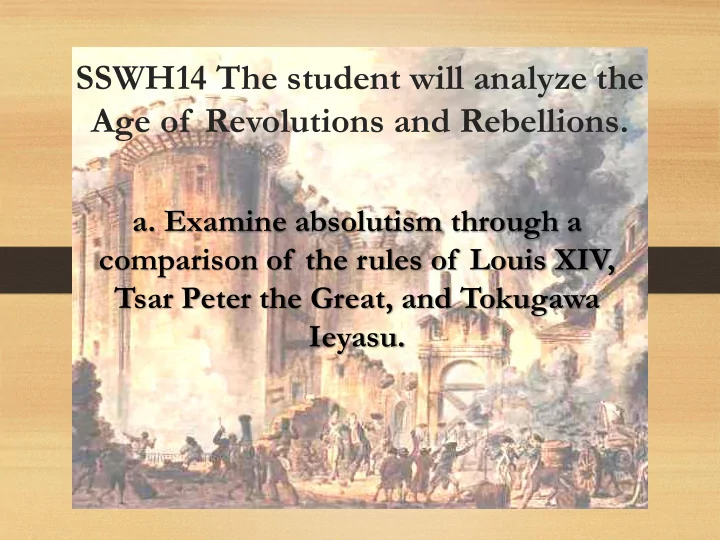
SSWH14 The student will analyze the Age of Revolutions and - - PowerPoint PPT Presentation

sswh14 the student will analyze the age of revolutions
SMART_READER_LITE
LIVE PREVIEW

SSWH14 The student will analyze the Age of Revolutions and - - PowerPoint PPT Presentation

SSWH14 The student will analyze the Age of Revolutions and Rebellions. a. Examine absolutism through a comparison of the rules of Louis XIV, Tsar Peter the Great, and Tokugawa Ieyasu. Louis XIV (1638-1715) Known as the Sun King,


slide-1
SLIDE 1

SSWH14 The student will analyze the Age of Revolutions and Rebellions.

  • a. Examine absolutism through a

comparison of the rules of Louis XIV, Tsar Peter the Great, and Tokugawa Ieyasu.

slide-2
SLIDE 2

Louis XIV (1638-1715)

  • Known as the “Sun King”,

Louis XIV, believed in the divine right of kings

  • He controlled the power of

France’s upper class and limited the power of the church

  • Supported the arts and

literature

  • Reigned from 1643-1715
slide-3
SLIDE 3

Tsar Peter the Great (1672-1725)

  • Took control of Russia’s

Eastern Orthodox Church

  • He reduced the power of the

large landowners

  • Pushed education reforms

and “westernized” Russia

  • Reigned from 1682-1721
  • Led a cultural & political

revolution of modernization and westernization.

slide-4
SLIDE 4

Tokugawa Ieyasu (1543-1616)

  • Was appointed Shogun, with

almost unlimited power

  • Redistributed power among

the upper class (daimyo)

  • Promoted the arts and

literature

  • Persecuted Christians
  • Tokugawa Shogunate ruled

from 1600-1868.

slide-5
SLIDE 5

Religion Arts Control of Power

Redistributed land among the upper class Reduced the power of the large landowners Limited the Power of the Upper Class Controlled religious choice Took control of the Church Took control of the Church Supported the arts and literature Westernized Russia, including education reforms Supported the arts and literature

Tokugawa Ieyasu Peter the Great Louis XIV

slide-6
SLIDE 6
  • b. Identify the causes and results of the

revolutions in England (1689), United States (1776), France (1789), Haiti (1791), and Latin America (1808-1825).

slide-7
SLIDE 7

England’s “Glorious Revolution” (1689)

  • In 1660 Charles II came to power
  • During his reign, Parliament passed

several measures limiting the power of the monarchy and giving certain rights to it’s citizens

  • When Charles died in 1685 he had no

children (heirs), which then allowed his brother James II, a Catholic, to assume the throne

slide-8
SLIDE 8

James II

  • In violation of English law,

James appointed several Catholics to positions of high office

  • After Parliament protested,

James dissolved it

slide-9
SLIDE 9

William and Mary

  • At the invitation of

Parliament, Mary, James’

  • ldest daughter, and a

Protestant, was asked to take

  • ver the throne with her

husband William

  • With very little fighting,

William and Mary took over the throne and formed a constitutional monarchy with Parliament (The Glorious Revolution)

slide-10
SLIDE 10

The American Revolution (1776)

By the mid 1700s:

  • European citizens left Europe in

search of religious freedoms, business opportunities, and/or new lives.

  • colonist had been living, away

from England, in North America for nearly 150 years

  • The British colonies had

developed trade with much of Europe

  • Many colonists had been born in

North American and not England

By the mid 1700s, who would have many colonist related more to, England or the colonies? Why?

slide-11
SLIDE 11

The American Revolution

  • In the mid 1600s, England

began taxing imported European goods, and restricted colonial trade to only England

  • In 1754 England/Colonists

fought France/American Indians in the French and Indian War. The French and Indians are defeated.

  • England forbids colonists from

entering Indian lands, land west of the Appalachian Mts by the Proclamation of 1763.

slide-12
SLIDE 12

The American Revolution

  • England, which had accumulated huge debts, expected the

American colonies to help pay for the French and Indian War

  • In 1765, Parliament passed the Stamp Act, taxing the

colonists on newspapers, wills, deeds, and playing cards among other things

  • The colonists protested this “direct tax”.
slide-13
SLIDE 13

The American Revolution

Between 1765 and 1775 tensions and hostilities between the two sides

  • increased. Anti-British sentiment increased among colonists.
  • After the British tax tea, colonist hold the Boston Tea Party. Boston

Massacre occurs. -The 1st and 2nd Continental Congress’ are formed as a way of organizing and protesting against the British. Taxation without representation was a major cause of the American Revolution.

  • The British and Americans fight at Lexington and Concord, starting

the American Revolution

slide-14
SLIDE 14

Results of the American Revolution

  • The colonies gained their independence from England and

became a free and independent nation.

  • Formed a new republic democracy with its foundation in a

written Constitution, influenced greatly by Montesquieu.

  • Inspired other countries to revolt and form democracies
slide-15
SLIDE 15

French Revolution (1789)

  • France was socially and politically

divided into 3 classes, or estates: 1st Estate: Clergy 2nd Estate: nobles, held

  • ffices of power

3rd Estate: middle, and lower classes, 97 %

  • f France belonged to

this class The clergy and nobles owned over 30% of the land, and paid very few taxes

slide-16
SLIDE 16

French Revolution

  • Problems begin to mount:
  • France’s economy began to falter in

the 1780s

  • Poor weather led to crop failure and

sky-rocketing food prices

  • France accrued huge debts helping

the American colonies against Britain

  • King Louis XVI and his Queen,

Marie Antoinette, spent lavishly, until France was nearly bankrupt

slide-17
SLIDE 17

French Revolution

  • To generate needed revenue, Louis XVI wanted to impose

taxes on the 2nd Estate at a meeting of the Estates General

  • At this meeting, with members of the clergy and nobles joining

them, the 3rd Estate representatives called for the end of the absolute monarchy

The Estates General was a meeting of all three Estates, with the 3rd Estate normally given very little voting power.

slide-18
SLIDE 18

French Revolution

  • Peasants in Paris, afraid that

the King would put down the Estates General by force, and by rumors of foreign troops invading France, attacked the Bastille, in search of gun powder and arms

  • The rebellion eventually

spread to the French countryside, and eventually led to the execution of the King and Queen

slide-19
SLIDE 19

Results of the French Revolution

  • From 1789 until 1794 France went

through a period of upheaval and unrest as various sides tried to take control

  • In 1795 a new form of government

was formed with a two-house legislation and a 5 man executive committee (The Directory)

  • The revolution eventually led to

Napoleon Bonaparte becoming emperor of France (1804)

slide-20
SLIDE 20

Haitian Revolution (1791)

  • Haiti (Saint Domingue), was

a French colony in the Caribbean, which was one

  • f the world’s largest

producers of sugar and contained numerous plantations

  • Slaves were brought in to

work in the cane fields and

  • utnumbered free people

10 to 1

slide-21
SLIDE 21

Haitian Revolution

  • Slave ownership in Haiti was different than the American slave

system:

  • Haitian slaves were mostly African born
  • Conditions in Haiti were harsh, with many slaves dying from
  • verwork and the lack of food, clothing, and shelter
  • In 1791, The French Revolutionary government, granted

citizenship to wealthy, freed men “of color”

  • The French plantation owners in Haiti refused to recognize this
  • rder, and minor fighting broke out between slaves and the owners
  • The slave revolt spread under the leadership of Toussaint

L’Ouverture

  • With France in disarray, the French couldn’t send a massive army
  • ver to Haiti to quell the rebellion
slide-22
SLIDE 22

Results of the Haitian Revolution

  • Haiti became the first

Latin American country to gain independence from a European power

  • The loss of Haiti

convinced Napoleon to abandon interest in North America and led to the sale of the Louisiana Territory to the U.S. in 1803

slide-23
SLIDE 23

Latin America (1808-1825)

  • In 1808, Napoleon

conquered Spain, leading to rebellions against Spanish rule in several Latin American countries

  • Many in Latin America

were spurred on by the Revolutions in America and France.

slide-24
SLIDE 24

Results of Latin American Revolutions

  • By 1830 many of the

Spanish and European colonies had gained independence

According to the map, what was the first colony to gain independence? How did this influence

  • ther colonies in the Western Hemisphere?
slide-25
SLIDE 25
  • c. Explain Napoleon’s rise to power, the role of

geography in his defeat, and the consequences of France’s defeat for Europe.

slide-26
SLIDE 26

Napoleon

  • Napoleon was a French general who had won several key

victories for France during the 1790s

  • After returning to France from key victories in Austria and Italy,

Napoleon found the post revolutionary Directory in disarray

  • Napoleon seized power in 1799 when he became the first

council (of three)

slide-27
SLIDE 27

Napoleon

  • Looking for stability, in 1800,

the French people voted to give the 1st Counsel the majority of power

  • Napoleon established the

Napoleonic Code which set up a uniform system of laws. It also limited the freedom of press and speech.

slide-28
SLIDE 28

Napoleon

  • In 1804 Napoleon, with

the support of the people, decided to make himself Emperor of France

  • His next move was to

expand France’s power throughout the World

slide-29
SLIDE 29

Napoleon’s Downfall

  • Between 1805 and 1813

Napoleon conquered much of Europe

  • In 1813 he decide to

invade Russia, with over 400,000 men

  • Russia lay over 600 miles

away, with most of his men having to walk

slide-30
SLIDE 30
  • After a 3 month march, and having lost 80,000 men, Napoleon

reached Moscow, only to find it abandoned and in flames

  • Napoleon’s supply lines were spread too thin to be effective and

the Russian winter began to take it’s toll on the French troops

By the time Napoleon's army left Russia, it had been reduced to only 10,000 men from the

  • riginal 420,000 man

army.

slide-31
SLIDE 31
  • Though Napoleon was able

to raise another army, he suffered his final defeat in 1815 at the Battle of Waterloo

  • Napoleon was exiled to a

small island in the South Atlantic where he eventually died

slide-32
SLIDE 32

Napoleon’s Defeat

  • Napoleon's defeat led to the

Congress of Vienna where European powers met to set a balance of power in Europe

  • France’s borders were

contained by stronger nations to prevent French aggression

  • Many European

monarchies were restored to power

  • Europe gained a long

lasting peace (40 years)

slide-33
SLIDE 33
  • d. Examine the interaction of China and Japan with

westerners; include the Opium War, the Taiping Rebellion, and Commodore Perry.

slide-34
SLIDE 34

Opium War

  • For the most part, China remained isolated from foreign powers

due in part to their culture, and their ability to be economically self- sufficient

  • Trade with foreigners was limited to one port city, with the Chinese

earning much more from their exports than what they paid for European imports-this created a trade imbalance in favor of the Chinese

slide-35
SLIDE 35

Opium War

  • Starting in the late 1700s the British decided to try and swing

the balance of trade in their favor by smuggling opium into China from their colony in India

By the mid 1830s nearly 12 million Chinese were addicted to opium-a product only the British controlled

slide-36
SLIDE 36

Opium War

  • After repeated requests to the British government to stop the

illegal opium trade, the Chinese and British fought mostly a naval war, in which the British crushed the Chinese.

  • China was made to sign a treaty which gave Britain Hong Kong,

and free trade with China

slide-37
SLIDE 37

Taiping Rebellion

  • By the 1850s a movement had

gained strength in southern China in which the followers believed that all Chinese would share the country’s wealth

  • The Chinese government,

along with French and British troops, attacked the Taiping rebels: by the mid 1860s nearly 20 million Chinese had died in this civil war

slide-38
SLIDE 38

Commodore Perry

  • Starting in the early 1600s under the rule of Tokugawa,

Japan shut it’s ports to outside influences

  • In the mid 1850s, U.S. Commodore Perry, anchored off

Japan with a treaty from President Fillmore demanding free trade with Japan.

slide-39
SLIDE 39

Commodore Perry

  • Perry threatened the

Japanese that the U.S. would attack if the treaty was not accepted

  • Faced with the U.S.’s

modern navy and cannons, Japan agreed to the treaty

  • Open trade led Japan to

modernize and them becoming a world power