SSWH1: The student will analyze the origins, structures, and - - PowerPoint PPT Presentation

sswh1 the student will analyze the
SMART_READER_LITE
LIVE PREVIEW

SSWH1: The student will analyze the origins, structures, and - - PowerPoint PPT Presentation

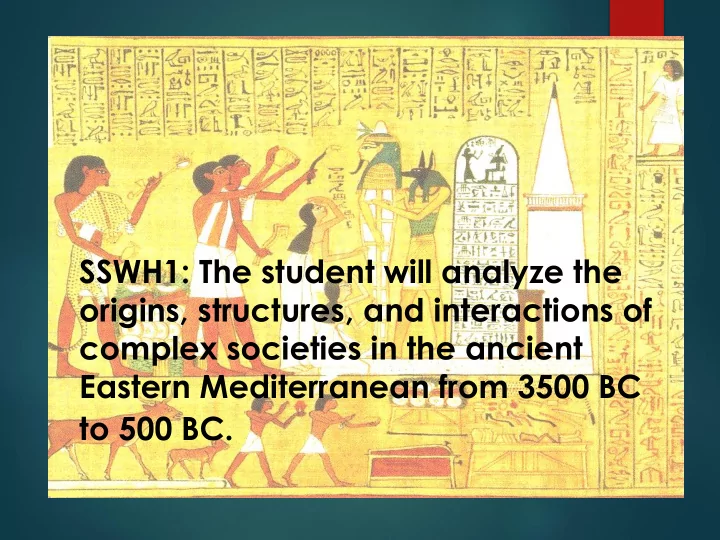
SSWH1: The student will analyze the origins, structures, and interactions of complex societies in the ancient Eastern Mediterranean from 3500 BC to 500 BC. SSWH1: The student will analyze the origins, structures, and interactions of complex

slide-1
SLIDE 1

SSWH1: The student will analyze the

  • rigins, structures, and interactions of

complex societies in the ancient Eastern Mediterranean from 3500 BC to 500 BC.

slide-2
SLIDE 2

SSWH1: The student will analyze the origins, structures, and interactions of complex societies in the ancient Eastern Mediterranean from 3500 BC to 500 BC.

  • a. Describe the development of Mesopotamian societies; include the

religious, cultural, economic, and political facets of society, with attention to Hammurabi’s law code.

  • b. Describe the relationship of religion and political authority in Ancient

Egypt.

  • c. Explain the development of monotheism; include the concepts

developed by the ancient Hebrews, and Zoroastrianism.

  • d. Describe early trading networks in the Eastern Mediterranean; include

the impact Phoenicians had on the Mediterranean World.

  • e. Explain the development and importance of writing; include

cuneiform, hieroglyphics, and the Phoenician alphabet.

slide-3
SLIDE 3

Civilization

 A complex culture with five characteristics:  Advanced cities  Specialized workers  Complex institutions  Record keeping  Advanced technology

slide-4
SLIDE 4

Advanced Cities

 A city is more than a large group of people

living together. The size of the population alone does NOT distinguish a village from a city.

 The key difference between a village and a

city is a center of trade.

 In ancient cities, farmers, merchants, and

traders brought goods to markets in the city.

slide-5
SLIDE 5

Specialized Workers

 Specialization- The developments of skills in a

specific kind of job.

 As cities grew, so did needs for more specialized

workers

Traders Government officials Priests  Some city dwellers became artisans. Artisans: Skilled workers who make goods by

hand

Examples: metal tools, weapons, pottery

slide-6
SLIDE 6

Complex Institutions

 Government, religion, and economy  Institution: A long lasting pattern of

  • rganization in a community.

 Growing populations made complex

institutions necessary

 Churches mainly governed ancient cities  Ancient economies began with bartering

slide-7
SLIDE 7

Record Keeping

 As government, religion, and the economy

became more complex (complex what?), people recognized the need to keep records.

 Earliest forms cave drawings  Systems of writing became necessary

because of early forms of taxes and keeping track of a calendar.

slide-8
SLIDE 8

Improved Technology

 New tools and technologies are always

needed to solve problems that emerge when large groups of people live together.

 Early example Early farmers harnessed

larger animals for agricultural needs

slide-9
SLIDE 9

Before Civilizations…

 Men and women of the stone age were Nomads  Nomads- Highly mobile people who moved from

place to place searching for new sources of food.

 Nomads whose food supplies depended on hunting

animals and collecting plant foods were called Hunter-Gatherers.

slide-10
SLIDE 10

The Neolithic Revolution

 Either an accidental or an experiment that

worked!

 Gatherers dropped, threw or planted some

seeds in an area. When they returned the next season to gather, they found plants.

*No record keeping*

 This discovery is known as the Neolithic

Revolution or the Agricultural Revolution.

slide-11
SLIDE 11

Farming Perfected…

 Some groups learned and practiced a

technique in which they cut down trees or grasses and then burned them. *Slash and Burn*

 The ashes would fertilize the soil.  After a year or two, farmers would move

to another piece of land.

 They repeated the process after several

years

slide-12
SLIDE 12

Domestication

 Hunters’ knowledge of animals

played a huge part in taming and training.

Used animals as tools and food  The earliest form domesticated

animals:

slide-13
SLIDE 13

The first Civilization

Most historians believe that one of the first civilizations arose in Sumer

 Located in Mesopotamia (modern day Iraq)

slide-14
SLIDE 14
  • a. Describe the development of Mesopotamian

societies; include the religious, cultural, economic, and political facets of society, with attention to Hammurabi’s law code.

 Mesopotamia:

Early civilization developed along the Tigris and Euphrates Rivers due to the rich soil used for agriculture

slide-15
SLIDE 15

Mesopotamia

 Religion: Polytheistic  Culture: Patriarchal, ruled by a

council of elders which developed into city-states, women could own property, written language, music

 Economics: Agriculture was the a

main economic force, especially along the Tigris and Euphrates Rivers

slide-16
SLIDE 16

Code of Hammurabi

 After years of constant fighting by Mesopotamian city-states,

Hammurabi came to power

 The first ruler of Babylon, Hammurabi set up a a code, or set of

laws for the people to follow

 Code & Punishment varied depending on status.  He wanted to rule fairly and

promote the welfare of the people

slide-17
SLIDE 17

Code of Hammurabi

slide-18
SLIDE 18
  • b. Describe the relationship of religion and

political authority in Ancient Egypt.

 Egyptian Pharaohs

(kings) were considered to be living gods

 The rule based on

religious authority is called a theocracy

 Pharaohs continued to

help rule after their deaths-pyramids were built to house the pharaoh and everything he would need in the after life

slide-19
SLIDE 19
  • c. Explain the development of monotheism;

include the concepts developed by the ancient Hebrews, and Zoroastrianism.

 Monotheism: the belief in one

god

 Zoroastrianism: a monotheistic

religion founded ̴ 3500 years ago in ancient Persia (modern day Iran)

  • Believed in good and evil,

and a final judgment based

  • n how well a person fought

for goodness

slide-20
SLIDE 20

Ancient Hebrews

 Believed that their

God had power over all people and that he would protect them

 Their God gave them

laws or commandments to

  • bey (Ten

Commandments)

 The history of the

Hebrews is written in their bible, the Torah

slide-21
SLIDE 21
  • d. Describe early trading networks in the Eastern

Mediterranean; include the impact Phoenicians had on the Mediterranean World.

 Many of the

ancient trade routes were water based

 The Minoans were

  • ne of the first

successful civilizations to trade throughout the Mediterranean (Crete)

slide-22
SLIDE 22

Phoenicians

 The Phoenicians developed a series of

powerful city-states along what is now

  • Lebanon. They colonized a large area.
slide-23
SLIDE 23

Phoenicians

 The Phoenicians were

great sailors and shipbuilders

 This enabled them to

explore and set up city-states throughout the Mediterranean

 These city-states were

used for trading posts for goods found throughout the region

slide-24
SLIDE 24
  • e. Explain the development and importance
  • f writing; include cuneiform, hieroglyphics,

and the Phoenician alphabet.

 Cuneiform: Created by Sumerian

scribes in ̴ 3800 BC as a means to keep records: written into moist clay which was then dried.

 Cuneiform means “wedge

shaped”

 Written with a square tipped

instrument.

 The symbols changed over time.

slide-25
SLIDE 25

Hieroglyphics

 In early Egyptian

hieroglyphics, created ̴ 3100 BC, pictures stood for an idea.

 As they developed, the

pictures came to represent sounds

 Egyptians used a form of

paper called papyrus to write on

 Writing allowed civilizations

to record their history, religious, and cultural beliefs

slide-26
SLIDE 26

Phoenician alphabet

 Developed ̴ 1250 BC as a means of recording trade

transactions-spread throughout the Mediterranean

 Was a phonetic system: one sign represented one

sound

 Other cultures based their alphabet on the

Phoenicians (Greece)

 22 letters based

  • n sound.

 The words

“Phonic” & “Phoenetic” have the same root word as Phoenecia.

slide-27
SLIDE 27

Ancient Alphabets

̴ 332 BC ̴ 1300 BC ̴ 700 BC ̴ 512 AD ̴ 1300-1250 BC