Berlin BF 026-1(43) Regional Concerns Meeting US Route 302 Bridge - - PowerPoint PPT Presentation

berlin bf 026 1 43 regional concerns meeting
SMART_READER_LITE
LIVE PREVIEW

Berlin BF 026-1(43) Regional Concerns Meeting US Route 302 Bridge - - PowerPoint PPT Presentation

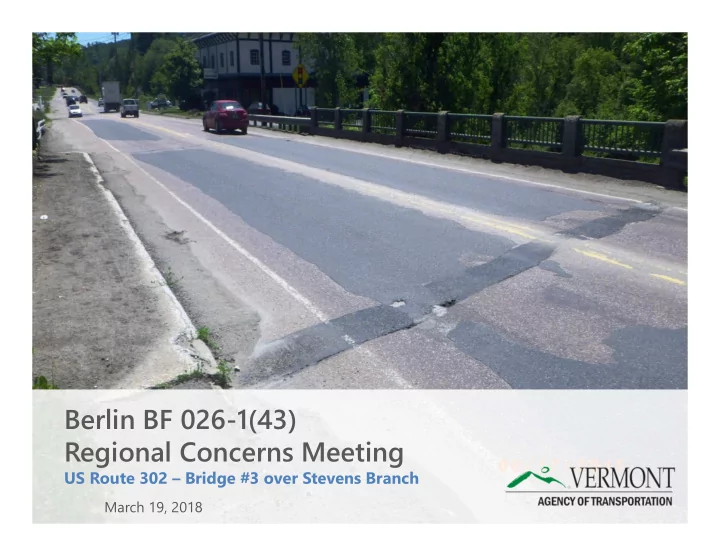
Berlin BF 026-1(43) Regional Concerns Meeting US Route 302 Bridge #3 over Stevens Branch March 19, 2018 Introductions Carolyn Carlson, P.E. VTrans Design Project Manager Laura Stone, P.E. VTrans Scoping Engineer Purpose of Meeting


slide-1
SLIDE 1

Berlin BF 026-1(43) Regional Concerns Meeting

US Route 302 – Bridge #3 over Stevens Branch

March 19, 2018

slide-2
SLIDE 2

Introductions

Carolyn Carlson, P.E.

VTrans Design Project Manager

Laura Stone, P.E.

VTrans Scoping Engineer

slide-3
SLIDE 3

Purpose of Meeting

  • Provide an understanding of our approach to the

project

  • Provide an overview of project constraints
  • Discuss our recommended alternative
  • Provide an opportunity to ask questions and voice

concerns

slide-4
SLIDE 4

Location Map

slide-5
SLIDE 5

Bridge 3 Project Location

slide-6
SLIDE 6

Meeting Overview

  • VTrans Project Development Process
  • Project Overview

– Existing Conditions – Alternatives Considered – Recommended Alternative

  • Maintenance of Traffic
  • Schedule
  • Summary
  • Questions
slide-7
SLIDE 7

VTrans Project Development Process

Project Definition Project Design Construction Project Funded Project Defined Contract Award

  • Quantify areas of

impact

  • Environmental

permits

  • Develop plans,

estimate and specifications

  • Right-of-Way

process if necessary

Initiated

  • Identify resources &

constraints

  • Evaluate alternatives
  • Public participation
  • Build Consensus
slide-8
SLIDE 8

Who are you representing?

  • A. Municipal Official
  • B. Resident
  • C. Local Business
  • D. School

E. Emergency Services F. Independent Organization

  • G. Other
slide-9
SLIDE 9

How often do you use this segment of US Route 302?

  • A. Daily
  • B. Weekly
  • C. Monthly
  • D. Rarely
  • E. Never
slide-10
SLIDE 10

How often do you walk over the bridge?

  • A. Daily
  • B. Weekly
  • C. Monthly
  • D. Rarely
  • E. Never
slide-11
SLIDE 11

How often do you bike over the bridge?

  • A. Daily
  • B. Weekly
  • C. Monthly
  • D. Rarely
  • E. Never
slide-12
SLIDE 12

What is your reason for attending this meeting?

  • A. Specific Concern
  • B. General Interest
  • C. Live in Close Vicinity
  • D. Other
slide-13
SLIDE 13

Project Overview

  • Existing Conditions
  • Alternatives Considered
  • Selected Alternative
slide-14
SLIDE 14

Description of Terms Used

Beams (Superstructure) Deck Abutment (Substructure) Bridge Rail

Cross Section of Bridge

slide-15
SLIDE 15

Existing Conditions - Bridge #3

  • Roadway Classification – Urban Principal Arterial
  • Bridge Type – 60’ Span Rolled Beam Bridge
  • Ownership – State of Vermont
  • Constructed in 1928

Looking East over Bridge

slide-16
SLIDE 16

Existing Conditions - Bridge #3

  • Deck Rating

4 (Poor)

  • Superstructure Rating

6 (Satisfactory)

  • Substructure Rating

6 (Satisfactory)

  • Channel Rating

6 (Satisfactory) Bridge Deck

slide-17
SLIDE 17

Existing Conditions - Bridge #3

  • Historic Railing
  • Substandard Width
  • Utilities

Looking West Over Bridge

slide-18
SLIDE 18

Western Abutment

Existing Conditions - Bridge #3

  • Laid-up stone wing walls
  • Widened in 1941
slide-19
SLIDE 19

Existing Conditions - Bridge #3

  • Partially laid-up stone
  • Widened in 1941

Eastern Abutment

slide-20
SLIDE 20

Existing Conditions - Bridge #3

  • Substandard Hydraulics and Bank Full Width
  • Northern Long-Eared Bat Habitat

Resource Constraints

slide-21
SLIDE 21

US Route 302 Typical Roadway Geometry

slide-22
SLIDE 22

Existing Conditions

slide-23
SLIDE 23
  • ADT of 14,400
  • DHV of 1,500
  • % Trucks: 5.6
  • Design Speed of 40 mph
  • Utilities
  • Area of significant commercial development

Design Criteria and Considerations

slide-24
SLIDE 24
  • No Action

– Additional maintenance required within 10 years

  • Deck Replacement

– Structural deficiencies would be addressed – Does not meet minimum roadway width or match the corridor (11’/5’ Typical) – Sidewalk Eliminated – 40 year design life – Does not meet Hydraulic Requirements

  • Superstructure Replacement

– Structural deficiencies would be addressed – Does not meet minimum roadway width or match the corridor (11’/5’ Typical) – Sidewalk Eliminated – 40 year design life – Does not meet Hydraulic Requirements

  • Full Bridge Replacement

– Widen to minimum standard matching corridor (5.5 sidewalk-8-11-11-11-8) – 80 year design life – Meets BFW, Does not meet Design Flood

Alternatives Considered – Bridge #3

slide-25
SLIDE 25

Selected Alternative - Bridge #3

  • Full Bridge Replacement

– Hydraulics improved – Widen to minimum standard (11’/8’) matching corridor – Sidewalk widened to meet ADA Standards – 80 year design life – Historic Documentation Required – Right-of-Way needed – Utility Relocation Needed

slide-26
SLIDE 26

Proposed Typical Section

slide-27
SLIDE 27

Proposed Layout Full Replacement On Alignment - Bridge #3

  • 11’/8’ typical, 80 year design life
slide-28
SLIDE 28

Proposed Profile

slide-29
SLIDE 29

Maintenance of Traffic Options Considered

  • Offsite Detour
  • Phased Construction
  • 3 Phases with two‐way traffic
  • Long Construction Duration
  • Temporary Bridge
slide-30
SLIDE 30

Temporary Bridge

  • Two Lane Temporary Bridge with Sidewalk
  • Placed on the downstream side
  • Would require additional ROW acquisition

Selected Maintenance of Traffic

slide-31
SLIDE 31

Temporary Bridge Layout Temporary Bridge Option - Bridge #3

  • Upstream temporary bridge has a greater impact to adjacent properties
  • Downstream temporary bridge has a greater impact to utilities
slide-32
SLIDE 32

Downstream Temporary Bridge Location Temporary Bridge Option - Bridge #3

  • Downstream temporary bridge has potential impact to utilities
slide-33
SLIDE 33

Preliminary Project Schedule

  • Construction – Summer 2022 or 2023
slide-34
SLIDE 34

Project Summary

  • Full Bridge Replacement with Traffic Maintained on a

Temporary Bridge

– Hydraulics improved – Widen to minimum standard (11’/8’) matching corridor – Sidewalk widened to meet ADA Standards – Two Lane Temporary Bridge with Sidewalk – Right-of-Way needed – Aerial Utility Relocation Needed

  • Underground utility relocation should be avoided
slide-35
SLIDE 35

Which would you be most concerned about?

  • A. Bridge Aesthetics
  • B. Environmental

Impacts

  • C. Business Impacts
  • D. Recreational Impacts
  • E. Traffic Impacts
  • F. Other
  • G. Not Really Concerned
slide-36
SLIDE 36

Which design aspect is the most important to you?

  • A. Shoulder

width/bicycle accommodations

  • B. Aesthetics – Bridge

Railing

  • C. Construction Year
  • D. Construction Duration
  • E. Cost
  • F. Other
slide-37
SLIDE 37

Did you find this presentation to be?

  • A. Too technical in

nature

  • B. Too simplified
  • C. Just about right
  • D. Not much use at all
slide-38
SLIDE 38

Do you find the recommended scope of work satisfactory?

  • A. Yes
  • B. No
slide-39
SLIDE 39

Berlin BF 026-1(43) Questions and Comments

US Route 302 – Bridge #3 over Stevens Branch

March 19, 2018

For more information:

  • https://outside.vermont.gov/agency/vtrans/external/Projects/Structures/13B254