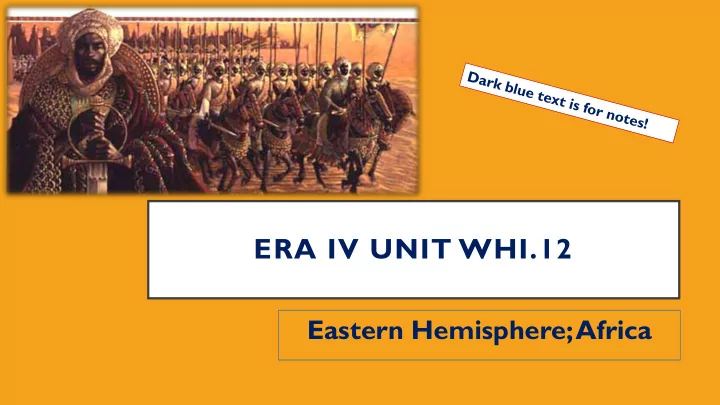
SLIDE 1
ERA IV UNIT WHI.12 Eastern Hemisphere; Africa EASTERN HEMISPHERE; - - PowerPoint PPT Presentation
ERA IV UNIT WHI.12 Eastern Hemisphere; Africa EASTERN HEMISPHERE; AFRICA 1000- 1500CE AFRICAS HISTORY LOST Muslim Arabs enslaved Africans after a battle. They were transported, with Asians and Europeans, across the Red Sea,
SLIDE 2
SLIDE 3
SLIDE 4
EASTERN HEMISPHERE; AFRICA
1000- 1500CE
SLIDE 5
AFRICA’S HISTORY LOST…
- Muslim Arabs enslaved Africans after
a battle.
- They were transported, with Asians
and Europeans, across the Red Sea, Indian Ocean, and the Sahara Desert.
- From the late 15th century,
Europeans joined the slave trade, with the Portuguese initially acquiring slaves through trade and later by force.
SLIDE 6
SLIDE 7
AFRICA TODAY:
SLIDE 8
AFRICA
- WHI.12 The student will apply social science skills to understand
the civilizations and empires of Africa, with emphasis on the African kingdoms of Axum and Zimbabwe and the West African civilizations of Ghana, Mali, and Songhai, by
- a) locating early civilizations and kingdoms in time and place and
describing major geographic features;
- b) explaining the development of social, political, economic,
religious, and cultural patterns in each region; and
SLIDE 9
SLIDE 10
SLIDE 11
SLIDE 12
SLIDE 13
SLIDE 14
SLIDE 15
- I. WEST AFRICA; GHANA, MALI, SONGHAI:
- A. Location-
- Niger River and the Sahara
- B. Trade-
- gold and salt
- C. City-
- Timbuktu
- center of trade and learning
- D. Religion-
- animism and Islam
SLIDE 16
SLIDE 17
SLIDE 18
GHANA
SLIDE 19
GHANA
SLIDE 20
GHANA
SLIDE 21
GHANA
SLIDE 22
GHANA
- 790- 1076
- First of several west African
empires to dominate the gold and ivory trade
- Conquered and split up by Muslim
invaders from northern Africa
SLIDE 23
WEST AFRICAN TRADE:
- The various kingdoms in West Africa made
very good trading partners. The north had
- salt. The south had gold.
- Ghana was in the middle. Ghana handled
the trades.
- Trades were even, ounce for ounce - an
- unce of gold for an ounce of salt.
- Both sides - north and south - paid Ghana a
tribute to handle the trades.
SLIDE 24
GHANA GETS RICH…
- Although Ghana never owned gold and
salt mines, they controlled the trade between the kingdoms to the north and the kingdoms to the south.
- With the arrival of camel trains, the
caravans, the Kingdom of Ghana expanded their control to include trade with the
- foreigners. They traded gold for spices and
- ther luxury goods as well as salt.
SLIDE 25
SLIDE 26
MALI
SLIDE 27
TIMBUKTU
SLIDE 28
MALI
- 1230- c. 1400’s
- Replaced Ghana
- Used military force to expand territory
- Began selling war captives to the Arabs as slaves
- Adopted Islam as its religion
SLIDE 29
- E. MANSA MUSA
- 1. Great King from Mali
- 2. famous pilgrimage to Mecca
(1324-1325)
- Caravan included:
- 500 slaves bearing golden staffs
- 100 camels, each loaded with 300
pounds of gold
- 12,000 slaves
- Effected economies wherever they
passed
- It took Cairo, Egypt 12 years to recover!
SLIDE 30
QUR’AN SCHOOL IN MALI
SLIDE 31
SLIDE 32
SLIDE 33
SLIDE 34
SLIDE 35
SLIDE 36
SONGHAI
SLIDE 37
SLIDE 38
SONGHAI
- Early 1400’s to late
1500’s
- Replaced Mali
- Emperor Sunni Ali
adopted strict Shari’ah Law
- Declined due to weak
leadership and slave trade
SLIDE 39
SLAVERY IN SUB-SAHARAN AFRICA
SLIDE 40
SONGHAI
SLIDE 41
SONGHAI
SLIDE 42
SLIDE 43
AXUM
SLIDE 44
SLIDE 45
AXUM
SLIDE 46
- II. AXUM
- A. Location-
- Ethiopian Highlands
and the Nile River
SLIDE 47
AXUM
- Between the third and sixth century A.D. (C.E.)
- Became a great market in northeastern Africa
- Merchants traded with civilizations beyond the Nile River
- During the fourth century A.D. (C.E.)
- B. Became a Christian kingdom
- Became politically and economically linked to Roman Egypt
SLIDE 48
AXUM
SLIDE 49
AXUM
SLIDE 50
SLIDE 51
QUEEN OF SHEBA
- Known in biblical, Islamic and
Ethiopian tradition
- Shown here on her way to visit
King Solomon in Jerusalem
- The illustration is from the early
20th century by French-born English illustrator Edmund Dulac.
SLIDE 52
QUEEN OF SHEBA
- Ethiopian (Aksum) legendary wife of Solomon
- In the biblical Book of Kings (I Kings 10), the Queen of Sheba
visits King Solomon at his court in Jerusalem
- Hoping to impress him with her wealth, she arrives with a
camel-train laden with spices, gold, and jewels
- She is overwhelmed by the splendor of Solomon’s state,
however, attributing this, and his people’s good fortune in being governed by such a king, to the Hebrew god, Yahweh
SLIDE 53
SLIDE 54
SLIDE 55
ZIMBABWE
SLIDE 56
ZIMBABWE
SLIDE 57
ZIMBABWE
SLIDE 58
- III. ZIMBABWE
- A. Location-
- proximity to Zambezi and
Limpopo rivers and the Indian Ocean coast
- B. City-
- “Great Zimbabwe” as capital
- C. Prosperous empire
SLIDE 59
ZIMBABWE
SLIDE 60
ZIMBABWE
- D. Utilized Indian Ocean
trade routes to connect with Asia
SLIDE 61
ZIMBABWE
SLIDE 62
ZIMBABWE
SLIDE 63
ZIMBABWE
- Prosperous empire
- Cattle herding
- Descendants of
Bantu people
- Zimbabwe collapsed
due to the slave trade
SLIDE 64
SLIDE 65
SLIDE 66
AFRICA
SLIDE 67
SLIDE 68
SLIDE 69
SLIDE 70
SLIDE 71
POINT OF NO RETURN
SLIDE 72
SLIDE 73
SLIDE 74
AFRICA
- WHI.12 The student will apply social science skills to understand
the civilizations and empires of Africa, with emphasis on the African kingdoms of Axum and Zimbabwe and the West African civilizations of Ghana, Mali, and Songhai, by
- c) evaluating and explaining the European interactions with these
societies, with emphasis on trading and economic interdependence.
SLIDE 75
- IV. EUROPEAN
INTERACTIONS WITH AFRICA
- A. God, Glory, and Gold!
- Support for diffusion of
Christianity (God)
- Political and economic
competition between European empires (Glory)
- Demand for gold, spices, and
natural resources in Europe (Gold)
SLIDE 76
SLIDE 77
EUROPEAN INTERACTIONS WITH AFRICA
- B. Age of Exploration
Innovations of European and Islamic origins in navigational arts
- 1. New technologies for sailing
Pioneering role of Prince Henry the Navigator
- 2. Prince Henry the Navigator promoted explorers
(he had a school) European trading posts were established along the coast of Africa
- 3. Europe begins to take hold of Africa
SLIDE 78
EUROPEAN INTERACTIONS WITH AFRICA
Prince Henry the Navigator
SLIDE 79
SLIDE 80
SLIDE 81
SLIDE 82