Ancient Epic: Homer and Vergil Vergil Ancient Epic: Homer and - - PowerPoint PPT Presentation

ancient epic homer and vergil vergil ancient epic homer
SMART_READER_LITE
LIVE PREVIEW

Ancient Epic: Homer and Vergil Vergil Ancient Epic: Homer and - - PowerPoint PPT Presentation

Ancient Epic: Homer and Vergil Vergil Ancient Epic: Homer and History and Literature Ancient Epic: Homer and Vergil Vergil Ancient Epic: Homer and History and Literature if histories like Herodotus encompass story along with


slide-1
SLIDE 1

Ancient Epic: Homer and Ancient Epic: Homer and Vergil Vergil

History and Literature

slide-2
SLIDE 2

Ancient Epic: Homer and Ancient Epic: Homer and Vergil Vergil

History and Literature

  • if histories like Herodotus’ encompass

“story” along with “history,” does literature then do the same?

  • historians benefit from the study of fictional

works in at least two ways:

– literature often includes much “history” – the process of writing literature overlaps with its historical cousin in many respects

  • all in all, good history is often good “story”
slide-3
SLIDE 3

Ancient Epic: Homer and Ancient Epic: Homer and Vergil Vergil

History and Literature

  • two of the best creators of fiction in western

literature are Homer Homer and Vergil Vergil

  • let’s examine their works from a historian’s

perspective and see what they teach us about what-really-happened-in-the-past

slide-4
SLIDE 4

Ancient Epic: Homer and Ancient Epic: Homer and Vergil Vergil

Homer

  • Quintilian: “Homer is the river from which all

literature flows.”

  • high quality of poetry: flashbacks, character

development, pathos

  • to many, he’s both the first and the best

Western author

slide-5
SLIDE 5

Ancient Epic: Homer and Ancient Epic: Homer and Vergil Vergil

Homer

  • The Iliad

The Iliad

– the earliest preserved epic epic in Western literature

  • an epic is a long narrative poem involving heroic

struggle, gods, and often the conquest of death

– set entirely at the walled city of Troy Troy (Ilium Ilium) – Achilles Achilles, , Agamemnon Agamemnon, , Hector Hector, , Priam Priam – centers around Achilles’ anger and his refusal to fight after Agamemnon shames him in public – does not tell the story of the Trojan Horse Trojan Horse or the Sack of Troy Sack of Troy!

slide-6
SLIDE 6

Ancient Epic: Homer and Ancient Epic: Homer and Vergil Vergil

Homer

  • The Odyssey

The Odyssey

– in the aftermath of the Trojan War, Odysseus Odysseus (Ulysses Ulysses) returns home

  • Odysseus makes it home safely to Penelope

Penelope

  • unlike Agamemnon who is killed by his wife

Clytemnestra Clytemnestra

slide-7
SLIDE 7

Ancient Epic: Homer and Ancient Epic: Homer and Vergil Vergil

Homer

  • the gods are major players in both epics

– e.g. Zeus Zeus and Hera Hera, the King and Queen of Olympus

  • equated with the Roman deities Jupiter

Jupiter and Juno Juno

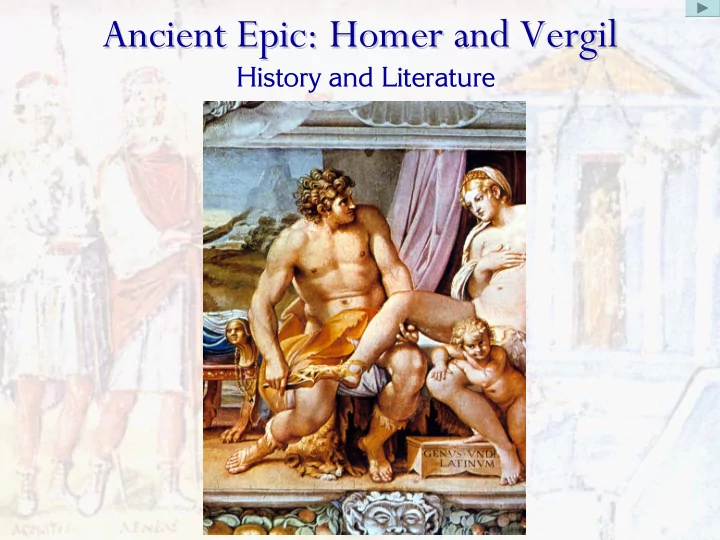
– but unlike God in the Old Testament, these divinities are sometimes treated comically – e.g. “The Seduction of Zeus The Seduction of Zeus” (Iliad, Book 14)

  • Homer also explores the tragic side of life

– e.g. “Odysseus and Argus Odysseus and Argus” (Odyssey, Book 17)

slide-8
SLIDE 8

Ancient Epic: Homer and Ancient Epic: Homer and Vergil Vergil

Homer

  • Who is Homer?

– little is known: birthplace? date of birth? – he probably was blind

  • Milman

Milman Parry Parry: : Homer was an oral bard

  • ral bard

– explains repetitive formulas (oral formulas

  • ral formulas)

– and also the frequency of weak joins weak joins

  • So how was Homer’s text preserved?

– through rhapsodes rhapsodes (“stitchers of song”)? – but do we have Homer’s actual text?

slide-9
SLIDE 9

Ancient Epic: Homer and Ancient Epic: Homer and Vergil Vergil

Homer and History

  • does Homer’s work preserve “history”?

– Unlikely, because Homer:

  • was probably blind
  • lived three dark and illiterate centuries after the fact
  • made a living as an entertainer, not a historian

– on the other hand, there could be echoes of what-really-happened historically in his work

  • he records accurately the armor of that day

– cf. Medieval bards who got many things right historically

  • epic was all Homer’s society had as a means of

remembering their past, which made it valuable

slide-10
SLIDE 10

Ancient Epic: Homer and Ancient Epic: Homer and Vergil Vergil

Homer and History

  • the question then is which details are “what-

really-happened” and which are “invented history”

– Troy itself may even have been a real place, as we’ll see in the next Section of the class – but exactly the way Homer describes the city?

  • finally, even if it is an invented history,

Homer’s work preserves the desires and values of a society, and those per se are important historical truths

slide-11
SLIDE 11

Ancient Epic: Homer and Ancient Epic: Homer and Vergil Vergil

Vergil

  • Vergil

Vergil is Rome’s greatest poet

  • much reliable biographical information

– 70-19 BCE; cf. Julius Caesar – e.g. middle-class but well educated – slow and meticulous perfectionist

  • however, very little reliable evidence is

preserved about his private life, suggesting he probably didn’t have much of one

slide-12
SLIDE 12

Ancient Epic: Homer and Ancient Epic: Homer and Vergil Vergil

Vergil’s Aeneid

  • early in his career, Vergil wrote pastoral

poetry (about life in the country)

  • in the early 20’s BCE, the Roman emperor

Augustus Augustus commissioned Vergil to write an epic poem glorifying Rome

slide-13
SLIDE 13

Ancient Epic: Homer and Ancient Epic: Homer and Vergil Vergil

Vergil’s Aeneid

  • the result was The Aeneid

The Aeneid

– published only ten years later – Vergil died leaving it unfinished – nevertheless, it became an instant classic – yet it was not about Augustus – instead, it is set in the distant (mythological) past

slide-14
SLIDE 14

Ancient Epic: Homer and Ancient Epic: Homer and Vergil Vergil

Vergil’s Aeneid

  • the central character is Aeneas

Aeneas

– problem for Vergil: Aeneas in Homer’s Iliad is a braggart and a coward

  • at one point, his mother Venus

Venus has to save him from being killed in battle

– Vergil’s solution: pius pius Aeneas

  • twelve “books” of The Aeneid

–vs. 48 (24 + 24) of The Iliad and The Odyssey – thus, The Aeneid is a “miniaturized” Homeric epic

slide-15
SLIDE 15

Ancient Epic: Homer and Ancient Epic: Homer and Vergil Vergil

Vergil’s Aeneid, Book 1

  • Vergil leaps in medias res

in medias res (“in the middle of things”)

– Aeneas is caught in a storm sent by Juno to destroy him (Book 1)

  • n.b. Aeneas is depressed

and suicidal

– he and his ragged band of Trojan refugees wash up on the shores of North Africa where he meets Dido Dido, the Queen of Carthage Carthage

slide-16
SLIDE 16

Ancient Epic: Homer and Ancient Epic: Homer and Vergil Vergil

Vergil’s Aeneid, Book 2

  • Dido hosts Aeneas and his men at a banquet

and then asks him to tell the assembled crowd how Troy fell

– again, Vergil’s focus is psychological as Aeneas “relives” the Sack of Troy – at the climax of Book 2, Aeneas recalls having seen Priam Priam killed by Pyrrhus Pyrrhus – Priam’s death recalls Pompey Pompey’s murder

slide-17
SLIDE 17

Ancient Epic: Homer and Ancient Epic: Homer and Vergil Vergil

Vergil’s Aeneid, Book 3-5

  • Aeneas and Dido have an intense love affair

but duty calls and the gods order Aeneas to serve a higher calling, the founding of Rome

  • Dido begs him to stay

in Carthage but he refuses and leaves

  • Dido commits suicide
slide-18
SLIDE 18

Ancient Epic: Homer and Ancient Epic: Homer and Vergil Vergil

Vergil’s Aeneid, Book 6

  • in Book 6, Aeneas goes to the Underworld

and sees the ghost of Dido who scorns him

  • at the climax of Book 6, he watches a

triumphal pageant of Rome-yet-to-come

  • at the end, Aeneas leaves through the “Gate
  • f Ivory” (Book 6)

– is Vergil saying Rome a “false dream”?

slide-19
SLIDE 19

Ancient Epic: Homer and Ancient Epic: Homer and Vergil Vergil

Vergil’s Aeneid, Books 7-12

  • Aeneas arrives in Italy and has to battle for a

new homeland for his Trojan comrades

  • he fights a local hero Turnus

Turnus over the hand in marriage of the king’s daughter

  • The Aeneid ends with Aeneas killing Turnus

in a one-on-one duel (Book 12)

slide-20
SLIDE 20

Ancient Epic: Homer and Ancient Epic: Homer and Vergil Vergil

Vergil’s Aeneid: Conclusion

  • what does Vergil mean with all these

confusing suggestions? – it seems clear The Aeneid is not only a story

about the deep mythological past – but what is the key to cracking this code? – Aeneas clearly begins as a depressed and disturbed “hero” and evolves into a ruthless murderer

slide-21
SLIDE 21

Ancient Epic: Homer and Ancient Epic: Homer and Vergil Vergil

Vergil’s Aeneid: Conclusion

  • what does Vergil mean with all these

confusing suggestions? – what is the learned poet’s diagnosis of Rome’s

tormented psychology? – is this epic what Augustus was paying for? – is that why Vergil on his deathbed asked that The Aeneid be burned? Because in writing it he had pointed to greater truths than he originally meant to — or had been paid to?

slide-22
SLIDE 22

Ancient Epic: Homer and Ancient Epic: Homer and Vergil Vergil

Conclusion: History and Literature

  • great questions are what great literature

brings to the feast of history

– fiction can reveal very real facets of the past abstracted as myth and fantasy

  • for instance, Homer shows how early the

human heart formed, where a noble dog’s death is worth a “salt tear”

– and those at the top don’t always comport themselves with the dignity of their position – so, is this Homer’s version of “chaos theory”?

slide-23
SLIDE 23

Ancient Epic: Homer and Ancient Epic: Homer and Vergil Vergil

Conclusion: History and Literature

  • in a very different way, Vergil gives voice to

the murmurs of discontented “slaves” who work for the regime oppressing them

  • if literature cannot stand alone as a gateway

to the past, it enriches and brings a healthy confusion to our assessment of history

– and even if that doesn’t actually take us nearer to what-literally-happened, it shows the psychological complexity underlying the ways in which the past has unfolded