
3/3/2016 1
Alice Sterling Honig, Ph.D. WEBINAR March 9, 2016 ahonig@syr.edu
Secure Attachment Promotes a Positive Emotional Life for Infants and Toddlers
What is Attachment?
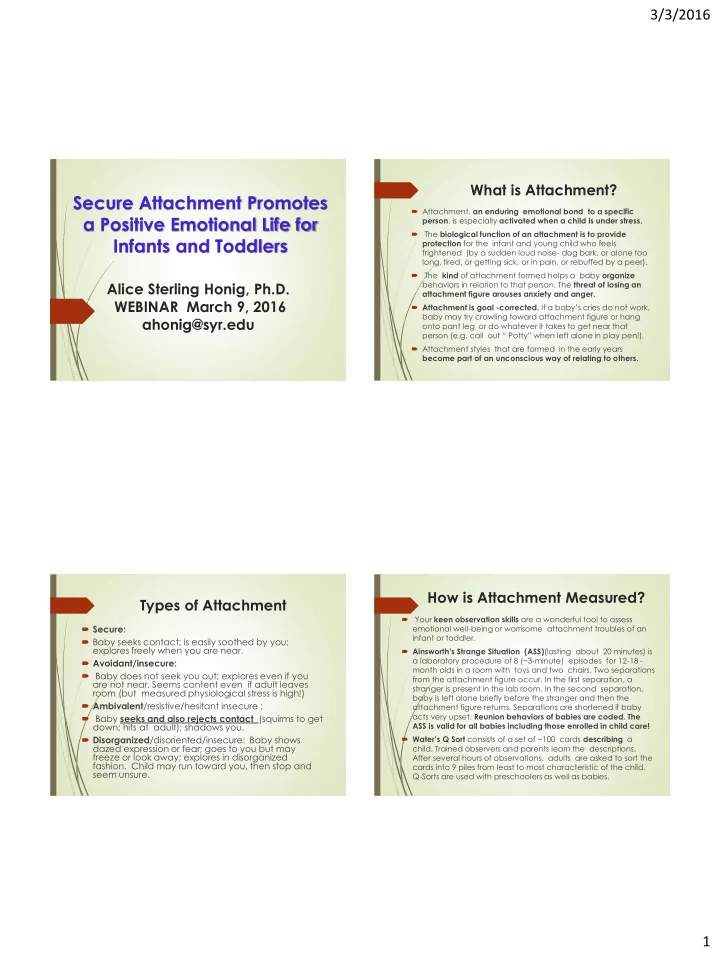
Attachment, an enduring emotional bond to a specific person, is especially activated when a child is under stress. The biological function of an attachment is to provide protection for the infant and young child who feels frightened (by a sudden loud noise- dog bark, or alone too long, tired, or getting sick, or in pain, or rebuffed by a peer). The kind of attachment formed helps a baby organize behaviors in relation to that person. The threat of losing an attachment figure arouses anxiety and anger. Attachment is goal -corrected. If a baby’s cries do not work, baby may try crawling toward attachment figure or hang
- nto pant leg or do whatever it takes to get near that
person (e.g. call out “ Potty” when left alone in play pen!). Attachment styles that are formed in the early years become part of an unconscious way of relating to others.
Types of Attachment
Secure: Baby seeks contact; is easily soothed by you; explores freely when you are near. Avoidant/insecure: Baby does not seek you out; explores even if you are not near. Seems content even if adult leaves room (but measured physiological stress is high!) Ambivalent/resistive/hesitant insecure : Baby seeks and also rejects contact (squirms to get down; hits at adult); shadows you. Disorganized/disoriented/insecure: Baby shows dazed expression or fear; goes to you but may freeze or look away; explores in disorganized
- fashion. Child may run toward you, then stop and
seem unsure.
How is Attachment Measured?
Your keen observation skills are a wonderful tool to assess emotional well-being or worrisome attachment troubles of an infant or toddler. Ainsworth’s Strange Situation (ASS)(lasting about 20 minutes) is a laboratory procedure of 8 (~3-minute) episodes for 12-18 - month olds in a room with toys and two chairs. Two separations from the attachment figure occur. In the first separation, a stranger is present in the lab room. In the second separation, baby is left alone briefly before the stranger and then the attachment figure returns. Separations are shortened if baby acts very upset. Reunion behaviors of babies are coded. The ASS is valid for all babies including those enrolled in child care! Water’s Q Sort consists of a set of ~100 cards describing a
- child. Trained observers and parents learn the descriptions.
After several hours of observations, adults are asked to sort the cards into 9 piles from least to most characteristic of the child. Q-Sorts are used with preschoolers as well as babies.