Emerging Interconnects Christof Teuscher, Neha Parashar, Mrugesh - - PowerPoint PPT Presentation

emerging interconnects
SMART_READER_LITE
LIVE PREVIEW

Emerging Interconnects Christof Teuscher, Neha Parashar, Mrugesh - - PowerPoint PPT Presentation

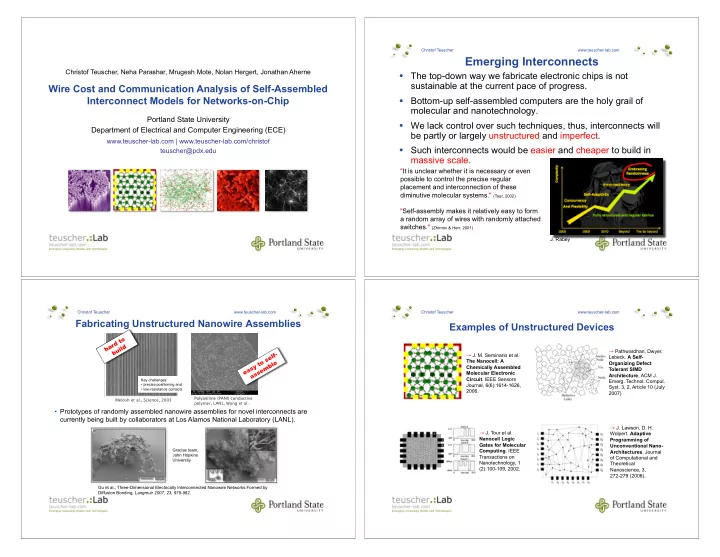
Christof Teuscher www.teuscher-lab.com Christof Teuscher www.teuscher-lab.com Emerging Interconnects Christof Teuscher, Neha Parashar, Mrugesh Mote, Nolan Hergert, Jonathan Aherne The top-down way we fabricate electronic chips is not


slide-1
SLIDE 1

Christof Teuscher www.teuscher-lab.com

Wire Cost and Communication Analysis of Self-Assembled Interconnect Models for Networks-on-Chip

teuscher@pdx.edu www.teuscher-lab.com | www.teuscher-lab.com/christof

Portland State University Department of Electrical and Computer Engineering (ECE)

Christof Teuscher, Neha Parashar, Mrugesh Mote, Nolan Hergert, Jonathan Aherne

Christof Teuscher www.teuscher-lab.com

Emerging Interconnects

  • The top-down way we fabricate electronic chips is not

sustainable at the current pace of progress.

  • Bottom-up self-assembled computers are the holy grail of

molecular and nanotechnology.

  • We lack control over such techniques, thus, interconnects will

be partly or largely unstructured and imperfect.

  • Such interconnects would be easier and cheaper to build in

massive scale.

"It is unclear whether it is necessary or even possible to control the precise regular placement and interconnection of these diminutive molecular systems." (Tour, 2002) "Self-assembly makes it relatively easy to form a random array of wires with randomly attached switches." (Zhirnov & Herr, 2001)

  • J. Rabey

Christof Teuscher www.teuscher-lab.com Melosh et al., Science, 2003 Key challenges:

  • precise positioning and
  • low-resistance contacts

Polyaniline (PANI) conductive polymer, LANL, Wang et al.

Fabricating Unstructured Nanowire Assemblies

Gu et al., Three-Dimensional Electrically Interconnected Nanowire Networks Formed by Diffusion Bonding, Langmuir 2007, 23, 979-982.

  • Prototypes of randomly assembled nanowire assemblies for novel interconnects are

currently being built by collaborators at Los Alamos National Laboratory (LANL).

Gracias team, John Hopkins University Christof Teuscher www.teuscher-lab.com

! J. M. Seminario et al. The Nanocell: A Chemically Assembled Molecular Electronic

  • Circuit. IEEE Sensors

Journal, 6(6):1614-1626, 2006.

Examples of Unstructured Devices

! J. Tour et al. Nanocell Logic Gates for Molecular

  • Computing. IEEE

Transactions on Nanotechnology, 1 (2):100-109, 2002. ! Pathwardhan, Dwyer,

  • Lebeck. A Self-

Organizing Defect Tolerant SIMD Architecture, ACM J.

  • Emerg. Technol. Comput.
  • Syst. 3, 2, Article 10 (July

2007) ! J. Lawson, D. H.

  • Wolpert. Adaptive

Programming of Unconventional Nano-

  • Architectures. Journal
  • f Computational and

Theoretical Nanoscience, 3, 272-279 (2006).

slide-2
SLIDE 2

Christof Teuscher www.teuscher-lab.com

Contributions of this Paper

  • Two physically-plausible models for generating unstructured

NoC interconnects:

– wire deposition – direct wire growth

  • Consider the wiring cost
  • Investigate NoC design trade-offs of these models.
  • Compare with other non-classical NoC models
  • Use of evolutionary algorithms to validate assumptions.

Christof Teuscher www.teuscher-lab.com

Wire Growth Model

  • Probabilistic cellular automata (CA)
  • Grid of cells
  • Each cell can be in one of multiple states
  • Cell states are updated depending on the neighbor cells
  • Wires start growing from seed points in a random direction
  • Wires turn with a certain probability t
  • Wires stop growing with a certain probability s

Christof Teuscher www.teuscher-lab.com

Wire Growth Model

  • Model parameters: (1) number of seed points N, (2) turn

probability t, (2) stop probability s

Christof Teuscher www.teuscher-lab.com

Results: Wire-length Distribution

  • The more we turn and the

earlier we stop, the more more shorter wires we get

  • Ultimate goal: match these

parameters with experiments:

slide-3
SLIDE 3

Christof Teuscher www.teuscher-lab.com

Levitan’s Model

  • S. P. Levitan. You can get there from here:

Connectivity of random graphs on grids. In Proceedings of the Design Automation Conference (DAC 2007), pages 272–273, San Diego, CA, Jun 4–7 2007. ACM.

  • Drop wires with uniform length

distribution on a surface

  • They form a network
  • On a !Nx!N grid, 80% of the

cells can be connected into a single spanning tree with only N wires

  • Example: 100 wires

Christof Teuscher www.teuscher-lab.com

Power-law Wire Length Distribution

Gaussian Power-law Distance l Connection probability

" l-"

Power-law nets: shown by physicists to minimize cost and path lengths. Uniform (Levitan)

Christof Teuscher www.teuscher-lab.com

Our Wire Drop Model

  • Drop wires with power-law length distribution on a surface: l-#
  • Decreases the total number of additional wires required and thus the

wiring cost.

Christof Teuscher www.teuscher-lab.com

Results: Spanning Tree and Unconnected Nodes

  • Knobs:
  • #
  • number of wires
  • #=0: uniform, Levitan

spanning tree unconnected nodes

slide-4
SLIDE 4

Christof Teuscher www.teuscher-lab.com

Results: Wiring Cost

global local average shortest path 12’500 links 7’500 links 10’000 links

Christof Teuscher www.teuscher-lab.com

Network Optimization by Evolutionary Algorithms

  • Evolutionary algorithms (EA) are a metaheuristic
  • ptimization technique inspired by natural evolution.
  • Given: N nodes
  • Questions:

– how to interconnect these nodes to maximize performance (average shortest path) and minimize cost (wire length) – what wire-length distribution evolves?

  • Model parameter:

– weight factor a – f= a x average shortest path + (1 - a) x cost

Christof Teuscher www.teuscher-lab.com

Results: Cost versus Average Path Length

cost

emphasis

  • n path

emphasis

  • n cost

path

Christof Teuscher www.teuscher-lab.com

Results: Wire Length Distribution

Gaussian fit

slide-5
SLIDE 5

Christof Teuscher www.teuscher-lab.com

Evaluation in NoC Framework

  • Evaluate the networks from the two models and the

evolutionary algorithm in a more realistic framework.

  • Processing and switch nodes
  • Virtual channels
  • Shortest path routing
  • Random traffic model
  • 64 nodes
  • 2D mesh for a baseline comparison

Christof Teuscher www.teuscher-lab.com

Results: Average Latency

grown deposited, uniform 2D mesh

Christof Teuscher www.teuscher-lab.com

Results: Throughput

evolved grown 2D mesh deposited

Christof Teuscher www.teuscher-lab.com

Results: Average Path and Wiring Cost

slide-6
SLIDE 6

Christof Teuscher www.teuscher-lab.com

Conclusions

  • Self-assembled NoCs will be largely unstructured.
  • This is much better than it sounds: with the right

paradigms, they are beneficial in terms of performance, wiring cost, robustness, and scalability against failures.

  • Reason: bottom-up fabrication results in wire-length

distributions that are driven by resource constraints (volume, area, time). We are in a “physical sweet spot”

  • Specific wire-length distributions allow to reduce the

total wiring cost (and thus the energy consumption).

Christof Teuscher www.teuscher-lab.com

References

  • Abstract NoC framework, unstructured NoC, benefits of randomness

  • C. Teuscher. Nature-inspired interconnects for emerging large-scale network-on-chip
  • designs. Chaos, 17(2):026106, 2007. arXiv:0704.2852

  • C. Teuscher and A. A. Hansson. Non-Traditional Irregular Interconnects for Massive Scale
  • SoC. IEEE International Symposium on Circuits and Systems, ISCAS 2008, Seattle, May

18-21, 2008, pages 2785-2788

  • Damage spreading and robustness in random dynamical networks:

  • T. Rohlf, N. Gulbahce, and C. Teuscher. Damage spreading and criticality in finite random

dynamical networks. Physical Review Letters, 99(24):248701, 2007. arXiv:cond-mat/

0701601

  • Q. Lu, C. Teuscher. Damage Spreading in Spatial and Small-world Random Boolean
  • Networks. In revision. arxiv:cond-mat/0904.4052
  • Architectural and computing considerations:

  • C. Teuscher, N. Gulbahce, and T. Rohlf. Assessing Random Dynamical Network

Architectures for Nanoelectronics. Proceedings of the IEEE/ACM Symposium on Nanoscale Architectures, NANOARCH 2008, Anaheim, CA, USA, Jun 12-13, 2008. arXiv:

0805.2684

  • C. Teuscher, N. Gulbahce, and T. Rohlf. An Assessment of Random Dynamical Network

Automata for Nanoelectronics. In press.

Christof Teuscher www.teuscher-lab.com

Check it out! Check it out!

www.teuscher-lab.com

Anza Borrego, 2006