
SLIDE 1
Emergency Action Plans
What should you do in an emergency situation?
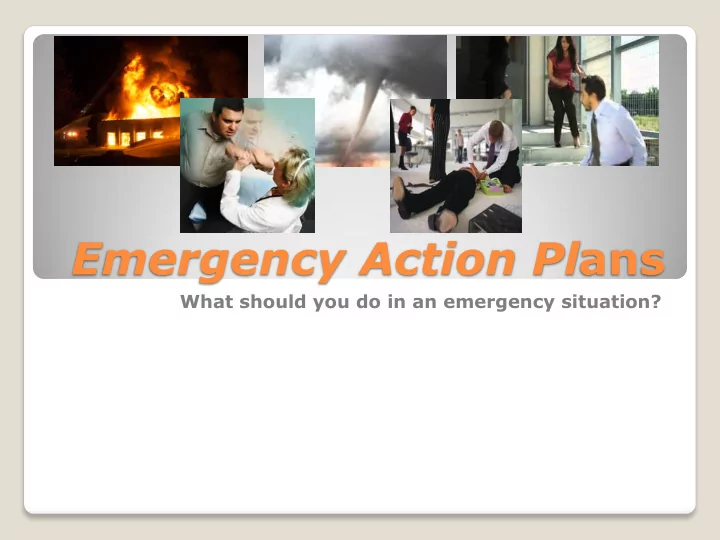
Emergency Action Pl ans What should you do in an emergency - - PowerPoint PPT Presentation
Emergency Action Pl ans What should you do in an emergency situation? An Emergency Action Plan (EAP ) is a written document required by OSHA. The purpose of an Emergency Action Plan ( EAP) is to facilitate and organize employer and
What should you do in an emergency situation?
An Emergency Action Plan (EAP) is a written document required by OSHA.
The purpose of an Emergency Action Plan (EAP) is to facilitate and
OFC has developed EAP policies and procedures to follow in specific emergency situations.
All employees will be trained on EAP policies and procedures annually.
Training Objectives:
Safety Committee or Administration.
OFC has developed an Emergency Action Plan for each emergency situation listed below:
The following slides will explain the Emergency Action Plan for each emergency situation and help your understand your responsibility/action.
Policy: In the event of a fire OFC will provide a safe and orderly exit of the building while providing maximum safety for patients, visitors, and staff.
Procedure: 1) Staff who observe/encounter a fire will stop what they are doing and begin evacuation of the patients, visitors, and staff from the immediate area. 2) If the alarm has not sounded, activate the overhead paging system by dialing “8” wait for the beep then “0” announce FIRE and the location of the fire three times. *If alarm has sounded the Switchboard will activate the
3) If alarm has not sounded, call 911. *If alarm has sounded 911 is automatically notified. 4) Begin to evacuate your respective areas of all patients, visitors, and staff using the closest exit. Department supervisors should be sure their area is clear of patients and staff upon their exit. Close all doors to your area (if possible, including exam rooms) upon exit, signaling that this area has been completely evacuated. 5) Once all the patients and staff have exited the building, a member of administration will double-check for any remaining personnel. 6) DO NOT re-enter the building until told to do so by the Fire Department or administration. 7) There will be an overhead page of “all clear” when the emergency has resolved.
In the event of a fire, REMEMBER the RACE acronym:
Extinguish the fire, if the fire is small, by using a fire extinguisher. Use the PASS system for extinguishing the fire.
Evacuate the building if unable to extinguish.
Employees should be aware of evacuation route and fire extinguisher placements.
Policy - In the event of Severe/Inclement weather OFC will provide maximum safety for patients, visitors, and staff.
Definitions:
employees of OFC.
blizzard, ice storms.
A watch is defined as conditions being favorable for weather condition. A warning is defined as a sighting of the type of weather condition in the immediate area.
and free from flying debris.
Safe Zone is located in the center of the building (nursing station and middle exam rooms). Employees should be aware of where the Safe Zone is located.
Tornado Watch Procedure:
1) When a watch is issued for Blue Earth and/or Nicollet County by the National Weather Service the administration department will monitor radio and television stations for up to date weather information. 2) Departments will be notified when a Tornado Watch has been issued for the area and staff should prepare/plan for the movement of patients, visitors, and staff to the designated Safe Zone of the building.
Tornado Warning Procedure:
1) When a Tornado Warning is issued for Blue Earth and/or Nicollet County by the NWS, administration will continue to watch the weather to decided if/when patients, staff and visitors should be moved to the safe zone. 2) When its decided to move to the safe zone the switchboard operator will announce three times Attention, The National Weather Service has issued a tornado warning for ____ County please take shelter immediately. 3) Begin to evacuate your respective areas of all patients, visitors and staff to the Safe Zone of the
exit. 4) Keep doors to areas with outside windows closed in all designated Safe Zone areas. Doors in non- designated areas should be left open. 5) Do not open any exterior windows or doors. 6) A member of the administration department will double-check for any remaining personnel. 7) Staff may return to their designated areas only after an “all clear” is announced by the switchboard
Policy: The Orthopaedic & Fracture Clinic is committed to providing its employees, patients and visitors with a safe, non-violent workplace and atmosphere.
Definitions:
is physically assaultive bullying verbal harassment sexual harassment a reasonable person would perceive as obsessively directed (e.g. intensely focused on a grudge, grievance, or romantic interest in another person) and reasonably likely to result in harm or threats of harm to persons or property consists of a communicated or reasonably perceived threat to harm another individual or in any way endanger the safety of an individual would be interpreted by a reasonable person as carrying potential for physical harm to the individual is a behavior or action that a reasonable person would perceive as menacing; involves carrying or displaying weapons, destroying property, or throwing objects in a manner reasonably perceived as threatening consists of a communicated or reasonably perceived threat to destroy property
Procedure:
1) If you have staff, patients, or visitors with uncontrolled behavior and need immediate assistance activate the overhead paging system by dialing “8” wait for the beep then “0” announce Code Green and the location of the disturbance three times. 2) If the act or altercation constitutes an emergency, CALL 911 immediately. 3) When a Code Green is paged, all available administrators and staff (male) should respond to the location. 4) Remain calm; try to control the situation without force, and without putting yourself in danger. 5) Administration/Switchboard will overhead page “all clear” when emergency is resolved.
Notify supervisor or administration for non-emergent situations.
Policy: Prevent the abduction of infants/children and/or the disappearance of any persons at The Orthopaedic & Fracture Clinic.
Procedure:
1) Notify supervisor and/or administration immediately with the goal being able to locate the abducted or suspected missing person as quick as possible. 2) Conduct a brief search of the immediate vicinity. 3) If Staff confirms abduction or disappearance, activate the overhead page dial “8” wait for the beep then “0” and announce Missing Person and location 3 times. 4) Call 911. 5) Upon hearing the Missing Person page all exits will be secured by OFC employees; no persons shall exit/enter the building.
6) Staff will immediately conduct a search of the entire facility. Remember to search unlikely places. 7) Follow police instructions upon their arrival. 8) Overhead page “all clear” when emergency is resolved.
Hostage Crisis Plan Terrorist/Bomb Threat: (Code Black) Active Shooter
Employee, Patient or Visitor Taken Hostage:
Captors are less likely to harm hostages at whom they are looking.
captor(s).
know or like.
create problems.
desperate and jumpy as hostages.
The First Person to Identify a Hostage Situation:
supervisors, will notify the Police Department and begin full evacuation of the clinic.
Negotiations - Trained hostage negotiators from the Police Department or
negotiators arrive, adhere to the following:
seek clarification.”
down.
In the event that a bomb threat or terrorist threat is called in or a suspicious package is found, the following guidelines have been developed by The Orthopaedic & Fracture Clinic:
where the bomb may be located. Write down key points. Questions to Ask:
Make note of:
the emergency personnel, evacuation will be determined. OFC will notify MSC and Mankato Clinic administrators of threat and possible evacuation.
announce Code Black and location of suspicious package/item if known three times.
place distinctive, warning sign near the suspicious area. Do not leave the area yourself; designate someone to bring you a warning sign.
this to administration or authorities assigned to situation.
An Active Shooter is an individual actively engaged in killing or attempting to kill people in a confined and populated area, typically through the use of firearms.
According to The United States Department of Homeland Security the following protocol should be applied with an active shooter.
shots.
When Law Enforcement Arrives:
The Orthopaedic & Fracture Clinic has instituted a “No Firearms” policy.
No guns are allowed on OFC property with the exception of the parking lots.
weapons while on OFC premises is strictly prohibited.
& Fracture Clinic Bans Guns on the Premises.”
secure their gun in their vehicle.
valid permit to carry a firearm. If the individual does not comply, OFC will contact the Public Safety Department to assist with removing the individual from the premises and taking any other action as necessary. Failure to comply will result in discipline, up to and including terminating employees for violating this policy.
Exceptions: The only exceptions to this policy are for on-duty police officers, security guards, and military personnel acting in the course and scope of their
Staff witnessing a patient become unstable or require immediate advanced intervention in a life-threatening situation will:
by dialing “8” wait for the beep then “0” announce Emergency Response Team respond to ___________ (location) three times.
give 911 dispatch as much information as possible: Location/address/entrance/gender/age/name/and signs and symptoms.
respond to the ERT page immediately bringing emergency equipment with them.
team.
Express Clinic Hours
Immediately call out for help and attend to the patient When help arrives call 911
requires CPR - you will complete one cycle of CPR before calling 911
It is each employee’s responsibility to understand the policy &
procedures for each EAP and the actions they will need to take during an emergency situation.
There are EAP cards placed in every department. Please take
time to review these EAP cards often so you become familiar with each EAP.
If an employee has any questions/concerns regarding OFC’s
Emergency Action Plans please see a member of the Safety Committee or Administration.