Clinical Neurodynamics Definition: clinical application of - - PDF document

clinical neurodynamics
SMART_READER_LITE
LIVE PREVIEW

Clinical Neurodynamics Definition: clinical application of - - PDF document

Property of VOMPTI, LLC www.vompti.com C LINICAL N EURODYNAMICS Kristin Kelley, PT, DPT, OCS, FAAOMPT Orthopaedic Manual Physical Therapy Series Charlottesville 2017-2018 Orthopaedic Manual Physical Therapy Series 2017-2018 Clinical


slide-1
SLIDE 1

Property of VOMPTI, LLC For Use of Participants Only. No Use or Reproduction Without Consent 1

www.vompti.com

Orthopaedic Manual Physical Therapy Series 2017-2018

Orthopaedic Manual Physical Therapy Series Charlottesville 2017-2018

CLINICAL NEURODYNAMICS

Kristin Kelley, PT, DPT, OCS, FAAOMPT

Orthopaedic Manual Physical Therapy Series 2017-2018 www.vompti.com

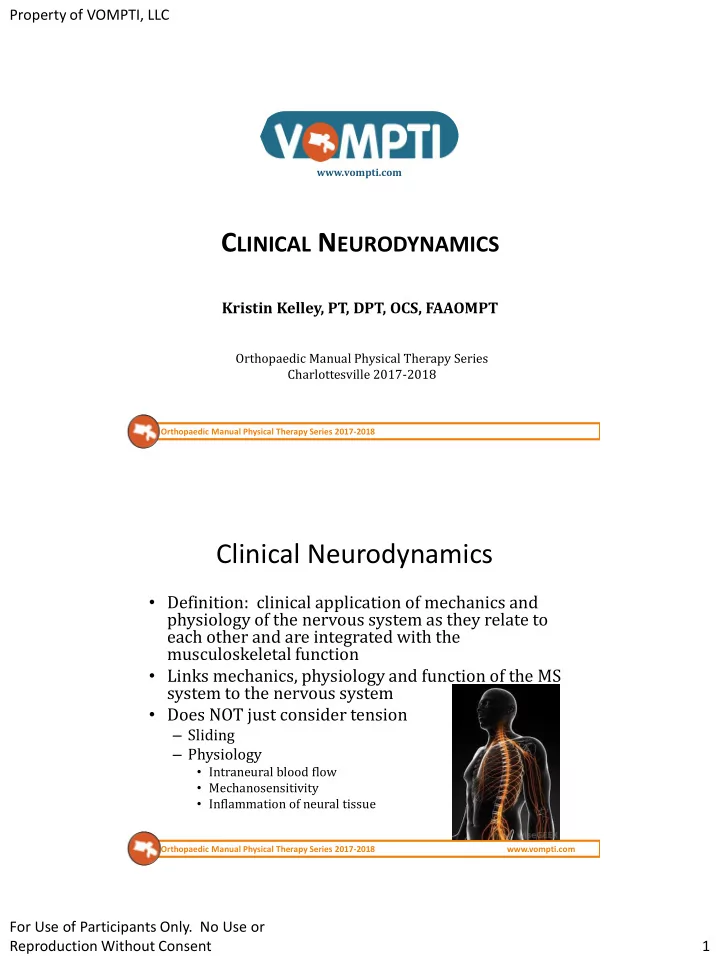
Clinical Neurodynamics

  • Definition: clinical application of mechanics and

physiology of the nervous system as they relate to each other and are integrated with the musculoskeletal function

  • Links mechanics, physiology and function of the MS

system to the nervous system

  • Does NOT just consider tension

– Sliding – Physiology

  • Intraneural blood flow
  • Mechanosensitivity
  • Inflammation of neural tissue
slide-2
SLIDE 2

Property of VOMPTI, LLC For Use of Participants Only. No Use or Reproduction Without Consent 2

Orthopaedic Manual Physical Therapy Series 2017-2018 www.vompti.com

Effect of clinical neurodynamics

  • Restoration of normal mechanics of the

connective tissues thus lessening the possibility of the nerve being entrapped in their surrounding connective tissue

  • Enhancing the intraneural pressure in the

nervous system and dispersion of intraneural edema

  • Improve vascularization of nervous system

and surrounding structures

  • Improve axoplasmic flow

Orthopaedic Manual Physical Therapy Series 2017-2018 www.vompti.com

Indications for Neurodynamic Testing

  • Pts w/symptoms anywhere in the

arm, head, LBS, and thoracic spine

  • Subjective exam suggests ANTT

(Cervical flexion produces LB or LE pain when getting in/out of car)

  • Post surgical pts, chronic

dysfunctions and symptoms w/o joint signs

slide-3
SLIDE 3

Property of VOMPTI, LLC For Use of Participants Only. No Use or Reproduction Without Consent 3

Orthopaedic Manual Physical Therapy Series 2017-2018 www.vompti.com

Indications for Neurodynamic Testing

  • Symptoms do not fit a normal pattern (arm or

leg symptoms not responding to local treatment)

  • UE or LE muscle tear
  • Post whiplash, CTS, DeQervains tenosynovitis,

tennis elbow, TOS, and repetitive strain injury

– Clinical example: When testing active shoulder flex/abd and the pt spontaneously performs movement w/elbow flexion and/or cerv SB toward involved extremity

Orthopaedic Manual Physical Therapy Series 2017-2018 www.vompti.com

CONTRAINDICATIONS

  • Malignancy
  • Instability
  • Recent worsening of

neurological signs/symptoms

  • Cauda equina

syndrome

  • Pathology of the

nervous system(e.g. diabetes, MS, Guillian- Barre)

slide-4
SLIDE 4

Property of VOMPTI, LLC For Use of Participants Only. No Use or Reproduction Without Consent 4

Orthopaedic Manual Physical Therapy Series 2017-2018 www.vompti.com

Nervous System: Three Part System

  • Nerve: peripheral nerve,

nerve root, dura

  • Interface: any tissue

adjacent to the nerve – Connective tissue – Bone – Muscle

  • Piriformis: mechanical

interface to the sciatic nerve as it pierces or courses just adjacent to it

  • Innervated tissue

Orthopaedic Manual Physical Therapy Series 2017-2018 www.vompti.com

Nervous system primary functions

  • Withstand tension

– 18-22% elongation before failure – Varies btw individuals and btw specific nerves – Elongation produces a change in blood vessel function—compromises sliding

  • Longitudinal sliding—

typically prevents excessive tension

  • Withstand Pressure
slide-5
SLIDE 5

Property of VOMPTI, LLC For Use of Participants Only. No Use or Reproduction Without Consent 5

Orthopaedic Manual Physical Therapy Series 2017-2018 www.vompti.com

Elongation of the cervical spinal cord with flexion and extension Elongation of the lumbar spinal cord with flexion and extension

Orthopaedic Manual Physical Therapy Series 2017-2018 www.vompti.com

Normal movement of the spinal cord and nerve roots in the cervical spine with a) Extension b) Flexion

slide-6
SLIDE 6

Property of VOMPTI, LLC For Use of Participants Only. No Use or Reproduction Without Consent 6

Orthopaedic Manual Physical Therapy Series 2017-2018 www.vompti.com

Tunnel for Nerve, Artery, Vein

  • Normal Pressure

Gradient

Orthopaedic Manual Physical Therapy Series 2017-2018 www.vompti.com

Tunnel for Nerve, Artery, Vein

  • 8% elongation--

intraneural veins start getting blocked

slide-7
SLIDE 7

Property of VOMPTI, LLC For Use of Participants Only. No Use or Reproduction Without Consent 7

Orthopaedic Manual Physical Therapy Series 2017-2018 www.vompti.com

Tunnel for Nerve, Artery, Vein

–Edema occurs further increasing intratunnel pressure –15%--all blood flow blocked

Orthopaedic Manual Physical Therapy Series 2017-2018 www.vompti.com

Tunnel for Nerve, Artery, Vein

  • Edema

contributes to increased fibroblastic activity

slide-8
SLIDE 8

Property of VOMPTI, LLC For Use of Participants Only. No Use or Reproduction Without Consent 8

Orthopaedic Manual Physical Therapy Series 2017-2018 www.vompti.com

NERVE

Compression Longitudinal Force

Orthopaedic Manual Physical Therapy Series 2017-2018 www.vompti.com

NERVE COMPRESSION INFLAMMATION EDEMA SCARRING IMPAIRED GLIDING CHRONIC TISSUE IRRITATION

slide-9
SLIDE 9

Property of VOMPTI, LLC For Use of Participants Only. No Use or Reproduction Without Consent 9

Orthopaedic Manual Physical Therapy Series 2017-2018 www.vompti.com

Nerve Compression

  • Disruption of axoplasmic flow due to nerve

compression IS reversible

  • 50 mm Hg x 2 hrs, reversible in 24 hrs
  • 200 mm Hg x 2 hrs, reversible in 3 days
  • 400 mm Hg x 2 hrs, reversible in 1 week

Orthopaedic Manual Physical Therapy Series 2017-2018 www.vompti.com

Nerve Movement

  • 3 ways to move nerves

–Move the joint –Move the actual nerve –Move the adjacent soft tissue (muscle, fascia)

slide-10
SLIDE 10

Property of VOMPTI, LLC For Use of Participants Only. No Use or Reproduction Without Consent 10

Orthopaedic Manual Physical Therapy Series 2017-2018 www.vompti.com

Transmission of Forces Along the System

  • Neural effects during neurodynamic

technique:

– Early in movement—taking up slack – Mid range– sliding effects – End Range– tension effects – Reference: Wright et all 1996

  • Directly translates to treatment progression

Orthopaedic Manual Physical Therapy Series 2017-2018 www.vompti.com

Upper Extremity Nerves

slide-11
SLIDE 11

Property of VOMPTI, LLC For Use of Participants Only. No Use or Reproduction Without Consent 11

Orthopaedic Manual Physical Therapy Series 2017-2018 www.vompti.com Orthopaedic Manual Physical Therapy Series 2017-2018 www.vompti.com

slide-12
SLIDE 12

Property of VOMPTI, LLC For Use of Participants Only. No Use or Reproduction Without Consent 12

Orthopaedic Manual Physical Therapy Series 2017-2018 www.vompti.com Orthopaedic Manual Physical Therapy Series 2017-2018 www.vompti.com

UE Neurodynamic Testing

  • Upper Limb “Tension” Testing (Provocation)

– “SLR of the Upper Extremity” – Not disorder specific except for a (-) test to rule out cervical radiculopathy – Biased to the terminal branches of the brachial plexus based on their anatomy

  • Median nerve (ULTT 1 and 2a)
  • Radial nerve (ULTT 2b)
  • Ulnar nerve (ULTT 3)

– Sensitivity 72-97% – Specificity 22-33%

slide-13
SLIDE 13

Property of VOMPTI, LLC For Use of Participants Only. No Use or Reproduction Without Consent 13

Orthopaedic Manual Physical Therapy Series 2017-2018 www.vompti.com

Median Neurodynamic Test1

1.Pistol grip isolate digits 1,2,3- median nerve distribution 2.Therapist hand sits on bed above shoulder using knuckles as a fulcrum. Lean on the hand with a straight elbow. Arm in 90 deg shoulder abduction, elbow at 90 deg flexion

  • 3. wrist ext

4.GH ER to approx. 90 deg. (in frontal plane, stop shoulder from elevating). Do NOT depress scapula

Orthopaedic Manual Physical Therapy Series 2017-2018 www.vompti.com

Median Neurodynamic Test1

  • 4. Elbow extension to symptom

reproduction or tension

  • 5. Cervical SB toward (?symptom ⬇)
  • 6. Cervical SB away (?symptom ⬆)
  • ***Structural differentiation:

– distal symptoms: use cervical SB toward/away – proximal symptoms: use wrist flexion

  • Normal response:
  • Symptoms: pulling anterior

elbow extending to the first 3 digits.

  • ROM—anything btw 60 deg to

full elbow ext

slide-14
SLIDE 14

Property of VOMPTI, LLC For Use of Participants Only. No Use or Reproduction Without Consent 14

Orthopaedic Manual Physical Therapy Series 2017-2018 www.vompti.com

Median Neurodynamic Test 2

1.Perform shoulder depression taking up slack in nerves with anterior thigh, NOT to the point of stretching. 2.Elbow extension

Orthopaedic Manual Physical Therapy Series 2017-2018 www.vompti.com

Median Neurodynamic Test 2

  • 4. External rotation/supination, wrist

and finger extension

  • 5. Shoulder abduction

** Structural Differentiation: Proximal symptoms: use wrist Distal symptoms: release shoulder elevation Normal response: Symptoms: pulling anterior elbow extending to the first three digits. Sometimes paresthesia in the hand in Median Nerve distribution ROM: anything btw 0-45deg abduction

slide-15
SLIDE 15

Property of VOMPTI, LLC For Use of Participants Only. No Use or Reproduction Without Consent 15

Orthopaedic Manual Physical Therapy Series 2017-2018 www.vompti.com

  • Evaluation of side to side differences in

elbow ROM during ULTT for Median and Radial nerves for onset of resistance (R1) and onset of nerve pain (P1)

  • No difference in mean ROM btw sides
  • Intra-individual inter-limb differences of

>15° for median nerve and >11° for radial nerve exceeds the range of normal ROM asymmetry of ULTT at R1 and P1

Orthopaedic Manual Physical Therapy Series 2017-2018 www.vompti.com

Neurodynamic Sequencing

  • Sequencing of movements influences the

location of symptoms

  • Greater symptoms at region moved first and

most strongly

  • Ref:Shacklock 1989, Zorn, Shacklock and

Trott 1995

slide-16
SLIDE 16

Property of VOMPTI, LLC For Use of Participants Only. No Use or Reproduction Without Consent 16

Orthopaedic Manual Physical Therapy Series 2017-2018 www.vompti.com

Neurodynamic Sequencing

  • Tsai 1995 Cadaver Study on Ulnar nerve

– Compared tensioning:

  • proximal to distal
  • Distal to proximal
  • Elbow first

– Greatest strain at ulnar nerve at the elbow with the Elbow First sequence (increased intraneural tension by 20%)

Orthopaedic Manual Physical Therapy Series 2017-2018 www.vompti.com

Neurodynamic Sequencing

  • Technique considerations:

– Must be consistent with testing – If you change technique, you change the test or change the treatment – Small technique changes may produce a BIG change in response

slide-17
SLIDE 17

Property of VOMPTI, LLC For Use of Participants Only. No Use or Reproduction Without Consent 17

Orthopaedic Manual Physical Therapy Series 2017-2018 www.vompti.com

Neurodynamic Sequencing Progressions

Protection Sliders Tensioners Focused Sequence LOW MEDIUM HIGH

Nerve Tension

Orthopaedic Manual Physical Therapy Series 2017-2018 www.vompti.com

Neurodynamic Sequencing

PROTECTIVE REMOTE

  • Example: Acute wrist pain

– 1. Cervical contralateral SB – 2. Shoulder abduction – 3. Elbow extension – 4. Release cervical contralateral SB---”Off Switch” should reduce wrist pain – NEVER change wrist position if it is the symptomatic area

  • Example: Low back pain

– 1. Dorsiflexion – 2. SLR to onset of pain – 3. Release DF---”Off Switch” should reduce back pain

slide-18
SLIDE 18

Property of VOMPTI, LLC For Use of Participants Only. No Use or Reproduction Without Consent 18

Orthopaedic Manual Physical Therapy Series 2017-2018 www.vompti.com

Neurodynamic Sequencing

SLIDER (Median nerve bias)

  • Nerve slides toward the site

where force is initiated

  • Moves both proximal and

distal area to floss vs. creating tension on nerve

  • Must understand course of

nerve to choose correct positioning

Orthopaedic Manual Physical Therapy Series 2017-2018 www.vompti.com

Active Median Nerve Slider

slide-19
SLIDE 19

Property of VOMPTI, LLC For Use of Participants Only. No Use or Reproduction Without Consent 19

Orthopaedic Manual Physical Therapy Series 2017-2018 www.vompti.com

Passive Median Nerve Slider

  • Wrist flex/elbow ext
  • Wrist ext/elbow flex

Orthopaedic Manual Physical Therapy Series 2017-2018 www.vompti.com

Slider dosage?

  • Allows nerve to return to rest position and never

allows reproduction of symptoms during treatment

  • Can be repeated several times during a session

provided a beneficial response occurs with frequent reassessments

  • Can perform 4-5 sets of 5-30 reps w/breaks of

seconds to minutes

slide-20
SLIDE 20

Property of VOMPTI, LLC For Use of Participants Only. No Use or Reproduction Without Consent 20

Orthopaedic Manual Physical Therapy Series 2017-2018 www.vompti.com

Slider dosage?

  • If negative response, alter technique
  • Do not give as HEP until 24 hour response is

noted

  • May then perform as HEP from 1x daily to

hourly dependent upon pt needs

  • If cases such as acute HS injury, CTS release,

shoulder surgery, and want to inhibit affects

  • f scar tissue lay down, may have pt

perform hourly

Orthopaedic Manual Physical Therapy Series 2017-2018 www.vompti.com

Neurodynamic Sequencing

TENSIONER (Median nerve bias)

  • Places nerve on tension
  • Must understand course of

nerve to choose correct positioning

slide-21
SLIDE 21

Property of VOMPTI, LLC For Use of Participants Only. No Use or Reproduction Without Consent 21

Orthopaedic Manual Physical Therapy Series 2017-2018 www.vompti.com

Coppieters et al. Different Nerve Gliding Exercises Induce Different Magnitudes of Median Nerve Longitudinal Excursion: A Study Using Dynamic US imaging. JOSPT 2009;39:164-171.

  • Different exercises produce

different amounts of longitudinal nerve excursion

  • (A) “Sliding Technique” produces

largest excursion – Ipsilateral cervical SB combined with elbow extension

  • (C)“Tensioning Technique”

produced smaller excursion – Contralateral cervical SB combined with elbow extension

Orthopaedic Manual Physical Therapy Series 2017-2018 www.vompti.com

Neurodynamic Sequencing

FOCUSED SEQUENCE (Median nerve bias)

  • Example1: chronic cervical pain

– 1. Cervical contralateral SB – 2. Shoulder abduction – 3. Elbow extension – 4. Wrist extension

  • Example 2: chronic wrist pain

– 1. Wrist extension – 2. Elbow extension – 3. Shoulder abduction – 4. Cervical contralateral SB

slide-22
SLIDE 22

Property of VOMPTI, LLC For Use of Participants Only. No Use or Reproduction Without Consent 22

Orthopaedic Manual Physical Therapy Series 2017-2018 www.vompti.com

Contralateral Neurodynamic Testing

  • Elvey 1979, Rubernach 1985
  • 95-97% of young, asymptomatic subjects

show a change in symptoms of tension with contralateral neurodynamic positioning

– 62% show a DECREASE – 33% show an increase – Approx 5% show no change

Orthopaedic Manual Physical Therapy Series 2017-2018 www.vompti.com

Contralateral Neurodynamic Tension

  • Part A (left), the nerve roots are

in their neutral position.

  • Part B (middle), this ipsilateral

nerve root is pulled and tensioned by the first (ipsilateral) neurodynamic test.

  • Part C (right), the ipsilateral

nerve root has loosened because the spinal cord has moved downward by the pulling of the contralateral nerve root with the contralateral neurodynamic test.

Nerve roots as they interact across the spinal cord and produce movement in the cord during contralateral ND tension

slide-23
SLIDE 23

Property of VOMPTI, LLC For Use of Participants Only. No Use or Reproduction Without Consent 23

Orthopaedic Manual Physical Therapy Series 2017-2018 www.vompti.com

Contralateral Neurodynamic Tension

  • permits the ipsilateral

nerve root to get looser

  • challenges past ideas that

contralateral testing produces an increase in neural tension in the ipsilateral nerve root.

  • clinicians often notice pts

with severe lumbar nerve root pain can get relief with contralateral nerve tension

Orthopaedic Manual Physical Therapy Series 2017-2018 www.vompti.com

Contralateral Neurodynamic Tension

  • Downward (caudal)

movement of the spinal cord producing a reduction in tension in the nerve roots (from Breig 1960, Shacklock 2007).

  • Produces a dec in distance

between exit point of the nerve root from the spinal cord and the intervertebral foramen

  • This results in a reduction in

tension in the nerve root.

slide-24
SLIDE 24

Property of VOMPTI, LLC For Use of Participants Only. No Use or Reproduction Without Consent 24

Orthopaedic Manual Physical Therapy Series 2017-2018 www.vompti.com

Slump Test: Effect of Contralateral Knee Extension on Response Sensations in Asymptomatic Subjects and Cadaver Study

  • 2 Fold study to compare the

response of subjects to contralateral slump test and examine cadaver contralateral LB neural tension

  • Control group of asymptomatic

subjects had normal thigh stretch reduced w/contralateral ST vs no change in control or sham

  • Contralateral reduction in LB neural

tension with unilateral nerve root tension in cadaver study – Supports proposed hypothesis of reduced contralateral n. root tension in healthy individuals

Orthopaedic Manual Physical Therapy Series 2017-2018 www.vompti.com

Contralateral Neurodynamic Tension

  • Often decreases nerve root tension
  • Can be used to “offload” cervical spinal root
  • Must be particular on body/limb position
  • Can decrease the power of a ND technique
  • Can change its level of tension/impact
  • Can use with normal progression of the

neurodynamic test

  • UE/cervical “offload”: use contralateral median

nerve tension or SLR tension

  • LE/LB “offload”: use contralateral SLR nerve tension
slide-25
SLIDE 25

Property of VOMPTI, LLC For Use of Participants Only. No Use or Reproduction Without Consent 25

Orthopaedic Manual Physical Therapy Series 2017-2018 www.vompti.com

Contralateral neurodynamic tension

  • R median nerve or

cervical nerve root irritability

  • R UE held in slack

position

  • L side tension to further

slack R UE tension

  • UE median nerve

tension position used to “off-load” opposite UE tension

Orthopaedic Manual Physical Therapy Series 2017-2018 www.vompti.com

Contralateral Tension Effects - LB Spine

  • Reduction in symptoms with

contralateral SLR is typical

  • Observations in clinical and

normal subjects suggest that the effects are MORE SIGNIFICANT than in cervical spine

  • Possibly because the intradural

nerve roots are more parallel and in a better position to assist

  • ne another
slide-26
SLIDE 26

Property of VOMPTI, LLC For Use of Participants Only. No Use or Reproduction Without Consent 26

Orthopaedic Manual Physical Therapy Series 2017-2018 www.vompti.com

SLR to Reduce Cervical Nerve Root Tension

  • SLR may be used to reduce

tension in the cervical nerve roots by moving the cord downward in the canal.

  • LE movements can be used to

ease pain and mobilize the nerve roots, including thoracic and cervical regions

  • LE movements can substitute

contralateral upper limb neurodynamic testing

Shacklock 2005

Orthopaedic Manual Physical Therapy Series 2017-2018 www.vompti.com

SLR to Reduce Cervical Nerve Root Tension

  • If the contralateral UE

nerve tension does not relieve a patient’s neck and or upper limb pain, the SLR can be applied instead

  • It is hypothesized that

the SLR pulls the cord downward in the canal which produces a reduction in tension in the cervical nerve root.

Shacklock 2005

slide-27
SLIDE 27

Property of VOMPTI, LLC For Use of Participants Only. No Use or Reproduction Without Consent 27

Orthopaedic Manual Physical Therapy Series 2017-2018 www.vompti.com

Diagnosing with Neurodynamic Testing

  • Structural Differentiation (nerve sensitizing or

desensitizing movement) – Used to make a distinction between neural and non- neural structures being the source of symptoms – When nerves in a problem area are moved w/o moving MS tissues – If symptoms change with the differentiating movement symptoms ARE NEUROGENIC – If symptoms do NOT change with the differentiating movement symptoms are NOT NEUROGENIC

Orthopaedic Manual Physical Therapy Series 2017-2018 www.vompti.com

Diagnosing with Neurodynamic Testing

Structural Differentiation (neural sensitizing/desensitizing movement) – EXAMPLE: Forearm symptoms with ANTT testing

  • Change nerve tension with cervical SB
  • If symptoms change—most likely neurogenic

in origin

  • If symptoms do NOT change—most likely

non-neural (muscle, fascia, scar tissue..etc)

slide-28
SLIDE 28

Property of VOMPTI, LLC For Use of Participants Only. No Use or Reproduction Without Consent 28

Orthopaedic Manual Physical Therapy Series 2017-2018 www.vompti.com

Diagnosing with Neurodynamic Testing

  • Performance of test must be:

– PRECISE

  • Hand positioning
  • Joint ROM
  • Movement resistance
  • Neurodynamic sequence
  • Slow
  • Careful

– Complete—stop when you encounter first obstacle:

  • Each movement to first

comfortable symptoms

  • Resistance

Orthopaedic Manual Physical Therapy Series 2017-2018 www.vompti.com

Diagnosing with Neurodynamic Testing

  • Produce response/effect

– Symptoms

  • Area/distribution
  • Choose differentiating movement

– Physical

  • ROM
  • Muscle responses
  • Protective movement
slide-29
SLIDE 29

Property of VOMPTI, LLC For Use of Participants Only. No Use or Reproduction Without Consent 29

Orthopaedic Manual Physical Therapy Series 2017-2018 www.vompti.com

Classification of Responses

  • MS response

– Does NOT change w/structural differentiation movement – Neural tissues are not likely source of symptoms

  • Normal Neural response

– Does change w/structural differentiation movement – Symptoms are similar in location, range of movement and quality of symptoms to normal subjects – Reasonably symmetrical in site and quality of symptoms – Reasonably symmetrical in ROM and behavior of resistance – Does NOT reproduce clinical symptoms

Orthopaedic Manual Physical Therapy Series 2017-2018 www.vompti.com

Classification of Responses

  • Abnormal Neural response

– Does change w/structural differentiation movement – Symptoms are different in location, range of movement and quality of symptoms to normal subjects – Reduction in ROM and increased resistance – Location and quality of symptoms can be different from unaffected side – May be abnormal but NOT reproduce patient’s symptoms – May indicate a subtle problem worth treating – May be hidden sub-clinical abnormality

slide-30
SLIDE 30

Property of VOMPTI, LLC For Use of Participants Only. No Use or Reproduction Without Consent 30

Orthopaedic Manual Physical Therapy Series 2017-2018 www.vompti.com

Classification of Responses

  • Abnormal Neural Response Example

– Pt has cc/o forearm pain with computer use – “ache” during ANTT at region of the problem but does not reproduce exact pain – Structural differentiation: neural w/cervical contralateral SB – ROM of elbow ext < unaffected side – Supination < unaffected side that improves with releasing cervical SB – Signs are relevant --missing them limits effective treatment

Orthopaedic Manual Physical Therapy Series 2017-2018 www.vompti.com

Relationship of Neurodynamic Testing Results to the Cause?

  • Abnormal ND test does NOT establish cause
  • SOMETHING in nervous system is wrong

and cause must be established through thoroughly evaluating the pt

  • Main thing that an abnormal neurodynamic

test offers is the fact that something in the nervous system is wrong and the cause needs to be established

slide-31
SLIDE 31

Property of VOMPTI, LLC For Use of Participants Only. No Use or Reproduction Without Consent 31

Orthopaedic Manual Physical Therapy Series 2017-2018 www.vompti.com

Relationship of Neurodynamic Testing Results to the Cause?

  • Possible causes of abnormal ND

test:

– Pancoast tumor or malignancy – Osteophyte – Disc bulge – Swollen joint or tendon sheath – Myotendinous or nervous system anomalies – Neuritis – Nerve compression – Joint movement dysfunction

Orthopaedic Manual Physical Therapy Series 2017-2018 www.vompti.com

Analysis of Test Responses

  • Once you have decide the test is positive (via

structural differentiation)

– Are those the symptoms you have had before?

  • Yes-abnormal response
  • No-perform stage 2 test

– Is the response similar to the known normal response?

  • ROM, tissue resistance, location, type of symptoms normal?
  • Yes- normal positive test
  • No-abnormal response

– Not sure?—compare to contralateral side – ** any variable used in classifying the response must be positive to structural differentiation

slide-32
SLIDE 32

Property of VOMPTI, LLC For Use of Participants Only. No Use or Reproduction Without Consent 32

Orthopaedic Manual Physical Therapy Series 2017-2018 www.vompti.com

Analysis of Test Responses

– Is it Relevant?

  • Relevant:

–Reproduces pts current clinical pain –Is tighter than normal –The symptoms spread further than normal –This is different from asymtomatic side –The difference is in the right location of the pt problem

Orthopaedic Manual Physical Therapy Series 2017-2018 www.vompti.com

Analysis of Test Responses

– Is it Relevant?

  • Irrelevant:

– Relates to an old problem that is no longer symptomatic – Anomalous response that is symmetrical (ie. Bilateral tightness) – Normally tight for that person and is symmetrical – May have anatomical anomaly that is not relevant

slide-33
SLIDE 33

Property of VOMPTI, LLC For Use of Participants Only. No Use or Reproduction Without Consent 33

Orthopaedic Manual Physical Therapy Series 2017-2018 www.vompti.com

Wainner RS, Fritz JM, Irrgang JJ et al. Reliability and diagnostic accuracy of the clinical examination and patient self-report measures for cervical radiculopathy.

  • 82 pts referred for electrophysiologic labs with suspected

CR or CTS

  • Examined Pt self report, NCS/EMG, and clinical exam
  • Test item cluster of 4 variables was identified and

produced a positive likelihood ratio of 30.3 for the pt having CR – 4 clinical exams: ( +) Spurlings A, (+) Distraction test, (+) ULTTA, involved cervical rotation < 60 degrees – Probability of condition (CR) is 65% with 3 out of 4, 90% with 4 out of 4

Spine 2003;28:52-62.

Orthopaedic Manual Physical Therapy Series 2017-2018 www.vompti.com

Planning Exam and Treatment

  • Multi-Level System of deciding the extent
  • f Exam:

– Level 0: Neurodynamic Testing Contraindicated

  • Severe Pain
  • Psychological Influences
  • Legal problems
  • Highly unstable condition,

worsening rapidly

slide-34
SLIDE 34

Property of VOMPTI, LLC For Use of Participants Only. No Use or Reproduction Without Consent 34

Orthopaedic Manual Physical Therapy Series 2017-2018 www.vompti.com

Multi-Level Exam System

Level 1: Limited – Indications

  • Pain easily provoked, highly irritable
  • Severe or latent pain
  • Pathology is present in nervous system or

mechanical interface (HNP pressing on nerve root)

  • Progressive worsening prior to physical exam

Orthopaedic Manual Physical Therapy Series 2017-2018 www.vompti.com

Multi-Level Exam System

Level 1: Limited (cont) – Method

  • Some components or ROM may be omitted to apply

less forces on nervous system

  • Sequencing can be altered (ie, remote alteration vs.

focal)

  • Restricted to first onset of symptoms, once only
  • Structural differentiation is still performed, but in

modified form

slide-35
SLIDE 35

Property of VOMPTI, LLC For Use of Participants Only. No Use or Reproduction Without Consent 35

Orthopaedic Manual Physical Therapy Series 2017-2018 www.vompti.com

Multi-Level Exam System

  • Level 1: Limited (cont)

– Modified Structural Differentiation:

  • Used as an “off” switch to REDUCE symptoms
  • Instead of additional movement which adds tension
  • Clinical example: Irritable wrist problem

– Cervical contralateral SB – Shoulder abduction – Elbow ext – Structural differentiation (off-switch)—neck back to neutral – Do NOT move irritable area (wrist)

Orthopaedic Manual Physical Therapy Series 2017-2018 www.vompti.com

Multi-Level Exam System

  • Level 2: Standard

– Neurodyanimic tests are performed to a comfortable production of symptoms only – May be, but not necessarily taken to end range – Indications:

  • Problem not particularly irritable
  • Neuro symptoms are absent or minor part of

condition

  • Symptoms not easily provoked
  • Problem is stable (not deteriorating rapidly)
  • Pain not severe and no severe latency of symptom

provocation

slide-36
SLIDE 36

Property of VOMPTI, LLC For Use of Participants Only. No Use or Reproduction Without Consent 36

Orthopaedic Manual Physical Therapy Series 2017-2018 www.vompti.com

Multi-Level Exam System

  • Level 2: Standard

– Method:

  • Test movements would not

produce excessive pain, neuro symptoms or go into a great deal of resistance

  • Standard neurodymic tests

are used

  • Full Range of movement may

be reached, but is not essential

Orthopaedic Manual Physical Therapy Series 2017-2018 www.vompti.com

Multi-Level Exam System

Level 3: Advanced:

  • Testing of nervous system more extensive and advanced than

previous levels

  • Specificity and sensitivity are the focus
  • Indications:

– Level 2 exam tests are normal and do not provide useful info – Problem is stable – Patient’s clinical pain is difficult to reproduce – No evidence of pathology that might adversely affect nervous system. – ** If sufficient info is gained from Level 1 or 2 exam, Level 3 is unnecessary and contraindicated

slide-37
SLIDE 37

Property of VOMPTI, LLC For Use of Participants Only. No Use or Reproduction Without Consent 37

Orthopaedic Manual Physical Therapy Series 2017-2018 www.vompti.com

Multi-Level Exam System

  • Level 3: Advanced:
  • Method:

– Level 2 test performed first (to be sure nervous system can cope w/further testing) and does NOT reproduce symptoms – Add sensitizing movements – Can alter sequencing to begin with provocative area first – Combine sensitization of neural structures with MS ones – Can use functional positions or activity to reproduce symptoms (ie, throwing)

Orthopaedic Manual Physical Therapy Series 2017-2018 www.vompti.com

Level 3 Test Example

  • Assessment technique of pt
  • The patient performs a

throwing position so as to reproduce the mechanism of symptoms.

  • The therapist can refine the

shoulder position or resist any chosen movement while altering the differentiation movements (wrist flex/ext and cervical SB) to detect a hidden neurodynamic component.