Education for Sustainable Development (ESD) - - PowerPoint PPT Presentation

education for sustainable development esd
SMART_READER_LITE
LIVE PREVIEW

Education for Sustainable Development (ESD) - - PowerPoint PPT Presentation

Education for Sustainable Development (ESD) Anne MacDiarmid- ESD Consultant K-12


slide-1
SLIDE 1
  • • • • • • • • • • • • • • • • • • • • • • • •

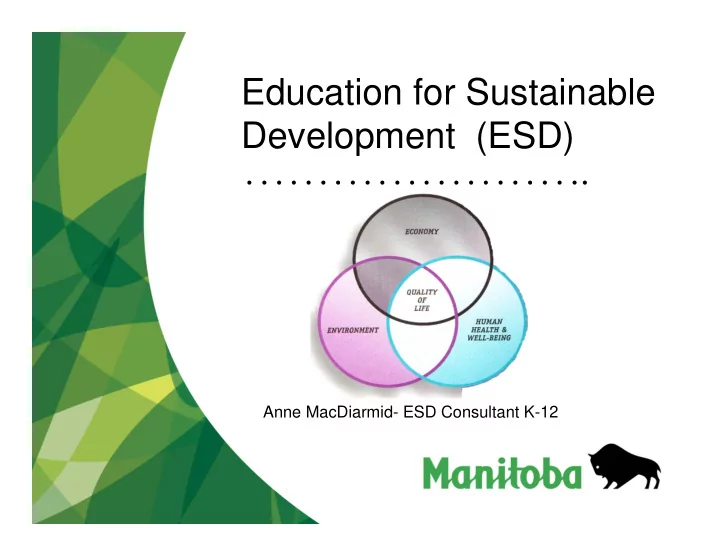
Education for Sustainable Development (ESD)

Anne MacDiarmid- ESD Consultant K-12
slide-2
SLIDE 2

Manitoba Education Education for Sustainable Development

Importance of ESD

http://commons.wikimedia.org/wiki/File:Globe.svg

slide-3
SLIDE 3

Manitoba Education Education for Sustainable Development

Provincial Priorities

Mission

  • To ensure that all Manitoba’s children and youth have access to an array of

educational opportunities such that every learner experiences success through relevant, engaging and high quality education that prepares them for lifelong learning and citizenship in a democratic, socially just and sustainable society. Vision

  • That every learner will complete a high school education with a profound sense of

accomplishment, hope and optimism. Overarching Goals

  • To ensure education in Manitoba supports students experiencing and learning

about what it means to live in a sustainable manner.

  • To ensure that education practice and policy in Manitoba is guided by the principle of

inclusion.

  • To significantly increase achievement levels of those students who have been

historically less successful.

  • To continue to increase the overall provincial graduation rate.

Priority Action Areas

  • Numeracy and Literacy
  • Education for Sustainable Development
  • Education in Low-income Communities
  • Aboriginal Education
  • Education in Rural Manitoba
  • Education in Northern Communities
slide-4
SLIDE 4

Manitoba Education and Advanced Learning has been encouraging a whole-school approach to sustainability. This means that the strategy of the institution, and ultimately its culture, is oriented towards sustainable development.

  • A whole school approach refers to the infusion of sustainability

across the curriculum (e.g. teaching, learning and research)

  • through facilities and operations (e.g. reducing its ecological

footprint),

  • in its capacity building efforts (e.g. providing training to staff),

governance (e.g. sustainable school plans and policies)

  • and through partnerships (e.g. reaching out to the community).
  • The activities found within this approach may vary within

school/school divisions, in order for it to be locally relevant.

Manitoba Education Education for Sustainable Development

slide-5
SLIDE 5

Sustainable School Plans

encouraging schools to have sustainable school plans by 2015

  • Annually integrated into the existing school

plan

  • Or can be a separate sustainable school

plan * Each school could have a unique plan relevant to their students and community*

Manitoba Education Education for Sustainable Development

slide-6
SLIDE 6

School Plan Document

  • Expected Outcomes- What specifically are

you trying to improve for students?

  • Indicators- How will you know you are

making progress?

  • Strategies – What actions will you take?
  • Data Sources- How will you collect

evidence of progress?

Manitoba Education Education for Sustainable Development

slide-7
SLIDE 7

Manitoba Education Education for Sustainable Development

slide-8
SLIDE 8

Manitoba’s ESD Vision

Students will

  • Be informed and responsible decision-

makers

  • Play active roles as citizens of Canada

and the world

  • Contribute to social, environmental, and

an equitable quality of life for all, now and in the future.

Manitoba Education Education for Sustainable Development

slide-9
SLIDE 9

ESD – An International Priority

“The overall goal of the Decade for ESD (2005-2014) is to integrate the values inherent in sustainable development into all aspects of learning to encourage changes in behavior that allow for a more sustainable and just society for all.” UNESCO, 2006

slide-10
SLIDE 10

Values and principles

  • Despite the variety of religions and

cultures around the world, we all share common beliefs about the need to care for

  • ther people and the natural environment.
  • Such beliefs are essential to a sustainable

future.

  • http://www.unesco.org/education/tlsf/mods/theme_c/mod10.html

Manitoba Education Education for Sustainable Development

slide-11
SLIDE 11

UNECE Steering Committee on ESD

March 2012

Gerald Farthing chairs this committee- CMEC

3 priorities

  • to ensure that every school has an ESD school plan by

2015

  • to promote the introduction of ESD into teacher

education

  • to reorient technical and vocational education and

training in support of sustainable development and the transition to a green economy. Manitoba Education has aligned our ESD focus with these priorities.

Manitoba Education Education for Sustainable Development

slide-12
SLIDE 12

To build on Manitoba's reputation as a leader in ESD, the province has:

  • Launched Global Issues: Citizenship and Sustainability to

promote active democratic citizenship, ecological literacy, critical media literacy and ethical decision-making

  • Created Canada's first Education for Sustainable Development-

Leadership Council comprised of school boards, teachers, parents and post-secondary institutions-creating the ESD Action Plan

  • Supported a goal of encouraging every school in Manitoba to have a

sustainable school plan by 2015

Manitoba Education Education for Sustainable Development

slide-13
SLIDE 13

Manitoba Education Education for Sustainable Development

slide-14
SLIDE 14

Manitoba Education Education for Sustainable Development

What is Sustainable Development?

“Sustainable Development can be defined as development that meets the needs of the present without compromising the ability of future generations to meet their own needs”

World Commission on Environment and Development , 1987

1 World Commission on Sustainable Development (1987) Out Common Future, Oxford University Press, p 43. as quoted in United

Nations Educational, Scientific and Cultural Organization. (October 2004). United Nations Decade of Education for Sustainable Development 2005-2014- Draft International Implementation Scheme United Nations p 7

slide-15
SLIDE 15

Manitoba Education Education for Sustainable Development

slide-16
SLIDE 16

Our well-being is tied to the health of

  • ur planet …
  • Our well –being is not secure unless the

environment is protected

  • Our future is bound up with other people

and places and we cannot all have a good quality of life in a world with poverty, inequality ,war and poor health

  • http://webarchive.nationalarchives.gov.uk/20130401151715/https://www.education.gov.uk/publications/eOrderingDownload/planning_a_sustainable_school.pdf

Manitoba Education Education for Sustainable Development

slide-17
SLIDE 17

End -Means Spectrum

Herman Daly

  • Ultimate Ends- love ,fulfillment, family
  • Intermediate Ends-food,water,shelter work
  • Intermediate Means-books,tools buildings,

capitol

  • Ultimate Means – air,water,food,resources

Manitoba Education Education for Sustainable Development

slide-18
SLIDE 18

Manitoba Education Education for Sustainable Development

slide-19
SLIDE 19

Schools have a special role to play in preparing students to build a better future

  • Help students understand their impact on

the planet and each other and to consciously choose more sustainable behaviours

  • e.g. management of energy, water, waste

biodiversity, school yard design, procurement-facilities, social justice

  • http://webarchive.nationalarchives.gov.uk/20130401151715/https://www.education.gov.uk/publications/eOrderingDownload/planning_a_sustainable_school.pdf

Manitoba Education Education for Sustainable Development

slide-20
SLIDE 20

As educators-

  • We are in a position to emphasize the

cause and effect of our actions to ensure long term sustainability

  • By immersing students in a learning

environment that puts ESD president, students can adopt a culture that shapes their thinking and understanding.

  • Eco Globe Transformation Schools
  • http://webarchive.nationalarchives.gov.uk/20130401151715/https://www.education.gov.uk/publications/eOrderingDownload/planning_a_sustainable_school.pdf

Manitoba Education Education for Sustainable Development

slide-21
SLIDE 21

Crestview School – Eco Globe Transformation 2012

  • They used the Sustainable Happiness

resource by Dr Catherine O’Brian to develop their culture of sustainability.

Manitoba Education Education for Sustainable Development

slide-22
SLIDE 22

Sustainable Happiness

  • Dr. Catherine O’Brian http://www.yesmagazine.org/happiness/sustainable-happiness-6-ways-to-get-there
  • Sustainable happiness takes into account that happiness is

interconnected with other people, other species, and the natural environment by a remarkable web of interdependence.

  • This means that our daily actions and decisions contribute to—or

detract from—our own well-being, and that of others.

  • Sustainable happiness can lead to a more sustainable lifestyle and

greater life satisfaction

Manitoba Education Education for Sustainable Development

slide-23
SLIDE 23

Sustainable Happiness

  • Dr. Catherine O’Brian- http://www.yesmagazine.org/happiness/sustainable-happiness-6-ways-to-get-there
  • 1. Cultivate Appreciation
  • According to happiness experts, gratitude and appreciation are

associated with happiness and life satisfaction.

  • 2. Embrace your Natural Highs
  • Natural highs are natural, everyday things that are found right under

your nose, like the fragrance of a rose garden.

  • 3. Chart Your Sustainable Happiness Footprint
  • Take a snapshot of a typical day with a Sustainable Happiness

Footprint Chart. Sustainable Happiness Footprint Chart.

Manitoba Education Education for Sustainable Development

slide-24
SLIDE 24

Manitoba Education Education for Sustainable Development

slide-25
SLIDE 25

Sustainable Happiness

  • Dr. Catherine O’Brian- http://www.yesmagazine.org/happiness/sustainable-happiness-6-ways-to-get-there
  • 4. Create an Interdependence Map
  • Is there one thing that I could change that would lead to sustainable

happiness? Even one shift has ripple effects in the world.

  • 5. Make Your Own "Happy List"
  • Ask yourself if anything on your list is detrimental to you, someone

else, or the environment

  • 6. Value Genuine Wealth
  • Genuine wealth is found in relationships, natural beauty, and an

appreciation for life, loving, and laughing.

  • How are you contributing to the genuine wealth of other people or

your community? Is there anything more that you would like to do?

Manitoba Education Education for Sustainable Development

slide-26
SLIDE 26

Manitoba Education Education for Sustainable Development

slide-27
SLIDE 27

Sustainable Happiness

  • Dr. Catherine O’Brian http://www.yesmagazine.org/happiness/sustainable-happiness-6-ways-to-get-there
  • To download Sustainable Happiness and

Health Education for Manitoba- K to grade 6 http://sustainablehappiness.ca/teachers

  • For more information on exploring

sustainable happiness: sustainablehappinesscourse.com.

Manitoba Education Education for Sustainable Development

slide-28
SLIDE 28

A sustainable school integrates;

  • High standards of achievement
  • Engaging relevant learning
  • Healthy living
  • Environmental stewardship
  • Community engagement
  • Citizenship

Manitoba Education Education for Sustainable Development

slide-29
SLIDE 29

There is a commitment to care for:

Oneself-

  • ur health and well -being

Each other - and all life forms-

across cultures, generations and locations

The Biosphere-locally and globally

  • http://webarchive.nationalarchives.gov.uk/20130401151715/https://www.education.gov.uk/publications/eOrderingDownload/planning_a_sustainable_school.pdf

Manitoba Education Education for Sustainable Development

slide-30
SLIDE 30

A Sustainable School prepares students for a lifetime of sustainable living through-

  • Teaching approaches
  • Culture of the school
  • Daily practices

Manitoba Education Education for Sustainable Development

slide-31
SLIDE 31

Transformation Level- Grosvenor School -2013

  • In 2010 Grosvenor School began a 3 year journey learning about

human rights “to help their students better understand and make sense of the world”

  • They did this by honoring the past, questioning the present and

building the future.2010 to 2012

  • This multi year inquiry engaged all the staff and students,was

interdisciplinary and multi media

  • Students took action ,both local and global as they began to look

beyond themselves and engage with others across borders of geography, politics, culture, religion and language.

  • They developed positive attitudes about global solidarity, peace,

tolerance, multiculturalism, environmental awareness and social justice.

Manitoba Education Education for Sustainable Development

slide-32
SLIDE 32

New 3 year journey

  • Year 1“Seedlings….Enough for All, For

Everyone ,Forever”

  • Year 2 is the "Nurturing of the Seed" – the big

picture focus will be about taking care of our planet and its resources

  • Year 3 will the "The Harvest" , a celebration of

the learning over the last 6 years at the Canadian Museum For Human Rights

Manitoba Education Education for Sustainable Development

slide-33
SLIDE 33

Guide for Sustainable Schools

Manitoba Education Education for Sustainable Development

slide-34
SLIDE 34

Whole School Approach to SD

  • Explore sustainability through curriculum
  • Experiential learning-student engagement
  • Continuous cycle of planning,

implementing and reviewing approaches to sustainability

  • Monitor and report on progress
  • Developing values that support a

sustainability ethos

Manitoba Education Education for Sustainable Development

slide-35
SLIDE 35

Guide for Sustainable Schools

  • Active student involvement in all stages
  • Active participation by all staff, parents etc
  • A holistic perspective that employs an

integrated systems approach to planning

  • Long term vision
  • Incorporating sustainability into the whole

school planning process

Manitoba Education Education for Sustainable Development

slide-36
SLIDE 36

Process

  • Team Building-who will be on your team?(Admin,students,teachers )
  • Identify-what is already happening in the school/division
  • Expand and Educate- involve others and support their

understanding

  • Build a Vision- what are the shared vision(s) of the school/division
  • Plan- to implement your vision- 1,3,5,10 years..
  • Evaluate-to insure you are making a difference

Manitoba Education Education for Sustainable Development

slide-37
SLIDE 37

Priority Strategies What actions will you take? Who is responsible? Curriculum Connections Expected Outcomes What specifically are you trying to improve? (Observable, measurable) Timeframe / Deadline Indicators How will you know you are making progress? Data Collection By what means will you collect evidence of progress? Results Status, data or anecdotal evidence

*Perhaps start with just one priority issue...

slide-38
SLIDE 38

ESD in Manitoba Curriculum

  • Knowledge
  • Skills
  • Values /Attitudes
  • Behaviour /Action

students should explore in order to work toward a sustainable future.

  • The evaluation section provides strategies to assess the

effectiveness of actions.

  • The document is divided into the 3 levels of schooling;

Early Years -Middle Years -Senior Years

Manitoba Education Education for Sustainable Development

slide-39
SLIDE 39

Manitoba Education Education for Sustainable Development

slide-40
SLIDE 40

Skills: Kindergarten - Grade 4

  • Assess the well being of an environment by observing, sampling , using past data

and making future projections

  • Define how living organisms (plants and animals) interact with the human

environment and the effects of weather, air and water in these systems

  • Spend time outdoors connecting to nature, gardening, understanding how they

belong in Earth’s natural systems.

  • Distinguish between needs and wants and how the impact of media and culture can

influence consumption

  • Develop systems for managing waste and consumption, recycling, composting and

re-think current consumption patterns.(energy, water,”stuff” etc)

  • Demonstrate ways to replenish plants, restore soils ,care for living things, protect

water quality

  • Develop a sense of self worth and well-being, understand their roles and

responsibilities, and set goals.

  • Provide strategies and take responsibility for, leading a physically active and healthy

life

  • Communicate effectively with others in addition to using a variety of media
slide-41
SLIDE 41

Manitoba Education Education for Sustainable Development

slide-42
SLIDE 42

ESD in Manitoba Curriculum

Evaluation: K- 4

  • Record observations of behaviours and actions students undertake
  • Critique the process students used to implement change
  • Assess the impact of students’ actions, feedback from others and how the

action enhanced sustainability

  • Reflect on how student actions impacted learning, understanding and

changed behaviour

slide-43
SLIDE 43

Manitoba Education Education for Sustainable Development

slide-44
SLIDE 44

Manitoba Education Education for Sustainable Development

http://webarchive.nationalarchives.gov.uk/20130401151715/https://www.education.gov.uk/publications/eOr deringDownload/planning_a_sustainable_school.pdf

slide-45
SLIDE 45

Australian –Sustainability Curriculum Framework

  • http://www.environment.gov.au/resource/sustainability-curriculum-framework-guide-curriculum-developers-and-policy-makers

Manitoba Education Education for Sustainable Development

slide-46
SLIDE 46

Manitoba Education Education for Sustainable Development

ESD contact information Anne MacDiarmid

Sustainable Development Consultant Manitoba Education Telephone: 204-945-6943

  • r 1-800-282-8069, extension 6943

Email: anne.macdiarmid@gov.mb.ca