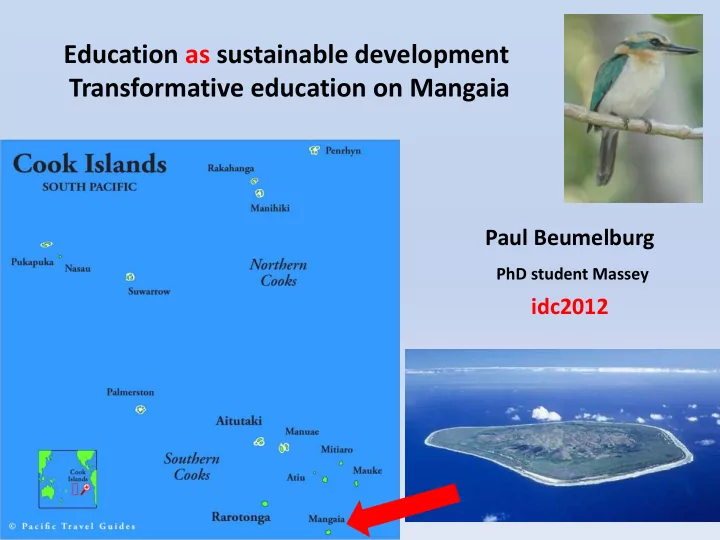
Paul Beumelburg PhD student Massey idc2012 Education for - - PowerPoint PPT Presentation
Education as sustainable development Transformative education on Mangaia Paul Beumelburg PhD student Massey idc2012 Education for Sustainable Development (ESD) Evolved out of Agenda 21 (Rio Summit) Decade of Education for Sustainable
But in the Cook Islands
- Focus on environmental education
- Little integration into the curriculum
Education for Sustainable Development (ESD)
- Evolved out of Agenda 21 (Rio Summit)
- Decade of Education for Sustainable Development (2005-2014 )
- Descriptive not prescriptive
Weeks Projects e.g. sandwatch Years
Education in the Cook Islands
binary curriculum Western academic achievement Cook Island Maori
- Taught as a separate
subject
- Culture is a relic
Focus on supporting economic development
- Rethinking Pacific
Education Initiative (RPEI)
- Pacific Regional
Initiatives for the Delivery of Basic Education (PRIDE )
Integrating research, policy and practice
Te oraanga tu rangatira kia tau ki te anoano o te iti
tangata e kia tau ki ta tatou peu Maori e te aotini taporoporoia o te basileia.
NSDP vision
Ministry currently focussed on:
- Determining how a transformative ESD might support NSDP
vision?
- Increased participation by parents in decision making
- Concerned about current student achievement results on the
- uter islands
Uriuri manako - Ministry of Education
Initial analysis of NCEA achievement information indicates that students achieve best in two subjects:
- Maori
- Tourism (a place based education course)
Pacific researchers say...
- There is a shortage of relevant literature on indigenous
education in the Pacific.
(Teaero 1999)
- Indigenous pedagogy should also be explored before it
is lost and it is too late.
(Sanga (2009)
Key questions:
- How do Mangaians conceptualise sustainable development?
- What skills and knowledge do Mangaians consider are
important for endogenous sustainable development?
- How does schooling support or not support this vision?
- How might the community in conjunction with Ministry of
Education and aid agencies best support any curriculum changes required?
- How might this link to academic success?
Methodology
- Qualitative research is best suited to capturing the diversity of
views on SD
- Seeks to understand people and their activities in context by
understanding peoples thinking, feelings and lived experiences
(Ary, 2006).
- Use semi structured interviews
- Critical research framework
- Rejects the entrenched assumptions e.g. economic determinism and technical
rationality
- Suspicious of linguistic and discursive powers
- Investigates relationships between culture and power (J.L. Kincheloe &
McLaren, 2002)
- Case study method allows … “investigators to retain the holistic and
meaningful characteristics of real life events”
(Yin 1990)
- Research morals, values and ethics
- Listen to pacific methodologies
- The aim is to develop a partnership, not just extract information
sit down, listen and learn (Chambers, 1983) avoid strategic silencing (Nabobo-Baba 2004)
- Be reflexive
- Form advisory group
- Acknowledge positionality
- Build relationships
- Participate in uipaanga
- Use talanoa
- Respect language
- Ethics
distinguish between a “celebration of indigenous knowledge and an appropriation”
- perate between the “ethical absolutist and the situational relativist”
(Glesne 2006)
Mangaia
- Six puna headed by pava and
ui rangitira
- No land court
Oraanga/akonoanga enua
Kimi i te oraanga meitaki / matutu / rangarangatu no te Mangaia
Whilst
akono akaperepere ma te taporoporo i te ipukarea
Aroaro’a / aroa taeake Te ipukarea ia rangarangatu (rangatira) Social
Government Island council Social welfare Hyperreality
Environment
Climate change Loss of Habitat Herbicides Conservation Sustainable energy
economic
Agriculture Tourism Small business MIRAB
Initial findings: Sustainable development on Mangaia
SD “Mangaian style “ illustrates the importance of:
- Indigenous epistemology
“cultural group's ways of thinking and of creating, reformulating, and theorizing about knowledge via traditional discourses” Based on different values = different conclusions
- indigenous critical praxis
“ refers to people's own critical reflection ... and then their taking the next step to act on these critical reflections” (Gegeo & Watson-Gegeo, 2001)
- The fact people don’t adopt one knowledge over another
simply because of its origin.
“farmers see development as progress not only in the adoption of Western farming techniques but also in their utilisation of indigenous knowledge”
(Moyo 2009)
“The right to know”
(Willinsky 1998)
NZQA standards can be tailored:
- Education for sustainability (EfS)
- Pacific indigenous knowledge
Currently developing critical pedagogical learning frameworks in partnership with teachers Kimi ravenga I te titau akatamanako and critical thinking
What might transformative education on Mangaia look like? New standards
Multiple livelihoods Resilience
Education as sustainable development
Mangaian knowledge and epistemology and relevant western knowledge used to develop real solutions to SD in a local context.
Education about (for) sustainable development
discuss and contest positions on SD continuum (Jickling 2004)
- Ecocentric versus technocentric
- Ecosystem versus biosphere people
reject “technological determinism” (Hodson 2003) and the
“myths of modernity” (Bowers 2008)
go beyond romanticizing culture for political reasons (Sveiby 2009)
Rethinking curriculum and pedagogy makes educational sense
- Making connections to students lives
- Aligning experiences to important outcomes
- Designing experiences that interest students (Aitken and Sinnema 2006)
Teaero (1999) identified barriers to indigenous education
- The foreign nature of formal education.
- Local teachers indoctrinated with western ideas
- Lack of relevant literature on indigenous education
- Aid-driven nature of educational innovation and reform
- Inferiority perception of anything local
- Politicisation of education
- Costs.
Ministry interested in the identification of barriers and potential solutions
ESD UNESCO
Transformative education
- critical indigenous praxis
- indigenous epistemology
- values attitudes
- culture
- language
- relevant western
knowledge Mangaian endogenous sustainable development Students … reject Empowered to lead own development Myths of modernity Technological determinism Globalisation? Improved academic achievement gap gap gap gap
)
Taka'i koe ki te papa 'enua, 'Akamou i te pito 'enua. A'u i to'ou rangi. You step on to solid land, Affix the umbilical chord And carve out your world
“if the people are the principal actors, the relevant reality must be people’s own, constructed by them only” (Rahman, 1993) “people cannot be developed, they can only develop themselves” (Julius Nyerere, former first President of Tanzania )