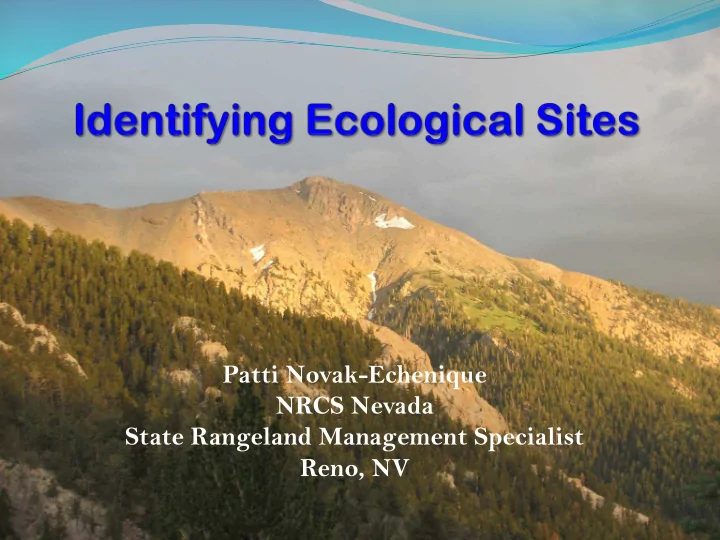
Patti Novak-Echenique NRCS Nevada State Rangeland Management - - PowerPoint PPT Presentation

patti novak echenique nrcs nevada state rangeland
SMART_READER_LITE
LIVE PREVIEW

Patti Novak-Echenique NRCS Nevada State Rangeland Management - - PowerPoint PPT Presentation

Patti Novak-Echenique NRCS Nevada State Rangeland Management Specialist Reno, NV Ec Ecolo logic ical Sit Sites A framework for stratifying and describing rangelands for assessments, land suitability, and land management planning.


slide-1
SLIDE 1

Patti Novak-Echenique NRCS Nevada State Rangeland Management Specialist Reno, NV

slide-2
SLIDE 2

Ec Ecolo logic ical Sit Sites

 A framework for

stratifying and describing rangelands for assessments, land suitability, and land management planning.

 Land (soil)-based

classification system

slide-3
SLIDE 3

Ecolo logic ical S Sit ite – Definiti nition (

  • n (2013)

3)

An ecological site, as defined for

rangeland, is a distinctive kind of land based on recurring soil, landform, geological, and climatic characteristics that differs from other kinds of land in its ability to produce a distinctive kinds and amounts of vegetation and in its ability to respond similarly to management actions and natural disturbances.

slide-4
SLIDE 4

Ecolog logica ical S Site D Develop elopment ent

 Background information: literature, existing

data, local expert knowledge, relict sites, photos

 Evaluate existing data – development of the

ecological site concept

 Defining the ecological site ‘modal’ concept: soil

properties, elevation, slope, aspects, vegetation dynamics – disturbance regimes, climatic variability

 Based on reference conditions representing

natural states – developed within the natural range of variability

slide-5
SLIDE 5

Ecolog logica ical S Site D Descr crip iptions tions

Physiographic Features Climatic Features Influencing Water Features Representative Soil Features Plant Communities - description &

dynamics, models, growth curves, function, structure, cover

Management Interpretations Other Information

slide-6
SLIDE 6

Inter teragency y Effort

MOU (2013)– BLM/NRCS/USFS

Interagency Workgroup – develops/recommends policy, procedures and data management for the development and use of ESD’s.

January 2013: Interagency Ecological

Site Handbook for Rangelands

slide-7
SLIDE 7

Hill shoulder Backslope Floodplain Drainageway

Land ndfor

  • rms and Soils

ils

slide-8
SLIDE 8

Claypan 10-12 Claypan 10-12

Aspen Thicket/Aspen Woodland)

slide-9
SLIDE 9

Stony Mahogany Savanna Mountain Ridge Aspen Woodland

Loamy 12-16

slide-10
SLIDE 10

Ecolog logica ical S Site D Descr crip iptions tions

 Management interpretations:

 Fire – different states in the same ecological site may

react differently to fire

 Forest/woodland – manage pest outbreaks and

documents vegetation change

 Hydrology – provide information on site characteristics

such as erosion potential

 Grazing – how grazing affects plant composition and

ecological processes

 Invasive species – STM’s highlight vulnerable

ecological sites and states

 Restoration – some states are easier to change than

  • thers

 Wildlife – ESD’s prioritize areas for habitat projects

slide-11
SLIDE 11

Agenc ncy A Applica icati tions

  • ns

 ESD’s can be used at different planning

levels: Strategic (National), Operational (State/Regional), Tactical (Ranch/Allotment)

 National:

 Development of consistent data collection

methodologies and protocols

 Consistent training tool and information

source

 Relationship with other classification

systems

 Incorporate into landscape functional units

– GIS/Soil/ESD mapping tools

slide-12
SLIDE 12

Nationa

  • nal L

l Level

Strategic – (National Level) ESD’s help

set realistic management objectives. Ex – ‘Utilize ESD’s to conduct land health assessments to determine if standards of rangeland health are being met. Develop specific objectives to conserve, enhance, or restore priority sage grouse habitat based on ESD’s and assessments’.

A Report on National Greater Sage-Grouse Conservation Measures – by the Sage-Grouse National Technical Team12/2011

slide-13
SLIDE 13

State a te and R Regional L ional Level el

 Operational:

 Refine the planning unit to areas that

respond similarly

 Provide baseline information for land

health assessments and monitoring

 Incorporate GIS/Soil/ESD’s into

effective mapping tool

 Watershed interpretations – erosion

potential, hydrologic condition

slide-14
SLIDE 14

Allotm tmen ent L t Level el

Implementation of

conservation practices: What is possible? What’s the likelihood of success or failure? What are the costs?

Determine goals and

  • bjectives

Determine carrying capacity

slide-15
SLIDE 15

Regio iona nal o

  • r

Allo llotment t Lev evel:

Refine Planning Units using Disturbance Response Groups for monitoring and land health assessments

slide-16
SLIDE 16

Regio iona nal Lev evel: Wildlife Interpretation: Prioritize sage grouse habitat areas

slide-17
SLIDE 17

Ecological Sites near Active Leks

 Elko County, NV: 214 Active leks – 5km buffer

  • Claypan 10-12: 65 (30%)
  • Claypan 12-16: 47 (22%)
  • Loamy 8-10: 44 (21%)
  • Shallow Clay Loam 10-14: 19 (9%)
  • Shallow Calcareous Loam 8-10: 19 (9%)
  • Loamy 10-12: 13 (6%)
  • Shallow Calcareous Loam 10-14: 4 (2%)
slide-18
SLIDE 18
slide-19
SLIDE 19

Water ersh shed ed Lev evel: Invasive Species Management – STM’s highlight vulnerable ecological sites and states

slide-20
SLIDE 20

Ranc nch L Level el Applica licatio tions ns

 Grazing Management – STM’s describe how

grazing affects plant composition and ecological processes; what species to manage for; carrying capacity

 Invasive Species – what species are more

vulnerable to disturbances (spread/establishment)

 Fire Management – describes the role of fire in

vegetation change, reduce fire risk, etc.

 Restoration or Range Improvements – what

actions are most likely to have a positive impact/prioritize areas

slide-21
SLIDE 21

Ranch/ h/Allot

  • tme

ment nt L Level Conser servation P Pract actice A ce Applica cations

 Brush Management (314)  Prescribed Burning (338)  Prescribed Grazing (528)  Range Planting (550)  Restoration & Management of Rare and

Declining Habitats (643)

 Riparian Forest Buffers (391)  Tree/Shrub Establishment (612)  Upland Wildlife Habitat Management (645)

slide-22
SLIDE 22

Brus ush M h Managem ement ent – Cr Crea eate the the desir ired ed p plant c nt communi nity ty c consis iste tent nt wit ith t the ecolo logi gical s sit ite

slide-23
SLIDE 23

Pha Phase 3 3: Pi Piny nyon n and nd J Juni uniper Removal – Mecha hanic nical C Cutting ng

slide-24
SLIDE 24

Wildfir ire R e Restor toratio tion n – STM’s h help lp priori

  • ritiz

tize a e areas as w where e restor toratio tion i n is most l likely ely t to succeed ceed

slide-25
SLIDE 25

Finally… ESD’s provide:

 A common framework for communication

  • f resource information among disciplines,

agencies and organizations.

 I nformation describing the interactions

amount soils, vegetation and land management.

 A foundation to assess current condition,

management opportunities, and monitor changes.

 A framework for transferring experience

and knowledge.

slide-26
SLIDE 26

http:/ / soils.usda.gov

slide-27
SLIDE 27

http:/ / esis.sc.egov.usda.gov/