Drawing on strengths: images of ecological contributions to - - PowerPoint PPT Presentation

drawing on strengths images of ecological contributions
SMART_READER_LITE
LIVE PREVIEW

Drawing on strengths: images of ecological contributions to - - PowerPoint PPT Presentation

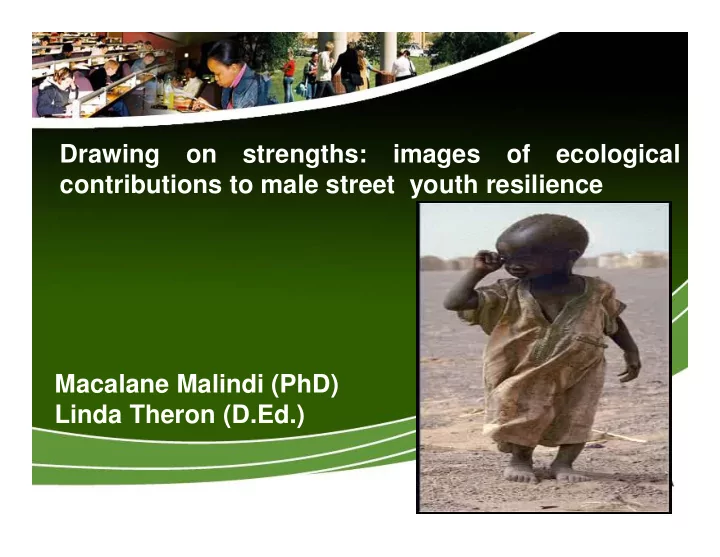
Drawing on strengths: images of ecological contributions to male street youth resilience Macalane Malindi (PhD) Linda Theron (D.Ed.) PRESENTATION OUTLINE Clarification of concepts; Background; Problem statement; Aim of


slide-1
SLIDE 1

Drawing

  • n

strengths: images

  • f

ecological contributions to male street youth resilience Macalane Malindi (PhD) Linda Theron (D.Ed.)

slide-2
SLIDE 2

PRESENTATION OUTLINE

  • Clarification of concepts;
  • Background;
  • Problem statement;
  • Aim of the study;
  • Study design;
  • Study design;
  • Findings
  • Conclusion
slide-3
SLIDE 3

CLARIFICATION OF CONCEPTS

Street Street Street Street youth youth youth youth: homeless or neglected child;

  • ccasionally return home; reside in safe houses;

who go to rubbish dumps in search of food

slide-4
SLIDE 4
  • Resilience

Resilience Resilience Resilience is broadly understood to mean ‘positive adaptation in the face of adversity’ (Schoon & Bynner, 2003, p. 21)

  • Resilience is a process and an outcome,

synonymous with ‘doing well’ in contexts synonymous with ‘doing well’ in contexts that predict the opposite.

slide-5
SLIDE 5
slide-6
SLIDE 6

BACKGROUND

  • South Africa is yet to win the war against

poverty and underdevelopment;

  • Multitudes of at-risk/vulnerable children

migrate to the streets;

  • They are labelled street children, a term
  • They are labelled street children, a term

laden with derogation;

  • They survive in hostile environments beset

with risks;

  • A heterogeneous group of young people;
slide-7
SLIDE 7
  • Street youth are regarded as ‘at-risk’ children

who are not resilient; however

  • Some studies suggest that they can be

resilient within the context

  • f

streetism (Donald & Swart-Kruger, 1994; Evans, 2002; Kombarakaran, 2004; Malindi, 2009; Malindi & Theron, 2010; Theron & Malindi, 2010;

  • Popular data collection strategies

(questionnaires and interviews) were limited with street youth;

  • This motivated our study, using symbolic

drawings

slide-8
SLIDE 8

PROBLEM STATEMENT

Can Can Can Can symbolic symbolic symbolic symbolic drawings drawings drawings drawings be be be be useful useful useful useful in in in in exploring exploring exploring exploring the resilience of street youth? the resilience of street youth? the resilience of street youth? the resilience of street youth?

slide-9
SLIDE 9

AIM OF THE STUDY

To explore the resilience of street youth by means of a phenomenological study using symbolic drawings and narratives (Guillemin, 2004) in order to generate rich and youth-centred evidence. and youth-centred evidence.

slide-10
SLIDE 10

STUDY DESIGN

  • Qualitative;
  • Sampling was purposeful
  • Size: 20 male street youth living in a shelter;
  • Ages: 10-18
  • Duration of stay on streets: 4-19 months
  • Data collection procedure: symbolic

drawings;

slide-11
SLIDE 11

EXAMPLE OF DRAWING BRIEF

“Think about what helps you to cope well with your life. Draw something in the space below that will show or illustrate what helps you to cope well with your life. Remember, how well you draw is not important.” draw is not important.” “Explain what your symbol is saying about what helps you to cope well with your life. Write 3–4 sentences, or ask the researcher to write them for you.”

slide-12
SLIDE 12

DATA ANALYSIS

  • The participants helped us interpret the

data by writing the narratives;

  • Individual inductive analysis
  • We held a vigorous consensus discussion;
slide-13
SLIDE 13
  • Inductive

analysis

  • f

drawings and narratives yielded six themes namely: – self-reliance, – reliance on others, FINDINGS – reliance on others, – respect for school and education, – safe spaces, – adherence to religion, and – recreation

slide-14
SLIDE 14

“If someone beat me or hurt me… I think to beat him, but I use my mind: I didn’t beat him …. And my mind help me to ask if I need something, and my mind help me

Self-reliance:

to think good things.” Participant 16.

slide-15
SLIDE 15

Figure 8.1. by Participant 16.

slide-16
SLIDE 16

Respect for school and education Respect for school and education Respect for school and education Respect for school and education

“School helps me to gain knowledge. I learn about life. School opens my mind and I avoid crime. mind and I avoid crime. School teaches me how to live like other people who support themselves.” Participant 12 Participant 12 Participant 12 Participant 12

slide-17
SLIDE 17

Figure 8.2: Participant 11.

slide-18
SLIDE 18

Safe spaces Safe spaces Safe spaces Safe spaces

“Having a place to sleep makes me

feel safe. I have food and receive care.” Participant 5 Participant 5

slide-19
SLIDE 19

Figure 8.3: Participant 6.

slide-20
SLIDE 20

Recreation Recreation Recreation Recreation

“If anyone upsets me I go

  • ut to play football, because

while I am playing no one can upset me. I can continue being happy.” continue being happy.” (Participant 15);

  • “When I am facing difficult

times, I like playing football to make myself forget” (Participant 19). (Participant 19). (Participant 19). (Participant 19).

slide-21
SLIDE 21

Figure 8.4: Participant 10

slide-22
SLIDE 22

CONCLUSIONS: METHODOLOGICAL

  • We enabled them to show what nurtures

their resilience through child-centred means (Guillemin, 2004) = irrefutable evidence;

  • Illustrated the value of engaging vulnerable

young people in participatory studies young people in participatory studies (Guillemin, 2004);

  • Our participatory approach encouraged

non-‘adultist’ data (Ennew, 2003)

slide-23
SLIDE 23

CONCLUSIONS: THEORETICAL

  • Findings provide an answer to what enables male

street youth to do well despite the challenges they face:

– Resilience of these street youth is anchored in ordinary

  • rdinary
  • rdinary
  • rdinary
  • rdinary
  • rdinary
  • rdinary
  • rdinary

structures structures structures structures structures structures structures structures of

  • f
  • f
  • f
  • f
  • f
  • f
  • f regular

regular regular regular regular regular regular regular everyday everyday everyday everyday everyday everyday everyday everyday life life life life life life life life (Masten, 2001) e.g. self self self self self self self self-

  • reliance

reliance reliance reliance reliance reliance reliance reliance, other

  • ther
  • ther
  • ther
  • ther
  • ther
  • ther
  • ther-
  • reliance

reliance reliance reliance reliance reliance reliance reliance, access to safe safe safe safe safe safe safe safe spaces spaces spaces spaces spaces spaces spaces spaces and to self self self self self self self self-

  • reliance

reliance reliance reliance reliance reliance reliance reliance, other

  • ther
  • ther
  • ther
  • ther
  • ther
  • ther
  • ther-
  • reliance

reliance reliance reliance reliance reliance reliance reliance, access to safe safe safe safe safe safe safe safe spaces spaces spaces spaces spaces spaces spaces spaces and to schools schools schools schools schools schools schools schools, religion religion religion religion religion religion religion religion, and

  • pportunities
  • pportunities
  • pportunities
  • pportunities
  • pportunities
  • pportunities
  • pportunities
  • pportunities

to to to to to to to to play play play play (typically soccer).

  • Additional pathways to resilience emerged:

– the capacity for hope hope hope hope – belief in benevolent strangers benevolent strangers benevolent strangers benevolent strangers – positive collective identity collective identity collective identity collective identity

slide-24
SLIDE 24

MUCHAS GRACIAS THANK YOU VERY MUCH