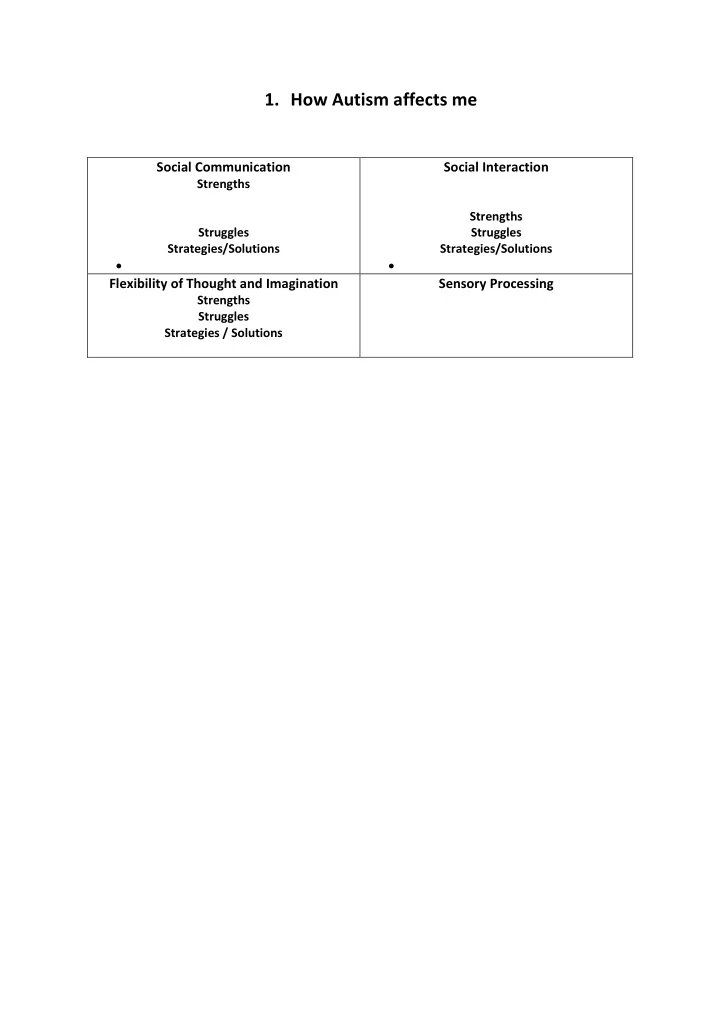
1. How Autism affects me Social Communication Social Interaction - - PDF document

1 how autism affects me
SMART_READER_LITE
LIVE PREVIEW

1. How Autism affects me Social Communication Social Interaction - - PDF document

1. How Autism affects me Social Communication Social Interaction Strengths Strengths Struggles Struggles Strategies/Solutions Strategies/Solutions Flexibility of Thought and Imagination Sensory Processing Strengths Struggles


slide-1
SLIDE 1
  • 1. How Autism affects me

Social Communication

Strengths Struggles Strategies/Solutions 

Social Interaction

Strengths Struggles Strategies/Solutions 

Flexibility of Thought and Imagination

Strengths Struggles Strategies / Solutions

Sensory Processing

slide-2
SLIDE 2
  • 2. How Autism affects me – Suggestions

Once you have watched the film consider the following suggestions with regard to your child and compile lists of their strengths and struggles at home, then you can share it with your child’s school and consider what can be put in place for your child to make life easier

Social Communication  What verbal skills does your child have  Level

  • f

vocabulary / can they understand more than then can say?  Do they use Makaton / PODD/PECs etc?  Will they use gestures or take you to things they need?  What is their level of IT skill?  Do they know when and how to start/stop a conversation – do they butt in, talk over others?  How do they cope with open and closed questions? (Open - what would you like to drink, Closed - would you a cup of tea)  Would starting sentences with, would, could, should, will you, cause confusion?  How do the cope with idioms such as “the pot calling the kettle black”?  Do they understand sarcasm?  Can they read body language, gesture, facial expression?  Do they understand other people emotions and respond appropriately?  Do they take things very literally? Strategies/ Solutions you could try  Makaton, PODD or PECs for a nonverbal child  Visual timetables  Simplifying your language  Breaking things down into manageable chunks  Using IT, texts, emails, diaries, apps  Now and next boards  Let’s make a deal Social Interaction  Behaving appropriately in different situations  Recognising and following social norms such as inside/outside voices  Changing their behaviour to different situations i.e. how you behave in a classroom is different to how you behave at the trampoline park.  Changing your behaviour in relation to

  • ther people i.e. its fine to hug and kiss

granny but not the checkout lady in Asda  Being able to make appropriate eye contact with people  Being overly reliant on adults – difficulty relating to peers and making/keeping friends as you get things wrong  Being able to read other people’s behaviour and respond appropriately i.e. a friend has fallen in the playground  Being passionate about a subject i.e. trains and being able to share that with

  • thers

 Having no interest in other people’s hobbies/interests can’t have a two-way conversation  Starting and stopping conversation – recognising when people are bored  Will copy the behaviours of others in

  • rder to fit in, this can be positive and

negative as doing it too much can be hard work and anxiety provoking. Strategies / Solutions you could try  Using social stories to teach appropriate behaviour  Joining special interest groups to meet likeminded friends  Role modelling appropriate behaviour  Setting boundaries proactively I.e. remember we use our inside voice in the café prior to going in - this way you are

slide-3
SLIDE 3

setting them up to succeed – Give lots of praise  Request social skills groups at school  Having an appropriate buddy for playground activities Flexibility of Thought and Imagination  Being able to see things from other people perspectives  Being able to problem solve – get themselves out of trouble  Being very literal – “If I told you to jump off a bridge would you”  Being able to cope with change whether it is expected or unexpected  Coping with transition such as the change of school example  Being able to read between the lines  Being able to get the gist of what it is happening around you and what you should do in response i.e. at a birthday party Strategies/Solutions you could try  Use Social Stories to underpin any changes and transitions  Ask for enhanced transition time/ resources for changes of class/school  Develop you Pre-frontal Cortex by playing lots of puzzles and game as this enhances your ability to problem solve  Teach them about emotions – start with easy once such as happy and sad, when you see them display other emotions such as angry, name it so they know what it’s called then go back to it later to explain why it happens  Learn more about how to manage change by watching the link below Sensory Processing Hyper – feeling things too strongly Hypo – not feeling things strongly enough  Sight  Smell  Taste  Sound  Touch  Balance  Proprioception/Interoception Please see the Frazzled Fred Booklet which is also available on The Pines Website Relevant Links Social Stories - https://www.youtube.com/watch?v=-KbcPwqC46Y Frazzled Fred - https://www.youtube.com/watch?v=bVT-22r5fwE Managing Change - https://www.youtube.com/watch?v=JOM6z6nExrU

slide-4
SLIDE 4
  • 3. Fred Smith – How Autism affects me

Social Communication Pressures  I use far more language than I actually understands and my processing speed is much slower than yours  Talks a great deal but struggles to listen effectively  I will repeat things that I have heard that I have no awareness off  I struggle to read the signs and know when know when to stop pushing  Knowing when to enter a conversation appropriately is tricky which makes me look rude sometimes Strengths  Good understanding of humour  Can read dad as dad is very black and white Ways you can help me  Please be careful how you word things particularly when I am anxious I cannot cope with phrases starting with: Shall we, could you, will you, should we etc. this puts doubt into my mind that I then struggle to process  Please avoid being passive I need you to be assertive and give me directions Social Interaction Pressures  I would tell everyone everything including private things  I really struggle to understand Social boundaries which gets me into trouble  I’m very easily led  I struggle to stop and think before I act  I struggle to filter what’s appropriate so may blurt out rude/offensive stuff  I not good a knowing when to stop so will go on and on and on! Strengths  I have a very strong sense of justice and I will help and support my friends – This can be a bit tricky in combination with not being able to stop and think before I act!  I know right from wrong but the lack of filter can make this tricky Ways you can help me  Give me guidance to know when I am going wrong – Don’t waffle as I’m no good at reading between the lines  I need an assertive but kind approach being too passive or aggressive are not helpful Flexibility of Thought and Imagination Pressures  I get really agitated when things change and I’ve not been pre-warned  I really struggle when people don’t turn up or are late  I struggle to build trust with people  I am very black and white. Grey areas are difficult for me to process  Things going wrong cause me major anxiety which I’m not always great at managing  Transition into new concepts at school are very stressful I will need your time and patience Strengths  I can manage well with a good routine Sensory Processing Pressures  I’m not great with loud unpredictable noise such as fire alarms so my anxiety is likely to go up if anything like this happens  My proprioception is not great due to my Autism and ADHD this means that I feel like I’ve had ten cups of coffee all of the time so I’m constantly fidgeting and moving and its really difficult for me to concentrate Strengths  I don’t seem to have any other sensory issues at the moment but Rachael will help me look at that in more depth once we sort the other stuff

slide-5
SLIDE 5

 If I’m feeling good I will let you know that the routine can change Ways you can help me  Have a very clear routine for me , it may help for me to have this visually as well as verbally as its easier to process  Help me to focus on my skills as my self esteem is not great  Give me some responsibility for helping

  • thers its something I’ve really thrived

at in the past  Reassure me at an age appropriate level How can you help me  I need to some serious support with my proprioception as when its really bad I wont be able to concentrate and my anxiety will get higher and higher  I need to do exercise and deep pressure every hour to help with this  Mum and dad are encouraging me to use the rowing machine before school  Mr Main is helping me to develop a programme of exercises that will help but I will need lots of encouragement  If you need any furniture of boxes moving this is great deep pressure for me

slide-6
SLIDE 6