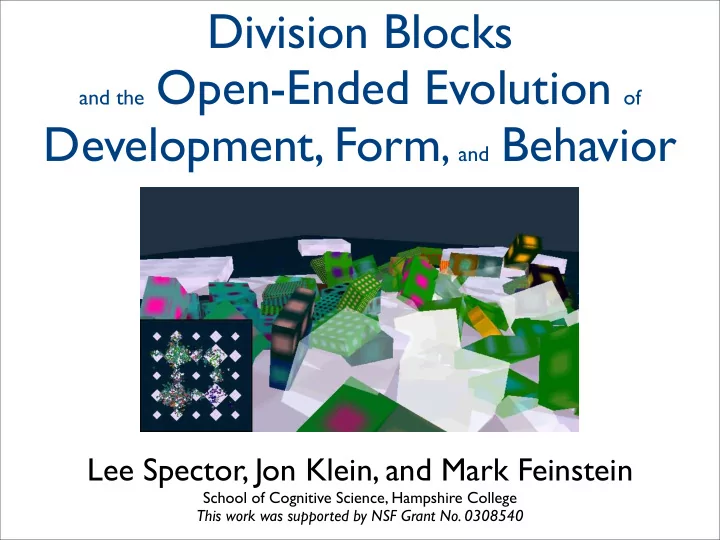
SLIDE 1 Division Blocks
and the Open-Ended Evolution of
Development, Form, and Behavior
Lee Spector, Jon Klein, and Mark Feinstein
School of Cognitive Science, Hampshire College This work was supported by NSF Grant No. 0308540
SLIDE 2
?
SLIDE 3 Goal
- Explore, in silico, key interactions among
development, form, physics, behavior (including reproductive behavior), and ecology that underpin biological evolution.
- How do these factors interact, under natural
selection, to produce adaptive complexity?
SLIDE 4 Open-Ended Evolution of Development, Form, and Behavior
- Wide repertoire of possible developmental
trajectories, forms, behaviors, and ecological interactions.
- No pre-specified goals, just ecological
interactions (possibly including aggregation and reproduction) within a resource- preserving 3D physical simulation.
- Reproductive and aggregative behaviors also
- pen-ended and may evolve.
SLIDE 5 Precursors
- Tierra
- Avida
- Echo
- Pushpop
- Sims’s Creatures
- Framsticks
- Artificial Ontogeny
- SwarmEvolve 2
- Robotic/structural evolution
- Plant growth evolution
- ...
SLIDE 6 Unfortunately Necessary
- Outrageous simplifications.
- Combinations of features normally
- bserved at radically different scales.
SLIDE 7
SwarmEvolve 2
SLIDE 8
SLIDE 9
SLIDE 10
Sensors
zero, plus, minus, energy, waste, exposure, pulse, rotx, roty, rotz, localtag, localenergy, localwaste, connectedtag, connectedenergy, connectedwaste, stemtag, stemenergy, stemwaste
SLIDE 11
Effectors
sizex, sizey, sizez, jointx, jointy, jointz, stemx, stemy, stemz, tag, donationsize, donationtolerance, stemdonationsize, stemdonationtolerance, collectionsize, collectiontolerance, stemcollectionsize, stemcollectiontolerance, copyfidelity, mutationlimit, matecontribution, matetag, adhesion, pulserate, sigmoidcompression
SLIDE 12 Neural Network
- Arbitrary recurrent architecture, genetically
controlled.
- Division (via growth) and genetics (mutation and
crossover) controlled by network outputs.
- Sigmoid activation function; steepness controlled
by an effector:
SLIDE 13 Skin
- Dot density = energy
- Frame red = waste
- Frame green = energy donation tolerance
- Frame blue = energy donation size
- Dot red = sun exposure
- Dot green = waste collection tolerance
- Dot blue = waste collection size
Patterns/colors show state. For results in paper:
SLIDE 14
Waste
SLIDE 15
Reproductive Competence
SLIDE 16
SLIDE 17
Variations
SLIDE 18
SLIDE 19 Figure 4: Averaged data from 40 runs
the Division Blocks system, collected after 1000 time steps
reproductive competence. Er- ror bars indicate ±1 standard deviation. A: average tag values; B: average donationsize (left) and donationtolerance (right); C: average stemdonationsize (left) and stemdonationtolerance (right); D: average matecontribution; E: average adhesion.
SLIDE 20 Prospects
- Cluster-based parallelism in progress.
- Long term evolutionary patterns.
- Unbounded evolutionary activity?
- Track new measures of adaptive complexity.
- Physical division blocks?
SLIDE 21